Evangelos Markopoulos, Hugo Rourke, Hannu Vanharanta (2022). The Scandinavian Democratic Governmental Support Model for Start-Ups and Innovations (SDeGMSI). In: Creativity, Innovation and Entrepreneurship. AHFE Open Access, vol. 31, pp. 259–270. https://doi.org/10.54941/ahfe1001528
Regional and national development has always been impacted with the synchronisation of the public and the private sector. The growth of privately owned enterprises contributes significantly to the national economy, employment and prosperity, but also to the national pride, brand name and reputation for further investments to be made in a country. Therefore the support of the public sector to the development of the private sector is mandatory for the public sector to keep its private sector and avoid a catastrophic brain drain. Scandinavia is one of the regions with remarkable achievements in innovation, science, technology and economy compared to its size, as league of nations and population with other countries or regions. This paper attempts to identify the main elements of the unique Scandinavian government business policy formula for innovation startup success, particularly in Sweden and Finland, which has been key in creating a region with an incredibly high density of “unicorns” (BN$ companies per capita), second to Silicon Valley.The paper has used a research methodology which is based on primary research taking the form of interviews and surveys, along with secondary research based on existing academic literature.The research conducted in this paper identifis and analyses tax structures, government favors, human resource bases, public private partnerships, social safety nets, venture capital and investment infrastructures, R&D investments, and business support systems available to entrepreneurs of the Scandinavian countries. Having identified such key elements, the paper propose a more globally applicable public sector model for the support and encouragement of startups, and business innovation. The model named Scandinavian Democratic Governmental Support Model for Start-Ups and Innovations (SDeGMSI) is based on the practices of Scandinavian governments, while also accounting factors such as cultural values, performance of local economies, and demographic characteristics. The democratic concept in the development of this model is supported by the Company Democracy Model, another Scandinavian innovation management model, and is critical for the fair and unbiased support of the government to all the organizations and startups that can demonstrate significant and valuable intellectual capital for the economy and the society. SDeGSISM is characterized by its triple-pyramid for public support of startups and Innovation and can be used to help develop more internationally competitive economies through the establishment of a series of publicly enforced innovation supports and changes to the business environment. The three interrelated pyramids of the model represent the levels of support provided by the government to start-ups (reversed pyramid 1), the types of organisations across which said support is distributed (pyramid 2), and the impact that support, once applied to start-ups, should have on an economic level (reversed pyramid 3). The pyramids, organised by volume of support provided, disruptive potential of businesses, and scale of impact, respectively, provide an indication and an assessment on how governments are aligned with the Nordic model for entrepreneurial support.Furthermore, structures, practices and metrics available in the model support the creation of more dynamic economies which favor market development and disruption over the continued market dominance of incumbents. The “market-favoring” economies which this model seeks to both encourage and foster are more conducive to economic dynamism and create greater opportunities for investors, as cycles of market disruption increases the potential for widespread returns.The paper indicates limitations on the proposed model and identifies areas of further research for future development and applications.
Scandinavian nations are considered to be some of the most innovative in the world. The European Innovation Scoreboard for 2021, which ranks 38 European nations, ranked Switzerland, Sweden, Finland, Denmark, and Belgium as the five most innovative countries in Europe. The economies of these three Scandinavian “innovation leaders,” are characterized by high R&D spending and high technological and industrial development levels. The Global Innovation Index ranks Sweden as the world’s second most innova- tive nation, after Switzerland, while Finland and Denmark are in the 7th and 9th place respectively (Dutta et al., 2021). Studying the Scandinavian countries to understand what makes them so creative can provide valuable insights.
Regional and national development has historically been impacted by the synchronizations of the public and the private sector. Large-scale projects such as highways, airports, constructions, and other infrastructure are facili- tated through public-private partnerships (PPP). The same principles can be
applied to fields like innovation which impacts the development of several industries and economies. The growth of privately-owned enterprises con- tributes significantly to the national economy, employment and prosperity, national pride, and to the nation’s brand as a place for foreign investment. Given the success of public-private cooperation and synchronization in Scan- dinavia, it can be argued that the support of public sector organizations can directly facilitate the upkeep of a solid private sector, and help nati- ons avoid catastrophic brain drain in the long term. Many of Scandinavia’s remarkable achievements in innovation, science, technology and economy, compared to its size, are partly attributed to the involvement of a robust, well- developed public sector ecosystem to support innovation and entrepreneurial initiatives.
RESEARCH METHODOLOGY The research conducted for this paper used primary and secondary research. The preliminary analysis was based on surveys and interviews with industry experts, while the secondary research was based on existing academic lite- rature. The study identifies and analyses tax structures, government favors, human resource bases, public-private partnerships, social safety nets, ven- ture capital and investment infrastructures, R&D investments, and business support systems available to entrepreneurs of the Scandinavian countries.
While the literature review mainly focuses on developing background and contextual information, the interviews aimed to capture internal knowledge and the perspectives of those directly involved with the Scandinavian start-up and innovation ecosystems. As such, interviews have been conducted with the Director of the Knut and Alice Wallenberg Foundation (Sweden’s most signi- ficant private donor to domestic R&D initiatives), the founder and CEO of MedBeat (a pioneering Swedish medical technology start-up), and the Deputy Director of Start-ups at Sweden’s Ministry of Enterprise. The interviewees were selected based on experience in relevant sector, and coordinated to tri- angulate the feedback and perspectives given from the private sector support ecosystems, the public sector support ecosystems, and the support recipients (founders).
LITERATURE REVIEW AND RESEARCH GAP Sweden is the most innovative of the Scandinavian nations, followed by Fin- land, with several highly innovative companies, ranging in size from start-ups to market incumbents. Several factors create market leaders, such as health research ecosystems, public sectors that offer support through financing, advisory, incubation, legislative change, and relatively stable economies with regionally low corporate tax rates. However, it’s important to note that these factors are driven by policies designed to protect entrepreneurs. Sweden’s Innovation Policy claims that Swedes are not naturally entrepreneurial, so to ensure the survival of the Swedish entrepreneur, according to the Swedish Innovation Strategy, it becomes essential to build strong support systems so that entrepreneurs can be encouraged in their journey.
The Scandinavian Democratic Governmental Support Model for Start-Ups 261
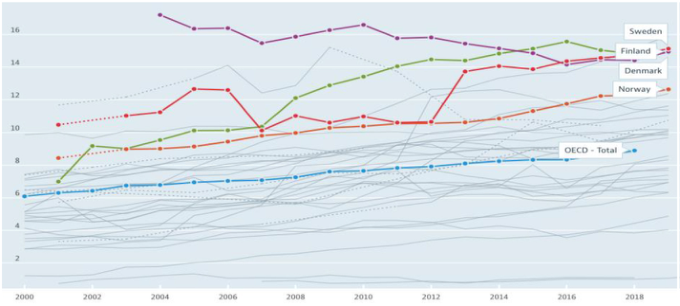
Figure 1: Scandinavian Research Ecosystems - Researchers per capita (OECD, 2021).
Public Universities and the Research Ecosystem One of these support systems is found in the research ecosystem facilitated by public universities across the region. Scandinavian universities effectively serve as innovation centers, performing R&D through public-private partner- ships for large companies. Figure 1 indicates that four OECD of the five top countries with the most researchers per capita are Scandinavian, ranked in order: Sweden, Finland, Denmark and Norway (OECD, 2021).
Reports from The Harvard Business Review have identified the importance of university-company collaboration (Lutchen, 2018), highlighting the long- term implications for increased innovativeness of both institutions. This trend that starts to be adopted in the United States, is already well underway in Scandinavia. Many Scandinavian universities have a long history of serving the interests of Scandinavian industrials, being always a critical element in powering regional innovation.
A notable example is a partnership between Uppsala University and Swe- dish construction company NCC. The collaboration between the two orga- nizations aims to support collaborative work in research, innovation, educa- tion, and long-term communication. The partnership facilitates joint research projects, workshops, study visits, and student projects (Uppsala University, 2021), which HBR identifies as key in such collaborative relationships.
Public-Sector Supports for Innovation Universities build a strong base that helps generate innovative ideas and sup- port ideas developed outside the academia in a mutual benefit agreement. However, the Scandinavian nations, in general, emphasize building vital, extensive public-sector infrastructure designed to support growing start-ups and the ideas of prospective entrepreneurs. Sweden’s ecosystems are arguably the most well developed, including thousands of organizations. State-owned Venture Capital (VC) firms like ALMI help to provide initial funding for innovative companies through convertible loans, which is crucial in develo- ping an ecosystem of start-ups that are primed for further VC investment and are familiar with VC financing procedures (Gidzgier, 2017).
Vinnova, the Swedish government agency for innovation, is one of the nation’s largest public providers of grants for research and development. The organization exists to foster collaboration between companies, researchers, and the public sector. It creates and drives developments and innovations that benefit Swedish society, while simultaneously develops new laws and policies to pave the way for innovation (Vinnova, 2021). “Tillväxtverket” translated to English as the Swedish Agency for Economic and Regional Gro- wth (SAERG), runs national and international accelerator programs, boot camps, and the Sweden Demo Day, the nation’s largest conference for com- panies within the technology ecosystem, allowing start-ups better access to investors, connections and more. Full help and support are provided at no cost (Tillväxtverket, 2021). Industrifonden, the Swedish Industry Fund, invests in companies with the potential to spur “techno-economic para- digm shifts” and has funded revolutionary Swedish companies like Arcam (metals manufacturing), QlikTech (data analytics), and Oatly (vegan milk) (Industrifonden, 2021).
Research Gap While the Scandinavian public innovation support systems are well docu- mented, there is limited literature that turns documentation into actionable insights to be used for the development of innovation in economies elsewhere. This effectively leaves a knowledge gap that negatively affects the availa- ble options for developing and emerging economies’ to establish national innovation strategies.
PRIMARY RESEARCH RESULTS The interviews forming the paper’s primary research provided valuable insi- ghts, mainly revolving around the importance of social security systems and high-level cooperation between various public and private organizations.
One of the interviewees revolved largely around the importance of the Swe- dish social security system, highlighting Sweden’s highly educated population and indicating that a surplus of engineers made it easy for his company to find the right people at the right time. Socialized healthcare is also essential, allowing people to feel comfortable taking the steps toward entrepreneur- ship, making the case that individuals in other nations who cannot afford to give up employment benefits avoid entrepreneurship. In addition to the social safety net, academic-based incubators are highly significant. MedBeat recei- ved tremendous support from both Lund University and Minc Incubators in facilitating growth. They clustered the company’s resources, marketing, advisory, office space, and more - allowing them to move and develop with greater agility and confidence.
According to the Directorate of Start-ups of the Swedish Ministry of Enter- prise, a widespread and highly coordinated network of start-up incubators and accelerators such as Vinnova are crucial elements of the public-sector support to innovators. In addition, the public-private innovation partnersh- ips, with meaningful and practical dialogues between CEOs and the govern- ment, play a vital role in ensuring incumbents remain innovative. Examples
The Scandinavian Democratic Governmental Support Model for Start-Ups 263
can be the Wallenberg and Bennet families, where such dialogues between impactful families and the government allowed the development of research grant programs and contributed to the continuation of innovation within the industrial holdings of each family.
Saminvest, a public-private partnership (PPP), coordinates cooperative investments drawing capital from the government and private investors. Organisations such as Tillväxtverket, Almi, Vinnova, Saminvest (an Almi subsidiary), and the Stiftelse av Strategisk Forskning (SSF) are examples of public-sector institutions in providing financing. Each organization in an ecosystem operates differently. Vinnova provides grants, early stage, and seed funding, while Almi, Saminvest, and Industrifonden provide later-stage capital to businesses with proof of concept and growth.
Today, NASDAQ, a private-sector institution, facilitates Sweden’s strong IPO culture. A creative revolution is underway in Sweden, different in the innovation strategy from the one in Silicon Valley, as nations must build on their pre-existing strengths, culture and human capital. The goal for Sweden is to foster innovative industrial incumbents while also building up a strong base of industrial start-ups with the potential to revolutionize the landscape.
The most significant result from the interviews was the description of a “web” of public and private-sector organizations that form a large and wide innovation support ecosystem. The “secret ingredient” in Sweden’s success is the PPP cooperation underlined by “naive trust,” a vital element of the Scandinavian culture. Trust, and transparency that come with it, are intrinsic to the success of the Scandinavian innovation support model.
SCANDINAVIAN CO-EVOLUTIONARY DEMOCRATIC INNOVATION MODELS The Scandinavian democratic innovation culture has contributed with several co-evolutionary knowledge creations, management, and utilization models and technologies. Some of them are The Holistic Concept of the Man (Rauh- ala, 1972) which introduces the concepts of corporeality, consciousness, and situationality. The Circles of Mind (Vanharanta, 2003), in turn, introduces the conscious experience on stage with mind processes in a specific situation. Furthermore, the Evolute technology (Kantola et al., 2006) is a collection of artificial intelligence expert systems that identify the current and future state of people’s and organizations’ knowledge and experiences for strategic mana- gement and leadership. The Wisdom Cube (Vanharanta and Markopoulos, 2019), in turn, finds the important dimensions of science, theory, technology and practice that foster innovation.
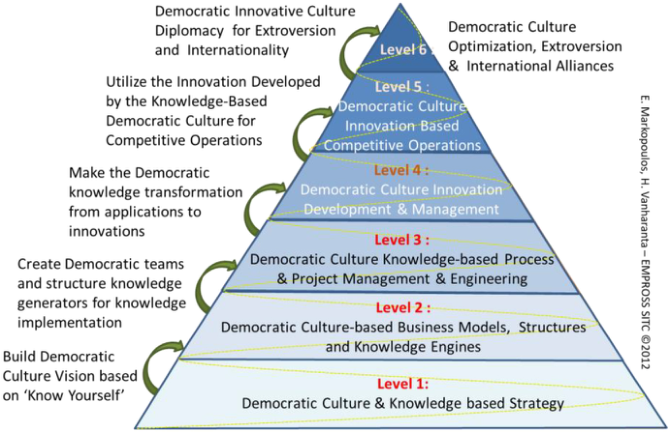
The Company Democracy Model (CDM) is a Scandinavian model which integrates the HCM, the CoM, and the Evolute in a six staged co-evolutionary roadmap where knowledge contributions are gathered, matured, develo- ped, and utilized as high impact organizational assets (Markopoulos and Vanharanta, 2014).
The pyramid shape and the democratic knowledge management concept of the Company Democracy Model (see Figure 2) has been used in the deve- lopment of other Scandinavian influenced innovation management models,
Figure 2: The company democracy model (Markopoulos and Vanharanta, 2014).
techniques, and strategies, such as the Green Ocean Strategy (Markopou- los et al., 2020a), the Pink Ocean strategy (Markopoulos, et al., 2020b), the Agile Start-up Business Planning and Lean Implementation Management Model (Markopoulos et al. 2020c), and other.
In addition, variations on the pyramid’s orientation have been used to demonstrate the results of the applied Company Democracy Model in ver- tical business operations. For example, the Democratic Society-Industry New Product Development Model uses the reverse pyramid (Markopoulos et al., 2020d), the Democratic Employee-Culture Fit Model uses an extended reverse pyramid (Markopoulos et al., 2020e), while the Democratic, Green Ocean Management Framework for Environmental, Social and Governance (ESG) Compliance Model uses a pyramid within a pyramid at various stages based on the type of organization applying the model (Markopoulos et al., 2020f).
THE SCANDINAVIAN DEMOCRATIC GOVERNMENTAL SUPPORT MODEL FOR START-UPS AND INNOVATIONS (SDEGMSI) This research extends on these Scandinavian knowledge management inno- vations and powered by the Company Democracy Model introduces the Scandinavian Democratic Governmental Support Model for Start-Ups and Innovations (SDeGMSI). The model is characterized by its triple-pyramid for public support of start-ups and innovation and can be used to develop more internationally competitive economies by establishing a series of publicly enforced innovations to support and impact the business environment.
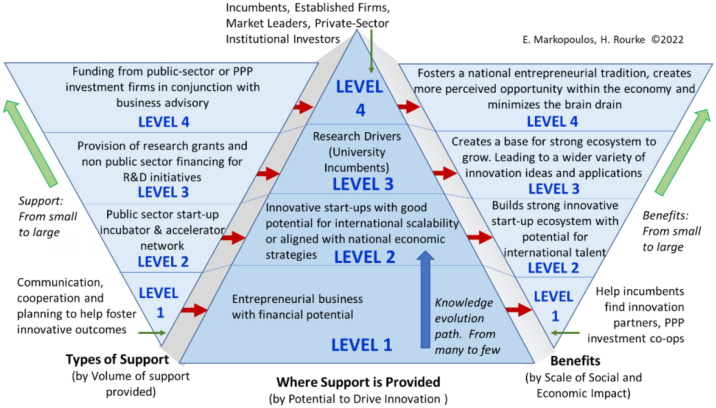
The three interrelated pyramids represent the levels of support provided by the government to start-ups (reversed pyramid 1), the support provided based on the organizational evolution (pyramid 2), and the socio-economic
The Scandinavian Democratic Governmental Support Model for Start-Ups 265
impact of the support received by the start-ups (reversed pyramid 3). The pyramids, organized by volume of support provided, the disruptive potential of businesses, and the scale of impact, respectively, giving an indication and an assessment of how governments are aligned with the Scandinavian model of entrepreneurial support.
While the middle pyramid drives the evolution of knowledge (from ideas to international competitive start-ups) of those who managed to advance in the next level, the support offered by the government and the markets, as well as the benefits from the market and the society increase on each level significantly (See Figure 3).
Figure 3: The scandinavian democratic governmental support model for start-ups and innovations (SDeGMSI).
The evolution of the knowledge from idea to competitive and innovative start-up presented in the middle pyramid drives the support offered initially by the government, and the markets after that, and impacts the value of the benefits.
The first level of knowledge evolution sets the base of the start-up deve- lopment process. It is a level where many ideas are being developed, seeking financial support and markets acceptance. However, the available funding is offered carefully to the ones that can provide viable business plans and commercialization roadmap.
The second level identifies the startups that can be aligned with the national economic strategies for developing the national economy locally (employ- ment) and interpretational (operations, reputation, sales), and provides them incubator and accelerator opportunities to verify, validate and enhance their business model.
The third level identifies the startups with state-of-the-art and novel soluti- ons and offers them high impact research and development support through
business incubators of research institutions to develop working prototypes. The fourth, and last level, brings the start-up to a global competitive stage were private funding and institutional investors feel safe to invest on a startup that went through these levels.
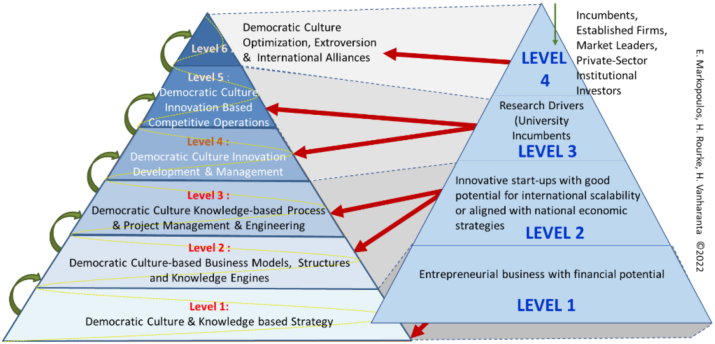
SDEGMSI OPERATIONS AND ALIGNMENT WITH THE COMPANY DEMOCRACY MODEL The four levels of the central pyramid of the Scandinavian Democratic Governmental Support Model for Start-Ups and Innovations (SDeGSISM) are aligned with the six levels of the Company Democracy Model (CDM) (See Figure 4).
Figure 4: Alignment of the SDeGSISM with the CDM.
The 1st level of the SDeGSISM is aligned with the first level of the CDM through a democratic knowledge creation culture. The 2nd level of the SDeG- SISM is aligned with the 2nd and 3rd levels of the CDM, where knowledge is further supported by teams of experts (level 2 at CDM), developed as pro- totypes, and tested in the market (level 3 of CDM). In the case of SDeGSISM, the 2nd and 3rd levels of the start-ups are supported with the participation of academic research institutions.
The 3rd level of the SDeGSISM is aligned with the 4th and 5th levels of the CDM, where the prototype’s success is turned into an innovation (level 4 at CDM) with academic research and obtain market competitive- ness (level 5 at CDM) and recognition. Lastly, the 4th level of the SDeGSISM is aligned with the 6th level of the CDM, where strategic partnerships and internationalization are achieved.
ACTORS AND SYNERGIES OF THE SDEGMSI The operations of the (SDeGMSI) are executed around the maturity of the knowledge and its transformation into a start-up. This includes several actors who provide technical support to the start-up or funding at various stages.
The Scandinavian Democratic Governmental Support Model for Start-Ups 267
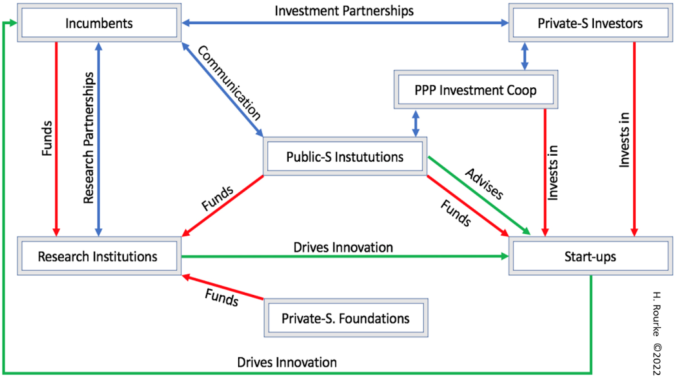
The leading actor in the model, besides the start-up, is the government or the public sector institutions that fund first and before anyone else Scandina- vian research. It is in the national interest innovative ideas to be funded by the government to attract further private investments, increase employment and contribute to the national economy and reputation. Figure 5 presents the actors based operational synergies on the SDeGMSI.
Figure 5: SDeGMSI operations and actors involved.
What is important to highlight in these operations that differentiate the SDeGMSI from any other innovation management model is the very close relationship of the research institutions with the start-up. Innovative ideas need high-impact human intellectual capital to be developed into innovations. This brainpower resides in the academic and research instructions, which can also utilizes their state-of-the-art infrastructure to further develop the technology, run the needed tests, simulations, and publish results that can give the innovation credibility and validity. Therefore, the research institutions become part of the start-up for their contribution and continuous support in developing both the innovation and the start-up.
This relationship encourages the government to invert on start-ups sup- ported or developed with academic research expertise, as the funding offe- red can be considered more secure when invested in academic institutions with the expertise to make the best out of it. In a way, the government funds the government (research institution), instead of private companies, to develop credible and reputable start-ups. This credibility is reflected in the private sector for future investments in the start-up. Moreover, the fact that the technology has been funded by the government, developed and tested in a research lab assures the investors that at least the inno- vation, if not the business model, can be considered a safe and justifiable investment.
SDEGMSI PRE AND POST CONDITIONS Given that the model is based on the success of the Scandinavian practices in Scandinavian economies, it is essential to recognize there are a series of pre-conditions on which the model must be implemented to ensure success. In the Scandinavian economies, success has been built on a more profound underlying trust, strong universities, and a well-educated population. It’s important to recognize these as contributing factors to the success of the Scandinavian approach, whose absence cannot guarantee the success of the model. Therefore, a primary pre-condition is a solid and human resource base with high-level skills built through a robust education system. Ano- ther pre-condition is the establishment of “naive” trust between individuals and between institutions as a significant facilitator of innovative progress. Therefore, high levels of ethical transparency between parties are crucial.
Postconditions can be considered the need for legislation stability for innovators and entrepreneurs, which are often quick to change. From a legis- lative perspective, organizations like Vinnova can impact the development of legislation to ensure that legislative conditions suit the current needs of entrepreneurs.
Lastly, on the business taxation, the Scandinavian nations take a fairly relaxed approach, despite the fierce taxation of individuals. This is someth- ing that needs to be maintained. Corporate income taxes in Scandinavia (FI 20%, DK 22%, NO 22%, SE 21.4%) are lower than that of the United Sta- tes (25.8%), which is considered as a model for capitalist economy (Asen, 2021). Generally, tax rates within this range are relatively business-friendly, and form a ‘pre’ but also a ‘post’ condition for success.
LIMITATIONS AND AREAS OF FURTHER RESEARCH The SDeGMSI systematically demonstrates a roadmap for effective innova- tion management at national level. However, there are several limitations to the adaptation of the model. First, it considers cultural and ethical dimensions related to the government’s trust in the industry and the responsible return of this trust from the industry to the government with successful innovations and start-ups. This can be considered a significant limitation of the model when applied in corrupted counties or countries with a lack of mutual trust and respect among the government, the industry, and the citizen.
Another limitation is that the adaptation of the model requires the existe- nce of responsible human intellectual capital to be in place with a patriotic mentality to work for the benefit and the reputation of their country; not easy in a globalized world.
The model has not been applied in countries with a different mentality than the Scandinavian; therefore, what seems to be a possible practical innovation management approach in this research might be ineffective in other parts of the world.
However, despite these limitations, the model sets up the base for thin- king the Scandinavian way, where innovation, democracy, and mutual respect between the state and the industry makes the difference.
The Scandinavian Democratic Governmental Support Model for Start-Ups 269
This research will be extended to identify quantitative and qualitative metrics for each of the three pyramids composing the SDeGMSI. These metrics will be used as benchmarking indexes between the operations of the model in Scandinavia, developed countries, emerging countries, and under- developed countries. The results can possibly develop variations of the model based on cultural differences.
CONCLUSION
Regional and national development has always been impacted by the synch- ronization of the public and the private sector. The growth of privately-owned enterprises contributes significantly to the national economy, employment and prosperity, and the national pride, brand name, and reputation for fur- ther investments in a country. Therefore, the support of the public sector on the development of the private sector is mandatory for a country to have an effective private sector and avoid the catastrophic brain drain.
Scandinavia is one of the regions with remarkable achievements in inno- vation, science, technology, and economy compared to its size, as a league of nations and population with other countries or regions. The SDeGMSI demonstrates a consolidated approach of the Scandinavian economies tow- ards national innovation strategies. Controversially, the standard govern- mental practices seen in developed economies such as the United States and elsewhere do not necessarily encourage or sufficiently develop the social type of innovative initiatives that intensively supported by governmental funding, set with governmental infrastructure (research centers), to be transformed into private sector businesses. SDeGMSI attempts to address this by crea- ting a guideline for building a vital innovation infrastructure and ecosystems through the cooperation and co-evolution of the public and private sector.
REFERENCES
Asen, E. (2021). How Scandinavian Countries Pay for Their Government Spending.
Tax foundation website: https://taxfoundation.org/publications/how-scandinavia n-countries-pay-for-their-government-spending/ Dutta, S., Lanvin, B., Wunsch-Vincent, S., & León, L. R. (2021). Global innovation index 2021: Tracking innovation through the COVID-19 crisis. Geneva, Switzerland: World Intellectual Property Organization. European Innovation Scoreboard 2021. Euraxess website https://euraxess.ec.europa
.eu/worldwide/south-korea/european-innovation-scoreboard-2021 Gidzgier, T. (2017). Funding your startup in Sweden. Startup funding boook website https://startupfundingbook.com/funding-your-startup-in-sweden/ Industrifonden. (n.d.). Industrifonden - About Us. Industrifonden website https://in
dustrifonden.com/about-us/ Kantola, J., Vanharanta, H., and Karwowski, W., (2006), The Evolute System: A Co- Evolutionary Human Resource Development Methodology. In the International Encyclopedia of Ergonomics and Human Factors. Karwowski, W. (editor), 2nd Edition, CRC Press, Boca Raton, Florida, USA. Lindström, J. (2021). About us. Sting website https://sting.co/about/ Lutchen, K. R. (2018). Why Companies and Universities Should Forge Long-Term
Collaborations. Harvard Business Review online. https://hbr.org/2018/01/why-co mpanies-and-universities-should-forge-long-term-collaborations
Markopoulos E., Ramonda M.B., Winter L.M.C., Al Katheeri H., Vanharanta H. (2020a) Pink Ocean Strategy: Democratizing Business Knowledge for Social Growth and Innovation. In: Markopoulos et al. (eds) Advances in Creativity, Inno- vation, Entrepreneurship and Communication of Design. AHFE 2020. Advances in Intelligent Systems and Computing, pp 39–51, vol 1218. Springer. Markopoulos E., Kirane I.S., Piper C., Vanharanta H. (2020b) Green Ocean Stra-
tegy: Democratizing Business Knowledge for Sustainable Growth. In: Ahram T., Karwowski W., Pickl S., Taiar R. (eds) Human Systems Engineering and Design II. IHSED 2019. Advances in Intelligent Systems and Computing, chapter 20, pp. 115–125. vol 1026. Springer, Cham. Markopoulos E., Umar O., Vanharanta H. (2020c) Agile Start-up Business Planning and Lean Implementation Management on Democratic Innovation and Creativity. In: Ahram T., Karwowski W., Pickl S., Taiar R. (eds) Human Systems Enginee- ring and Design II. IHSED 2019. Advances in Intelligent Systems and Computing, chapter 134, pp 885-895, vol 1026. Springer, Cham. Markopoulos E., Gann E.L., Vanharanta H. (2020d) Democratizing New Pro-
duct Development Through an Industry-Society Entrepreneurial Partnership. In: Ahram T., Karwowski W., Pickl S., Taiar R. (eds) Human Systems Engineering and Design II. IHSED 2019. Advances in Intelligent Systems and Computing, chapter 127, pp 829-839, vol 1026. Springer, Cham. Markopoulos E., Kirane I.S., Gann E.L., Vanharanta H. (2020e) Avoiding Post- Merger Corporate Downsize Restructuring: The Democratic Employee-Culture Fit Model (DeECFit). In: Ahram T. et al. (eds) Human Interaction, Emerging Tech- nologies and Future Applications II. IHIET 2020. Advances in Intelligent Systems and Computing, pp 51-62. vol 1152. Springer, Cham. Markopoulos E., Kirane I.S., Gann E.L., Vanharanta H. (2020) A Democratic, Green
Ocean Management Framework for Environmental, Social and Governance (ESG) Compliance. In: Ahram T. et.al. (eds) Human Interaction, Emerging Technolo- gies and Future Applications II. IHIET 2020. Advances in Intelligent Systems and Computing. pp. 21–33, vol 1152. Springer, Cham. Markopoulos E. and Vanharanta H. (2014). ‘Democratic Culture Paradigm for Organizational Management and Leadership Strategies - The Company Democracy Model.‘ In: Charytonowicz J. (ed) Advances in Human Factors and Sustaina- ble Infrastructure. 5th International Conference on Applied Human Factors and Ergonomics. Krakow, Poland. vol 20. pp 190-201 (2014) NEFI. (2021). Sweden - ALMI - NEFI - Network of European Financial Institutions
for SMEs. Nefi website http://www.nefi.eu/our-members/sweden-almi/ OECD (2021). Researchers (indicator). OECD Publishing. doi: 10.1787/20ddfb0f-en Rauhala, L. (1972), The Hermeneutic Metascience of Psychoanalysis. Man and World 5, 273–297 Sweden, The Swedish Ministry of Enterprise, Energy and Communications. (n.d.). The Swedish Innovation Strategy. Article Number: N2012.33 Tillväxtverket. (2021, October 22). Startup Sweden. Tillvaxtverket website https:
//tillvaxtverket.se/english/startup-sweden.html Uppsala University. (2021). Collaborations and partners. Uppsala University website: https://uu.se/en/collaboration/collaborations-partners/ Vanharanta, H. (2003). Circles of mind. In Identity and diversity in organizations-
building bridges in Europe Programme XIth European congress on work and organizational psychology. May 2003. pp. 14–17. Vinnova. (2021). Vinnova öppnar upp för innovation som gör skillnad. Vinnova website: https://www.vinnova.se/sa-framjar-vi-innovation/vi-oppnar-upp- for-innovation/
LISTED IN THE AHFE DIGITAL BOOKSTORE CATALOGUE
Explore the complete digital volume
Creativity, Innovation and Entrepreneurship
Read this individual research paper free through the original publisher, or explore the full digital proceedings book.
ISBN 978-1-958651-07-0
Explore this ISBN in the AHFE Bookstore ↗Listed in the July 2026 bookstore catalogue; search by ISBN to confirm current availability · Digital book purchase optional