Simrun Sethi (2022). Interdisciplinary Learning - Tomorrow’s Executive as Creative Problem Solvers. In: Creativity, Innovation and Entrepreneurship. AHFE Open Access, vol. 31, pp. 7–13. https://doi.org/10.54941/ahfe1001501
Incorporating creative processes in the business curriculum can provide a framework for dealing with uncertainty in new product development. The paper explores the role and significance of user-focused aspects of the human-centered process in creating successful products and services. Demystifying the creative process can be challenging, as many students have trouble when engaging in 'need-finding' and problem-solving for the first time. Coping with uncertainty seems to be a vital factor in a student's ability to generate new products. Bringing creative tools and approaches into the classroom and sharing how to solve problems through observation, experiment, analysis, reflection establishes the place of the creative process, as a bridge, as a guiding principle – as a method for generating new products and new products business strategies.Keywords: Creative Process, Embracing Ambiguity, Interdisciplinary Learning, User-Focused.
Interdisciplinary structures are essential to teaching new product develo- pment in a design thinking approach, where the curriculum is nurtured and supported by design schools. The reflections and observations stated in this paper emerge from the actual practice of teaching business students New Product Development. The problem in consideration is the development of creative ways of navigating ambiguity in students at the Business School. In teaching business, one must start with conscious control and analysis – the students train themselves to apply the rational rules by which a business argu- ment is built up step by step. Such conscious learning does not suffice for dealing with uncertain situations in an increasingly complex business envi- ronment. Rational handling of ideas prevents the development of the intuitive capacity from visualizing the overall scenario. The creative structure allows for business innovation; this shift from rationale to intuitive ability equips them to tackle ambiguous and ill-defined problems.
Creative Process as a Framework The creative problem-solving approach is constructive, utilizes subjective rather than scientific methods (Darke, 1979) “scientists’ problem-solve by analysis, whereas creatives’ problem-solve by synthesis” and is a process of “satisficing” rather than optimizing. (Cross, 2016). Constructivist learning
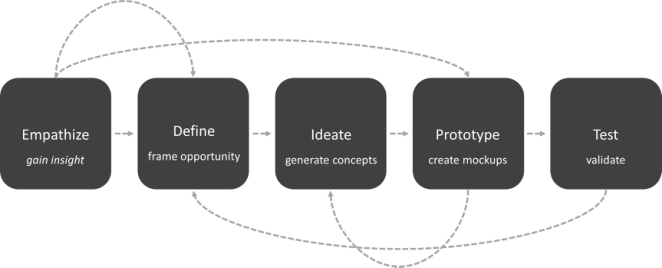
Figure 1: Five stages in the NPD process (Adapted from ID Foundation).
signifies that learners construct knowledge on their existing knowledge by themselves (Piaget 1970) and describes learning as making sense of indivi- dual experiences (Wheatley 1991). The description provides a framework for encouraging reflective thinking about NPD, conceivably expanding the question of how students’ experiences and values influence the act of ima- gination. Creatives construct a narrative to make sense of experiences. The student’s mind manages complexity and uncertainty through its ability to imagine and create an elaborate vision of the future. (Sethi, 2015) Business schools adopted the Stanford University D-School method (Fig. 1) of “empathy, define, ideate, prototype, and feedback” (Brown et al., 2018) – to support interdisciplinary learning and navigate the increasing complexity and ambiguity of the constantly changing business environment. Creative approaches require students to step outside of their comfort zone to explore. They must let go of the analytical ways and need control, which propels them to interpret situations for themselves and encourages them to grapple abstractly with the context. And soon realize that there are no ready-made models for this way of working. Students in design schools also go through this struggle, and some clear direction can be gained from reworking studio content to the classes taught in the business school.
Embracing Ambiguity Embracing Ambiguity “encourages people to consider the personal significa- nce of things, behaviors, or events in their environment.” (Gaver, 2003). A student who can navigate ambiguity can effectively cope with change, con- nect the dots, tell their story, and generate innovative products and services without having a complete picture. Becoming comfortable with uncertainty and ambiguity is what gets them to take risks.
In my experience, a dialogue between the instructor and the student plays a crucial role in dealing with uncertainty. “A need exists to develop a stu- dent’s intuitive nature and the ability to see possible future images” (Itten, 1967). An emphasis is to develop each student’s ability to look inside them- selves and find their potential. It is essential to encourage the students to leave their comfort zone and draw the idea from their own experience rather than from marketing design briefs imposed on them. The students in developing a
Interdisciplinary Learning: Tomorrow’s Executives as Creative Problem Solvers 9
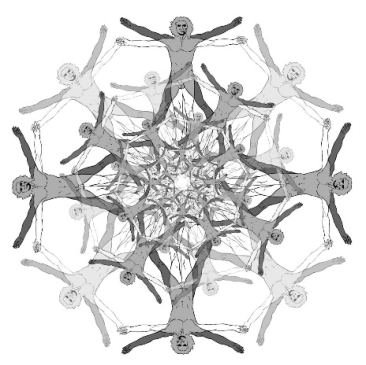
Figure 2: Visualize personal significance and relationships – dealing with uncertainty is the first step in tackling the ‘wicked problem.’ Illustration: K. Zheng.
project have the freedom to choose the project that has personal significance (Fig 2). Students become actively engaged in constructing knowledge when the instructor creates a learning space where a critical commentary becomes something not to be feared but to be relished and embraced. Whereby stu- dents make meaning and personal interpretation. (Dehler et al. 2001) When students problematize an issue, their focus shifts from articulating the mea- ning in other people’s ideological positions and theories to theorizing their own experiences.
Learning by Doing Business students focus on the problem to discover the rules to be applied; learning by doing is introduced in the course to learn about the issue by explo- ring various possible solutions. As students develop their projects, they learn about the problem by trying out multiple solutions, and they can achieve the ends they see as meaningful. Working, getting out of their comfort zone, and figuring out the user’s needs give them a different experience level. It opens the way they see and think, enhancing learning and understanding by ado- pting the perspectives of others, then testing those views, and engaging in self-critique.
The students begin by identifying the user group to find the problem. By observing and empathizing with user needs and focusing on the user experi- ence, they gain insights to define the opportunity. In this way of working, the emphasis is to identify the right problems to solve in the first place. Once the problem is determined, the creative process begins. Multiple solu- tions are generated, as many as possible. Concept generation is followed by making prototypes of the best solutions and testing to validate user feedback. Learning by doing is an iterative process, done several times to improve the solution.
10 Sethi
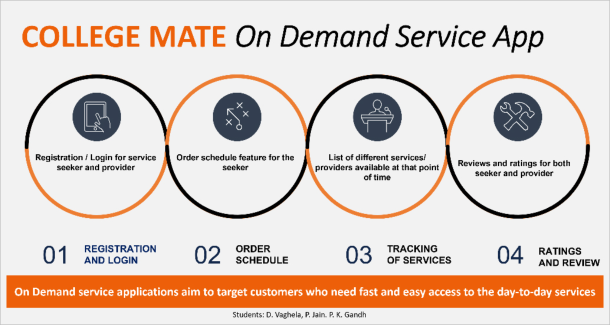
Figure 3: App design: One destination.
The purpose of design work, in the NPD, is to facilitate sensemaking. The method of making and analyzing design judgment is a discussion. Design issues have to be discussed to be defined, negotiating ambiguity is finding a way to make unanimous interpretation in the creative process. Design judgments vary with change in the evaluator, the point is to get others to agree, not to find an absolute design. The role of the instructor is to ini- tiate the discussion by encouraging the team members to engage with one another, enabling them to negotiate ambiguity. In the iterative process of development changes in perspective emerged continuously, however because of discussion the issue became more perceptible, and it became possible to establish a pattern for creating the design solution. The discussion allows the team to capture the more interpretive, non-analytical dimensions of design, grasp the meaning of the situation instantaneously, reach an agreement in an ambiguous situation, and propose an appropriate solution.
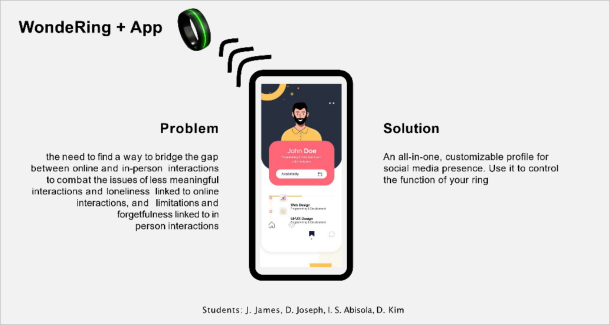
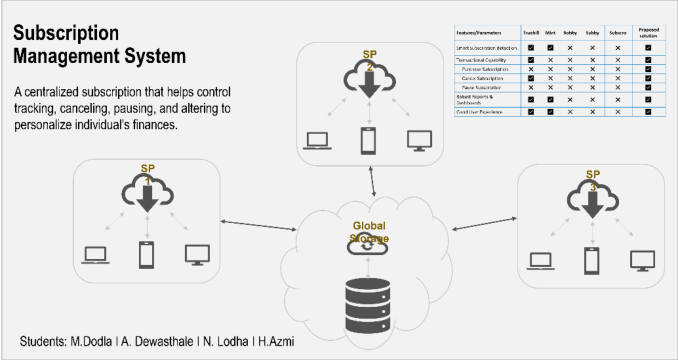
The examples that follow are pictures of what the design concepts would look like, in the early phase of the NPD process, since it is in this phase there is the likelihood of encountering ambiguity. Discussing and reflecting on their experiences, allowed the team members to explore empathy and arrive at an understanding of the users’ point of view. The discussions among the team members were continuously negotiated by discursive, and concept visuali- zation. By making a visual representation of the new design the students mitigate their solution and validate with the users the appropriateness of the solution. This approach is more likely to lead to better solutions that address the most critical user needs and do so more efficiently than traditional NPD approaches alone (Fig. 3–7).
Learning by doing is a collaborative effort in which any solution has several contributors. It often does not follow a predefined, single plan but the course of action emerges from engaged activity with the project. The search is not for an optimum solution to the given problem or is not limited to materials and the production methods. It is an exploratory process, “it embraces the
Interdisciplinary Learning: Tomorrow’s Executives as Creative Problem Solvers 11
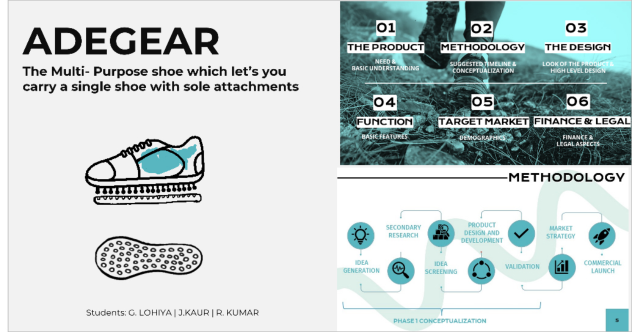
Figure 4: App design: College mate.Figure 5: Product design: Adegear.Figure 6: Product with App design: WondeRing + App.
unknown, and by leaving room for the emergent properties of the creative process” (Wendt, 2018), the solution reveals in doing.
CONCLUSION
Success is not dependent on a singular, linear plan of action but on adapting in real-time. We must change how we fundamentally feel about developing a product; it’s imperative to know what the user wants rather than just giving them what we think they want. Getting to know consumer need is criti- cal in the business world. Immersing in the users’ world, need-finding, and problem-solving is the process of digging deep. It is a way toward creative col- laboration, where success is not dependent on a single rational plan. The aim of this study was to how the creative process can play an important role in the fuzzy phase of NPD and how the structured strategy of lectures in NPD needs to build on students’ connection to the project, developing intuitive, emotional capacities and risk-taking abilities to cope with the uncertainty.
ACKNOWLEDGMENT
The author would like to acknowledge the contribution of all the students in the New Product Development class over the years, without whom this study would not be possible.
REFERENCES
Brown, A.H., & Green, T.D. (2018). Beyond teaching instructional models: Exploring the design process to advance professional development and expertise. Journal of Computing in Higher Education, 30(1), 176–186. https://doi.org/10.1007/ s12528-017-9164-y Cross, N. (2016). Design Thinking Understanding How Designers Think and Work.
London: Bloomsbury Publishing Pte.
Interdisciplinary Learning: Tomorrow’s Executives as Creative Problem Solvers 13
Darke, J. (1979) The primary generator and the design process, Design Studies, vol. 1, no. 1, pp 36–44. Dehler, Gordon & Welsh, M. & Lewis, Marianne. (2001). Critical Pedagogy in the
‘New Paradigm.’ Management Learning - MANAGE LEARNING. 32. 493–511. 10.1177/1350507601324005. Gaver, William & Beaver, Jake & Benford, Steve. (2003). Ambiguity as a Resource for Design. https://www.researchgate.net/publication/2903668_Ambiguity_as_a_Res ource_for_Design Itten, J. (1967). Design and Form. The Basic course at the Bauhaus, Johanness Itten,.
London: Thames and Hudson. Plattner, Hasso, Christoph Meinel and Ulrich Weinberg (2009), Design Think!ing.
Innovation lernen, Ideenwelten öffnen. München: miWirtschaftsverlag. Sethi, S. (2015). Every Design Tells a Story. ICERI2015 Proceedings (pp. 6529–6535). Seville: IATED Publications. Retrieved from https: //library.iated.org/publications/ICERI2015 Wendt, T. (2018). Arational Design, In P. E. Vermass, Advancement in the Philosophy of Design (pp. 101–120). Cham: Springer International Publishing AG. https://do i.org/10.1007/978-3-319-73302-9_6. Wheatley, Grayson H. (1991), “Constructivist Perspectives on Science and Mathe-
Read this individual research paper free through the original publisher, or explore the full digital proceedings book.
ISBN 978-1-958651-07-0
Explore this ISBN in the AHFE Bookstore ↗Listed in the July 2026 bookstore catalogue; search by ISBN to confirm current availability · Digital book purchase optional