Evangelos Markopoulos, Maria Barbara Ramonda (2022). An ESG-SDGs alignment and execution model based on the Ocean Strategies transition in emerging markets. In: Creativity, Innovation and Entrepreneurship. AHFE Open Access, vol. 31, pp. 93–103. https://doi.org/10.54941/ahfe1001511
Sustainable Development has been introduced in 1987, and it is underpinned by three equally essential pillars: economy, society, and the environment. The adoption of the Sustainable Development Goals in 2015 was a watershed moment in the campaign for sustainable growth. Since then, this set of 17 objectives has steered the private and governmental sectors toward more sustainable, inclusive, and responsible processes. In addition, the ESG Index has recently gained prominence primarily in the financial industry. While ESG Investment Markets in developed nations have proliferated, many emerging market businesses have been marginalized, owing to a lack of human and financial resources for ESG compliance. Considering that the appropriate ESG credentials may result in various advantages, ranging from attracting potential investors to establishing a good reputation and gaining a competitive edge, it is critical for firms in Emerging Markets to employ tactics that will assist them in achieving this.The research conducted involve an extensive literature review on this subject, a survey with 86 valid responses and four interviews with international experts. The results indicate that within different challenges regarding ESG compliance, the unbalanced approach that many businesses adopt is a major one. Societal issues seem to be the aspect that companies primarily focus on, while Environment issues appear to be neglected or forgotten. This is especially true in Emerging Markets because of a lack of data, a lack of interest and a lack of political pressure. Therefore mapping ESG and SDGs requirements can bring significant benefits to organizations that can improve their Corporate Sustainability without harming their economic growth, development and strategy.This research introduces an ESG – SDG mapping model and its execution process to achieve the maximum of this relationship. The prioritization of the SDGs has to be related to the ESG strategy an organization is committed to executing based on its capability and maturity. The proposed model is based on integrating the Blue, Pink and Green oceans and the gradual achievement of SDGs during the transition from one ocean to the other. This Pink Ocean and Green Ocean driven ESG framework is targeted primarily for the Emerging Markets where the need to adapt the SDGs is more significant than other regions. The paper indicates the initial limitations in the strategy and application of the proposed model and areas of further research that can overcome these limitations and wider its areas and regions of adaptation, and improve the scoring parameters and process. Local and international companies can use the proposed model to ignite and boost their Corporate Sustainability by complying with the ESG metrics and align themselves to the Sustainable Development Agenda.
Sustainable Development has been introduced in 1987, and it is underpinned by three equally essential pillars: Economy, the Environment, and Society (EES). The adoption of the Sustainable Development Goals in 2015 was a watershed moment in the campaign for sustainable growth. Since then, this set of 17 objectives has steered the private and governmental sectors tow- ard more sustainable, inclusive, and responsible processes (UNWTO, 2015). In addition, the ESG Index has recently gained prominence primarily in the financial industry (Garcia et al., 2019). While ESG Investment Markets in developed nations have proliferated, many emerging market businesses have been marginalized, owing to a lack of human and financial resources for ESG compliance (Odell and Ali, 2016). Considering that the appropriate ESG cre- dentials may result in various advantages, ranging from attracting potential investors to establishing a good reputation and gaining a competitive edge, it is critical for firms in Emerging Markets to employ tactics that will assist them in achieving such benefits (Garcia et al., 2017).
RESEARCH METHODOLOGY The research conducted involve an extensive literature review on this sub- ject, a survey with 86 valid responses and four interviews with international experts. This paper’s primary research includes a mix of qualitative and quantitative market research. The data gathered through the face-to-face research approach is semi-structured or unstructured in the qualitative mar- ket research study. Personal interaction in the form of an interview was used in this qualitative research approach. Quantitative research has also been used to conduct organized market research using an online survey to acquire statistical data that can assist the solutions and proposals.
The first stage of the research process was the creation of relevant and appropriate surveys to ensure that respondents and interviewees provide as clear a response to the research topic and sub-questions as feasible. During the second stage the surveys were launched to a targeted audience that could provide valid responses. The responses identified the need for updated the interview questions to gather specific data and insights on ESG compliance in firms throughout the world. The third stage was the strategically selection of the interviewees and the execution of the interview process. Six experts par- ticipated in the interview process. The last stage was the data interpretation analysis, and cross reference of the data collected from the primary and secon- dary research to set the base for recommendations to answer the research questions and contribute on the proposed methodological framework.
LITERATURE REVIEW AND RESEARCH GAP In industrialized nations, particularly in Europe, where investment choices are made using sustainable development criteria, ESG investing is beco- ming more established. According to a Harvard Business Review study that analyzes key research conducted on the issue, it is feasible to have strong pro- fitability while following ESG criteria. The relative performance metrics for Europe also indicate that organizations which are regarded as more socially responsible, outperform their competitors (Fatemi et at., 2018). Indeed, cor- porations with the highest ESG ratings surpass those with the lowest ratings by up to 40%. (Eccles and Klimenko, 2019).
Emerging Markets, when combined with ESG investments, provide inve- stors significant growth potential as well as regional, currency, industry, credit quality, and maturity diversification. In terms of macroeconomics, although developed nations’ growth is slowing, emerging markets are contributing an increasing share of global GDP growth (Muller, 2018). Investing in Emer- ging Markets, however, comes with jurisdictional and political concerns. As a result, it seems to be critical to understand all potential causes that might have an impact on firms, especially since emerging economies have less fina- ncial flexibility to handle external shocks, such as Covid-19 where investors especially demanded low-ESG risk funds and discarded the high-risk ones (Ferriani and Natoli, 2020). Research endorses the importance of ESG ele- ments in Emerging Markets studies. According to research published by the Organisation for Economic Co-operation and Development (OECD) there is
An ESG-SDGs Alignment and Execution Model 95
a clear link between decreasing income disparity and economic development (Cingano, 2014).
In the past, data disclosure has been more irregular in Emerging Markets, limiting transparency and, as a result, investors’ ability to understand the characteristics of socially responsible criteria. ESG fund costs are typically on the higher end of the spectrum. The typical sustainable and responsible investment fund costs more than non-ESG funds of equal size (Kathman, 2017). Reporting, monitoring, and implementing new regulations cost time and other resources, particularly human resources, that enterprises in Emer- ging Markets may not have readily available. Publishing corporate CSR activities has also a significant cost. Going beyond CSR towards ESG requi- res organizational activities that engage more the company with the society (Markopoulos et. al., 2021a).
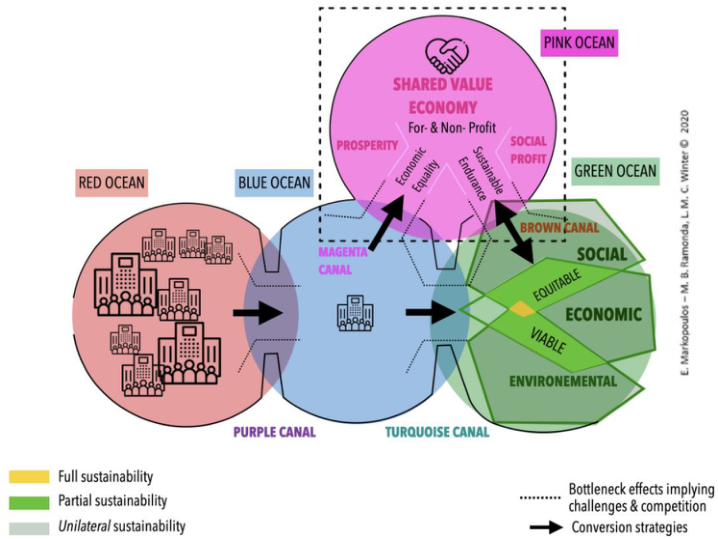
The Green and Pink Ocean Strategies Since the introduction of the ESG concept there have been several models and theories that can be followed for the implementation of the ESG require- ments or for the formulation of an ESG strategy. Two of those are the Green (GOS) and the Pink (POS) Ocean Strategies that work as an evolution of the Red and Blue Ocean Strategies towards sustainable (Green) and social (Pink) innovation oceans (See Figure 1).
The GOS was created from the need for an evolution of the Blue Ocean that includes disruptive and open innovation but also Corporate Sustainability at
Figure 1: The BOS, GOS and POS (Markopoulos et al., 2020a).
96 Markopoulos and Ramonda
its core. The main goal of the GOS is to create business ideas that are aligned with Blue Oceans but also utilise human and financial resources to make eco- nomic innovations sustainable and environmentally friendly. Such a strategy allows companies to create competitive advantage and long-lasting contri- butions to societies that not only crave for innovation but also deliver green solutions. Usually, companies seek to transition from a Red Ocean to a Blue Ocean, but this shall not be the end of their development strategies. When transitioning into a Green Ocean, businesses ought to take into considera- tion that this transformation needs to include democratisation of knowledge and the creation of a green innovation culture (Markopoulos et al., 2020b). Successful implementation of the GOS leads to the concept of Green Capi- talism where sustainability gets a double meaning as the environmental sustainability is aligned with the financial sustainability (Markopoulos et al., 2020c). Similarly, the POS can be considered as an alternative extension of the Bule Ocean towards Social Innovation. POS was created as the natural response to the need for a strategy that covers socio-economic trends and focuses on a socially driven and shared value culture. The POS aims to create Social Innovations that benefit not only the environment but also the soci- eties and communities directly and indirectly related to a business. Similar to the GOS, the POS strategy also promotes the democratisation of know- ledge in the transition stage of any company from the Blue to the Pink Ocean (Markopoulos et al., 2020a).
When including ESG into this analysis, it can be determined that the GOS contributes towards reaching the Environmental dimensions within a business, while the POS contributes towards the Social and Governance components. For instance, the Democratic ESG Green Ocean Model (DeE- SGGOM) is a model that supports the symbiosis of the ESG and the CSR practices under the Green Ocean Strategy for Environmental and Sustaina- ble innovation (Markopoulos et al., 2020d). Therefore, when both strategy models (GOS and POS) complement each other create the opportunity to improve businesses’ ESG credentials. This is critical for the Emerging Markets where the democratisation of knowledge can lead to ESG cost-effectiveness.
Research Gap Based on the literature review, the sustainable development pillars (Economy, the Environment, and Society) can be considered broad and abstract for corporations to adequately measure their influence within an economy and society. Furthermore, the ESG has proven to be a luxury that many Emerging Markets enterprises cannot afford, owing to a lack of financial and human resources. As a result, there is a void in the literature for a new model that can translate abstract notions and expensive measurements into a model that can construct sustainable and practical innovation spaces.
PRIMARY RESEARCH RESULTS The data analysis from the interviewing process indicates that there are no significant differences in the perception of ESG between developed and
An ESG-SDGs Alignment and Execution Model 97
emerging economies. The common denominator amongst the interviewees is some level of awareness regarding environmental, social and governa- nce issues and how providing proper credentials regarding these matters can benefit them. Such benefits are perceived to be mainly the good reputation, the creation of a positive brand image, and the potential competitive advan- tage in markets that are already focusing on sustainability. Nevertheless, the perception of the role of the state in ESG compliance seems to differ. Can- didates from developed economies tend to believe that governments play a crucial role when promoting ESG compliance in businesses. On the other hand, interviewees from Emerging Markets do not currently see the state as a facilitator nor an ally when it comes to creating policies/laws that consider not only profit but also the environment, society and corporate and national governance.
According to the information gathered from the surveys, the Society seems to be the component of ESG considered most relevant. This indicates an unba- lanced approach on the ESG between the Developed and Emerging Markets. Subsequently, the surveys conducted demonstrates that businesses pay the least attention to the Environment component of ESG. This is especially true in Emerging Markets where environmental awareness is lower than in the Developed Markets, while political pressure is usually non-existent. Ano- ther main reason for this, indicated from the literature review, is a lack of data of ESG compliance from the Emerging Markets, but also from smaller capitalised markets.
ESG-GDGs MAPPING The research results indicate that within different challenges regarding ESG compliance, many businesses adopt and unbalanced approach. Societal issues seem to be the aspect that companies primarily focus on, while Environment issues appear to be neglected or forgotten. This seems to be true in Emerging Markets because of a lack of data, a lack of interest and a lack of political pressure. Therefore, mapping ESG and SDGs requirements can bring signifi- cant benefits to organizations that can improve their Corporate Sustainability without harming their economic growth, development and strategy.
To take advantage of the opportunities and challenges presented by the SDGs, businesses need to set priorities and understand which goals are the most relevant and urgent for their daily activities and operations. Finding organisational practices that interconnect SDGs to more than one ESG com- ponent could be a promising first step. This would assure that such practices can have positive impact throughout more than one ESG component, even though they many be mainly focusing on one.
The increase in the popularity of Corporate Sustainability and Socially Responsible Investment in recent years has been directly proportional to the tsunami of acronyms used when valuing such investments, businesses strictly with financial criteria, and less with social impact. As a result, it is common to observe that the terms ESG and sustainability used as synonyms throughout academic papers and industry articles. Nevertheless, there are major differe- nces between these two terms and should not be used interchangeably. One
98 Markopoulos and Ramonda
of the main differences is the fact that Corporate Sustainability is analysed and studied through the lenses of the three pillars of Sustainable Develo- pment: Environment, Economy and Society (EES). As a result, Sustainability Managers work with more abstract projects using metrics such as carbon emissions, energy usage, among others. On the other hand, ESG initiatives fit into specific rubrics and are measurable by utilising diagnostic tools.
However, there are some relationships to be found between ESG and EES. Taking into consideration that, according to MSCI, companies with favoura- ble ESG momentum outperform companies with no or negative ESG activity, it can be stated that ESG disclosure can bring positive impact to EES per- formance (MSCI, 2020). In other words, having ESG strategies in place and measuring them successfully has a direct impact on the both the corporate environmental sustainability and financial economic.
It is therefore important for a business that tries to improve Corporate Sustainability to take into consideration that ESG provides a fixed, structu- red and measurable framework that facilitates this goal. Using a framework that unifies both ESG and EES can enhance the existing organizational sustai- nability but also create the necessary corporate culture to comply with ESG index. Naturally, further benefits can derive from such an approach, such as positive brand image, competitive advantage, and employee attractiveness, among others (Henisz et al., 2019).
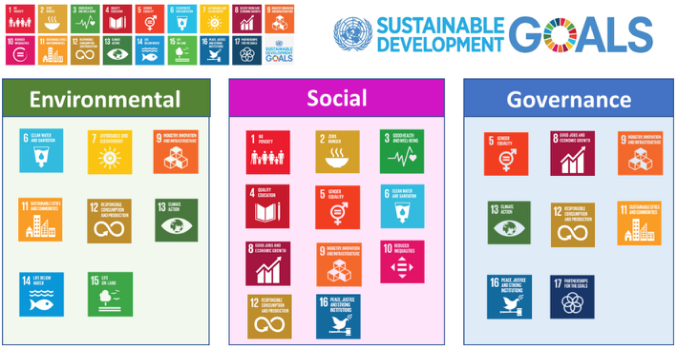
Inclusive engagement with external and internal stakeholders is vital during the ESG and SDGs mapping stage. Paying particular attention to stakeholder issues, interests, concerns, and expectations can help identify and build a comprehensive understanding of the real impact of a business. Consequently, unifying this analysis within an ESG framework can help give structure, order and a clearer sense for businesses. Figure 2 suggests a mapping tool for SDGs within an ESG framework. It must be noted that some SDGs are repeated throughout the different components, such as SDG N° 12, “Responsible Consumption and Production”, which belongs to all three Environment, Social and Governance dimensions.
Figure 2: Mapping for SDGs within an ESG framework.
An ESG-SDGs Alignment and Execution Model 99
SDGs NAVIGATION THROUGH THE INNOVATION STRATEGY OCEANS The Literature Review analysis indicates that the Environment component of the ESG can be developed, enhanced and analysed through the lenses of the Green Ocean Strategy (GOS). Likewise the Social component can be develo- ped with the Pink Ocean Strategy (POS) while the Governance component can be developed with elements from both the GOS and the POS such as ethical management, participative management, and democratic innovation with the use of the Company Democracy Model (Markopoulos et al., 2014). It must be noted that both the GOS and the POS are based on the BOS (Blue Ocean) as no sustainable or social innovation can not exist if it is not profitable (Markopoulos et al., 2020c).
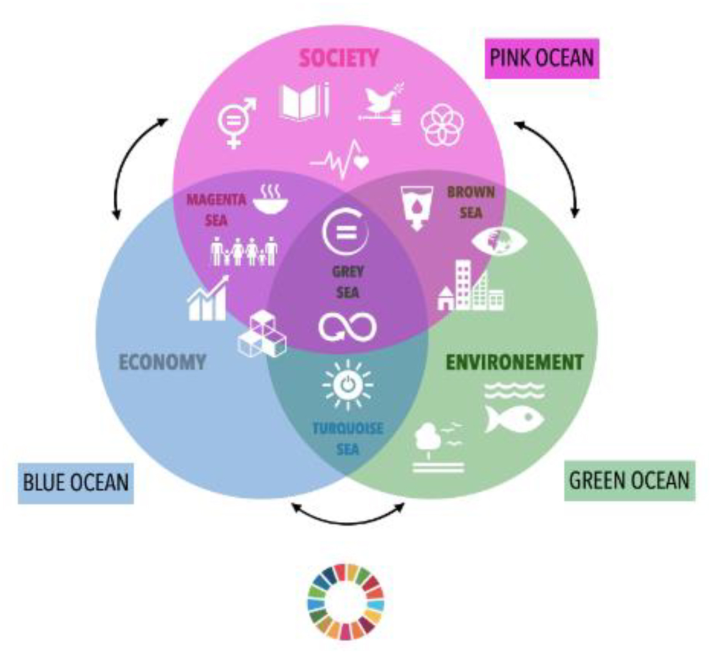
The result of this analysis is a GOS and POS driven model for ESG com- pliance supported with four seas that are created from the overlapping of the oceans (See Figure 3). By integrating the EES, SDGs, the Ocean Strate- gies and, therefore, ESG, the proposed model presents a holistic framework an organization can utilize to develop different innovation spaces based on the corporate strategy. To successfully address the issues targeted by
Figure 3: GOS and POS to achieve SDGs for ESG compliance.
100 Markopoulos and Ramonda
SDGs, businesses around the world need to find new and innovative solu- tions to old problems. Nonetheless, being innovative only for capitalistic and profit-oriented reasons is no longer enough in a world were climate change and inequalities are pressuring global issues.
Therefore, transitioning from Blue Oceans to Green and Pink Oceans allows companies to cover more SDGs but also to discover overlapping inno- vation spaces where more than one aspect of the ESG and EES is covered. These overlapping spaces, named ‘Seas’ in this model are shared innovation spaces that allow companies to sail across the oceans, but also to stay when adapting specific business needs to the relevant SDGs.
The four innovation overlapping Seas in this model, which could be seen as sub-innovation oceans, are the turquoise, magenta, gray and brow.
The Turquoise Sea helps a company to focus on goals that can contribute towards both economic and environmental aspects. When trying to work within this space, companies can focus on achieving SDG N° 7, “Affordable and clean energy”.
The Magenta Sea includes both the Economy and Society aspects of EES, and the SDGs included are N°1, “No poverty”, and N°2, “Zero hunger”. Additionally, SDG N° 8, “Decent work and economic growth”, can also benefit from the POS, regardless of being a more profit-oriented goal.
The Brown Sea is an innovation space that involves the Green and Pink Ocean Strategies. The SDGs that can be achieved here are N°13, “Climate Action”, N°11, “Sustainable cities and Communities”, and N° 6, “Clean water and sanitation”.
The Gray Sea is the central innovation space that involves all aspects of EES and ESG, and, therefore, requires strategies that involve all three oceans to succeed. The SDGs present in the Grey Sea are, N°10, “Reduced inequalities”, and N°12, “Responsible production and consumption”. Additionally, SDG N° 9, “Industry, innovation and infrastructure”, regardless of being a goal that requires sophisticated economic innovations, also involves a societal and environmental aspect to it.
LIMITATIONS AND AREAS OF FURTHER RESEARCH Within Corporate Sustainability, many types of sustainable practices can be distinguished, such as environmental, judicial, social or economic, which fre- quently seek to promote partial or biased views of sustainability, sometimes even lacking intellectual depth, and without major awareness about the nega- tive consequences. Moreover, sustainability operates through many different actors, with different (and sometimes conflicting) agendas. As a result, this requires some precaution when evaluating the relationship between sustai- nability and the various related business models, frameworks, or indexes (such as ESG). Under those circumstances, the main limitation of this model is based on the question of whether or not sustainability can neutralise short- term solutions and ignorance on global pressing issues. In case it does, the question is the proposed model is an adequate tool to contribute to proactive, intellectual and long-term actions required to ignite the necessary paradigm shift towards sustainability.
An ESG-SDGs Alignment and Execution Model 101
AREAS OF FURTHER RESEARCH The GOS and POS driven ESG model is the first attempt to create an agile business strategy that includes all ESG elements, EES pillars while maintai- ning the Blue, Green and Pink innovation aspects. Henceforth, for this model and its mapping strategies to be successful, it will be vital do develop specific metrics, indexes, and a staged process framework that will drive its execution.
Another aspect left for further research and analysis is the creation of an economy where companies with the necessary ESG credentials can trade, invest, interact and buy from each other. B Corporations can be studied on how they can create a B Economy (Kim et al., 2016). The Bilateral Knowledge-Sharing for New Product Development model under the UN Sustainable Development Goals (Markopoulos et al., 2021b) can for the base for B Corporations and B Economies to be developed under the Geo- Entrepreneurship borderless innovation framework (Markopoulos et al., 2020e) developed to address the UN SDGs. Therefore, there is a solid base for further research and challenging opportunities for the GOS and POS ESG compliance to be further developed and applied.
CONCLUSION
The continue but also rapid changes in the world stresses the abilities of the companies to successfully adapt and continue their operations. A collective and global paradigm shift fueled by individuals, organisations, the public sector and institutions is imperative for the global economy and markets to continue operate under financial and environmental sustainability, social awareness and impact, and democratic, ethical and participative corporate governance (Markopoulos and Vanharanta, 2014). The ESG Index is a tool to measure such operations requirements, therefore, it is vital for the Emer- ging Markets, and the less developed world. To find practical and effective solutions that can be translated into Environmental, Social and Governance strategies. Sustainable leadership and Innovation should be at the core of this process (Markopoulos et al, 2021c). Many renowned scientists and sociolo- gists have warned that “business as usual” is not acceptable anymore, and, in many cases, it can be disastrous. Climate change, inequalities and corruption are only some of the issues that desperately need to be tackled and handled in the short term with social and sustainable innovation.
Moreover, Emerging Markets were profoundly and unmercifully affected by the Covid-19 pandemic, which left behind collapsed systems, broken eco- nomies and most of all politically polarised societies (Hart et al., 2020). The years yet to come will be challenging, especially for these countries where human and financial resources are already lacking. Thus, a model that seeks to establish a culture where everyone can creatively contribute is vital for the economy and the society. The POS and GOS driven ESG model aiming to unify the UN Sustainable Development Goals with the three sustainability pillars for ESG compliance. It is an initial approach to con- nect such strong concepts, but according to Plato, the start is the half of the whole.
102 Markopoulos and Ramonda
REFERENCES
Cingano, F. (2014). Trends in Income Inequality and its Impact on Economic Growth.
OECD Social, Employment and Migration Working Papers, 163. Eccles, R. G., & Klimenko, S. (2019). The Investor Revolution. Harvard Business Review. Fatemi A., Glaum G., and Kaiser G. (2018). ESG performance and firm value: The
moderating role of disclosure. Global Finance Journal, Volume 38, pp. 45–64, https://doi.org/10.1016/j.gfj.2017.03.001. Ferriani F. & Natoli F. (2021) ESG risks in times of Covid-19, Applied Economics Letters, 28:18, pp. 1537–1541, DOI: 10.1080/13504851.2020.1830932 Garcia, A.S., Mendes-Da-Silva, W., Orsato, R.J. (2019). Corporate Sustainability,
Capital Markets, and ESG Performance. In: Mendes-Da-Silva, W. (eds) Individual Behaviors and Technologies for Financial Innovations. Springer, Cham. https://do i.org/10.1007/978-3-319-91911-9_13 Garcia, A.S., Mendes-Da-Silva, W., Orsato, R.J. (2017). Sensitive industries produce better ESG performance: Evidence from emerging markets. Journal of Cleaner Production, Vol. 150, pp. 135–147, https://doi.org/10.1016/j.jclepro.2017.02. 180. Henisz W., Koller T., and Nuttall R. (2019). Five ways that ESG creates value.
McKinsey Quarterly. November 2019. Odell, J. and Ali, U. (2016), ESG Investing in Emerging and Frontier Markets. Journal of Applied Corporate Finance, 28: 96-101. https://doi.org/10.1111/jacf.12181 Kathman, D. (2017, March 16). Are Sustainable Funds More Expensive? Morning
Star. Kim S., Karlesky M., Myers C. and Schifeling T. (2016). Why Companies Are Becoming B Corporations. Harvard Business Review. June 17, 2016. Markopoulos E., Staggl A., Gann E.L., Vanharanta H. (2021a) Beyond Corporate
Social Responsibility (CSR): Democratizing CSR Towards Environmental, Social and Governance Compliance. Advances in Creativity, Innovation, Entrepreneur- ship and Communication of Design. AHFE 2021. Lecture Notes in Networks and Systems, vol. 276, pp. 94-103. Springer. https://doi.org/10.1007/978-3-030- 80094-9_12 Markopoulos E., Gann E.L. (2021b) Bilateral Knowledge-Sharing for New Product Development Under the UN Sustainable Development Goals. Advances in Creativity, Innovation, Entrepreneurship and Communication of Design. AHFE 2021. Lecture Notes in Networks and Systems, vol. 276, pp. 85–93. Springer. https://doi.org/10.1007/978-3-030-80094-9_11 Markopoulos E., Winter L.M.C., Vanharanta H. (2021c) Sustainable Leadership
Wisdom Cube: Sustainable Leadership Style Evaluation Application to the Wis- dom Cube Scientific Knowledge Space. Advances in Creativity, Innovation, Entrepreneurship and Communication of Design. AHFE 2021. Lecture Notes in Networks and Systems, vol. 276, pp. 403–413. Springer. https://doi.org/10.1007/ 978-3-030-80094-9_48 Markopoulos, E., Ramonda, M. B., Winter, L. M., Vanharanta, H., & Al Katheeri, H. (2020a). Pink Ocean Strategy: Democratizing Business Knowledge for Social Growth and Innovation. In: Markopoulos E., Goonetilleke R., Ho A., Luximon Y. (eds) Advances in Creativity, Innovation, Entrepreneurship and Communica- tion of Design. AHFE 2020. Advances in Intelligent Systems and Computing, pp. 39–51, vol. 1218. Springer, Cham. https://doi.org/10.1007/978-3-030-51626- 0_5
An ESG-SDGs Alignment and Execution Model 103
Markopoulos, E., Kirane, I., Piper, C., & Vanharanta, H. (2020b). Green Ocean Strategy: Democratizing Business Knowledge for Sustainable Growth. In: Ahram T., Karwowski W., Pickl S., Taiar R. (eds) Human Systems Engineering and Design II. IHSED 2019. Advances in Intelligent Systems and Computing, chapter 20, pp. 115–125. vol. 1026. Springer, Cham. https://doi.org/10.1007/978-3-030- 27928-8_19 Markopoulos E., Gann E.L., Kirane I.S., Vanharanta H. (2020c) Green Capitalism:
Democratizing Sustainable Innovation by Recycling Intellectual Capital Energy. In: Ahram T., Taiar R., Gremeaux-Bader V., Aminian K. (eds) Human Intera- ction, Emerging Technologies and Future Applications II. IHIET 2020. Advances in Intelligent Systems and Computing, pp. 507–519. vol. 1152. Springer, Cham. DOI https://doi.org/10.1007/978-3-030-44267-5_77 Markopoulos E., Kirane I.S., Gann E.L., Vanharanta H. (2020d) A Democratic, Green Ocean Management Framework for Environmental, Social and Governa- nce (ESG) Compliance. In: Ahram T., Taiar R., Gremeaux-Bader V., Aminian K. (eds) Human Interaction, Emerging Technologies and Future Applications II. IHIET 2020. Advances in Intelligent Systems and Computing. pp. 21–33, vol. 1152. Springer, Cham. DOI: https://doi.org/10.1007/978-3-030-44267-5_4 Markopoulos E., Markopoulos G., Vanharanta H. (2020e) Democratizing Inno-
vation. A Geo-Entrepreneurial Analysis and Approach Through the Company Democracy Model. In: Markopoulos E., Goonetilleke R., Ho A., Luximon Y. (eds) Advances in Creativity, Innovation, Entrepreneurship and Communication of Design. AHFE 2020. Advances in Intelligent Systems and Computing, pp. 3–16, vol. 1218. Springer, Cham. https://doi.org/10.1007/978-3-030-51626-0_1 Markopoulos E., and Vanharanta H. (2014). ‘Democratic Culture Paradigm for Organizational Management and Leadership Strategies - The Company Demo- cracy Model.’ In: Charytonowicz J. (ed) Advances in Human Factors and Sustai- nable Infrastructure. 5th International Conference on Applied Human Factors and Ergonomics. vol. 20. pp. 190–201 (2014) MSCI. (2020). MSCI ACWI + Frontier Markets Index (USD). MSCI. Muller, D. (2018). Emerging Markets – Powerhouse of global growth. Ashmore
Group. Sustainable Development Commission. (n.d.). History of SD. Retrieved from Sustainable Development Commission: http://www.sd-commission.org.uk/pages/histo ry_sd.html United Nations . (2015). The 17 Goals. Retrieved From United Nations Sustainable
Development Goals: https://sdgs.un.org/goals UNWTO (2015). United Nations World Tourism Organization (UNWTO). Annual Report, 2015.
LISTED IN THE AHFE DIGITAL BOOKSTORE CATALOGUE
Explore the complete digital volume
Creativity, Innovation and Entrepreneurship
Read this individual research paper free through the original publisher, or explore the full digital proceedings book.
ISBN 978-1-958651-07-0
Explore this ISBN in the AHFE Bookstore ↗Listed in the July 2026 bookstore catalogue; search by ISBN to confirm current availability · Digital book purchase optional