Yi Liu, Shunqing Jia, Huibin Lian (2025). Triggers and Consequences: A Multidimensional Analysis of the Rebound Effect in Sustainable Design. In: Advances in Human Factors of Transportation. AHFE Open Access, vol. 186, pp. 52–62. https://doi.org/10.54941/ahfe1006493
1 College of Design and Innovation, Tongji University, 1239 Siping Road, Shanghai 200092, China ↗
2 College of Civil Engineering, Tongji University, 1239 Siping Road, Shanghai 200092, China ↗
3 College of Mechanical and Electrical Engineering, Zhongyuan Institute of Science and Technology, Yongchang Eastern Road, Xu Chang City, Henan Province, 461000, China ↗↗
With advancements in technology and societal development, improvements in energy efficiency have heightened expectations for environmentally friendly sustainable products and services. However, sustainable design, despite its intention to reduce environmental burdens, often generates unintended negative consequences due to the rebound effect. Addressing the rebound effect within sustainable design is therefore critical to ensuring true sustainability. This study systematically investigates the factors within sustainable design that contribute to the rebound effect, starting from the three dimensions of sustainable design: economic society and environment and focusing on the interplay between resource and energy efficiency, user behaviour, and overall consumption dynamics. The findings reveal that designers' decisions, often driven by technological optimization and user-centric goals, can unintentionally amplify resource consumption. Similarly, design processes lacking systemic foresight may overlook sociocultural impacts, while design outcomes, may encourage higher usage frequencies due to cost reductions. To mitigate these challenges, the study proposes a set of multidisciplinary strategies aimed at fostering a more holistic approach to sustainable design. Ultimately, it offers a robust framework for achieving economic, social, and environmental goals, ensuring that sustainable design truly fulfills its promise of creating a better future for all.
“The science of sustainability” has always been the fundamental principle and direction followed by nations around the world in pursuit of progress and development (Habeeb et al., 2020). From a long-term perspective on societal evolution, the concept of sustainability not only ensures the livelihood of contemporary populations but also provides essential conditions for the prosperity and continuation of future generations. In the field of design, the concept and principles of sustainability are now universally and extensively applied to the practice of various design products and services. However,
Triggers and Consequences: A Multidimensional Analysis of the Rebound Effect 53
in the thriving era of sustainable design, one should not overlook the potential negative impacts it may bring. Many scholars have identified instances where sustainable designs have not achieved their environmental protection goals but instead have led to excessive consumption of resources and environmental pollution due to overproduction and use (Sareh, 2024). For example, the production and utilization of clean energy electric vehicles, while reducing reliance on coal and other energy sources and decreasing pollutant emissions, have become increasingly popular due to their favorable pricing and government subsidies. This popularity has led to a continuous upward trend in purchases, which paradoxically requires the consumption of more resources and energy for mass production. This phenomenon is known as the rebound effect (Steren et al., 2022).
In today’s highly competitive international environment, with the continuous advancement of technology, the methods of energy extraction have become increasingly diversified, and the efficiency of energy utilization has been steadily rising. This has made the choice of energy and resources in design more complex and has rendered the outcomes of sustainable design unpredictable due to many factors that present sustainability challenges. For designers, their creativity can be constrained by the materials used, thus prolonging the design cycle (Sareh, 2024). In an effort to use eco-friendly materials, designers may also find their choices for product appearance and functionality limited. When it comes to the design process, green design, as opposed to traditional industrial production, requires new manufacturing processes, updating and overhauling production lines, which can lead to new environmental consumption. New findings suggest that existing sustainable designs may not achieve their intended sustainable outcomes when considering the entire design process, even with Life Cycle Assessments, due to potential rebound effects. Therefore, if rebound effects in sustainable design are overlooked, they could lead to outcomes that fall short of expectations or, worse, exacerbate the issues. Thus, studying rebound effects within sustainable design can help us refine the design process, optimize design methods, and better showcase the effects of sustainable design. It has been found that current research in design studies includes rebound thinking, but there is relatively little exploration and research on rebound effects in the field of design at this stage. Therefore, this study aims to explore the relationship between sustainable design and rebound effects, identify factors that trigger rebound effects, and, considering the characteristics of rebound effects, propose strategic modifications and updates to sustainable design practices.
THE REBOUND EFFECTS IN SUSTAINABLE DESIGN IN THE ECONOMIC DIMENSION In traditional production, how to handle the contradiction between economic development and environmental protection has always been the focus of research topic. Sustainable design, with the goal of environmental protection, aims to reduce the unlimited exploitation of energy by improving energy utilization efficiency and hopes to promote the use of more clean energy through energy transformation and upgrading (Spangenberg et al.,
2010). Therefore, with the rise of a new round of energy revolution, sustainable design should better balance the contradiction between economic development and environmental pollution to avoid potential rebound effects in the design and better achieve sustainable development goals.
From the perspective of industrial structure, sustainable design has promoted the development of green technology, environmental industries, and renewable energy sectors, driving economic transformation, upgrading, and sustainable development (Zheng et al., 2024). This transformation not only creates new job opportunities but also promotes long-term economic growth. From an overall economic perspective, economic policies can promote the development of sustainable design through incentives (such as policy subsidies, tax relief), encourage enterprises to adopt environmentally friendly technologies for clean production, and also prompt more enterprises to update and upgrade production tools for efficient production with sustainable design. But if the relationship between supply and demand is not well managed, the consequent expansion of production could lead to the need for more energy development and use and greater waste emissions. Also, the influx of a large number of products into the market can promote increased consumption, which in turn stimulates more production, thereby weakening environmental protection goals and triggering rebound effects (Wei et al., 2019). Therefore, if the rebound effect is not fully considered, it may lead to the failure of sustainable policy goals.
From the perspective of the consumer market, the innovative development of sustainable design has led to a new wave of consumer enthusiasm and the development of the consumer market (Boiger et al., 2024). As environmental issues become more severe, more and more people are beginning to reflect on the negative effects of overconsumption on the environment and deeply realize the importance of sustainable development. Sustainable design products and services, as a concrete manifestation of the concept of sustainable development and an important way to achieve environmental sustainability, have also received widespread attention from the market and consumers (Behtash et al., 2024). However, this market expansion leading to increased production can trigger a rebound in resource use and a large amount of environmental pollution (Le et al., 2024). In the long run, the consumer-dominated market has not truly achieved the concept of sustainable development because, with the increase in consumption, there is a clear rebound effect. Furthermore, innovative design has improved production efficiency. From the perspective of direct impact, increased production efficiency has reduced production costs, leading to lower product prices, which in turn stimulates more consumption. Indirectly, increased efficiency also leads to increased monetary savings for consumers, which can be used to consume more energy- intensive products and services (Lu & Wang, 2024).
From the perspective of consumer groups, the improvement in energy efficiency has made the purchase of high-power appliances more common (Ferrante et al., 2024). With the advancement of technology and policy promotion, more and more high-efficiency appliances enter the market. These products not only provide better performance but also significantly reduce
Triggers and Consequences: A Multidimensional Analysis of the Rebound Effect 55
energy consumption, thereby attracting consumer attention and desire to purchase, directly affecting consumer consumption patterns. Additionally, consumers often extend the usage time of appliances to enhance their quality of life, which naturally leads to an increase in energy consumption. However, many modern appliances have superior energy-saving features, and while consumers enjoy convenience and comfort, they are also subtly achieving efficient use of energy. More importantly, the money consumers save on energy consumption is often spent on activities beyond household expenses (Bjelle et al., 2018). For example, the money saved on energy can allow families to have more surplus for long-distance travel or invest in newer travel equipment, making their lifestyle more diverse. It not only enhances the consumer experience but also promotes the diversified development of the economy to some extent. However, this diversity in development brings about diverse production and consumption, and the increase in consumption greatly diminishes the intended energy-saving effects because it can lead to direct and indirect rebound effects.
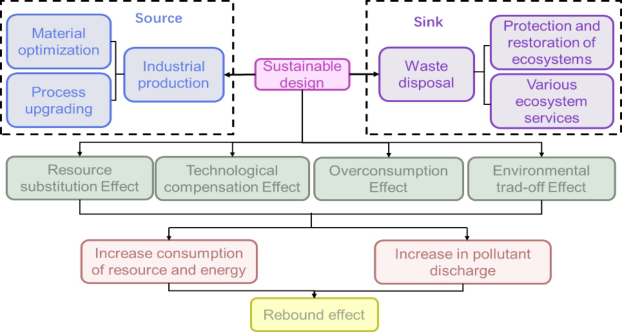
THE REBOUND EFFECTS IN SUSTAINABLE DESIGN IN THE ENVIRONMENT DIMENSION Compared to economic and social dimensions, the environmental dimension is more directly and severely affected by rebound effects. The rebound effects on sustainable design within the environmental dimension mainly involve two aspects: “source” and “sink”(Novaes et al., 2024)(Figure 1). On the “source” side, design directly impacts the utilization and development methods of resources. Sustainable design requires the selection of materials for products, the energy used in the industrial production processes, and the consumption of resources to comply with environmentally friendly and low-energy principles, thereby influencing the way natural resources are utilized (Yilmaz, 2024). Thus, if the design takes into account the renewability and environmental friendliness of resources, it can effectively reduce energy consumption. At the same time, considering the reduction and degradability of waste in the design process helps to decrease pollution to the ecological environment (Lilit et al., 2022). For instance, modular construction using standardized designs can significantly reduce the design process, improve design efficiency, and ensure that building components have high interchangeability and universality, which helps to lower the generation of waste (Liu et al., 2023). From the “sink” perspective, design can directly affect the protection and restoration of ecosystems (Liang et al., 2022). For example, designing artificial wetlands to purify water quality and promoting green roofs to increase urban vegetation cover can enhance the ecosystem’s ability to absorb and process pollutants. Additionally, design can also affect the various ecosystem services provided by the ecosystem (Zalloom, 2023), such as water conservation, soil retention, and air purification. By designing appropriate ecological protection areas and corridors, the stability and service functions of the ecosystem can be improved, thereby maintaining the survival and development of human society.
Similarly, although sustainable design has a positive impact on the environment in terms of resource substitution and utilization, the potential
rebound effects it may trigger should not be overlooked. In this regard, the rebound effects of sustainable design on resource and environmental aspects are mainly reflected in the following areas: Under the framework of sustainable design, resource substitution effects (Lilit et al., 2022) often occur, where a material or technology considered more environmentally friendly is adopted, but in reality, it may have a greater negative impact on other resources or the environment. For example, the use of biodegradable materials may lead to the overuse of land and water resources, or the extensive use of agricultural chemicals to produce these biodegradable materials, thereby increasing the pollution of pesticides and fertilizers to the environment. Second is the technological compensation effect (Amjadi et al., 2022). Technological innovations introduced by sustainable design may bring about technological compensation effects, where the introduction of new technology does not always reduce resource consumption or environmental pressure (Jütting, 2024). For instance, although energy-saving light bulbs can reduce electricity consumption, people might install more light bulbs in more places, negating the energy-saving effect of individual bulbs. Third is the overconsumption effect (Da Rocha & de Almeida, 2021). Products of sustainable design may lead to overconsumption behaviours because their eco-friendly attributes make people feel more supportive of environmental protection. For example, after purchasing a piece of clothing made of eco-friendly materials, people might buy new clothes more frequently due to their eco-friendly attributes to satisfy the psychological need to “support environmental protection,” thus increasing overall resource consumption (Wang et al., 2024). Finally, there is the environmental trade- off effect (Boehringer & Rivers, 2021). In the practice of sustainable design, environmental trade-offs are sometimes necessary, meaning that solving one environmental problem may create another (Vinayagamoorthi et al., 2024). For example, producing solar power with solar panels is an environmentally friendly practice, but the manufacture of solar panels might generate toxic waste, causing pollution to the environment.
Figure 1: Sustainable design and rebound effect in the environment dimension.
Triggers and Consequences: A Multidimensional Analysis of the Rebound Effect 57
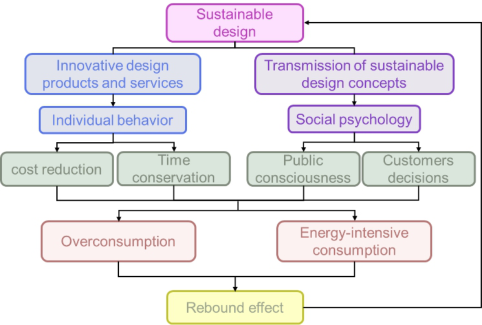
THE REBOUND EFFECTS IN SUSTAINABLE DESIGN IN THE SOCIAL DIMENSION Sustainable design principally instigates rebound effects through its impact on individual behaviour and social psychology. It directly affects people’s behaviour through innovative design products and services, or indirectly affects the recognition and consumer psychology of the whole society through the transmission of sustainable design concepts (Figure 2).
Figure 2: Sustainable design and rebound effect in the social dimension.
The way individual behaviour is influenced depends on a multitude of factors. The sustainability of products and services designed by designers may have different effects on consumers from various backgrounds and environments (Wang et al., 2022). As energy efficiency improves, the total cost spent on energy tends to decrease over the same period, leading people to increase the usage time or expand the range of energy-consuming devices for a more comfortable living environment. Consequently, people might choose to purchase more energy-efficient products and services, such as replacing ordinary light bulbs with sustainable, energy-saving ones to achieve energy savings. However, besides switching to energy-saving products, many families tend to increase the usage time of these products, which also leads to an increase in energy consumption. In addition to the direct rebound effect mentioned above, an indirect rebound effect can also be triggered, as the money saved from reduced energy prices allows low-income families to make more discretionary purchases (Lange & Berner, 2022). This might lead to increased consumption beyond basic household needs, such as travel and shopping. Besides the energy consumption aimed at saving money, the energy consumed to save time is also a major trigger for the rebound effect (Kaur & Luchs, 2022). Lower energy prices allow more people to choose faster modes of travel and consumption, which consume more energy than traditional methods, leading to additional energy resource consumption (for example, for long-distance travel, people choose airplanes over trains to save time). Whether the behaviour change is aimed at saving money or time, the
result tends to be energy-intensive consumption (Font Vivanco et al., 2022). Changes in individual consumption drive changes in group behaviour, and when multiplied by the total population, this can lead to a significant rebound effect. Such rebound effects can offset the energy savings anticipated by energy-efficient design.
Sustainable design not only influences the formulation of policies and specific practices related to sustainability but also permeates public consciousness, affecting societal recognition and ultimately impacting consumer decisions, triggering rebound effects. Through this permeation of sustainable ideals, societal values and shared ethics can intervene in decision-making, leading to these effects. Each sustainable product embodies sustainability in its craftsmanship, materials, and design to align with sustainable development. When consumers purchase sustainable products, they incorporate sustainability into their consumption mindset. Over time, as they use these products, they gradually accept and recognize the sustainability principles reflected in them, evolving into shared values (Morita et al., 2022). As more people buy sustainable products and services, this admiration becomes a widespread societal recognition. Products that attract significant attention are especially effective in raising awareness for sustainable development, promoting the consumption of environmentally sustainable designs and services, thereby facilitating the popularization and advancement of sustainable design concepts. Designers hope that these designs not only allow people to conserve energy and resources through purchasing but also encourage the formation of sustainable lifestyles through a range of products (Xu et al., 2024). However, by using sustainable products, people may feel they have contributed to sustainable design, leading to increased purchases and usage, which can relax restrictions on other consumption and increase resource use. This public recognition can actually undermine the environmental benefits of the design, triggering rebound effects. Beyond purchasing products, the incorporation of sustainability into derivative products can spark new consumption trends, increasing resource consumption. Meanwhile, sustainable development has become a mainstream focus, prompting companies to promote the sustainable aspects of their products to align with consumer interest and policy demands. In this context, sustainable design becomes an added value, reassuring consumers and catering to societal recognition, especially when scaling up, which can lead to rebound effects. At the same time, it can increase the visibility of sustainable design and public interest in sustainable products, making sustainability a key factor in consumer purchasing decisions (Steren et al., 2022). However, when rebound effects reach a certain level, sustainable design intended to reduce environmental pressure may instead have negative impacts on the environment, even if these effects are not immediately noticeable.
DESIGN STRATEGIES From the discussion of the rebound effect in the above section, there are three main factors affecting the sustainability challenge of the design:
Triggers and Consequences: A Multidimensional Analysis of the Rebound Effect 59
efficiency, number and total amount. That is, the improvement of efficiency does not mean the reduction of the total amount, if the increase of the amount is not controlled, it will be the result of the increase of the total consumption. The rebound effect has a profound influence on the design effect of sustainable design in the three dimensions of economy, society and environment. Therefore, in the face of this challenge, design needs to be sustainably updated from three aspects at these three levels respectively to avoid the challenge of rebound effect: designer, design process and design result.
In the economic dimension, the sustainability of design is not just about improving energy efficiency; it also involves addressing the issues arising from the expansion of industrial production and increased market consumption triggered by sustainable design (Sonu et al., 2023). Therefore, when innovating products and services, designers should focus not only on enhancing performance and environmental friendliness but also on the comprehensive impact of these designs throughout the entire lifecycle of production and consumption, ensuring the realization of true sustainable development. In the environmental dimension, the sustainability of design is a complex and comprehensive concept. This means that designers should not only consider the environmental impact of individual products but also think about the potential excess consumption and waste that may arise when production reaches a certain scale. By incorporating rebound effects into the overall process considerations, designers can better understand how to optimize resource use at different stages. Additionally, real-time monitoring of energy consumption and emissions during production is key to achieving sustainable design (Sundin et al., 2022). This dynamic feedback mechanism enables designers to identify potential issues promptly and adjust or update design plans as necessary to maximize environmental benefits (Boehringer & Rivers, 2021). In the social dimension, the sustainability of design goes beyond the functionality and aesthetics of the product itself; it is deeply intertwined with human needs, cultural backgrounds, and social values. Designers must not only focus on the practicality and appearance of products but also fully understand the needs, habits, and preferences of their target users. This comprehensive perspective ensures that designs align with the principles of sustainable development while meeting consumers’ practical needs and psychological acceptance. In today’s society, design should not be seen merely as a tool for achieving sustainability; it should expand its application to become an interactive medium and an art form. This transformation in design thinking requires that design is no longer limited to creating physical products but adapts to the trends of the internet and artificial intelligence. This process can convert some physical entities into online virtual products while addressing the needs of users across different age groups, effectively reducing resource consumption and pollution emissions associated with physical production.
CONCLUSION
This study discusses the role of sustainable design in conserving energy resources, reducing waste pollution, and addressing potential rebound effects against the backdrop of current resource and energy issues and the rapid economic development of various countries. In the economic, environmental, and social dimensions, the emergence of rebound effects means that the outcomes of sustainable design may not meet expectations. Therefore, it is essential to upgrade and transform design processes from three aspects: designers, design processes, and design results. These transformations require designers to shift their design thinking in line with technological advancements and societal developments. Designers must pay more attention to factors that may trigger rebound effects and influence market consumption during the design process, as well as consider the usage scenarios and cultural habits related to the products, avoiding designs that are out of touch with reality or that incite excessive consumer desires. Lastly, this study notes a lack of discussion on how to monitor rebound effects in design, highlighting this as a direction for future research. It emphasizes the need for specific measurement and analysis methods to monitor rebound effects in design, allowing for timely adjustments in design approaches to genuinely reduce and mitigate the sustainability challenges posed by rebound effects.
ACKNOWLEDGMENT
The authors would like to acknowledge College of Design and Innovation, Tongji University.
REFERENCES
Arnette, A. N., Brewer, B. L., & Choal, T. (2014). Design for sustainability (DFS): The intersection of supply chain and environment (Article). Journal of Cleaner Production, Vol. 83(No. 0), 374–390. https://doi.org/10.1016/ j.jclepro.2014.07.021 Bjelle, E. L., Steen-Olsen, K., & Wood, R. (2018). Climate change mitigation
potential of Norwegian households and the rebound effect. Journal of cleaner production, 172 (Jan. 20 Pt. 1), 208–217. https://doi.org/10.1016/ j.jclepro.2017.10.089 Boehringer, C., & Rivers, N. (2021). The energy efficiency rebound effect in general equilibrium. 109(Sep.), 102508.102501–102508.102517. https://doi.org/ 10.1016/j.jeem.2021.102508 Boiger, T., Mair-Bauernfeind, C., Asada, R., & Stern, T. (2024). Shifting wood
between material and energy use: Modeling the effects of substitution. Journal of Industrial Ecology, 28(5), 1198–1211. https://doi.org/10.1111/jiec.13530 Confente, I., & Kucharska, W. (2021). Company versus consumer performance: does brand community identification foster brand loyalty and the consumer’s personal brand? Journal of Brand Management, 28(1), 8–31. https://doi.org/ 10.1057/s41262-020-00208–4 Da Rocha, F. F., & de Almeida, E. L. F. (2021). A general equilibrium model of
macroeconomic rebound effect: A broader view. Energy economics, 98(Jun.), 105232.105231- 105232.105217. https://doi.org/10.1016/j.eneco.2021.105232
Triggers and Consequences: A Multidimensional Analysis of the Rebound Effect 61
Font Vivanco, D., Freire-González, J., Galvin, R., Santarius, T., Walnum, H. J., Makov, T., & Sala, S. (2022). Rebound effect and sustainability science: A review. Journal of Industrial Ecology, 26(4), 1543–1563. https://doi.org/10.1111/ jiec.13295 Habeeb, M., Uma, H. R., & Rajgowda, M. (2020). Migration and sustainable
development. International Journal of Commerce and business management, 03(9), 58–60. Jütting, M. (2024). Introducing the lifecycle perspective to innovation ecosystem design: The innovation ecosystem clock model. Journal of Cleaner Production, 483, 144262. https://doi.org/10.1016/j.jclepro.2024.144262 Kaur, T., & Luchs, M. G. (2022). Mindfulness enhances the values that promote
sustainable consumption. Psychology & Marketing, 39(5), 990–1006. https:// doi.org/10.1002/mar.21636 Lange, S., & Berner, A. (2022). The growth rebound effect: A theoretical– empirical investigation into the relation between rebound effects and economic growth. Journal of Cleaner Production, 371, 133158. https://doi.org/10.1016/ j.jclepro.2022.133158 Le, T.-H., Dang, P., & Bui, T. (2024). Towards Sustainable Products and Services:
The Influences of Traditional Costumes in Promoting Sustainable Fashion. Sustainability, 16(22). Liang, H., Lin, S., & Wang, J. (2022). Impact of technological innovation on carbon emissions in China’s logistics industry: Based on the rebound effect. Journal of Cleaner Production, Vol. 377, 134371. https://doi.org/10.1016/ j.jclepro.2022.134371 Lilit, A., Chengxin, Z., Sue, B., Ehsan, M. P., Fred, F., Shan, B., & Feng, Z. (2022).
Design a sustainable micro-mobility future: Trends and challenges in the US and EU. Journal of Engineering Design, 33(7/9), 587–606. https://doi.org/10.1080/ 09544828.2022.2142904 Liu, J., Gao, W., Liu, T., Dai, L., Wu, L., Miao, H., & Yang, C. (2023). A Bibliometric Analysis of the Impact of Ecological Restoration on Carbon Sequestration in Ecosystems. Forests, 14(7). Novaes, M. d. O., Bertassoni, A., & De Marco Júnior, P. (2024). What are a source
and a sink under ecological and evolutionary perspectives? Biological Journal of the Linnean Society, 142(2), 233–245. https://doi.org/10.1093/biolinnean/ blad138 Sandén, B. A., Jonasson, K. M., Karlström, M., & Tillman, A.-M. (2005). LCA of emerging technologies: A methodological framework. LCM 2005-Innovation by Life Cycle Management, Siddique, S., Chaudhry, M. N., Ahmad, S. R., Nazir, R., Zhao, Z., Javed, R.,
Alghamdi, H. A., & Mahmood, A. (2023). Ecological and human health hazards; integrated risk assessment of organochlorine pesticides (OCPs) from the Chenab River, Pakistan. Science of The Total Environment, 882, 163504. https://doi.org/ 10.1016/j.scitotenv.2023.163504 Sonu, Rani, G. M., Pathania, D., Abhimanyu, Umapathi, R., Rustagi, S., Huh, Y. S., Gupta, V. K., Kaushik, A., & Chaudhary, V. (2023). Agro-waste to sustainable energy: A green strategy of converting agricultural waste to nano-enabled energy applications. Science of The Total Environment, 875, 162667. https://doi.org/ 10.1016/j.scitotenv.2023.162667
Spangenberg, J. H., Fuad-Luke, A., & Blincoe, K. (2010). Design for Sustainability (DfS): The interface of sustainable production and consumption (Article). Journal of Cleaner Production, Vol. 18(No. 15), 1483–1491. https://doi.org/10.1016/ j.jclepro.2010.06.002 Steren, A., Rubin, O. D., & Rosenzweig, S. (2022). Energy-efficiency policies
targeting consumers may not save energy in the long run: A rebound effect that cannot be ignored. Energy Research & Social Science, 90, 102600. https://doi.org/ 10.1016/j.erss.2022.102600 Sundin, N., Persson Osowski, C., Strid, I., & Eriksson, M. (2022). Surplus food donation: Effectiveness, carbon footprint, and rebound effect. Resources, Conservation and Recycling, 181, 106271. https://doi.org/10.1016/ j.resconrec.2022.106271 Vinayagamoorthi, R., Bhargav, P. B., Ahmed, N., Balaji, C., Aravinth, K., Krishnan, A., Govindaraj, R., & Ramasamy, P. (2024). Recycling of end of life photovoltaic solar panels and recovery of valuable components: A comprehensive review and experimental validation. Journal of Environmental Chemical Engineering, 12(1), 111715. https://doi.org/10.1016/j.jece.2023.111715 Wang, K., Xin, L., & Zhang, Y. (2024). Sustainable and efficient process design
for wastewater recovery of cyclohexane/isopropyl alcohol azeotrope by extractive distillation based on multi-objective genetic algorithm optimization. Chemical Engineering Research & Design: Transactions of the Institution of Chemical Engineers, 201, 593–602. https://doi.org/10.1016/j.cherd.2023.12.004 Wang, M., Kim, E., & Du, B., (2022). Promoting Emotional Durability and Sustainable Fashion Consumption through Art Derivatives Design Methods. The design journal, 25(5), 789–806. https://doi.org/10.1080/ 14606925.2022.2088095 Xu, S., Xu, L., & Liu, Y. (2024). The effects of global product design on supply chain efficiency and natural resources management. Resources Policy, 98, 105366. https://doi.org/10.1016/j.resourpol.2024.105366 Zalloom, B. (2023). Towards a Sustainable Design: Integrating Spatial Planning with
Energy Planning When Designing a University Campus. International Journal of Energy Production and Management: The Quest for Sustainable Energy, 8(2), 115–122. https://doi.org/10.18280/ijepm.080208 Zheng, T., Chai, Z., Zuo, P., & Wang, X. (2024). The Effect of Multilateral Economic Cooperation on Sustainable Natural Resource Development. Sustainability, 16(17).
LISTED IN THE AHFE DIGITAL BOOKSTORE CATALOGUE
Explore the complete digital volume
Advances in Human Factors of Transportation
Read this individual research paper free through the original publisher, or explore the full digital proceedings book.
ISBN 978-1-964867-62-5
Explore this ISBN in the AHFE Bookstore ↗Listed in the July 2026 bookstore catalogue; search by ISBN to confirm current availability · Digital book purchase optional