Zhaoyi Kang, Mengfei Liu (2026). Catalyst Theory-Informed Design Methods for Community Health Science Communication Services. In: Creativity, Innovation and Entrepreneurship. AHFE Open Access, vol. 206, pp. 110–120. https://doi.org/10.54941/ahfe1007388
As the fundamental unit for disseminating health science, the effectiveness of community-based services is of critical importance. However, the traditional “top-down” model of science communication often suffers from low resident engagement, challenges in translating knowledge into practice, and issues of service sustainability. This paper explores how Catalyst Theory—an intervention philosophy originating from urban design—can provide an innovative methodological framework for designing community health science communication services. The study first reviews the value of Catalyst Theory in the field of “service and social innovation.” Then, through case analysis, it identifies four core catalysts within community health science communication: “space, activity, digital, and interpersonal.” Based on this, a design framework consisting of four stages—“catalyst diagnosis, catalyst network construction, progressive activation, and impact evaluation”—is developed. This research offers a novel theoretical perspective and practical design tools to address the challenges of participation and sustainability in community health science communication service design.
As fundamental units of society, communities serve as crucial venues for the delivery of health science education and the achievement of the “preventive treatment” goal. However, current community health science initiatives predominantly rely on traditional formats such as bulletin boards and lectures, which are often characterized by oneway information delivery, passive resident participation, and limited behavioral change (Chen & Wan, 2024). The core challenge lies in treating residents as passive recipients of knowledge rather than active cocreators of a healthy community, thereby lacking effective mechanisms to stimulate residents’ intrinsic motivation and sustained engagement.
Since its proposal by Wayne Attoe and Donn Logan, Catalyst Theory has demonstrated its value in urban renewal by triggering “chain reactions” through “strategic smallscale interventions.” The theory offers an insightful perspective to address the aforementioned challenges in community health education. It suggests that the designer’s role is not to provide a final solution, but to skillfully design a series of “catalysts” that activate positive interactions
Catalyst Theory-Informed Design Methods for Community Health Science 111 among residents, the environment, and community organizations, enabling healthy behaviors to emerge and sustain organically. This concept aligns closely with the social innovation design principle of “designing interventions to catalyze social change.” Although Catalyst Theory is wellestablished in physical space design, its systematic application in public service and social innovation design—particularly in the specific field of health science education—remains underexplored.
Therefore, this study aims to bridge this theoretical gap. The central research question is: How can Catalyst Theory inspire the design of community health science services to develop more effective strategies and methods? To address this question, the paper will first discuss the value of applying Catalyst Theory within the service design process. Second, through case study analysis, it will identify key types of catalysts in community health science services. Finally, it will construct a systematic design operational framework to guide designers in more precisely identifying intervention points, designing service methods, and evaluating longterm effects, thereby empowering communities to develop endogenous health promotion capabilities.
Catalyst Theory and Its Value in Service Design Catalyst Theory, as an interdisciplinary analytical framework, traces its conceptual roots to the catalyst principle in chemistry. Following its creative adaptation by urban studies scholars, it has evolved into a significant theoretical tool for explaining and guiding urban spatial renewal. The author contends that Catalyst Theory holds even greater potential value in the field of service design and, by extension, in social innovation design.
Core Connotations and Evolution of Catalyst Theory “Catalyst” originally is a chemical term referring to a substance that alters the rate of a chemical reaction without being consumed itself. In the 1930s, American architects Wayne Attoe and Donn Logan first introduced this concept into urban construction research, proposing the “Urban Catalytic Theory.” They posited that “introducing new elements into the urban development process can stimulate and transform the functions of related elements, meaning that one urban development project can trigger a chain reaction of multiple others.” (Attoe and Logan, 1989) This theory breaks through the limitations of traditional large-scale urban renewal, advocating for stimulating the self-renewal capacity of urban environments through precise, small-scale interventions. The core connotations of Catalyst Theory encompass three key dimensions: selective intervention, chain reaction, and sustainable transformation. Firstly, the theory emphasizes identifying and selecting key elements with high catalytic potential as intervention points, rather than undertaking comprehensive, widespread renovation (Wang and Tang, 2024). Secondly, the catalytic effect manifests as a chain reaction in space and function, where the initial intervention triggers adaptive changes in the surrounding environment (Zhang et al. 2025). Thirdly, Catalyst Theory pursues sustainable urban transformation, stressing that interventions should
112 Zhaoyi and Mengfei respect the original context of a place and stimulate endogenous drivers rather than impose external order (Gong, 2024).
The evolution of Catalyst Theory in urban renewal practice reveals three notable trends: First, expansion from material-space catalysts to socio-cultural catalysts. For instance, scholars like Jiang Jieru (Jiang et al. 2023) explored how to transform historic residences in Yuzhong into “cultural catalysts,” preserving the buildings themselves while promoting the inheritance and development of urban culture. Second, progression from single catalysts to catalytic networks, gradually forming three catalyst types: “point, line, and area.” For example, Kou Tingyue et al. (Kou et al. 2024) from a catalytic perspective, designed for Wuhan’s Yangtze River cruise ships, constructing an integrated “point-line-area-virtual” catalytic system. Third, deepening from short-term catalytic effects to long-term catalytic mechanisms. Examples include the design of Tai’an Panhe Central Park, which proposed a three- stage strategy of “site awakening - urban catalyst - guiding sustainability,” emphasizing the sustained nature of catalytic effects.
The Application Value of Catalyst Theory in the Service Design Process The main stages of service design typically revolve around four key components: service context research, service need insight, service concept design, and service design implementation (Zhang and Hu, 2018). Traditional service design models lack focus on and influence over the post-design phase: once designers have optimized touchpoints and improved the user experience, the service design project is considered complete. However, the ultimate goal of contemporary social innovation design is to form a system that can operate independently of the designer, placing greater emphasis on the profound social impact generated. Therefore, the catalytic efficacy of “catalysts”—triggering chain reactions and sustainable transformation— precisely addresses the shortcoming of service design’s neglect of the post- implementation phase.
Transitioning from spatial renewal to service design, Catalyst Theory holds the potential to further develop into a crucial theoretical bridge connecting design intervention with social change. Commonalities exist between urban space and service design across three aspects: system, object, and goal. The significant value Catalyst Theory has demonstrated in the urban spatial domain indicates its equally substantial potential value in service design and social innovation design.
Design System: Public services, especially community health science education, constitute a complex social system composed of various elements such as residents, healthcare workers, community staff, physical environments, and information resources. Like urban space, this system also exhibits complex characteristics such as nonlinearity and self-organization. This shared understanding of complexity leads both fields to favor incremental, adaptive intervention strategies.
Design Object: Catalyst Theory provides a philosophy of systemic intervention, not a fixed spatial form. When the “object of intervention” shifts from physical space to “human behavior and community relationships,” the
Catalyst Theory-Informed Design Methods for Community Health Science 113 carriers of catalysts naturally transform from physical structures to service processes, interactive activities, digital interfaces, and social relationships.
Design Goal: Catalyst Theory aims to stimulate a system’s self-renewal capacity through catalytic elements. Similarly, the ultimate goal of social innovation design is to establish a social system capable of achieving autonomy without the designer’s constant involvement. A successful community health activity can function like a successful public building: attracting people, fostering interaction, changing perceptions, and inspiring residents to spontaneously organize further health initiatives. This is precisely the manifestation of a “chain reaction” at the service level.
Deconstruction of Catalyst Types in Community Health Science Services Through a comparative analysis of innovative cases—including Singapore’s “Healthy 365” program, the US MedlinePlus website, health science outreach activities by medical universities (Zhang and Ren, 2017), the Fujian Nursing Association’s community science volunteer initiative (Xiao and Jiang, 2013), and community health service centers in Shanghai—this study deconstructs the core catalyst types within the community health science service system, as detailed in Table 1.
Table 1: The core catalyst types and functions of community health science popularization services.
Table available in the original PDF paper.
Catalyst Type Form Function Space Health kiosks, walkways, corridors
Integrate into life and provide scenario- based prompts
Activity Lectures, free medical consultations, and reading days
Create experiences and build communities Digit APP, AR, website Break through time and space and provide feedback
Interpersonal Community linker, volunteer Trust spreads, behavior sets an example
Spatial Catalysts: Environmental Interventions Embedded in Daily Life Spatial catalysts materialize the function of health science education within the community’s physical environment, making it an inadvertent part of residents’ daily routines. The core value of such catalysts lies in their contextual nature and permeability. They do not require residents to invest extra time and effort to acquire knowledge specifically but seamlessly integrate health information into their existing daily pathways, shifting the paradigm from “deliberate learning” to “incidental attention.”
Typical examples include transforming unused stairwell corners into “Health Knowledge Corners” displaying information on seasonal epidemic prevention, or installing signage systems along community garden pathways
114 Zhaoyi and Mengfei that indicate walking distances and estimated calorie expenditure. These design practices demonstrate that successful spatial catalysts can translate abstract health knowledge into perceptible, interactive environmental language, subtly influencing residents’ health perceptions and behavioral decisions through continuous contextual exposure.
Activity Catalysts: Experiential Co-creation for Building Collective Memory Activity catalysts refer to designed, health-themed events or participatory workshops. Unlike static spatial catalysts, the efficacy of activity catalysts is built upon social interaction and emotional connection. They transform dry health knowledge into vivid embodied experiences by creating shared practical encounters, thereby fostering collective memory and social norms regarding health among participants.
For example, local hospitals regularly organize free medical consultation services within the community, allowing residents to access professional medical resources while leveraging the gathered interest to conduct health education outreach. The Yangpu District Health Promotion Center in Shanghai, among others, launched the “Family Health, Nutrition First” competition. This activity not only disseminated nutritional knowledge but also sparked residents’ interest in improving their dietary habits through the enjoyment of cooking and tasting. The success of such catalysts hinges on their ability to evolve from “task-oriented activities” into “meaningful events,” ensuring that the health concepts they promote continue to resonate and spread within the community through conversation and imitation even after the event concludes.
Digital Catalysts: Intelligent Bridges Enabling Precision Service Digital catalysts leverage information technologies such as the Internet of Things (IoT), Augmented Reality (AR), and big data to construct a virtual interaction layer for health science. Their distinct advantage lies in transcending physical and temporal constraints while providing immediate, personalized feedback, thereby enabling the precision and scalability of science outreach services.
Specific application forms are diverse. For instance, MedlinePlus, a platform created and operated by the US National Library of Medicine since 1998, offers patients, families, and the general public a free, easy-to-understand, accurate, and up-to-date repository of health knowledge resources (Wang and Luo, 2015). Digital catalysts serve as crucial bridges connecting online and offline realms and merging the virtual with the real. They not only expand service coverage but also, through data accumulation and analysis, enable continuous optimization of service content, forming a virtuous cycle where the system becomes increasingly intelligent with use.
Catalyst Theory-Informed Design Methods for Community Health Science 115 Interpersonal Catalysts: Trust-Based Dissemination via Social Networks
Interpersonal catalysts are influential, persuasive, and trusted key individuals within the community who serve as “living carriers” of health information and behavioral models. Compared to authoritative information from official channels, the trust-based “acquaintance dissemination” conducted by interpersonal catalysts is often more persuasive and impactful, acting as the core driver for the “social diffusion” of healthy behaviors within the community.
Such catalysts can include enthusiastic retired healthcare professionals, community elders who consistently exercise and maintain good physical fitness, or opinion leaders with organizational influence in groups like square dancing. The UK’s Social Prescribing initiative is a model example of systematically cultivating interpersonal catalysts. It connects patients with community resources through link workers, integrating social support with health management. The link worker engages in in-depth conversations with residents or patients to understand their needs and goals. Based on these conversations, the link worker guides the patient to the most suitable local community service or activity. The designer’s role lies in identifying, connecting, and empowering these potential “health leaders,” transforming their personal influence into a shared community health asset through appropriately designed platforms and mechanisms.
The four catalyst types—spatial, activity, digital, and interpersonal—each possess unique catalytic logics and pathways of influence. They are not isolated but are interdependent and mutually reinforcing within the complex system of community health science outreach. This clear deconstruction lays a typological foundation for constructing a systematic catalyst design framework in the next chapter.
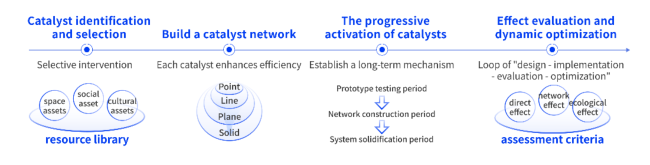
Constructing a Catalyst Theory-Driven Design Framework for Community Health Science Services Based on the preceding theoretical discussion, this chapter aims to construct a systematic and operational catalyst-driven design framework to provide methodological guidance for designers engaging in practice within the field of community health science. This framework translates the core concepts of Catalyst Theory into concrete design processes and tools, enabling service design to encompass the complete journey from initial problem diagnosis to post- implementation impact assessment. Its overall structure is illustrated in Figure 1.
Figure 1: Construction of a service design framework based on catalyst theory.
The objective of this phase is to accurately identify potential catalyst carriers with high catalytic potential from the complex community environment. While traditional needs analysis often focuses on a “deficit-based” perspective, this framework advocates for an “asset-based” approach, mapping the community’s health assets.
First, community profiling and needs mapping serve as foundational work. Designers should employ methods such as in-depth interviews, participatory observation, and surveys to clarify the community’s demographic structure, existing health literacy levels, key health issues, and the residents’ actual daily routines. Concurrently, mapping the community health asset inventory requires systematically documenting three core asset types: 1) Spatial Assets, such as community centers, gardens, pathways, and unused corners; 2) Social Assets, including existing interest groups, community volunteers, community health service centers, local pharmacies, and other organizations and individuals; 3) Cultural Assets, such as unique community festivals, shared collective memories, and local knowledge. This process views the community as a “repository of potential” rather than a “pool of problems.”
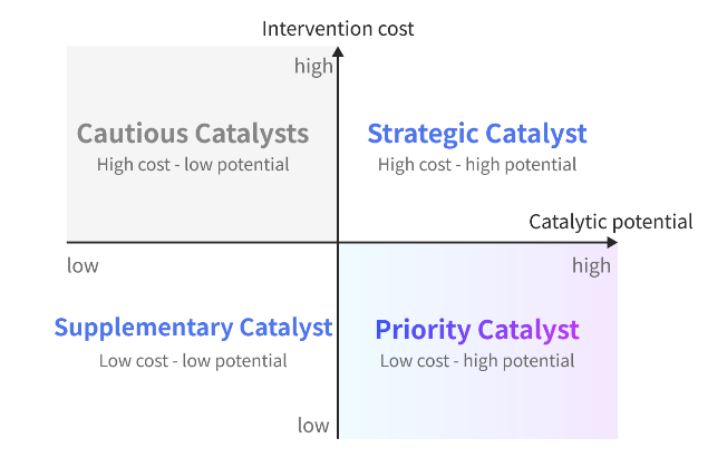
Subsequently, the Catalyst Assessment Matrix (see Figure 2) is used to prioritize potential catalysts. This matrix positions “Intervention Cost” on the vertical axis and “Transformative Potential” on the horizontal axis, dividing catalysts into four quadrants.
Figure 2: Catalyst evaluation matrix.
Catalyst Theory-Informed Design Methods for Community Health Science 117 In the catalyst evaluation matrix, intervention cost and catalytic potential are the two core evaluation indicators. The definitions of the two are decomposed as shown in Table 2:
Table 2: Explanation of evaluation indicators.
Table available in the original PDF paper.
Assessment Criteria
Evaluation Index Detailed Assessment Dimensions Intervention cost material needs It refers to the material resources required for the catalyst to function, which may include money, venues, etc
Non-material needs It refers to the non-material resources required for the catalyst to function, which may include human resources, policies, etc Catalytic potential Catalytic intensity It refers to the strength of the effect produced in terms of degree after the catalyst takes effect. The drilling indicators may include the positive review rate, penetration rate, etc
Influence sphere It refers to the popularization effect produced in the range after the catalyst takes effect. The drilling indicators may include area, time, number of people, etc This matrix provides designers with a clear decision-making tool, guiding them to allocate limited resources primarily to catalysts with high leverage effects. This selective intervention approach, rooted in catalytic thinking, offers an efficiency paradigm for resource-constrained social innovation projects.
Catalyst Network Weaving Once key catalysts are identified, the core of the design work shifts from creating singular touchpoints to weaving synergistic catalyst networks. This framework proposes that a robust catalyst network should follow a “Point- Line-Area-System” construction logic.
“Points” refer to specific, directly perceptible catalyst carriers, such as a health education installation, a health champion, or a health screening event. “Lines” are the pathways or sequences connecting these points, which could be residents’ behavioral flows within the community or designed experience journeys. For example, a resident moves from “Point A” (a health trail), is guided via QR code to “Point B” (an online health quiz), and upon completion receives a digital pass to “Point C” (a community health day event). “Areas” are specific scenarios or thematic fields formed by the interweaving of multiple “lines” and “points,” such as a complete series of “Community Health Month” activities. Finally, when multiple “areas” overlap, interpenetrate, and deeply integrate with the community governance structure, a sustainable health support “System” emerges—a vibrant, healthy community ecosystem.
The focus of catalyst application lies in establishing long-term mechanisms. A phased, conditional approach to releasing catalytic effects can effectively sustain social initiatives, avoiding system rejection caused by premature or excessive intervention. This framework divides the catalyst activation process into three progressive stages.
First is the Prototype Testing Phase. Designers should prioritize “low-cost, high-potential” catalysts, creating low-fidelity prototypes for rapid testing. For example, simulating a health challenge activity using hand-drawn posters and a WeChat group rather than immediately developing a mini- program. The goal is not to deliver a perfect product but to test the “catalytic activity” of the catalyst—its ability to attract participation, spark discussion, or inspire follow-up actions—at minimal cost.
Upon receiving initial positive feedback, the process enters the Network Construction Phase. Based on test results, designers gradually enrich catalyst types and connect the validated single catalysts according to the pre-defined network structure to form preliminary synergies. This stage requires close attention to the “chemical reactions” of catalyst interactions and timely adjustments to the network structure.
Finally, the Institutionalization Phase. Here, catalyst models proven effective through practice are translated via design into sustainable community mechanisms. Examples include formalizing a resident-initiated walking group into a “Thursday Walking Day” managed by a community association, or linking an online health points system to discounts at the local supermarket. The goal of this phase is to transition from a “designer-led project” to a “community-owned routine,” ensuring the long-term efficacy of the catalytic effect.
Effect Assessment and Dynamic Optimization Traditional service design evaluation often focuses on user satisfaction and the achievement of predefined objectives. This framework proposes that the assessment of catalytic effects should shift towards measuring system vitality and the transformation process. This assessment system should encompass three levels:
Direct Effects: Evaluating the performance of the catalyst itself, such as participation rates, usage frequency, and knowledge acquisition rates.
Network Effects: Assessing the occurrence of chain reactions, paying particular attention to the frequency and scale of residents spontaneously sharing, imitating, adapting, or co-creating health activities.
Ecological Effects: Evaluating long-term indicators of system health, such as the strengthening of community social capital, increased resident ownership of health issues, and the formation of a supportive health environment.
The ultimate purpose of assessment is dynamic optimization. Designers need to establish regular review mechanisms to maintain and adjust the catalyst network based on assessment data and community feedback: reinforcing high- efficacy catalysts, adjusting or replacing low-efficacy ones, and even introducing
Catalyst Theory-Informed Design Methods for Community Health Science 119 new catalysts to meet evolving community needs. This creates a virtuous cycle of “design-implement-assess-optimize,” an “adapt-as-you-go” approach that is more suited to complex environments than a fixed plan.
The catalyst-driven design framework constructed in this chapter translates a macro intervention philosophy into a structured, tool-explicit, and directly applicable operational process for designers. It emphasizes co-creation with the community from the diagnostic stage, strategic construction of catalyst networks, and gradual, iterative activation and optimization. Its ultimate aim is to catalyze the formation of a self-renewing community health ecosystem, offering a new methodological pathway to address the sustainability challenge in community health science outreach.
CONCLUSION
Addressing the practical challenges in community health science services— such as low resident engagement, difficult knowledge translation, and unsustainable service models—this study innovatively introduced Catalyst Theory, originally from urban design, into the domain of public service design, constructing a systematic design framework. The main research conclusions are as follows: First, this study elucidates the necessity and feasibility of applying Catalyst Theory within service design. Through theoretical review and case study deconstruction, it demonstrates that the three core principles of Catalyst Theory—selective intervention, chain reaction, and sustainable transformation—possess high applicability in addressing complex social system issues like community health. Elements within health science services, such as spatial nodes, activity events, digital platforms, and key individuals, can all be regarded as potential “service catalysts.” Designers need to strategically deploy various catalysts to stimulate residents’ spontaneous participation and behavioral change.
Second, this study proposes an operable catalyst-driven framework for health science service design. This framework encompasses four key stages: “Catalyst Diagnosis, Network Construction, Gradual Activation, and Effect Assessment.” It provides designers with a complete methodological toolkit from problem identification to effect optimization, enabling an effective shift in service models from “one-way dissemination” to “two-way interaction,” and from “one-off activities” to a “sustainable ecosystem.” Design guided by Catalyst Theory ultimately aims not to provide a definitive service solution, but to foster an endogenous capacity for health promotion within the community through strategic intervention. Only when residents transform from passive knowledge recipients into active health practitioners and disseminators does the construction of a healthy community gain enduring, internal momentum.
This study still possesses certain limitations. First, while the proposed design framework is based on theoretical deduction and case analysis, it has not yet been fully validated through large-scale, long-term community practice projects. Its effectiveness requires further support from empirical research. Second, regarding the assessment of catalytic effects, although
120 Zhaoyi and Mengfei multi-dimensional indicator directions have been established, precisely quantifying the intensity and scope of “chain reactions”—particularly measuring changes in social relationship networks—remains a methodological challenge.
REFERENCES
Attoe, W., Logan, D. (1989). American Urban Architecture: Catalysts in the Design of Cities.University of California Press, 1989. Chen, F., Wan, J.J. (2024). Communication path of popular medical science in
communities from the perspective of supply side reform. Chinese Rural Health Service Administration, 2024, 44(02). Deng, C.L. (2010). Touch the Service Touchpoints. ZHUANGSHI, 2010, (06):13–17. Gong, L.M. (2024). The protection and inheritance of cultural heritage in Guangxi Ethnic Ecological Museum. Culture Industry, 2024, (23):25–27. Jiang, J.R. et al. (2023). Research on the Revitalization of Urban Historical Buildings
from the Perspective of “Cultural Catalyst”: A Case Study of the Former Residences of Celebrities in Yuzhong District, Chongqing City. Proceedings of the 2023 China Urban Planning Annual Conference, 2023:56–66. Kou, T.Y.et al. (2024). Research on the Design Strategy of Urban Cultural Theme Cruise Ship from the Perspective of Catalyst. Design, 2024, 37(16). Wang, J., Tang, Y. (2024). A Study on Renewal Design of Urban Historic Streets
based on CatalystTheory:Taking Yangzhou Dongguan Street as an Example. Architecture & Culture, 2024, (09):2–7. Xiao, H.M., Jiang, X.Y. (2013). Innovate community science popularization activities to serve the health needs of residents. Society, 2013,(05):54–58. Zhang, X., Hu, F. (2018). General Strategy Process of Service Design. Packaging
Engineering, 2018, 39(02). Zhang, X.G., Ren, S.M. (2017). Exploration in the Improvement of the Whole Nation’s Health Literacy in the Socialized Media Environment. Journal of Medical Informatics, 2017, 38(01).
LISTED IN THE AHFE DIGITAL BOOKSTORE CATALOGUE
Explore the complete digital volume
Creativity, Innovation and Entrepreneurship
Read this individual research paper free through the original publisher, or explore the full digital proceedings book.
ISBN 978-1-964867-82-3
Explore this ISBN in the AHFE Bookstore ↗Listed in the July 2026 bookstore catalogue; search by ISBN to confirm current availability · Digital book purchase optional