Zhaoyi Kang, Yijun Liu, Mengfei Liu (2024). The Awakening Role of Design in Social Innovation. In: Human Factors in Design, Engineering, and Computing. AHFE Open Access, vol. 159, pp. 2065–2075. https://doi.org/10.54941/ahfe1005774
Amidst societal transformations including economic, political, social, cultural, and ecological realms, social innovation has emerged as a burgeoning field of research and practice. Influenced by societal demands, there has been a paradigm shift in design methodologies and objectives. Diverging from conventional process-oriented design approaches, this paper advocates for an outcome-oriented perspective. It comprehensively explores how design can catalyze "awakening" in social innovation through its intervention at the levels of objects, actions, and outcomes. By emphasizing this shift, the paper offers insights into how design can effectively engage with and contribute to social innovation endeavors.This paper conducts a literature review to analyze the current status and characteristics of social innovation and social innovation design. 1) Social Innovation: Social innovation projects possess four fundamental attributes: innovativeness, practicality, societal participation, and locality. They generally follow six developmental steps: problem identification, action theme determination, involvement of relevant stakeholders and institutions, solution formulation and implementation, retrospective analysis (forming event prototypes), and promotion and diffusion (becoming an incubator). 2) Social Innovation Design: Social innovation design aims for societal transformation, driven by social change, engaging in collaborative design activities. It solely aims at catalyzing positive social change, differing from traditional design in research methods, design objects, and output outcomes. 3) Design intervention in social innovation is not only a necessity for the development of social innovation but also an inevitable consequence of the evolution of design discipline. Existing design tools have accumulated a wealth of mature innovation methods and have been widely applied in fields such as product design, interaction design, and service design. However, due to the lack of a comprehensive discipline system in social innovation design, the role of design in social innovation often remains underutilized. Design requires a more proactive approach to address societal changes.This paper comprehensively discusses how design can play a constructive role in various stages of social innovation through specific case analyses of six social innovation projects including the Di Gua Community and Otera Oyatsu Club. Using deductive reasoning, the paper analyzes and summarizes the perspectives and methods of design intervention in social innovation, concluding that design can "awaken" social innovation in terms of its objects, actions, and outcomes—awakening social consciousness among individuals and facilitating communication between individuals or organizations; stimulating participants' innovative thinking and actively engaging them in social innovation activities, becoming project drivers; and transforming participants into a group with design thinking, some of whom may evolve into future initiators of social innovation, forming a virtuous cycle. This design approach is defined as "social awakening design," aiming to provide researchers with a conceptual framework for design intervention in social innovation and encouraging rational design involvement in social innovation projects.
Society is experiencing changes and challenges in the economic, political, social, cultural, and ecological aspects. A series of complex social problems such as the environment, urban system, education, medical care, elderly care, and consumption need to be addressed through multi-faceted solutions (Li and Ni, 2023). The emergence of various social problems has triggered more frequent innovation activities. Social Innovation (SI) is an important emerging field that is increasingly attracting the interest of practitioners, policymakers, and academia. As a form of innovation, SI is gradually becoming on par with market-driven technological innovation and state- driven political and bureaucratic innovation (Krlev et al., 2015). Influenced by social needs, design methods and goals are also changing. Social Innovation Design (SID) was born in the context of the failure of traditional models to solve problems (Yang and Tang, 2023), and aims to trigger positive social changes. However, there is currently no complete SID discipline system, and design needs a more proactive approach to respond to social changes. How can designers participate in SI? What is the significance of design intervention in SI?
Different from the previous process-oriented design methodology, this article derives from the result-oriented approach and comprehensively discusses how design can play an awakening role in SI from the 3 aspects of object, action, and result. It defines this as Social Awakening Design and aims to clarify the important significance of design in SI activities.
In recent years, there has been a large increase in academic institutions on SI, and many researchers and scholars have proposed their own definitions. However, there is no unified definition of SI, and its related concepts are still under discussion and clarification. SI was formally proposed in 1973 by American management scholar Peter Drucker (Ji and Yue, 2012) in his book Management: Tasks, Responsibilities, Practices (Drucker, 1993). The Young Foundation in the UK defines SI as “a type of innovative activities and services aimed at meeting social needs and creating new ideas for new social relations or cooperation models (Murray et al., 2010)”. In 2014, the TRANSIT project funded by the European Union proposed that “social innovation is the socialization of means and ends, including new social practices, new concepts, models, rules, relationships, services and/or products.” The concept proposed by the project emphasizes the better use of assets and resources to meet multi-level social needs. The TEPSIE project supplemented the definition of SI in practical applications. Researchers defined SI as new ways to address social needs through social means and achieve social goals; attracting and mobilizing beneficiaries during the project process and helping to change social relations by improving beneficiaries’ access to social power and resources (TEPSIE, 2014).
Based on the existing definitions, the following essential attributes of SI projects can be summarized.
1) Innovativeness. Whether the activity method, form or goal is innovative or not largely determines whether the activity can be classified as SI. Phills clearly pointed out that the solutions proposed by SI should be more effective, efficient and sustainable than existing solutions (Phills et al., 2008).
2) Practicality. SI can be applied to a very wide range of activities, including the production and application of new products or services (Zhou and Guo, 2023), the dismantling or restructuring of social relations, the adjustment of social rights (Moulaert et al., 2013), the transformation of social institutions (Westley, 2008), and so on. This diverse range reflects one fact that SI is generated through diverse practices themselves, rather than activities guided by academic definitions (TEPSIE, 2014). McNeil’s view that “social innovation can operate simultaneously in academia and policy fields” also supports this view (McNeill, 2006).
3) Social participation. The purpose of SI is to solve a social problem or meet a social need. Therefore, the implementation of SI requires some or all of the following conditions to be met: decision-making by policymakers, support from investors, participation from social organizations, and recognition from citizens. All stakeholders in the activity become participants and promoters of SI.
4) Locality. The development of SI projects must be based on locality. Locality defines geographical boundaries and has a social and cultural system that has been accumulated in historical development. Only in a specific place and scale can we analyse the development of specific problems through social processes (Zhou, 2020).
The Awakening Role of Design in Social Innovation 2067
Design Intervention in SI With the popularization of SI and the development of the concept of design discipline, the connection between SI and design is becoming closer. Design intervention in SI is not only a need for the development of SI, but also an inevitable result of the development of design discipline (Gong, 2010). Ezio Manzini, the founder of the Design for Social Innovation and Sustainability (DESIS), proposed the concept of SID, calling it “design activities that guide and maintain social sustainable development with design thinking”(Manzini, 2016). SID is different from traditional design in terms of research methods, design objects and output results. From the perspective of research methods, SID focuses on user participation, sharing and collaboration. Designers are no longer the only design subjects. They are integrated into (or even withdraw from) the process of SI in a variety of roles. From the perspective of design objects, design is no longer just about aesthetic issues (Li and Ni, 2023). SID focuses on hot social issues, and its design objects have changed from people to more systematic objects such as relationships and structures, with different entry points in different aspects such as people’s livelihood, economy, and culture. From the perspective of output results, unlike traditional material design outputs, the results of SID are closely related to the impact of SI. In other words, whether SID has valuable output results is determined by whether the design has triggered SI.
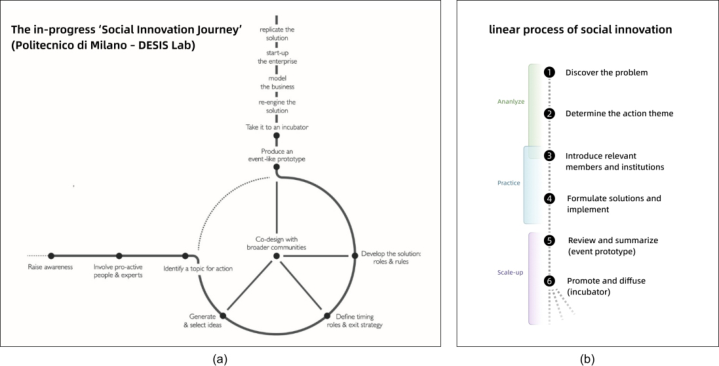
SID Model In order to better study the participation of design in SI projects and its impact on SI projects, it is necessary to clarify the workflow and project structure of current SI projects to provide an analytical framework for the case analysis in the following text. After literature search and comparison, this article refers to the SI behaviour paradigm Social Innovation Journey proposed by Meroni et al. (2013). This paradigm is formed from the perspective of designers and focuses on action research and field actions. It can help the development and prototype construction of SI. The specific behaviour paradigm is: (1) Raise awareness; (2) Determine the theme of action; (3) Introduce active members and experts; (4) Generate and select plans; (5) Define time, roles and exit strategies; (6) Co-design with the wider community; (7) Develop solutions: roles and rules; (8) Create event prototypes; (9) Become an incubator; (10) Structure the business model and implementation (See Figure 1-a). The author provides a relatively complete SI project process, covering the start of the project to the final SI scale-up, and emphasizes that designers need to exit the project during the project process.
To better fit this study, we have adjusted the paradigm, emphasizing the linearity of the process, making it more suitable for the analysis of the entire project process. Finally, the SI project process is summarized into the following steps: (1) Discover the problem; (2) Determine the action theme; (3) Introduce relevant members and institutions; (4) Formulate solutions and implement; (5) Review and summarize (event prototype); (6) Promote and diffuse (incubator) (See Figure 1-b). The following will use this model to
analyse some SI project cases and study the impact and role of design in SI projects.
Figure 1: SI project process model (adapted from Meroni et al., 2013).
CASE STUDY – DESIGN AWAKENS SOCIAL INNOVATION The term awakening is a new understanding that the we have drawn from a large number of SID cases. In this paper, awakening is an important function of design in SI and a method for design to intervene in SI. The following article analyses 5 SI projects to better explain the significance of design awakening SI.
China: Digua Community Since 2000, the number of people living underground in Beijing has been increasing (Zhou, 2022). In 2015, Zhou Zishu, a designer from the Central Academy of Fine Arts, officially established the Digua Community, which has a library, cinema, barber shop and other functional areas with good environment, where residents enjoy a comfortable community life. Through design transformation, the Digua Community transforms the idle space of the community into a new shared space, giving energy and rights to the residents of the community, thus creating an impact and bringing about change.
Social problems and idle underground resources caused by urbanization have always existed, but due to the absence of, the possibility of resource reorganization and utilization has been hidden. Digua Community focuses on these social problems and the demands of this special groups, using existing resources through design to create a new community model to reshape the public’s cognition of urban space attributes.
Japan: Otera Oyatsu Club The project originated from a vicious social incident: in 2013, a single mother in a large-scale incident starved to death because she had no money to raise
The Awakening Role of Design in Social Innovation 2069
her child. The Japanese temple Anyangji was influenced by this incident and noticed the social problem of child poverty, so it shared the temple’s offerings with similar single-parent families. Since then, the Otera Oyatsu Club, a platform that connects temples with social organizations, has been gradually improved. Public welfare and charity organizations in various places log on to this platform to distribute the surplus offerings donated to temples by the public to poor children.
The prevalence of the cultural ways of religion and offering in Japan is the basis for this design. However, before the development of the Otera Oyatsu Club, Japan’s sacrificial culture had not been applied in the field of helping poor children. The emergence and development of this project awakened the cultural attribute of Japanese sacrifice and reorganized social resources including relationships and materials. At the same time, the Otera Oyatsu Club transferred the tributes provided to gods and Buddhas to poor single-parent children, which is an innovation in religious concepts and social cognition.
Japan: Echigo-Tsumari Art Triennale The Echigo-Tsumari Art Triennale is an art exhibition that interweaves nature, humans and art. It is the world’s largest international outdoor art festival. Echigo-Tsumari is a mountainous region in northern Japan. After the period of rapid economic growth in Japan, with the gradual outflow of population, the Echigo-Tsumari region began to face severe social problems such as aging, school closures, and abandoned farmland. In order to solve these problems, the Echigo-Tsumari Art Triennale launched with the goal of local reconstruction began to inject new vitality into Echigo-Tsumari. It creatively integrating artistic creation into the natural environment, and giving new vitality to economically depressed areas with an extremely attractive tourism industry. The success of this project has gained a huge influence: other regions outside of Japan have also begun to experiment with Land Art Festivals in recent years, including China’s Tonglu Land Art Festival (2020), Jingdezhen Fuliang Land Art Festival (2021–2022), Guangdong Nanhai Land Art Festival (2022–2023), etc.
Italy: Coltivando - The Convivial Garden at Politecnico di Milano Coltivando is a shared vegetable garden planted on the green land of the Candiani campus of the Politecnico di Milano. Coltivando encourages interaction between neighborhood residents and the university community, promotes a sustainable lifestyle, and provides public green space. Anyone can join the vegetable garden and participate in its maintenance. At the same time, Coltivando is supported by policies. In the same year that Coltivando opened, the Milan City Council approved a policy to use green and abandoned public spaces as (vegetable) gardens for local residents. Since the spatial concept of the Coltivando garden is based on a spatial model, it also has the possibility of being replicated in other parts of the world, which is of great value for expanding the influence of the project.
Coltivando is a SI project initiated by designers. In addition, Coltivando is jointly promoted by the community and has been building connections with other local gardens, associations and schools, which has promoted the social relevance of the project and strengthened the communication between designers and the community.
America: Red Hook Hub The Red Hook Hub is a SI project for sharing community information and is part of the participatory design program DESIGN/RELIEF. At the end of October 2012, Hurricane Sandy hit the eastern United States, including Red Hook, causing a large amount of damage to infrastructure, houses, and buildings (Tang, 2018). During Hurricane Sandy, many residents were unable to get timely community notifications or emergency information, and could only rely on word of mouth among neighbours to obtain information. After in-depth understanding of the local situation and stakeholders’ opinions, the Red Hook Hub project team decided to create a communication and information center for Red Hook - Hub. In the process of continuous development and improvement of the project, HUB has formed a shared information platform including offline bulletin boards and online websites, collecting and displaying information related to community needs in crisis and non-crisis situations: official content is shared by organizers and community partners, and others can freely publish participatory content such as activities and social networking.
By analysing the 5 cases according to the SI model summarized in last section, we can get the development logic of each case as shown in Table 1.
Table 1. Analysing 5 cases according to the SI model.
Table available in the original PDF paper.
Project No.
Step 2 Determine the Action Theme
Step 3 Introduce Relevant Members and Institutions
Step 4 Formulate Solutions and Implement
Step 5 Review and Summarize (Event Prototype)
Step 1 Discover the Problem
Step 6 Promote and Diffuse (Incubator)
Digua community
Overpopulation in cities; housing difficulties for migrants;
Empower the basement stakeholders and rebuild social relations in the community
Transform and utilize urban underground public space to become underground community.
DiGua has established 4 community spaces in Beijing and Chengdu, and is still expanding its influence.
Invite residents, neighborhood committees, residents’ representatives, social organizations and many other stakeholders to participate in the discussion.
Redefine the basement (space transformation, image design, etc.) and develop a sustainable community strategy (space sharing, co-creation, and co-governance).
/
Otera oyatsu club
Set up official website with various stakeholders to participate in the specification.
Child poverty; Prejudice against single- parent families;
The temple donated the surplus temple offerings to poor children to alleviate child poverty
The Otera Oyatsu Club project provides a platform to connect temples with social organizations, and donate excess offerings from temples to poor children in Japan.
1,500 temples, NPOs, welfare committees, administrative counters and other organizations joined the cooperation to establish the non-profit organization Otera Oyatsu Club.
(Continued)
The Awakening Role of Design in Social Innovation 2071
Table 1. Continued Step 2 Determine the Action Theme Project No.
Table available in the original PDF paper.
Step 5 Review and Summarize (Event Prototype)
Step 4 Formulate Solutions and Implement
Step 3 Introduce Relevant Members and Institutions
Step 6 Promote and Diffuse (Incubator)
Step 1 Discover the Problem Echigo- Tsumari Art Triennale Rural population outflow; Rural development stagnation;
The combination of natural scenery and art exhibitions has formed the form of the Earth Art Festival.
The project is jointly organized by local governments, artists, villagers and non-profit organizations (NPOs).
Other areas’ art festival: Tonglu Land Art Festival (2020), the Jingdezhen Fuliang Land Art Festival (2021–2022), etc.
Solve serious social problems such as aging, school closures, and abandoned farmland caused by population outflow, and revitalize rural development
The three-year exhibition will be held in the Echigo-Tsumari area, with nature and original buildings as the creative medium, and will be presented in the form of art.
Coltivando Hunger problem; Autism problem
Return common areas on campus to the community, provid fresh organic food and strengthen social connections
The continuous co-design approach enables designers to communicate with the community in a timely manner and get feedback.
Work with the community to design and build garden spaces, plant and grow garden vegetables, and then distribute them in a shared, communal way.
DESIS Lab developed the design, the community participated in the co-design, and the Milan City Council supported the project.
Milan’s City Council approved a policy to use green, abandoned public spaces as (vegetable) gardens for local residents. Red Hook Hub
Create a communications and information center to serve the community
Problems with post- disaster urban construction; Lack of information
The whole architecture of the Red Hook Information Center system are shown on the official website.
There is no scalability because the nature of the problem itself is not high- frequency and common.
The project is in partnership with Good Shepherd Services, Digital Stewards at Red Hook Initiative, the Brooklyn Public Library, and the Red Hook Alliance’s Communications Working Group.
A HUB bulletin board was created, and a HUB digital ticker was placed at a real estate company. As the project progressed, a Hub website was established, and a series of Digital Stewards workshops were held.
DEFINITION AND EXPLANATION OF SOCIAL AWAKENING DESIGN From the research review and case analysis in the previous article, it can be concluded that the development of SI activities requires the support and coordination of multiple parties. For a complete SI project, the scheduling and coordination of pre-project resources (object & action), the coordination of stakeholders (object), the innovative activities required for the formulation of project plans (action), the practice and response observation during the project promotion process (action), and the iterations and modifications (result) that the plan may face in the future all require awakening from different angles and meanings. Based on the summary of literature and case analysis, this article elaborates on the awakening role of design in SI from the 3 dimensions of object, action, and result.
Object: Awakening Objects and Relationship Connections In the TEPSIE project’s definition of SI, the research team focused on describing how SI projects attract and mobilize beneficiaries, ultimately benefiting them and changing social relations (TEPSIE, 2015). The attraction and mobilization mentioned here can be understood as an awakening of the social consciousness of the beneficiaries. Social consciousness here refers to the social responsibility of citizens. The scope of benefit is not limited to
improving material needs through SI projects, but also the awakening and construction of spiritual needs. Through design, we can gain insight into and sort out social problems, and implement them in a form that people can perceive (visual, auditory, and tactile), which plays a role in awakening individuals.
The awakening of design is not limited to the spiritual awakening of individuals, but also to the awakening of all stakeholders involved in SI activities. Multi-party collaboration and co-design (social participation) are the main methods of social design. The participatory design process refers to the participation of stakeholders (users) in the design process (Yang and Cai, 2023). Through design intervention, the communication barriers between stakeholders can be broken down, and both parties have the opportunity to exchange and express accurate information, thereby helping to update management organizations and institutions (Tian, 2023). In SID, with co- design as the guide, participants and relevant interest groups are organized to promote design projects. The awakening and reconstruction of social relations is also an important role of design intervention.
In summary, for individual objects of SI, design can present problems in a perceptible way; for organizations in SI, design can provide a communication interface, act as a lubricating buffer space, connect all parties, and promote the adjustment of social relations.
Action: Innovation Awakening and Awareness Awakening (1) Creative stimulation during project – Awakening of Creativity
The solution generation stage is the part that needs the most innovation, and it is also the stage where design can play a significant role. After the previous stage of sorting out, designers not only have an understanding of social structure, but also have the collection and experience of more relevant social information. By exerting creativity, using design tools and design thinking, the innovative ability of participants can be awakened, thereby awakening and activating resources that may be neglected, and proposing solutions with a problem-solving orientation, thereby injecting new vitality into improving the existing situation. In the case of the Art Land Festival in Echigo-Tsumari, the Echigo-Tsumari area was originally declining due to the serious population loss in social development. When the designer Fram Kitagawa first conceived the plan, his main purpose was to promote the revitalization of the area. He observed the local strong rural settlement culture and large tracts of land resources and natural scenery. He held the Art Land Festival in Echigo-Tsumari and invited artists from all over the world to come here, so that the area has regained vitality. In this case, by creating contexts for sharing of experience and practice (Ceschin, 2013; Ehn, 2008) that enable people to act in a more creative way, continuous actions are awakened.
(2) From passive participation to active participation - Awakening of Consciousness In a relatively complete SI activity, the participants’ journey is roughly from participation-iteration-autonomy. In the initial stage, participants participate
The Awakening Role of Design in Social Innovation 2073
in SI activities in a collaborative form. At this stage, participants need more guidance to initially awaken their consciousness. The iteration stage refers to the participants’ actual participation in the project and gaining a sense of accomplishment because of the development of the project. In the continuous feedback, the participants’ social consciousness and sense of responsibility are further awakened. In the stage of autonomy, the role of the guide gradually fades out, and participants who have awakened consciousness can form autonomy. In other words, the goal of design intervention is to awaken a better system, but designers cannot always exist in the system. Ultimately, designers need to leave the project and leave behind design thinking that can drive the growth of the SI project itself. In the action part, design methodology and design tools can provide strong help in the creative divergence stage. Persuasive design and user experience design are beneficial to the long-term development of the program and stimulate the innovation and participation awareness of participants.
Results: Project Scale-Up and Results Diffusion After a period of development, SI projects gradually enter a stable operating state and form a social impact within a certain range. On this basis, SI activities will further develop in 2 modes: scale and diffusion (Cunha and Benneworth, 2020). The scale here does not refer to the growth of the organization, but to the scale of social impact (Davies et al., 2013). The social impact here is also a kind of awakening. Awareness awakening can be spread and radiated through various social media platforms (Kleverbeck, 2019). Among the people who are radiated by social influence, there is a group that is highly similar to the participants of SI. They can be inspired by it and may awaken their consciousness and trigger their own actions to become trialists; the other part is social organizations and various stakeholders (including financial organizations, governments, social organizations, etc.). Through the project, the potential of the organization and the organization’s cognition of the application of its own capabilities are first awakened. Secondly, they are encouraged to carry out execution and SI projects to promote development and achieve more macro goals. By designing awakening actions, and then expanding the influence to awaken the initiative of a wider range of groups, this is also the ideal development state of SI.
CONCLUSION
This paper analyses the development status and activity characteristics of SI and SID through literature research: SI projects have 4 basic attributes: innovation, practicality, social participation and localization, and basically follow the 6 development steps of discovering problems - determining action themes - introducing relevant members and institutions - formulating solutions and implementation - reviewing and summarizing (forming event prototypes) - promoting and diffusing (becoming an incubator). Design intervention in SI is not only a need for the development of SI, but also an inevitable result of the development of the design discipline. Through the specific analysis of 5 SI cases, this paper comprehensively discusses how
design can play a positive role in different stages of SI. The conclusion of this paper is that design can awaken from the 3 aspects of SI: object, action and result. From the perspective of object, design awakens the social consciousness of individuals and the communication between individuals or organizations; from the perspective of action, design can awaken the innovative thinking of participants, and actively participate in SI behaviours and become the promoters of projects; from the perspective of result, participants have become a group with design thinking in SI activities, and some of them are likely to become the initiators of future SI, forming a virtuous circle. This article defines this design form as Social Awakening Design, hoping to provide current researchers with a reference for how to intervene in SI through design, and to encourage the reasonable intervention of design in SI projects.
ACKNOWLEDGMENT
The project is funded by MOE (Ministry of Edu-cation in China) Project of Humanities and Social Sciences, under project No.18YJC760050.
REFERENCES
Ceschin, F. (2013). Critical factors for implementing and diffusing sustainable product-Service systems: insights from innovation studies and companies’ experiences. Journal of Cleaner Production, 45, 74–88. Cunha, J., & Benneworth, P. (2020). How to measure the impact of social innovation
initiatives? International Review on Public and Nonprofit Marketing, 17(1), 59–75. Davies, A. R., Simon, J., & Rodin, J. (2013). How to grow social innovation: A review and critique of scaling and diffusion for understanding the growth of social innovation1. Drucker, P. F. (1974). Management: Tasks, Responsibilities, Practices. Ehn, P. (2008). Participation in design things. Participatory Design Conference. Ji, G. X., Yue, L. L. (2012). An analysis of Drucker’s social innovation thought and
its value. Foreign Economics & Management, 2012, 34(9): 1–6. Gong, M. M. (2010). Wellbeing Lifestyle and Social Innovation: Strategic Design for Sustainable Society. Art & Design, 2010(03): 123–124. Kleverbeck, Maria & Krlev, Gorgi & Mildenberger, Georg & Strambach, Simone &
Thurmann, Jan-Frederik & Terstriep, Judith & Wloka, Laura. (2019). Indicators for Measuring Social Innovation. Krlev, G. et al., (2015). Social innovation indicators and their assessment at the national level. Foreign Theoretical Trends, 2015(07): 113–123. Li, Y., Ni, M. Q. (2023). Ni Minqing: designers need to be the enabler of social
relations. Design, 2023, 36(08) 51–54. Manzini, E. (2016). Design, When Everybody Designs. Beijing: Publishing House of Electronics Industry. Rabadjieva, M., Butzin, A. (2019). Emergence and diffusion of social innovation
through practice fields. European Planning Studies, 28(5), 925–940. McNeill, D. (2006). The Diffusion of Ideas in Development Theory and Policy.
Global Social Policy, 6(3), 334–354. Meroni, A., Fassi, D., & Simeone, G. (2013). Design for Social Innovation as a form of Design Activism: An action format.
The Awakening Role of Design in Social Innovation 2075
Moulaert F., et al (ed). (2013). The International Handbook on Social Innovation.
Cheltenham, UK: Edward Elgar Publishing Limited. Murray, R., Caulier-Grice, J., & Mulgan, G. (2010). The Open Book of Social Innovation. Phills Jr., J. A., Deiglmeier, K., & Miller, D. T. (2008). Rediscovering Social
Innovation. Stanford Social Innovation Review, 6(4), 34–43. Tian, J. (2023). Research on Rural lmage Design under the Concept of Social innovation Design-Taking Nancun Vilage, Yintian Town, ShaoshanCityHunan Province as an Example. Brand & Standardization, 2023(S1):35–37+41. Tang, X. (2018). The Social Innovation Research: A Concept of ParticipatoryDesgin
Perspective. (PhD thesis, Hunan University). TEPSIE (2014) Social innovation theory and research : a guide for researchers. A deliverable of the project: “The theoretical, empirical and policy foundations for building social innovation in Europe” (TEPSIE), European Commission – 7th Framework Programme, Brussels: European Commission, DG Research. Westley F. (2008), The Social Innovation Dynamic, Social Innovation Generation,
University of Waterloo, 2008. Yang, J., Cai, Z. J. (2023). Prospects of Artificial Intelligence Enabling Social Design in the Big Data Era. Packaging Engineering, 2023, 44(12): 89–97. Yang, Y., Tang, C. Q. (2023). The Value and Path of Social Innovative Design under
the Background of Rural Sustainable Development. Design, 2023, 36(21): 65–67. Zhong, F., Liu, X., Liang, R. R. (2022). Production to Practice: Looking at the Practical Connotation of Social Design from the Perspective of Aging-Friendly Renovation Design. Art & Design, 2022(03): 44–49. Zhou, S. S., Guo, S. (2023). Research on New ldea and Model of Social Innovative
Design in Traditional Handicrafts. Design Research, 2023, 13(05): 39–43. Zhou, Z. S. (2020). Innovation and Society - Eight Thoughts on Social Design. Art Research, 2020, (05): 124–128. Zhou, Z. S., Tang, Y. (2022). Digua Community: Shared Space Creation Methods.
Beijing: Tsinghua University Press.
LISTED IN THE AHFE DIGITAL BOOKSTORE CATALOGUE
Explore the complete digital volume
Human Factors in Design, Engineering, and Computing
Read this individual research paper free through the original publisher, or explore the full digital proceedings book.
ISBN 978-1-964867-35-9
Explore this ISBN in the AHFE Bookstore ↗Listed in the July 2026 bookstore catalogue; search by ISBN to confirm current availability · Digital book purchase optional