Hezhu Pan, Mengfei Liu (2023). Social media in rural life: Design innovation for participatory cultural communication in China. In: Ergonomics In Design. AHFE Open Access, vol. 77, pp. 744–754. https://doi.org/10.54941/ahfe1003435
The development of internet technology and social media has rapidly changed everyday experiences. Rural people benefit from new technology. They share their stories on digital social media platforms, and promote agricultural products on Live Streaming platforms and E-commerce platforms. Rural communities have been an active part of the booming social media phenomenon in the past few years, especially in China. The study is based on fieldwork in a rural village in the Hunan Province of China, which has a rich ethnic culture, including intangible cultural heritage such as Huayao cross stitch. Local communities partner with designers to create cultural product designs, digital cultural content, etc. Rural people in that village participated in this study and their related social media were retrieved, using a dataset collected from their widely used social media platform, we analyze rural people’s profiles, more than 120 online short videos and images they posted on their accounts within one year.By combining both quantitative data from surveys and qualitative data from semi-structured interviews, We explored the ways and new features of Chinese rural cultural communication in the Internet era, and summarized three deficiencies in the current cultural communication of Huayao. These Inadequacies helped us reveal how design innovation can provide new ways of enhancing the impact of participatory communication of rural culture.By establishing a rural cultural image, guiding rural people's content of the creation, and stimulating their subjectivity, design innovation could address the gap as a definer, planner, facilitator and promoter, and rural people could play a positive and important role in digital culture communication. Individuals and communities can benefit from the content made by rural people themselves on social media. Finally, design innovation could promote the infusion of local cultures into the global and build a sustainable way of rural cultural communication.
With the widening gap between urban and rural areas brought about by rapid urbanization, the decline of the countryside has become a major social pro- blem in China. The 19th Party Congress proposed the implementation of rural revitalization strategy and wrote it into the Party Constitution. Under such a background, Various industries of rural revitalization have develo- ped rapidly and people from all walks of life have made many attempts.
China and other countries have made efforts to revitalize the countryside by design innovation in their practical exploration of rural industrial revi- talization. A large number of design branches, including industrial design, product design, visual design, public art and digital media, have been applied to rural construction, and have achieved excellent results. At the same time, with the rapid development of information technology, the ways of cultu- ral communication in rural area are constantly iterating and becoming more diversified. Social media has become a transformative force in the revitaliza- tion of China’s countryside. With the rapid spread of social media app, rural people are transformed from recipients of information to spontaneous nar- rators, sharing their own stories proactively. However, design innovation in digital media do not seem to exert enough power to spread rural culture in the participatory communication of rural people yet.
THE NEW STATE OF CULTURE COMMUNICATION IN RURAL CHINA China has a long history of traditional vernacular culture, so rural revita- lization has always been a top priority in China. Since the 20th century, the popularity of the Internet in rural China has brought new opportuni- ties for rural areas to bend the curve. Extensive infrastructure penetration, high villager participation, and large scale of digital industry are all huge advantages of China’s rural Internet development (Zhang, Xu et al. 2022). According to the 49th Statistical Report on the Development Status of the Internet in China released by China Internet Network Information Center (CNNIC) in 2022, as of December 2021, the gap between urban and rural Internet users in China continued to narrow. The size of rural Internet users reached 284 million, accounting for 27.6% of the overall Internet users. The Internet penetration rate in rural areas was 57.6%, an increase of 1.7 percen- tage points from December 2020, and the Internet penetration rate in urban and rural areas narrowed by 0.2 percentage points. Against this backdrop, cultural communication in rural China has taken a bold and novel path.
Cultural communication needs to be realized through certain media. Rural communication media are divided into exogenous media and endogenous media according to the different functions in the rural communication eco- logy (Chen 2017) In the previous exogenous media (TV and radio are typical examples) rural culture was the viewed other, and the media was not rele- vant to the rural people (Yang and Lei 2018). But social media, an exogenous medium originating from the city, has begun to empower rural people. Rural people in general have been given a voice and established the right to be seen and known under the influence of connected technology. Through social media, communication in rural China is changing from a vertical mode to a horizontal mode with local participation and tends to be more diverse, small-scale, localized, and non-institutionalized (Han 2009).
Digital media are reshaping the type of communication and social life (Zheng 2022). Digital media, such as short videos and live streaming, have rapidly entered the lives of Chinese rural residents and have greatly changed the way of production and cultural communication in rural areas.
746 Pan and Liu
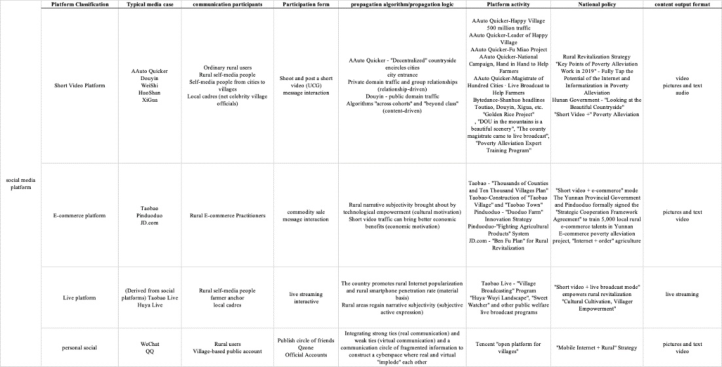
Figure 1: Social media platform in participatory communication in rural China.
These various platforms are becoming the dazzling stars of China’s rural revitalization in the digital era (see Figure 1).
For China’s large rural communities, participatory communication high- lights its vitality in rural China (Duan 2021). In the participatory commu- nication model, participants communicate horizontally with each other, and people actively participate in the production of information and control of communication tools (Han 2010). Thus rural cultural communication in China has produced the following new features.
From Passive Reception to Active Narrative With the combined effect of the development of Internet technology and the popularity of smartphones, everyone has become a content maker and distri- butor. This has given rural people the opportunity to become the center to express their self-awareness and spread their self-act (Wang and Li 2020). The relationship between media and audience changes from oratory to dialogue, and people are no longer passive recipients of information but active partici- pants. Social media have transformed the status of people as the recipients of communication, stimulating their participation in communication and giving them the right to speak (Zheng and Ren 2022). This has led to a different type of participation than before, where rural people’s own creativity is given full play (Wang and Li 2020). From radio to television, and then to social media, rural people have been liberated by technological development and transfor- med from the “other” in rural narratives to the “subject” of self-speech (Sha and Zhang 2019). The vitality of rural culture is being recreated and enriched by people’s active narration and communication. Rural culture, which used to be told only by the urban areas, is showing its true power in the hands of the rural people themselves.
Social Media in Rural Life: Design Innovation 747
From High Capability to User Friendly For most rural users, video editing and production is a professional and complex operation. The short video software simplifies this work into a simple process that can be completed with a single click, greatly reducing the user’s threshold and allowing users to use it smoothly (Yu 2016). Because of the user-friendly application, the short video platform can maintain an open and shared cooperative relationship with rural self-publishers. The platform provides easy-to-use tools for rural people, who then proactively use the tools to create and disseminate on the platform.
From One-Way Reception to Multi-Way Interaction Interactive communication is becoming an important way for villagers. Tra- ditional media communication delivers information to the receiver in one direction, while participatory communication achieves mutual communica- tion between every communicator and the receiver. Likes, comments, retweets and other interactive methods enrich the interactive dialogue of rural cultural communication.
From Single Field to Integrated Coexistence As the scale of digital industry continues to expand, various fields no longer develop independently. in March 2016, “mushroom street” officially launched the live streaming portal, thus China’s “live strea- ming +e-commerce” took off. Video-based commercial media platforms have an innate e-commerce gene (Zheng and Ren 2022). The role of “short video + live streaming” in rural cultural communication should not be unde- restimated (Wang and Li 2020). Nowadays, the digital industry chain of “live streaming +e-commerce”, “short video + e-commerce” and “live stre- aming + short video” is gradually developing and maturing. The flexible and diversified Internet fields have developed into a characteristic emerging power in the countryside.
REGION BACKGROUND: SHORT VIDEO OF HUAYAO WITH UNLIMITED POTENTIAL The Huayao belongs to a branch of the Yao ethnic group in China and nowadays live in the impoverished mountainous region of Hunan Provi- nce, at an average altitude of 1,320 meters above sea level in the HuXing Mountains. It is rich in natural resources, not only with magnificent natural landscapes such as high mountain terraces and waterfalls, but also with a mysterious and unique culture, with local cross-stitch techniques as a natio- nal non-foreign heritage. However, the per capita GDP of Huayao is less than 1/4 of the average of China.Project teams from universities and companies have been investigating and designing to greatly contribute to the sustai- nable development of local economy and culture through several means, including visual and product design and information interaction design. With the expansion of social media applications, the digital communication
748 Pan and Liu
and development of rural culture, led by short videos, have gained more attention.
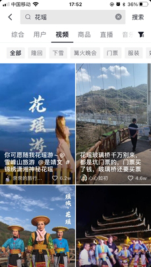
Researchers entered the Huayao region, and by examining local social media usage, selected the “Douyin” platform as the research target. This research draws upon the thematic analysis of 120 Huayao short videos and interviews with 5 local people who use Douyin. By searching keywords such as “Huayao” and “Yao” on Douyin, we collected the top 100 short videos in terms of the number of plays and likes as of January 15, 2023 (see Figure 2). Meanwhile, according to the relevant content recommendations, some videos did not mention “Huayao”, but some content such as “Huayao cross-stitch” also belongs to Huayao culture, which is also collected. The short video ten- ded to be accompanied by text-based titles and videos, these text and short videos are imported for thematic analysis. A purposive sample of interview participants was selected by identifying local people who regularly post (more than once a week).
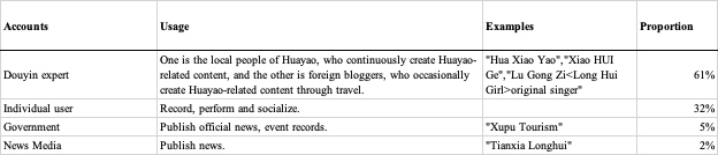
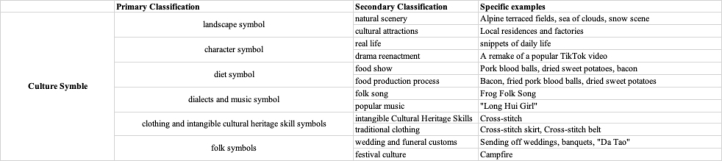
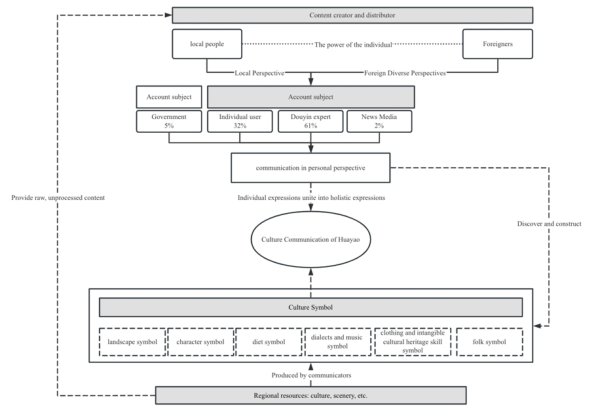
Giving full play to the advantages of participatory video, Huayao short videos show the power as a wildly growing rural system that can counteract the description of the other, and establish a cultural communication system written by the rural people themselves. In the new era of communication, short videos have given individuals the opportunity to participate in writing about local culture, and the effectiveness of individual communication has become a force to be reckoned with in developing the intangible assets of the region (Tan and Liu 2019). There are different account categories in Jitterbug that carry different descriptions of Huayao culture (see Figure 3). Specialists in tourism and food, local villagers and media workers have expressed the Huayao culture under their own vision. In the process of active creation by different accounts, various cultural symbols of Huayao are perceived by vie- wers (see Figure 4), and gradually integrated to produce an overall regional cultural image.
Through the previous study, a participatory cultural communication path has been established through the Huayao short video published by local people (see Figure 5).
Figure 2: The interface of “Huayao” videos sorted by the number of likes.
Social Media in Rural Life: Design Innovation 749
Figure 3: Douyin accounts in top 120 Huayao short videos.Figure 4: Symbols of Huayao culture in short videos.Figure 5: Path of participatory culture communication of Huayao.
DEFECTS IN THE HUAYAO COMMUNICATION ON SOCIAL MEDIA First, attention is a scarce resource in the Internet era, and an interesting and appealing topic can bring more powerful communication effects. Nowadays, the principle of “content first” will probably be taken as a guideline again when rural people’s access to media is no longer a problem (Chang and Chang 2020). Based on the textual analysis of trending videos, we sum- marized the feature word list. After filtering out meaningless words such as “everyone”, 25 content-related terms were filtered out, such as “aerial photography”, “terraces”, “ethnic “, “cross-stitch”, “bonfire”, etc. Through content analysis, we found that the content of current Huayao short videos
750 Pan and Liu
basically revolves around local customs, scenery and activities. The unique rural culture and scenery are a treasure trove of resources for Huayao, but it also limits the breadth of content to a certain degree. Without a continu- ous infusion of fresh content and topics, the continuous performance of the original resources is not sustainable.
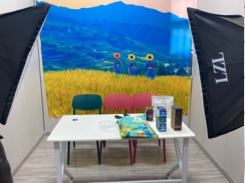
Second, the proportion of creative users is imbalanced. Professional self- publishing media, such as Douyin master, occupies more than half of the content creation; individual creators’ content is mostly casual records of daily life. Although the village has set up a professional live broadcast room and video shooting scene (see Figure 6), but due to the non-confidence of villagers in professional skills, it has not been officially put into use.
Figure 6: Broadcast room in Huayao.
Lastly, the visual elements lack a holistic regional character.Rural users not only dispatch images, animation effects, emoticons, stylized captions, text and other media, but also focus on the expression of “body narratives”, such as distinctive self-decorative elements, and strive for vividness, realism and scenarios (Liu and Zhou 2019). Through textual analysis, the most frequen- tly used adjectives in Huayao-related videos are “mysterious” and “ancient”, while those related to visual elements are “colorful”, “bright” and “exqui- site”. “bright”, “exquisite”, and so on, all of which demonstrate the style of the cultural resources of the Huayao region that have been inherited to this day. Although the content creators are using the same culture and photogra- phing the same Huayao scenery, there is no unified tone and symbol that can clearly distinguish Huayao. In the absence of commonality, it is difficult to spread the image of the region to the people.
In general, it seems that the local culture communication of Huayao still has much room for upward mobility on the short video platform. How to improve the communication content, promote different creative subjects, and shape an accurate rural image becomes the next direction of effort for design innovation.
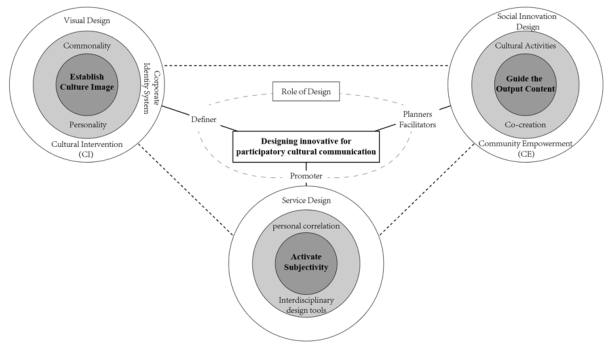
EXPLORING DESIGN INNOVATION STRATEGIES Design innovation should revolve around three dimensions of image establi- shment, content guidance and subjective motivation, follow the basic logic of rural culture communication in social media, and effectively promote the rise of rural culture communication with the combination of various design methods (see figure 7).
Social Media in Rural Life: Design Innovation 751
Figure 7: Design innovation for participatory cultural communication in three dimensions.
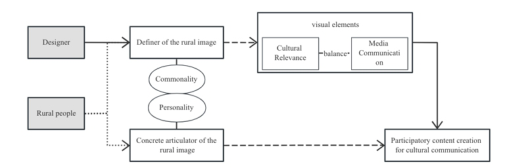
First, the establishment of a regional image is carried out so that regio- nal commonality and individuality can coexist. In the digital media stage, the designer needs to be the definer of the rural image; the villager beco- mes the concrete articulator of the rural image by creating content related to the rural image. Design innovation at this stage is still basically subordi- nated to the cultural intervention (CI) model, where external experts make decisions and deliver outputs. The designers have already explored the local cultural resources of the Huayao villages and formed the accumulation of ori- ginal materials for design innovation. In the extraction of the cultural genes of Huayao cross-stitch, designers organize the collected cross-stitch cultural materials and use the hierarchical analysis method to interpret the design information (Liu and Luo 2017). To establish visual identity genealogy and cultural identity genealogy, designers use geometric, abstract and deconstru- ctive methods to extract gene reconstruction (Lu 2021). However, neither the original materials of local cultural resources excavated, such as texts, pictures and images of rural texture, landscape, beliefs, folk culture and traditional skills; nor the symbols of cultural elements refined by analyzing and filtering the original materials, have been applied in the short video of Huayao. In order to utilize the elements provided by cultural resources in social media, the need for both commonality and personality should be met (see Figure 8).
Figure 8: Visual elements’ role in participatory communication.
752 Pan and Liu
The commonality refers to the commonality of the cultural image of the region to the outside world, which means the design should do proper visual definition at first. The visual symbols should be balanced both social media communication and cultural relevance, so as to lay a good visual founda- tion for the precise establishment of the image of rural areas. Visual-oriented design is a relatively basic direction in the design discipline, and numerous predecessors have already explored similar rural interventions, such as intro- ducing CIS (Corporate Identity System) theory into regional image design, or creating IP. Designers as definers should make full use of local resources and basic knowledge of design disciplines as well as creativity to precisely define the image of the rural areas and provide reusable visual materials for communication. Personality means preserving the possibility of users’ par- ticipatory creation, and giving users the opportunity to extend and change the elements to facilitate their creation. Avoid unchangeable elements limi- ting rural people’s willingness to use them. This means that the designers should first make full use of the existing cultural collation, and on this basis, establish a set of local cultural visual identities applicable to social media communication for the rural people. Then the right to apply and develop this set of identification resources is given to the rural people, who apply the visual elements in social media communication, so as to build and spread the local cultural brand image, and enhance the cultural identity. The two most played videos is about Huayao wedding ceremony events and rituals. Such large events require a large number of participants from the rural people and are not common in daily life.
Second, design innovation could guide the output content of village people through cultural activities. The content created by villagers on social media is an important carrier of cultural participatory communication, through which the image of the village is presented and spread. Outstanding content can quickly capture viewers’ attention and even bring unique viewing experie- nces. Designers need to explore possibilities for social innovation that can improve the content and enrich the topics.With this aim, design innovation can utilize the Community Empowerment (CE) mode: a more diverse, but largely event-driven process rooted in short-term events such as festivals. In order to guide villagers to produce content, design needs to act as a facili- tator and planner, planning cultural events to achieve inclusive co-creation. The event should be based on the characteristics of the rural areas, reflecting the historical traditions and regional characteristics. This process provides a semi-proposed theme for the villagers to participate in, and the co-creation under the community will form a common output. And these are the very elements that are difficult to record on a daily routine from an individual perspective. It has been noted that participatory theatre lowers the bar for mass participation, and has a clear, public output after co-creation, which sustains public motivation for engagement(Wang, Bryan-Kinns et al. 2016). Through interdisciplinary engagement, design acts as a planner and facilita- tor to bring participatory cultural activities to rural people, guiding them to collectively create and disseminate content as a community.
Finally, it is necessary to activate subjectivity, and use “personal corre- lation” to promote creativity. Villagers are the internal subjects of rural
Social Media in Rural Life: Design Innovation 753
revitalization, and the external power can function more sustainably only through the reception and amplification of internal subjects. At this stage, design needs to act as a facilitator to stimulate the subjectivity of rural peo- ple. In the study of rural image communication, Taiping Xie proposed the “personal correlation” of images. From the experience and data of field com- munication, “personal correlation”is the condition and driving force of rural image communication, and the creation and communication of rural images occur because of their relevance to rural people (Xie 2017). Under social media, personal correlation has a richer connotation, which no longer refers to the content of the image only, but includes the content of the image and the whole producing process of the content. Designers need to use interdisci- plinary design tools to help villagers meet their correlation throughout the creation process. Service design tools and methods such as guided brainstor- ming, mind mapping, and experience maps can be used to gain a deeper understanding of the villagers’ complete creation process and to consider how to enhance psychological proximity and improve their self-image satisfaction.
CONCLUSION
In the digital age, social media in rural areas have begun to take on the important role of cultural communication, and villagers’ spontaneous and participatory communication has become an important force that cannot be ignored in building the cultural image of a region. China’s rural areas have taken a different revitalization path from other countries due to the Inter- net, which is both an opportunity and a challenge for design. As a tool for rural construction, there is a lack of research on participatory cultural com- munication in digital media. Through design innovation, we can improve the content presentation and communication effect of rural participatory cultu- ral communication, so that rural culture can go out through social media communication, and enhance the scope and effect of communication. It is still a challenging topic to continue the practice of design innovation in rural participatory communication in the future.
REFERENCES
Chang, M. and Y. Chang (2020). “The path of rural self-media communication from the perspective of rural revitalization.” Youth Journalist (02): 37–38. Chen, Y. (2017). “Differential Spread and Reconstruction of Rural Cultural Changes
under the Dual Structure.” Journalism and Mass Communication Monthly (09): 44–48. Duan, P. (2021). “The Gradual Disappearing of the Divide: Farmer Participation and Rural Revitalization in the Perspective of the Development Communication- Short Videos of Agriculture, Rural Areas and Farmers as a “New Farming Tool”.” Contemporary Cinema (07): 134–139. Han, H. (2009). “The Enlightenment of Participatory Communication to the Deve-
lopment of Chinese Rural Broadcasting.” Contemporary Communications (02): 93–95. Han, H. (2010). “Participatory Communication Paradigim Shift of Development Communication and its Chines Values.” Journalism & Communication 17(01): 40–49+110.
754 Pan and Liu
Liu, N. and X. Zhou (2019). “Self, Alienation, and Actor-Network: The Cultural Subjectivity of Self-media Visual Production.” Modern Communication (Journal of Communication University of China) 41(07): 105–111. Liu, Z. and P. Luo (2017). “Extraction and Design Application of Huayao Cross-
stitch Culture Genes.” Design (19): 95–97. Lu, Y. (2021). “Construction and Design Application of Gene Pedigree of Huayao Cross-stitch Art in Xiangxi.” West Leather 43(07): 59–62. Sha, Y. and S. Zhang (2019). “Media and rural cultural life in the perspective of
publicness.” News and Writing (09): 21–25. Tan, Y. and H. Liu (2019). “The construction of a city’s image through a personal perspective of short video puzzle-like communication.” Contemporary Communications (01): 96–99. Wang, D. and K. Li (2020). “Winning the fight against poverty- Cultural commu-
nication in the countryside empowered by short videos.” Chinese Editorials (08): 9–14. Wang, W., N. Bryan-Kinns and T. Ji (2016). “Using community engagement to drive co-creation in rural China.” International Journal of Design. Xie, T. (2017). “Extraction and Design Application of Huayao Cross-stitch Culture
Genes.” Journal of Swupl 19(05): 120–127. Yang, H. and J. Lei (2018). “The usage of “Kuaishou” and the transmission of folk culture in the countryside.” Global Journal of Media Studies 5(04): 140–148. Yu, X. (2016). “Exploring the communication and marketing model of short videos
in the mobile social era.” View on Publishing (24): 57–59. Zhang, E., K. Xu, Y. Cai, J. Liu, Q. Wan, Z. Zhan, L. Gao, Y. He and C. Wang (2022).
“Digital Economy and China’s High-Quality Development.” Yuejiang Academic Journal 14(05): 80–104. Zheng, X. and Z. Ren (2022). “How Rural Live Streaming Can Empower Rural Revitalization.” RADIO&TV JOURNAL (01): 140–142. Zheng, Z. (2022). “The Integration of interpersonal Communication and Mass
Communication: Robert E. Park’s Symbolic Interactionism.” Journalism & Com- munication 29(05): 24–42+126.
LISTED IN THE AHFE DIGITAL BOOKSTORE CATALOGUE
Explore the complete digital volume
Ergonomics In Design
Read this individual research paper free through the original publisher, or explore the full digital proceedings book.
ISBN 978-1-958651-53-7
Explore this ISBN in the AHFE Bookstore ↗Listed in the July 2026 bookstore catalogue; search by ISBN to confirm current availability · Digital book purchase optional