Anzara Ausaf, Kazi Ruslan Rahman, Sanchita Ghose (2026). Understanding Individual Differences in Adolescents’ Emotional Responses to Social Media Through Human-Centered Causal and Dynamic Modeling. In: Artificial Intelligence and Social Computing. AHFE Open Access, vol. 203, pp. 109–118. https://doi.org/10.54941/ahfe1007323
Social media platforms shape adolescents’ daily social experiences by making peer feedback, visibility and social comparison highly salient. Yet research on social media and adolescent well-being remains inconsistent, partly because many studies rely on broad between-person measures that obscure within-person dynamics and developmental differences. This paper proposes a human-centered computational framework using Ecological Momentary Assessment (EMA) to examine how adolescents’ emotional responses to online validation vary within individuals and across developmental stages. Focusing on early adolescents (ages 13–15) and later adolescents (ages 16–20), the framework analyzes longitudinal EMA data on online validation events, emotional state and contextual factors using a three-part modeling pipeline: (1) multilevel within-person models to estimate immediate changes relative to individual baselines, (2) Dynamic Structural Equation Modeling (DSEM) to capture temporal dependencies and carryover effects across prompts and (3) causal forest modeling to estimate heterogeneous effects and identify profiles of sensitivity to validation. As an initial methodological step, the framework is validated using a synthetic dataset designed to reflect realistic EMA-style patterns of behavior, missingness and emotional dynamics before real-world deployment. The proposed pipeline provides a reusable and developmentally sensitive approach for studying adolescent digital well-being with greater precision than coarse between-person measures of social media use.
Social media is a central part of adolescents’ daily social environments, shaping how peer feedback, visibility and social comparison influence emotional experience. Likes, comments, replies and other visible signals can function as immediate indicators of social standing and peer approval, making online feedback emotionally meaningful during a developmental period already Received March 21, 2026; Revised May 3, 2026; Accepted May 18, 2026; Available online July 20, 2026
marked by heightened sensitivity to evaluation and belonging. At the same time, findings on social media and adolescent well-being remain mixed: some studies report associations with anxiety, loneliness and lower self-esteem, whereas others find small or context-dependent effects (Keles et al., 2020; Valkenburg and Peter, 2013; Odgers and Jensen, 2020). A major reason for this inconsistency is that many studies rely on broad between-person measures, such as total time spent online, that are too coarse to capture the specific mechanisms adolescents actually experience.
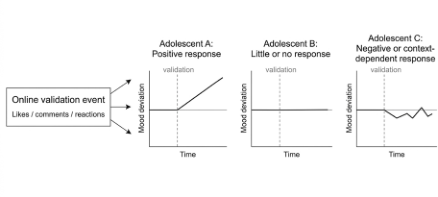
This paper focuses on online validation, defined as visible and socially meaningful feedback received through likes, comments, reactions and related signals. Questions about whether adolescents who use more social media are worse off are conceptually different from questions about whether a given adolescent feels better or worse than usual after receiving online feedback. Intensive longitudinal work increasingly suggests that average effects can mask substantial heterogeneity: some adolescents show little change, some respond positively and others respond negatively depending on context, prior emotional state and individual susceptibility (Beyens et al., 2020). For this reason, approaches that separate within-person change from stable between-person differences are essential.
Ecological Momentary Assessment (EMA) provides a strong basis for studying these processes because it captures repeated in-the-moment assessments of emotional states, online experiences and context in daily life (Shiffman et al., 2008). When combined with intensive longitudinal modeling, EMA enables analysis of immediate emotional changes following validation events, temporal carryover effects across prompts and heterogeneity across adolescents. These advantages are especially relevant for youth research, where online experiences may be brief, context-dependent and difficult to reconstruct accurately through retrospective reports.
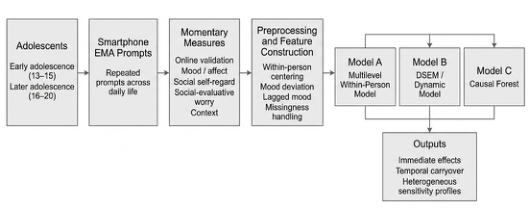
In response, this paper proposes a human-centered computational framework for studying adolescents’ emotional responses to online validation using EMA-style data. The framework compares two developmental groups, ages 13–15 and 16–20, and addresses three linked questions: what immediate within-person emotional changes follow validation events, what temporal dynamics emerge across repeated observations and for whom such effects are stronger or weaker. To answer these questions, the framework combines a multilevel within-person model, a Dynamic Structural Equation Modeling (DSEM) component and a causal forest model. Before real- world deployment, the full pipeline is evaluated using synthetic EMA-style data designed to reflect realistic baseline differences, temporal dependence, missingness and heterogeneity.
The main contributions are fourfold. First, the framework centers within- person emotional change rather than broad between-person contrasts. Second, it integrates EMA principles with computational modeling in a developmentally sensitive design. Third, it combines multilevel modeling, DSEM and causal forest estimation to study immediate associations, temporal carryover and heterogeneity within one pipeline. Fourth, it validates that pipeline on synthetic EMA-style data before real-world deployment.
Figure 1: Human-centered EMA modeling pipeline for adolescent online validation.
BACKGROUND AND RELATED WORK Social Media, Online Validation, and Adolescent Well-Being
Research on social media and adolescent well-being has produced mixed findings, with reported effects varying by platform use, context and measurement strategy (Keles et al., 2020; Valkenburg and Peter, 2013; Agyapong-Opoku et al., 2025, 2024). One recurring limitation is the use of broad exposure indicators such as time spent online, which often fail to capture the psychologically meaningful features of adolescents’ experiences. A more specific mechanism is online validation: the visible social feedback adolescents receive through likes, comments, reactions and replies. Prior work suggests that such feedback can be linked to social self-esteem, although these relationships may weaken after accounting for stable baseline differences (Valkenburg et al., 2017). Related work on passive versus active use similarly suggests that emotional outcomes depend less on overall exposure than on the quality and interpretation of interaction (Verduyn et al., 2015).
The Differential Susceptibility to Media Effects Model (DSMM) is particularly relevant here because it emphasizes that media effects depend on dispositional, developmental and social susceptibility factors (Valkenburg and Peter, 2013). In the present context, that perspective implies that the same validation event may have different consequences for early and later adolescents, making developmental stage more than a simple control variable.
Ecological Momentary Assessment EMA is well suited to studying adolescents’ digital experiences because it captures repeated reports of emotions, behaviors and context as they occur in daily life (Shiffman et al., 2008). Compared with retrospective surveys, EMA reduces recall bias and supports analysis of short-term fluctuations in mood and experience. In adolescent digital media research, this is especially important because online interactions are often brief, variable and socially contextual. EMA-based studies have shown its usefulness for examining adolescents’ online interactions, social connectedness and related microprocesses across the day (Armstrong-Carter et al., 2023; Schneider et al., 2017).
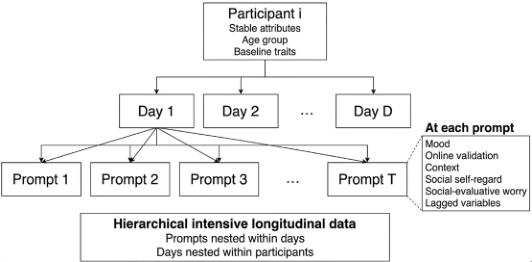
Figure 2: Structure of EMA observations in the proposed study.
Individual Differences and Dynamic Modeling A growing literature suggests that social media effects are highly heterogeneous. For example, Beyens et al. (2020) found that passive social media use was associated with lower well-being for some adolescents, little or no change for many others and positive effects for a smaller subset. Developmental differences are also relevant, as early adolescence is often marked by heightened sensitivity to peer evaluation, whereas later adolescence may involve greater emotional regulation and cognitive maturity (Steinberg and Morris, 2001).
These findings motivate within-person and dynamic approaches that distinguish short-term change from stable trait-like differences. Intensive longitudinal data also require models that account for temporal dependence across prompts. In this paper, those needs are addressed through a combined framework consisting of within-person multilevel modeling, DSEM-style temporal modeling and causal forest estimation for heterogeneity.
METHODS
Overview The planned study collects intensive longitudinal self-report data via smartphone EMA from adolescents in two developmental groups (13–15 and 16–20). The primary exposure is online validation, such as likes, comments or reactions received since the previous prompt and the subjective meaning of that feedback. The primary outcomes are momentary emotional well-being and social self-related states, such as social self-esteem, social acceptance and social-evaluative worry, measured repeatedly across daily life.
Study Design and Sampling EMA prompts are delivered multiple times per day for a short burst period, such as one to two weeks, to capture within-day and day-to-day fluctuations. Prompt scheduling should prioritize feasibility and compliance in youth, since
Understanding Individual Differences in Adolescents’ Emotional Responses 113 compliance tends to be higher at lower daily prompt counts and declines as frequency increases (Schneider et al., 2017). Recruitment can occur through schools, community organizations and online outreach, with attention to demographic diversity and representation across the two age groups.
Data Structure and Measures The EMA design produces a hierarchical dataset consisting of repeated prompt-level observations nested within days and participants. Each prompt includes momentary emotional state, recent social media experiences and contextual factors. Participant-level variables include stable attributes such as age group, while prompt-level variables capture mood, validation events and situational context.
The EMA instrument should include recent social media behaviors (e.g., passive scrolling versus active posting or messaging), validation events, subjective interpretation of feedback, emotional state and relevant context such as social setting, stressors and offline interactions. This emphasis on mechanisms addresses concerns that coarse self-reports of amount of use do not always align well with psychologically meaningful experiences or objective measures (Verbeij et al., 2022).
Ethics, Missingness and Feature Construction Research with minors requires clear consent and assent procedures, strong data protection and procedures for responding to elevated distress or risk disclosures. The synthetic validation step supports privacy-preserving method development before real deployment.
EMA data also require careful time alignment because of irregular intervals and variable response delays. Missingness is expected and should be examined descriptively, with handling strategies such as Bayesian estimation in DSEM, multiple imputation where suitable and sensitivity checks (Schneider et al., 2017). Within-person centering of key variables is used to distinguish deviations from a participant’s own typical level from stable between-person differences.
Derived features include baseline mood, defined as each participant’s mean mood across prompts; mood deviation, defined relative to that baseline; and lagged mood, denoted mood lag1. Observations with missing lagged values, such as the first prompt for each participant, are excluded from models requiring temporal structure. All analyses are implemented through a reproducible workflow covering synthetic data generation, preprocessing, modeling and visualization.
The framework consists of three complementary models applied to the same EMA dataset. Model A estimates the average within-person association between validation and emotional outcomes. Model B captures temporal
dynamics across prompts. Model C estimates heterogeneous treatment effects across adolescents and contexts. Together, they separate average effects, temporal processes and individual heterogeneity.
Within-Person Statistical Model (Model A) The first layer estimates immediate associations between validation and outcomes within individuals using multilevel models with person-specific intercepts and, where needed, slopes. Developmental stage is included as a moderator to test whether average within-person sensitivity differs between the two age groups. The model can be expressed as
Equation reproduced from the original PDF.
where ui represents participant-level random intercepts capturing stable individual differences in baseline mood.
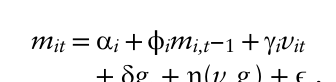
Temporal model (Model B: DSEM / Multilevel VAR) The second layer models dynamics across prompts. DSEM combines time- series and structural equation modeling for intensive longitudinal data and is well suited to repeated measures collected many times per person. In this study, it is used to estimate autoregressive effects, cross-lagged relationships and individual differences in those parameters. A representative dynamic specification is
Equation reproduced from the original PDF.
where mit denotes mood for participant i at time t, vit denotes online validation and gi denotes developmental group. Here, ϕi captures subject- specific autoregressive persistence and γi captures subject-specific sensitivity to online validation.
Heterogeneous Effect Model (Model C: Causal Forest) The third layer targets heterogeneity more flexibly. Causal forests extend random forests to estimate conditional average treatment effects under a potential outcomes framework with ignorability assumptions (Wager and Athey, 2018). For continuous treatment, an implementation such as grf or related causal machine-learning frameworks can estimate
( ) [ | , ] x Y T X
E (3)
T
where the treatment is the amount of online validation received since the previous prompt. The goal is to estimate how the marginal effect of validation on mood deviation varies across observed covariates such as developmental group, baseline social-evaluative worry, typical social media patterns, time of day and offline context.
Table 1: Summary of the modeling pipeline.
Table available in the original PDF paper.
Model Analytical Goal Outcome Key Predictors Main Contribution Model A: Multilevel Regression
mood online validation, age group, interaction
Quantifies the short-term relationship between validation and mood while accounting for repeated observations within participants
Estimate the average within-person association between online validation and emotional state Model B: Dynamic Model mood mood lag1, online validation, age group, interaction Model temporal dynamics and carryover effects across prompts
Captures autoregressive mood dynamics and tests whether validation predicts subsequent emotional change over time
mood deviation
Model C: Causal Forest
Estimate heterogeneous effects of online validation
Treatment: online validation; controls include mood lag1 and social covariates
Identifies whether the emotional effect of validation differs across developmental groups and contexts
Identification Assumptions and Sensitivity Because EMA data are observational, causal interpretation depends on assumptions. The framework reduces confounding risk by controlling for prior outcomes, time-varying context and stable individual differences, but it cannot guarantee the absence of unmeasured confounding (Keles et al., 2020; Odgers and Jensen, 2020). Accordingly, causal outputs are treated as estimates under assumptions, with sensitivity checks based on alternative lag structures, robustness analyses and related diagnostics.
Computational Implementation The modeling pipeline is implemented in Python using a modular analysis workflow. Multilevel regression models are estimated using statsmodels, Bayesian dynamic models are implemented using PyMC and heterogeneous treatment effects are estimated using EconML’s CausalForestDML. Diagnostics include convergence checks for Bayesian sampling, inspection of mixed-model residuals and stability analysis for causal forest treatment effect estimates.
SYNTHETIC VALIDATION AND ANALYSIS PLAN Rationale
Before deploying the protocol in real participants, the pipeline is validated on a synthetic EMA dataset designed to mimic realistic properties such as intra- individual baseline differences, temporal autocorrelation in affect, stochastic validation events and missingness patterns. This supports end-to-end testing
of the workflow and enables parameter-recovery-style evaluation under known generative conditions.
Figure 3: Illustration of heterogeneous emotional responses to online validation.
Generative Structure The synthetic data generator encodes three components. First, person- level traits such as baseline affect, baseline social self-esteem, typical social media engagement and trait social-evaluative worry create stable between- person differences. Second, within-person dynamics include autoregressive affect processes, context-driven shifts and validation-triggered deviations. Third, heterogeneity mechanisms allow the effect of validation to vary by person and developmental group, consistent with the DSMM emphasis on developmental susceptibility.
Evaluation Goals and Reporting Validation focuses on whether the pipeline can recover average within-person effects, temporal carryover effects and known heterogeneity patterns. DSEM is evaluated on recovery of autoregressive and cross-lagged parameters, whereas causal forests are evaluated on their ability to identify higher- and lower-sensitivity subgroups and produce stable estimates under resampling (Wager and Athey, 2018). Results are reported through descriptive summaries of the synthetic dataset, parameter recovery plots and tables for Models A and B and heterogeneity diagnostics for Model C, including the distribution of estimated τ (x) and comparisons between true and estimated subgroup patterns.
DISCUSSION
This framework shifts attention from broad questions of how much adolescents use social media to the more specific process of online validation. That shift matters because the literature suggests that coarse measures of exposure often yield weak or inconsistent associations with well-being (Keles et al., 2020; Valkenburg and Peter, 2013; Odgers and Jensen, 2020). By centering visible peer feedback and modeling emotional changes relative to individual baselines, the present approach targets a mechanism that is more psychologically specific and more consistent with developmental theory.
Understanding Individual Differences in Adolescents’ Emotional Responses 117 Methodologically, the framework combines three complementary perspectives. Multilevel within-person modeling estimates immediate emotional change, DSEM captures temporal carryover and recovery processes and causal forests estimate heterogeneity across adolescents and contexts. Together, these components support a more developmentally sensitive account of digital well-being than models that assume a uniform effect of social media across all adolescents.
Several limitations remain. First, the framework relies on observational EMA data, so causal claims remain conditional on modeling assumptions and the adequacy of measured covariates (Keles et al., 2020; Odgers and Jensen, 2020). Second, youth EMA studies can suffer from incomplete compliance, making prompt burden and missingness handling important design considerations (Schneider et al., 2017). Third, online validation is only partially captured by counts of likes or comments; its emotional significance also depends on source, content and subjective interpretation (Verbeij et al., 2022). Future real-world applications should therefore combine event-based indicators with adolescents’ own appraisals of feedback.
Despite these limitations, the framework offers a reusable pipeline for identifying when and for whom online feedback is most emotionally consequential. If validated on real EMA data, it could support more targeted guidance for adolescents who appear especially reactive to digital feedback and could be adapted to related mechanisms such as social comparison or exclusion.
CONCLUSION
This paper presents a human-centered, developmentally stratified computational framework for understanding adolescents’ emotional responses to social media feedback. Rather than correlating overall screen time with well-being, the proposed EMA-based pipeline focuses on within- person mood change following online validation. By integrating multilevel modeling, DSEM and causal-forest-based heterogeneity estimation, the framework aims to provide a more precise account of how online feedback shapes momentary well-being in early and later adolescence. The current validation is based on synthetic data; future work will apply and refine the framework using real EMA data collection.
ACKNOWLEDGMENT
The authors would like to acknowledge San Francisco State University for supporting this interdisciplinary work at the intersection of computing, mathematics and engineering.
REFERENCES
Agyapong-Opoku, F., Grealish, X. and Greenshaw, A. J. (2024), ‘Social media use and its impact on adolescent mental health: a systematic review’, Current Treatment Options in Pediatrics, in press.
Agyapong-Opoku, N. et al. (2025), ‘Effects of social media use on youth and adolescent mental health: a scoping review of reviews’, Behavioral Sciences, 15, Art. 574. Armstrong-Carter, E. et al. (2023), ‘Momentary links between adolescents’ social
media use and social experiences and motivations: individual differences by peer susceptibility’, Developmental Psychology, 59(4), 707–719. Beyens, I. et al. (2020), ‘The effect of social media on well-being differs from adolescent to adolescent’, Scientific Reports, 10, Art. 10763. Keles, B., McCrae, N. and Grealish, A. (2020), ‘A systematic review: the influence
of social media on depression, anxiety and psychological distress in adolescents’, International Journal of Adolescent Medicine and Health, 32(1). Odgers, C. L. and Jensen, M. R. (2020), ‘Annual research review: adolescent mental health in the digital age: facts, fears, and future directions’, Journal of Child Psychology and Psychiatry, 61(3), 336–348. Rideout, E. A. and Robb, L. F. (2018), Social Media, Social Life: Teens Reveal Their
Experiences, Common Sense Media. Schneider, C. et al. (2017), ‘Compliance with mobile ecological momentary assessment protocols in children and adolescents: a systematic review and meta- analysis’, Journal of Medical Internet Research, 19(4), e132. Shiffman, A., Stone, S. and Hufford, M. (2008), ‘Ecological momentary assessment’,
Annual Review of Clinical Psychology, 4, 1–32. Steinberg, L. and Morris, A. S. (2001), ‘Adolescent development’, Annual Review of Psychology, 52, 83–110. Valkenburg, P. M. and Peter, J. (2013), ‘Differential susceptibility to media effects:
understanding social media’, Journal of Communication, 63(2), 221–243. Valkenburg, P. M., Koutamanis, M. and Vossen, H. G. (2017), ‘The concurrent and longitudinal relationships between adolescents’ use of social network sites and their social self-esteem’, Computers in Human Behavior, 76, 35–41. Verbeij, T. et al. (2022), ‘Experience sampling self-reports of social media use
have comparable predictive validity to digital trace measures’, Scientific Reports, 12, 7611. Verduyn, P. et al. (2015), ‘Passive Facebook usage undermines affective well-being: experimental and longitudinal evidence’, Journal of Experimental Psychology: General, 144(2), 480–488. Wager, S. and Athey, S. (2018), ‘Estimation and inference of heterogeneous treatment
effects using random forests’, Journal of the American Statistical Association, 113(523), 1228–1242.
LISTED IN THE AHFE DIGITAL BOOKSTORE CATALOGUE
Explore the complete digital volume
Artificial Intelligence and Social Computing
Read this individual research paper free through the original publisher, or explore the full digital proceedings book.
ISBN 978-1-964867-79-3
Explore this ISBN in the AHFE Bookstore ↗Listed in the July 2026 bookstore catalogue; search by ISBN to confirm current availability · Digital book purchase optional