Luyu Song, Yiwei Zhao, Tianmei Zhang (2026). Bridging the Proprioceptive Gap: Ergonomic Development and Evaluation of a Task-Specific Controller for Adolescent First-Aid Serious Games. In: Human Factors and Ergonomics In Design. AHFE Open Access, vol. 210, pp. 266–276. https://doi.org/10.54941/ahfe1007448
Although digital twins provide high visual immersion in medical education, existing emergency training paradigms suffer from a significant mismatch between sensory input and motor output. First-aid skills rely heavily on proprioception and physical resistance, yet current digital interactions reduce complex biomechanical tasks to symbolic commands, creating a proprioceptive gap and risks of negative muscle memory transfer. This study proposes a human-factors-driven framework to map user perceptions to physical engineering parameters. A survey of 320 adolescents identified perceived control and visual aesthetics as core drivers of embodied cognition. Ergonomic benchmarking established a 12 percent scaling factor based on hand data differences between adolescents and adults. Morphological evolution using industrial clay determined an optimal 22.5 degree tilt angle for the operation panel to ensure an anatomical neutral position. A high-fidelity prototype was developed featuring anthropometric alignment, a modular magnetic system, and nonlinear variable stiffness feedback that simulates realistic resistance from soft tissue to bone. A within-subject experiment with 20 adolescents showed that the specialized device significantly outperformed general-purpose tools with p < 0.001. The mean System Usability Scale score increased from 61.75 to 85.25, while the Borg RPE fatigue rating decreased from 15.35 to 10.75. These results confirm that the design significantly enhances embodied cognition. This research provides an innovative tool for first-aid training and establishes a quantifiable paradigm for developing specialized interaction equipment for safety-critical tasks.
The Embodied Deficit in Motor Skill Acquisition While digital twins and serious games offer high visual immersion in medical education, current emergency training paradigms suffer from a significant mismatch between sensory input and motor output (Boada et al., 2020; Farsi et al., 2021). First-aid skills, such as cardiopulmonary resuscitation (CPR) and hemostatic bandaging, require motor skill acquisition that relies on physical resistance and proprioception (Michael & Chen, 2005; Sigrist et al., 2013).
Bridging the Proprioceptive Gap: Ergonomic Development and Evaluation 267 Current interactions in serious games, such as mobile swiping or keyboard clicking, reduce complex biomechanical tasks to abstract symbolic commands. According to embodied cognition theory, cognition forms through real- time interaction between the body and the physical environment (Shapiro, 2019). However, digital interactions disrupt this feedback loop, leading to a gap between knowledge and action. Without authentic tactile resistance and dynamic force feedback, adolescents cannot establish correct neural mappings. This deficiency leads to secondary injuries in real-world, high- pressure scenarios due to movement inaccuracies and poor force regulation (Chen, 2023; Zaborek & Plechawska-Wójcik, 2020).
Pedagogical Failure: A Paradigm Critique of Interaction Fidelity The digital transformation of first-aid training faces significant interaction distortion. Although commercial controllers like the DualSense or Xbox Elite perform well in entertainment, their logic remains limited to symbolic mapping. This logic conflicts with the continuous biomechanical feedback required for emergency operations. Based on Fitts’s Law, interaction efficiency depends on the semantic alignment between the control medium and task objectives (MacKenzie, 2024; Zhai et al., 1994).
General-purpose devices lack ecological validity during high-sensitivity tasks like simulated CPR or variable stiffness hemostasis. Research shows that fine motor skills require high haptic fidelity rather than simple binary triggers (Sigrist et al., 2013). Because commercial controllers do not provide physical damping equivalent to human skeletal resistance, learners are prone to negative transfer during practice (Coles et al., 2010; Rose et al., 2000). Specifically, proficiency in a virtual environment may lead to incorrect muscle memory that is dangerous in real-world situations. This low hardware fidelity is a bottleneck that prevents serious games from moving beyond visual narrative toward skill enhancement (Boada et al., 2020).
Research Framework: Mapping Perception to Physical Parameters This study proposes a human-factors-driven framework to map adolescent perceptions to engineering parameters, addressing both psychological acceptance and ergonomic adaptation (Kurosu & Hashizume, 2022; Venkatesh & Davis, 2000).
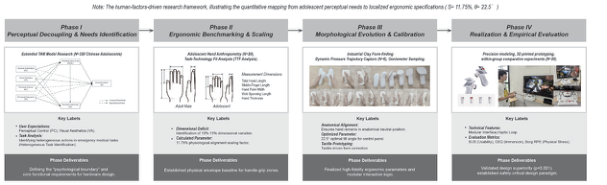
Figure 1: Research framework.
As illustrated in Figure 1, the research follows three phases: (1) Perceptual Deconstruction, using an extended TAM to identify perceived control and aesthetics as design boundaries; (2) Morphological Evolution, converting qualitative needs into physical dimensions through clay-based exploration and anthropometric modeling of handle length and tilt angles; and (3) Validation, where high-fidelity 3D-printed prototypes are evaluated through usability testing to verify gains in movement accuracy and cognitive load reduction.
USER RESEARCH & REQUIREMENTS Ergonomic Benchmarking of Industrial Controllers
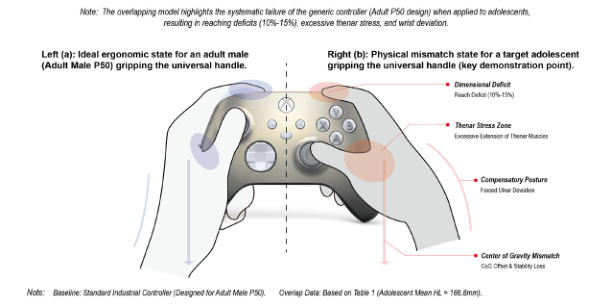
Ergonomic benchmarking against commercial baselines including Xbox Elite and DualSense identified three core conflicts as shown in Figure 2.
Figure 2: Ergonomic benchmarking and mismatch analysis.
First, dimensional incompatibility exists because standard P50 adult designs exceed adolescent hand sizes by 10 to 15 percent, shifting the center of mass backward and causing thenar muscle overextension and fatigue. Second, a sensory mismatch occurs as linear or binary feedback from standard triggers fails to simulate the non-linear resistance (soft tissue to bone) required for tasks like CPR, preventing accurate force threshold judgment. Third, formal rigidity limits multi-task interaction, as fixed controller structures cannot reconfigure to match diverse emergency actions such as single-handed pumping or two- handed compressions. These factors force learners into inappropriate gaming postures, creating a fundamental conflict between interaction logic and life- saving operations.
User Requirements and Design Specifications A TAM survey of 320 adolescents confirmed that Perceived Control and Visual Aesthetics are significant predictors of usage intention (p < 0.001), highlighting requirements for intuitive feedback and aesthetic quality. These findings were translated into three core design specifications. First,
Bridging the Proprioceptive Gap: Ergonomic Development and Evaluation 269 Adolescent Hand-Scaling reduces grip diameter by 10 to 12 percent and recalibrates inclination angles to align the device center of mass with the palm, eliminating size-related fatigue. Second, Task-Oriented Modularity employs a magnetic system to reconfigure hardware morphology for specific tasks, such as flat surfaces for CPR and multi-axis components for bandaging, providing physical cues and reducing cognitive load. Third, Non-linear Force Feedback replaces binary clicking with variable stiffness motors to simulate resistance from soft tissue to bone. This reconstructs haptic channels and establishes authentic motor mappings, preventing negative transfer where virtual practice fails to match real-world mastery.
ERGONOMIC DESIGN PROCESS The development process follows a closed loop based on physiological data, physical iteration, and parameter calibration.
Defining Anthropometric Envelopes and Scaling Factor To resolve size mismatches, hand characteristic points of 20 adolescents (aged 12–18) were measured and compared with adult male P50 data (Pheasant & Haslegrave, 2018),as shown in Table 1. Analysis identified systemic constraints in palm length and grip span.
Table 1: Comparison between adolescent measured data and adult male baseline data (Unit: mm).
Table available in the original PDF paper.
Dimensions AdultMale P50*
Adolescent Mean SD Difference Scaling% Hand Length (HL) 189.00 166.80 6.97 22.20 11.75%
*Baseline data adapted from the Pheasant (2016) Bodyspace standard database.
A scaling factor (S) was introduced based on the ratio between baseline adult palm length (Ladult) and adolescent mean length (Ladolescent):
100% 11.75% adult adolescent L
adult S − = × ≈ L L
To ensure anatomical alignment, grip circumference and functional coverage were reduced by 11.75% (rounded to 12% for engineering). This reduction mitigates passive stress on the thenar muscle and helps users maintain a neutral posture.
Morphological Evolution via Malleable Prototyping Industrial clay was used for form-finding instead of traditional digital modeling. This material allows designers to capture subtle variations in physical affordance during simulations.
1. Experimental Process and Pressure Trajectory Capture
Six adolescent participants performed simulated CPR and hemostatic pumping. They adjusted the operation panel angle on clay models to find the optimal tactile experience. We recorded the dynamic movement arcs and pressure tracks left by their thumbs.
2. Physical Sampling Based on Goniometry
A digital goniometer was used to sample the final panel tilt angles. The six collected angles were 21°, 23°, 22°, 24°, 22.5°, and 23°, with a mean value of 22.58°. For manufacturing standardization, the final design parameter was set at 22.5°.
[Equation or mathematical symbol available in the original paper PDF] x
21 23 22 24 22.5 23 22.58 6 + + + + + = ≈
3. Biomechanical Validation and Empirical Logic
This angle ensures the wrist maintains a dorsal extension neutral position (20°–25°) during high-frequency tasks. This minimizes radial or ulnar deviation, reducing ligament stress and preventing muscle fatigue.
Ergonomic Refinement of Design Features The final design achieves physical adaptation for emergency tasks through three key features:
1. Asymmetric Grip Design
The handle uses an asymmetric geometry to fit the natural curves of the palm. This increases the support area and disperses pressure, ensuring the wrist stays in a neutral position to prevent injury.
2. Button Layout Optimization
Core keys, such as the CPR rhythm button, are placed along the natural swing path of the thumb. Distinct keystroke depths allow users to identify control states through tactile feedback alone, increasing concentration.
3. Magnetic Modular System
A magnetic system allows users to switch components within three seconds to match different tasks (e.g., CPR vs. bandaging). This ensures form matches function, making operations more intuitive and reducing cognitive load.
THE FINAL DESIGN SOLUTION Physical Implementation and Form Factor
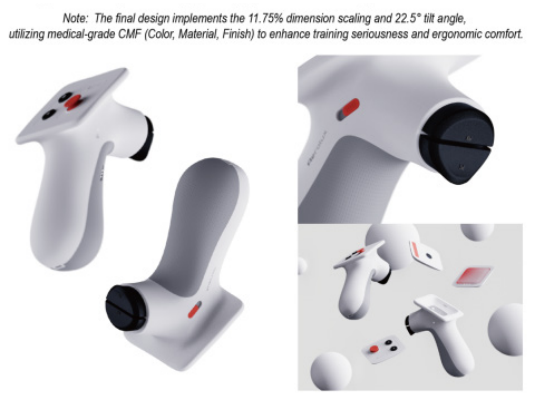
The final physical morphology was developed based on the 11.75% percent reduction and the 22.5 degree panel inclination angle as illustrated in Figure 3.
Figure 3: High-fidelity prototype of the task-specific controller.
The asymmetric ergonomic surfaces employ a variable-curvature design to ensure uniform pressure distribution across the palm at various operational angles. By maximizing the contact area between the hand and the controller, this design eliminates muscle tremors caused by unstable gripping and improves the precision of simulated operations. Regarding color, material, and finish (CMF), the surface uses matte antibacterial materials with a high-contrast medical red and white color scheme. This approach utilizes color semantics to enhance the seriousness and immersion of the training environment, aligning the visual identity of the device with its life-saving purpose.
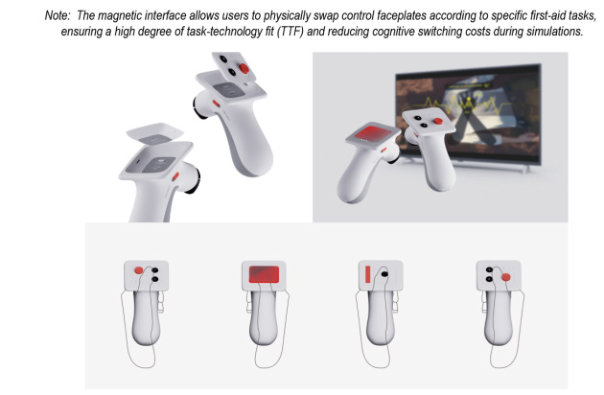
Magnetic Modular Interaction System To adapt a singular hardware platform to heterogeneous tasks, this solution incorporates a physically reconfigurable interface.
Figure 4: Modular interaction system and task-oriented reconfiguration.
The magnetic interface features standardized high-strength magnetic positioning slots within the core operating area of the controller. Users can manually exchange functional panels, such as high-damping compression panels or multi-directional rolling panels, to match specific virtual pedagogical tasks including CPR or hemostasis simulation. This physical component switching reduces cognitive load by providing intuitive scaffolding for adolescent users. Such physical semantic alignment allows participants to confirm the current operational mode through tactile sensation, which removes the need to refer to user interface instructions during high-pressure training.
Proposed Interaction and Haptic Framework While this research focuses on the ergonomic optimization of physical morphology, a rigorous interaction feedback logic was predefined for future hardware development.
The action mapping system uses a concrete trigger logic. In CPR mode, buttons are no longer treated as simple binary switches but are defined as continuous displacement values characterized by virtual stiffness. The theoretical model for force feedback integrates a variable stiffness logic within the interaction protocol. Design specifications require the system to simulate resistance gradient curves ranging from soft tissue resistance to skeletal support based on feedback from the virtual casualty. This design utilizes haptic channels to correct common issues among adolescents, such as excessive compression force or insufficient pressure during emergency maneuvers, ensuring that the skill acquisition process is accurate and safe.
EVALUATION AND USABILITY TESTING This study conducted a controlled comparative experiment to verify the effectiveness of the proposed controller in bridging the proprioceptive gap. The
Bridging the Proprioceptive Gap: Ergonomic Development and Evaluation 273 evaluation examined whether optimizing hardware specifications, including the 12 percent size scaling and 22.5 degree inclination angle, improved operational usability, physiological load, and interaction experience.
Experimental Design and Procedure The experiment used a within-subjects design with 20 adolescent participants aged 12 to 18. The sample maintained a balanced gender ratio. Participants performed CPR compression and hemostasis tasks in a virtual emergency environment using both a baseline general-purpose controller and the proposed task-specific prototype. The order of device usage was randomized to mitigate experimental error.
Evaluation Metrics and Scoring Logic The research employed a multi-dimensional evaluation system with standardized scoring. Hardware usability was assessed via a modified System Usability Scale (SUS) with five positive statements. Raw scores were adjusted by subtracting one from each item and multiplying the sum by five to align with standard SUS norms. This algorithm maps scores onto a normalized interval from 0 to 100 to facilitate grade determination. Interaction experience was measured using the competence and physical immersion dimensions of the Game Experience Questionnaire (GEQ) on a five-point scale. Subjective fatigue was evaluated using the Borg 6-to-20 Rating of Perceived Exertion (RPE) scale.
Quantitative Results Analysis Data were analyzed using paired-samples t-tests in SPSS version 27.0, with results presented in Table 2.
Table 2: Statistical comparison of interaction performance between the proposed and baseline controllers (N=20).
Table available in the original PDF paper.
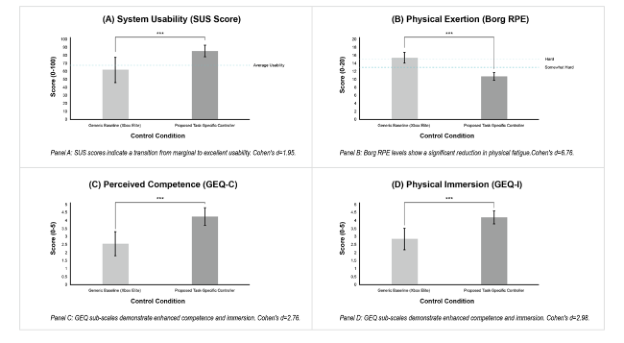
Metrics Baseline Proposed t p Cohen’s d SUS 61.75 (SD 15.75) 85.25 (SD 7.34) −8.728 < .001 1.95
Borg RPE 15.35 (SD 1.35) 10.75 (SD 0.97) 30.228 < .001 6.76 Results indicate that the proposed controller demonstrated significant superiority across all dimensions. The Cohen’s d effect size for Borg RPE reached 6.76, which represents exceptionally high experimental power.
DISCUSSION
The baseline controller received a mean SUS score of 61.75. Based on the criteria from Bangor et al. (2008), this score is marginal and falls below the acceptable threshold of 68. This reflects ergonomic deficiencies of
general-purpose devices for specialized first-aid tasks. In contrast, the proposed controller achieved a mean score of 85.25, which is categorized as excellent. This confirms that the 12 percent size alignment effectively lowered operational barriers for adolescents.
Borg RPE ratings decreased from 15.35 to 10.75, representing a shift from the hard category to the light category. This improvement validates the role of the 22.5 degree tilted panel in maintaining an anatomical neutral wrist position. Correcting the physical form suppresses localized muscle fatigue caused by postural compensation. Furthermore, significant improvements in GEQ dimensions confirm that the modular system successfully reconstructed the physical semantics of the interaction. Participants moved beyond simple button clicking to more stable motor neural mappings through resistance feedback and task guidance provided by the controller.
Figure 5: Comparative analysis of interaction performance between the proposed controller and the generic baseline.
CONCLUSION
This study developed and validated a human-factors-driven interaction system to bridge the gap between virtual instructions and physical operations in adolescent first-aid training. The results confirm the ergonomic superiority of the device and highlight the critical role of interaction hardware in acquiring complex motor skills.
Design Contributions and Specifications The main contribution of this research is a quantifiable paradigm for translating perceptual expectations into physical engineering parameters. By critiquing industry benchmarks and analyzing adolescent anthropometric data, this study established an 11.75 percent scaling factor and an optimal 22.5 degree tilt angle for the 12 to 18 age group. Morphological experiments using industrial clay showed that these parameters maintain the hand in an
Bridging the Proprioceptive Gap: Ergonomic Development and Evaluation 275 anatomical neutral position and reduce the Borg RPE fatigue rating to 10.75. Additionally, the magnetic modular system achieved semantic alignment between actions and functions, which reduced cognitive load during high- pressure simulations.
From Rote Memory to Embodied Learning This research shows that effective first-aid training requires bridging the proprioceptive gap. Experimental results indicate that the specialized controller with variable stiffness feedback outperformed traditional tools in immersion with a mean score of 4.25. This advancement marks a shift in training paradigms from passive memorization to active acquisition through proprioception. This embodied learning model helps adolescents establish correct motor mappings and mitigates the risk of negative transfer caused by the mismatch between virtual practice and real-world mastery.
Limitations and Future Work Although this study progressed in ergonomic development, several limitations exist. First, the sample was restricted to Chinese adolescents. Because anatomical differences in hand development and reach envelopes exist among various ethnic groups, the universality of the 11.75 percent scaling factor needs verification in cross-cultural contexts. Second, the prototype focused on physical morphology and interaction logic. The force feedback system is still transitioning from theoretical models to high-fidelity versions and cannot yet capture real-time electromyography signals during complex operations.
Future research will involve cross-ethnic experiments to establish global guidelines for training hardware. We also plan to integrate sensor arrays and adaptive algorithms to improve the feedback precision of variable stiffness mechanisms. Finally, large-scale clinical testing will be conducted to evaluate the impact of the specialized controller on long-term skill retention.
ACKNOWLEDGMENT
The authors received no financial support for the research, authorship, or publication of this article.
REFERENCES
Boada, I., Benitez, A. R., Thió-Henestrosa, S., & Soler, J. (2020). A serious game on the first-aid procedure in choking scenarios: design and evaluation study. JMIR serious games, 8(3), e16655. Chen, Y. (2023). Interactive Design of Immersive First Aid Skills Teaching Based on
Multimedia Devices. International Conference on Human-Computer Interaction, Coles, T. R., Meglan, D., & John, N. W. (2010). The role of haptics in medical training simulators: A survey of the state of the art. IEEE Transactions on haptics, 4(1), 51–66.
Farsi, Z., Yazdani, M., Butler, S., Nezamzadeh, M., & Mirlashari, J. (2021). Comparative effectiveness of simulation versus serious game for training nursing students in cardiopulmonary resuscitation: a randomized control trial. International Journal of Computer Games Technology, 2021(1), 6695077. Kurosu, M., & Hashizume, A. (2022). Usability and user experience (UX) of human-
automation interaction: concept and measurement method. In Human-Automation Interaction: Manufacturing, Services and User Experience (pp. 311–325). Springer. MacKenzie, I. S. (2024). Human-computer interaction: An empirical research perspective. Michael, D. R., & Chen, S. L. (2005). Serious games: Games that educate, train, and
inform. Muska & Lipman/Premier-Trade. Pheasant, S., & Haslegrave, C. M. (2018). Bodyspace: Anthropometry, ergonomics and the design of work. CRC press. Rose, F. D., Attree, E. A., Brooks, B. M., Parslow, D. M., & Penn, P. R. (2000).
Training in virtual environments: transfer to real world tasks and equivalence to real task training. Ergonomics, 43(4), 494–511. Shapiro, L. (2019). Embodied cognition. Routledge. Sigrist, R., Rauter, G., Riener, R., & Wolf, P. (2013). Augmented visual, auditory, haptic, and multimodal feedback in motor learning: a review. Psychonomic bulletin & review, 20(1), 21–53. Venkatesh, V., & Davis, F. D. (2000). A theoretical extension of the technology acceptance
model: Four longitudinal field studies. Management science, 46(2), 186–204. Zaborek, K., & Plechawska-Wójcik, M. (2020). Analiza możliwości zastosowania gry typu serious game do nauki postępowania podczas udzielania pierwszej pomocy. Journal of Computer Sciences Institute, 14, 65–72. Zhai, S., Buxton, W., & Milgram, P. (1994). The “Silk Cursor” investigating
transparency for 3D target acquisition. Proceedings of the SIGCHI Conference on Human Factors in Computing Systems.
LISTED IN THE AHFE DIGITAL BOOKSTORE CATALOGUE
Explore the complete digital volume
Human Factors and Ergonomics In Design
Read this individual research paper free through the original publisher, or explore the full digital proceedings book.
ISBN 978-1-964867-86-1
Explore this ISBN in the AHFE Bookstore ↗Listed in the July 2026 bookstore catalogue; search by ISBN to confirm current availability · Digital book purchase optional