Yiwei Zhao, Mengshi Yang, Ruchen Hu (2024). My tool my rule:User-Participatory Design of an Angle Grinder. In: Human Factors in Design, Engineering, and Computing. AHFE Open Access, vol. 159, pp. 446–452. https://doi.org/10.54941/ahfe1005610
As a tool primarily designed for grinding, angle grinders are extensively used by workers in processing and maintenance tasks. However, using angle grinders for cutting purposes is not compliant with safety regulations, yet this practice is widespread. This misuse imposes significant wrist strain and safety hazards on workers. Existing tool designs often prioritize technology or market demands, frequently neglecting workers' needs and considerations for ergonomics and user experience.This study conducted multiple rounds of experiments and collaborated with users to advance a design plan for an angle grinder. We interviewed angle grinder users from various professions and observed their work processes, discovering numerous ergonomic issues in the actual use of angle grinders. Based on the forces exerted during operation, we proposed three new gripping methods to make the angle grinder suitable for both cutting and grinding. These methods were tested with users, leading to the creation of more detailed models to refine the mode-switching mechanism. This iterative process incorporated new user feedback into the design and resulted in the production of a prototype. The prototype was provided to 12 users for evaluation, and the scale results showed that the angle grinder designed with user participation significantly enhanced the user experience compared to traditional angle grinders.Based on this case, we developed a user-centric tool design methodology. This method begins with observing and interviewing users to extract their needs, followed by initial modifications to existing tools and seeking user feedback. The next steps involve integrating this feedback into design and structural development, conducting multiple rounds of discussions with users to adjust the design, and finally inviting users to evaluate the design outcome. Implementing this method requires detailed communication, extensive real-world experiments, and rigorous evaluation and collaborative decision-making. This approach finds a balance between practical conditions and users' ideal usage patterns, leading to more ergonomic design results. It enhances the user experience while providing new insights for designers and engineers.This user-centric design methodology emphasizes deep user involvement throughout the design process. By bridging the gap between actual working conditions and users' needs, it offers a new perspective on tool design that prioritizes ergonomics and user satisfaction. This method can lead to innovative solutions that improve the usability and safety of tools, ultimately benefiting both workers and the design community.
The angle grinder is a powerful and versatile handheld tool widely used in construction, metalworking, and manufacturing. The global market for angle grinders was valued at $2.0746 billion in 2019 and is projected to reach $2.5052 billion by 2026, with a compound annual growth rate of 2.7% during the forecast period (Business Research website). The tool operates by driving a rotating grinding disc or wheel through a motor-driven spindle. Its compact and flexible design makes it easy to handle, suitable for tasks such as grinding and polishing. The portability and compact size of angle grinders have made them a staple for professionals and DIY enthusiasts alike.
Angle grinders, primarily designed for grinding, are widely used in processing and maintenance. However, due to its versatility, many workers use angle grinders for both grinding and cutting tasks. Using an angle grinder for cutting is not in compliance with safety regulations, yet this practice remains common, posing significant wrist strain and safety risks to workers. For example, incidents of penetrating head injuries have occurred due to shattered rotating grinder discs. (Khan, K. A., Gandhi, A., Sharma, V., & Jain, S. 2018).
Current angle grinder designs are often driven by technical or market considerations, such as improving battery life, enhancing brand visual
My Tool My Rule: User-Participatory Design of an Angle Grinder 447
characteristics, and differentiating products. Such designs often neglect worker needs and fail to adequately consider ergonomics and user experience. A survey report states that only a few manufacturers mention ergonomic features in their advertisements for grinding tools (Kyle Odum, Maria Celeste Castillo, Jayanti Das, Barbara Linke, 2014). Clearly, the requirements for posture and grip are influenced to some extent by tool design and can be alleviated through ergonomic design (Reinvee, M., Aia, S., & Pääsuke, 2019). Ergonomic principles for manual tool design emphasize minimizing static muscle load, preventing localized palm pressure, maintaining a neutral wrist position, and reducing repetitive finger movements. As a typical manual tool, the handle design of an angle grinder is crucial. The traditional right- angle design does not allow users to maintain a natural wrist alignment and comfortable exertion state. According to the UKHSE, over 25% of injuries annually are related to handle design (Zhang Jiumei, 2012). Additionally, observations of users have shown that most prefer to grip the head of the angle grinder for more precise control of direction and force. While this grip does provide better control, it places a greater burden on the wrist and increases the risk of injury. A comfortable and ergonomically designed handle can significantly reduce the risk of hand and arm injuries, thereby improving work efficiency.
While innovation in angle grinder design is emphasized both domestically and internationally, increasing attention is also being paid to the physiological and psychological needs of users. However, there are still design shortcomings in the user experience of current angle grinders (Niu Luyao, 2018). In addition to enhancing comfort, safety, and usability, it is important to focus on improving the user experience by enhancing users’ sense of identity, value, and belonging through the product’s design semantics and usage experience.
In the past, research and design of handheld tools often involved designers proposing concepts, creating sketches and models, and drawing design conclusions through digital simulations or simple tests. This design process and outcome often disconnect from actual users, leading to idealized results that may not align with real-world usage.
Therefore, the primary goal of this study is to redesign the shape and grip of the angle grinder to reduce the risk of injury, improve work efficiency, and enhance user experience. Additionally, this study aims to propose a user- centered tool design method that produces results more aligned with human factors and actual needs, avoiding idealized designs.
DESIGN PROCESS AND METHODOLOGY We conducted interviews with angle grinder users from various professions and observed their work processes, identifying numerous ergonomic issues during actual use. Based on the forces exerted during operation, we proposed three new gripping methods, enabling the angle grinder to be effectively used for both cutting and grinding tasks. These methods were subsequently tested in collaboration with users. Subsequently, more specific models were used to refine the switching mechanism between different usage modes, incorporating new user feedback into the design and prototype development.
The prototype was provided to 12 users for evaluation, and the results showed that the user-designed angle grinder significantly outperformed traditional models in terms of user experience.
STUDY ON GRIPPING METHODS We used a WORX cordless brushless angle grinder and simple handles made from corrugated cardboard to determine different gripping methods. The initial methods were categorized into three types: perpendicular to the grinding disc (Figure 1-1), parallel to the grinding disc (Figure 1-2), and angled above the grinding disc (Figure 1-3), as shown below.
Figure 1-2. Figure 1-3.
Figure 1-1.
We presented the three mock-up models to workers around the school for testing. During the trials, the workers generally found that the handle parallel to the grinding disc was suitable for cutting, while the handle angled above the grinding disc was more appropriate for grinding. The parallel handle, similar in structure to traditional cutting machines, helps transfer some of the pressure from the wrist to the forearm during cutting. It also provides space for a two-handed grip, reducing hand strain while enhancing safety and stability during cutting (Figure 2-1). The angled handle allows for better control of direction and force during grinding while maintaining a natural wrist alignment (Figure 2-2).
Figure 2-1. Figure 2-2.
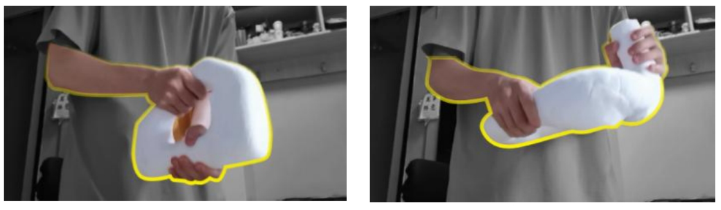
INTEGRATION OF GRIPPING METHODS Through the development of mock-up models and extensive trials with workers, we identified two optimal gripping methods tailored for cutting and grinding tasks. However, the differing handle positions posed a challenge in integrating both methods into a single angle grinder. After careful analysis and multiple iterations, we devised a rotating handle with a specifically engineered curvature. This handle can smoothly transition from a side
My Tool My Rule: User-Participatory Design of an Angle Grinder 449
position to an upper-left angle, effectively addressing the limitations of a basic 90-degree rotation. This innovative design achieves the optimal angle, ensuring that the tool satisfies ergonomic and functional requirements for both cutting and grinding. This solution not only enhances user comfort but also improves safety and operational efficiency.
Figure 3: Clay models in different working states.
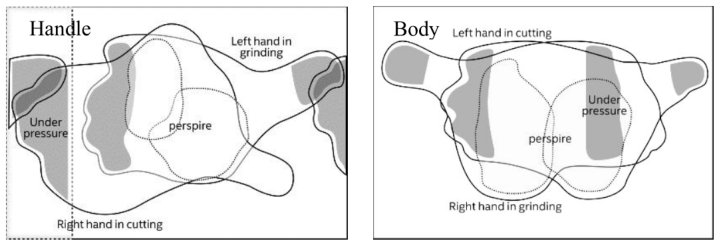
DETERMINING THE SHAPE OF THE GRIP We used cut-out paper on the previously made mock-up models to record the grip shapes required for different holding methods, then flattened and documented them onto a single plane. This approach allowed us to summarize the overall shape of the grip and condense it into a simple geometric form.
Figure 4: Hand glue shape record.
FINALIZING THE DESIGN The cross-sectional shape of the handle should maximize the contact area with the hand; for power gripping, a larger contact area between the handle and the hand results in lower pressure. An oval cross-section can prevent slipping and rolling, and it also avoids stress concentration and difficulty in exerting force caused by rectangular corners (Niu Luyao, 2018). Based on the general shape created from the initial clay modeling and the outline of the
hand grip shape, sketches were drawn, followed by AIGC-assisted modeling, 3D modeling, and 3D printing to produce a prototype of the product.
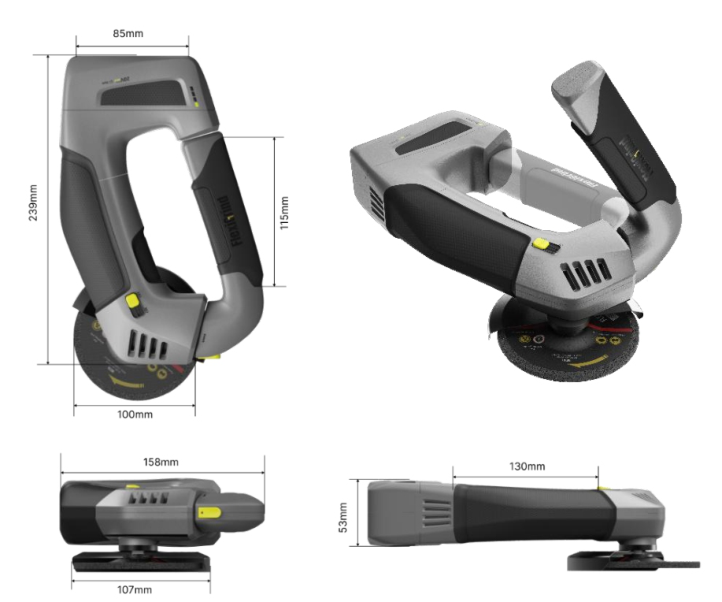
DESIGN OUTPUT Unlike traditional vertical handles, this product features a rotating handle, enabling users to switch between gripping methods suited to different work modes. The body is compact and streamlined, catering to users’ needs for a flexible and convenient angle grinder. The cooling vents located above the grinding disc and in front of the battery ensure the machine operates at an optimal temperature. The grip’s texture enhances friction while subtly guiding users to employ the angle grinder correctly. The integrated design of the body and functionality not only supports both cutting and grinding but also restricts certain unsafe gripping methods, effectively reducing the chances of improper use, thereby improving both user experience and safety.
Figure 5: Product three views and axonometric map.
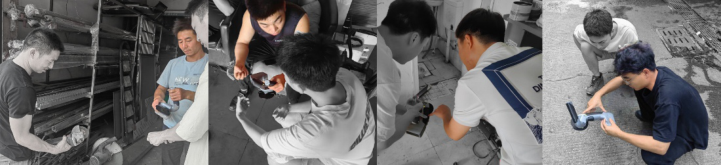
USER EXPERIENCE AND FEEDBACK We provided the prototype to 12 actual users, who evaluated the angle grinder using the SUS scale after use, resulting in a score of 74.3, indicating above-average usability. Additionally, we received further feedback from
My Tool My Rule: User-Participatory Design of an Angle Grinder 451
some users, with the majority suggesting a slimmer right handle, and a few recommending that the grip position be moved further away from the grinding disc and that an auxiliary straight-cutting feature be added. This feedback is valuable for iterating and improving the design.
Figure 6: User experience record (part).
CONCLUSION
In this design study, we integrated cutting and grinding functions through user participation, innovated the grip design of the angle grinder, and optimized its ergonomics and user experience. The user-designed angle grinder demonstrated superior user experience compared to traditional models.
Additionally, the design process and methods were innovated, allowing for better user involvement in identifying and solving problems. Participatory design is a way to enhance the relationship between designers and users, motivate designers, and ensure that the design meets user needs (Lee, 2006). The user participation process in this study involved the following steps: first, extracting user needs through observation and interviews, then making preliminary improvements to the existing tool and seeking user feedback. Next, design and structural development were carried out based on the feedback, followed by multiple rounds of discussions with users to refine the design. Finally, users were invited to evaluate the design outcomes together. This approach requires detailed communication, extensive real- world experiments, rigorous evaluation, and joint decision-making.
ACKNOWLEDGMENT
We would like to express my gratitude to the workers who participated in the interviews and user observations, especially the 12 workers around the school who were actively involved in this design process. Their contributions were crucial in advancing our design, and they allowed us to experience the beauty of creating designs that solve real-world problems.
REFERENCES
Business Research Website: https://www.businessresearchinsights.com/zh/market-r eports/angle-grinder-market-110604.
Khan, K. A., Gandhi, A., Sharma, V., & Jain, S. (2018). Penetrating head injury due to angle grinder: an occupational hazard. British Journal of Neurosurgery, 33(2), 202–206. https://doi.org/10.1080/02688697.2018.1467375 Kyle Odum, Maria Celeste Castillo, Jayanti Das, Barbara Linke, Sustainability
Analysis of Grinding with Power Tools, Procedia CIRP, Volume 14, 2014, Pages 570-574, ISSN 2212-8271, https://doi.org/10.1016/j.procir.2014.03.011 Lee, Y. (2006) Design Participation Tactics: Redefining User Participation in Design, in Friedman, K., Love, T., Côrte-Real, E. and Rust, C. (eds.), Wonderground - DRS International Conference 2006, 1–4 November, Lisbon, Portugal. https://dl.designresearchsociety.org/drs-conference- papers/drs2006/researchpapers/60 Niu, L. (2018). Optimization Design of Angle Grinder Handle Based on Gripping Methods. Shandong University of Science and Technology. Reinvee, M., Aia, S., & Pääsuke, M. (2019). Ergonomic Benefits of an Angle
Grinder With Rotatable Main Handle in a Cutting Task. Human Factors, 61(7), 1112–1124. https://doi.org/10.1177/0018720819827184 Zhang, J. (2012). Ergonomic Design Research on the Form Design of Electric Hand Drills. Packaging Engineering, Mechanical Engineering College, Sichuan University of Science & Engineering.
LISTED IN THE AHFE DIGITAL BOOKSTORE CATALOGUE
Explore the complete digital volume
Human Factors in Design, Engineering, and Computing
Read this individual research paper free through the original publisher, or explore the full digital proceedings book.
ISBN 978-1-964867-35-9
Explore this ISBN in the AHFE Bookstore ↗Listed in the July 2026 bookstore catalogue; search by ISBN to confirm current availability · Digital book purchase optional