Louis Poague, Alexandre Anibal Campos Bonilla (2026). Biomechanical plausibility of generative AI models: A validation methodology for studying cultural motor accents. In: Artificial Intelligence and Social Computing. AHFE Open Access, vol. 203, pp. 119–127. https://doi.org/10.54941/ahfe1007324
The rapid advancement of AI video generation models presents new opportunities to reduce financial and logistical barriers in biomechanical research in diverse cultural contexts. However, the capacity of these tools to generate movement with physical fidelity remains insufficiently validated. This study evaluated the performance of Google VEO 3.1 Fast in representing a culturally defined motor task: the Japanese seiza sitting posture. Kinematic measures of actual human performance were compared with AI-generated sequences using OpenPose for pose estimation purposes. AI sequences were generated from reference frames extracted from the original performance, including virtual camera rotations produced using Qwen AI Image Edit to enable novel view synthesis. All kinematic trajectories were temporally normalized before analysis. The results indicated that while the model achieved high temporal correspondence for knee flexion (r = 0.936), it introduced substantial discrepancies in postural control. In particular, AI-generated movements exhibited a tendency toward postural regularization, reducing trunk flexion toward a more idealized vertical orientation, with mean absolute errors of approximately 10° relative to the original performance. Furthermore, subtle motor variations, such as eccentric control phases and micro-pauses, were systematically smoothed. These findings indicate that current generative video models are not yet capable of faithful biomechanical reconstruction, as they homogenize motor execution and compromise the preservation of cultural motor accents essential for rigorous quantitative analysis.
Biomechanics explores the mechanical principles of human movement and its interactions with the environment through four main modalities: kinematic, kinetic, electromyographic, and physiological (Hamill et al., 2015). Beyond laboratory experimentation, biomechanics has increasingly been applied to non-traditional sources, such as fossils and anthropological records with human depictions, expanding the analytical scope of the field. Examples include a comparative analysis of stress distribution between the humerus of a Neanderthal and Homo sapiens during spear throwing (Berthaume & Elton, 2023); biomechanical markers of equestrian activity in human skeletal remains across nomadic societies, Renaissance Europe, and Native American Received February 5, 2026; Revised April 5, 2026; Accepted April 25, 2026; Available online July 20, 2026
120 Poague and Bonilla populations (McGrath, 2015); static analysis of postures depicted in Ancient Greek pottery, such as those of the sport Pankration, revealing differences between ancient and modern combat techniques and posture transitions (Bourantanis et al., 2024); and biomechanical plausibility of high and low attack postures of proto-gladiators depicted in Lucanian tomb frescoes in Paestum, Italy (Pontonnier & Salvan, 2020).
Humans are biocultural. Our movements emerge from the relationship between physiological, psychological, and social aspects, meaning that we cannot simply detach motor actions from the context in which they occur. For any task, we develop motor concepts - mappings between bodily coordinations and their ecological meanings - and motor accents, which are stereotyped and predictable movement patterns of an individual or subgroup (Ting et al., 2024). This is possible because of the “degrees of freedom” problem, which states that humans can achieve the same motor goal by multiple combinations of movements, muscles, and joints (Brill, 2018). Consider how walking is shaped by differences in terrain, contrasts between eating with forks, Chinese chopsticks, or bare hands, or the relationship between hand gestures and their meaning in different societies.
Hewes (1955) mapped nearly 100 postural habits across 480 cultures and some stand out: he ‘Nilotenstellung’, or resting on one leg with a supporting stick, exhibits an asymmetric weight distribution for long periods of rest, observed in Nilotic peoples of Sudan, Nambiquara in Brazil, and Ye’kuana in Venezuela. The deep squat, with buttocks close to the ground, shared between Asia, Africa, and pre-Columbian America, and used for activities like cooking, sewing, talking, or resting, is nearly impossible for many Westerners to perform. Recent studies have revealed the impact of culture on movement, which can be seen through the lens of biomechanics. For example, in China, the practice of laying babies in sandbags delays the onset of crawling and walking by several months (Karasik et al., 2011). A good running technique (landing with the fore or midfoot, typically not producing abrupt collision forces) seems to depend on societies where running is routine, such as the Kalenjin in Kenya and the Tarahumana in Mexico (Wallace et al., 2022).
Recent advances in generative AI video models, structured around diffusion models and transformer architectures, raise the possibility of re-presenting human movement from limited visual inputs. Such systems could assist biomechanical research on motor accents by correcting camera perspectives, stabilizing recordings, or reconstructing occluded motions. Google’s Veo 3 and OpenAI’s Sora 2 represent a leap in physical simulation and temporal consistency, with both companies marketing their models ability to “simulate real-world physics for authentic movements” (Fortin et al., 2025) and “more accurate physics” (OpenAI, 2025) from images and text descriptions. These claims make them subject to empirical validation.
RESEARCH QUESTIONS AND HYPOTHESES This study addresses the following research question:
RQ1: Can generative AI video models reproduce the biomechanical characteristics of human movement with quantitative fidelity? RQ2: Do AI-generated re-presentations preserve or homogenize culturally
specific motor patterns?
Biomechanical Plausibility of Generative AI Models 121 RQ3: Are AI-generated viewpoint transformations suitable for biomechanical analyses?
The following hypotheses were formulated: H1: Recent generative AI models can generate temporally coherent
continuations of human movement from reference frames, approximating joint kinematic trajectories with limited physical fidelity. H2: Recent generative AI models are technically capable of correcting the visual properties of video data and re-presenting human movements from standardized viewpoints. H3: Recent generative AI models exhibit the capacity to maintain the
kinematic patterns that constitute a specific motor accent. H4: AI-generated movements exhibit systematic regularization and homogenization, suggesting a tendency to reduce motor variability and potentially erase culturally specific movement characteristics.
METHODOLOGY
A 32-year-old adult with no reported musculoskeletal injuries performed the Japanese way of sitting, namely ‘seiza.’ The movement consists of transitioning from standing to kneeling, distinguished by an upright spine, backward leg positioning, and pronounced knee flexion, ranging from 150° to 165° (Darmanto et al., 2022), and a plantar ankle flexion of approximately 60° to ease contact between the buttocks and heel (Miyasaka et al., 2025). The participants were recorded in the frontal and lateral planes using a fixed camera setup to capture full-body motion. Digital stabilization was applied to reduce camera vibration without altering the temporal characteristics of the movement.
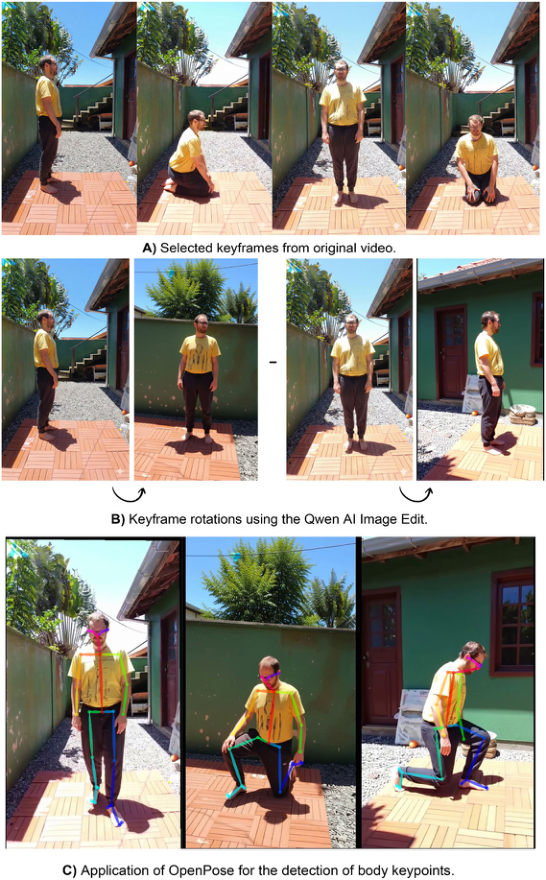
AI-generated videos were produced using Veo 3.1 Fast based on selected keyframes and text descriptions of the action. The keyframes consisted of the initial standing posture and the final seiza position. Two types of sets were employed: frames extracted directly from the original recordings and frames generated through virtual camera rotations (specifically, turns of 90°). The latter were produced using Qwen AI Image Edit (Alibaba, Qwen Team). Rotations resulted in unfaithful environment elements; nevertheless, the participant’s new body viewpoints were approximate, remaining largely unchanged. The subtle variations consisted of hair or shirt print designs. Procedure allowed the generation of AI sequences representing both native and rotated viewpoints while preserving the overall phase structure of the movement, though not its absolute timing. In total, six videos were created, two original recordings and four AI-generated re-presentations, namely:
1. AI-Lateral (Native): Lateral view AI-generated video produced from frames extracted from the original lateral recording. 2. AI-Lateral (Rotated): Lateral view AI-generated video produced from frames generated via virtual camera rotation of the original frontal recording. 3. AI-Frontal (Native): Frontal-view AI-generated video produced from frames extracted from the original frontal recording.
4. AI-Frontal (Rotated): Frontal-view AI-generated video produced from frames generated via virtual camera rotation of the original lateral recording.
Body keypoints were obtained using OpenPose (Cao et al., 2017) and later tracked using Tracker (Brown, 2025). Joint angles and trunk orientation were computed using the keypoint coordinates. As the points exhibited jitter and the AI-generated and original recordings differed in duration and phase timing, procedures such as moving average filter and temporal normalization were applied. The series were normalized to 0–100% of the movement cycle. Pipeline is represented in Figure 1. Posture data extracted from AI-generated videos were quantitatively compared against reference posture data extracted from the original recordings.
Figure 1: Overview of the experimental pipeline.
Biomechanical Plausibility of Generative AI Models 123 The dependent variables included knee flexion, trunk flexion (relative to a fixed vertical axis), and shoulder symmetry (the difference between their coordinates along the Y-axis). The mean absolute error (MAE), maximum error, mean relative error, and Pearson correlation coefficients were computed for comparative analysis. The results are presented in Table 1.
RESULTS
Table 1: Error metrics and temporal correlation coefficients for knee, trunk, and shoulder kinematics across experimental conditions.
Table available in the original PDF paper.
Pearson (r)
Variable Plane Condition MAE Max Error Mean Rel. Error (%) Knee flexion Sagittal AI-Lateral (Native) 12,23° 64,06° 19,04 0,936 AI-Lateral (Rotated) 19,53° 96,94° 29,59 0,852
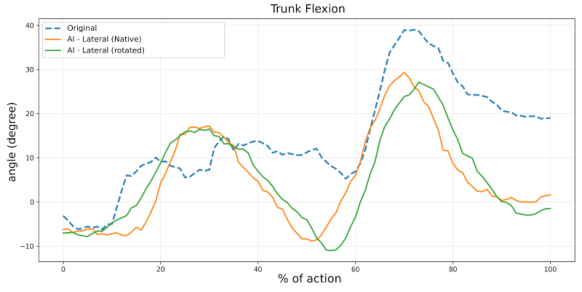
SAGITTAL PLANES Knee flexion exhibited the strongest agreement between the conditions. AI-Lateral (native) demonstrated high temporal correspondence with the original movement (r = 0.936) and an MAE of 12.23°. In contrast, AI-Lateral (Rotated) showed a reduced correlation (r = 0.852) and increased error (MAE = 19.53°), indicating sensitivity to the viewpoint reconstruction. Maximum errors of 64.06° and 96.94° for knee flexion were ascribed to differences during the descent phase: in the original recordings, keeling on the floor was fast, followed by an abrupt pause with an upright trunk before sitting on heels, whereas in the generated versions, the descent to the sitting pose was smooth and gradual. Nevertheless, the overall movement dynamics maintained a high degree of correlation in both cases, as illustrated by the curves in Figure 2. Synthetic sequences exhibited smaller amplitudes than the original sequences. In the resting position, the posture created by the AI was more erect - thus closer to the ideal seiza - than that of the actual participant. MAE was similar across conditions (10.84° and 10.64°). The correlations remained moderate (r = 0.674 and r = 0.698), implying that while the temporal dynamics of flexion were captured, attenuation occurred in both the direction and velocity of the movement.
Figure 2: Knee and trunk flexion angles in sagittal planes.
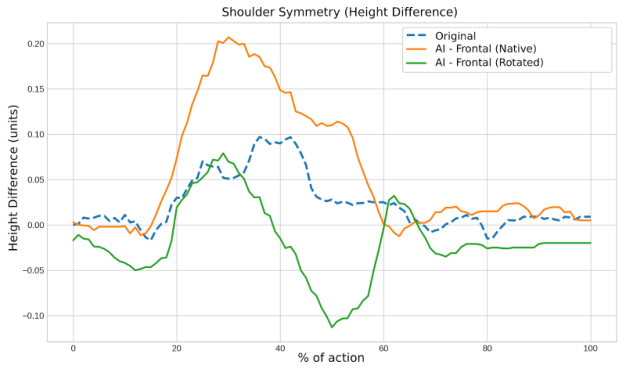
FRONTAL PLANES Human performance was characterized by minimal lateral trunk deviation, whereas the AI-generated frontal views exhibited amplified and smooth oscillations. AI-Frontal (Native) produced moderate temporal correspondence (r = 0.631) and increased variability. AI-Frontal (Rotated) exhibited poor temporal alignment (r = –0.129), despite comparable maximum deviation values. The latter exhibited a vertically mirrored movement relative to the original. Whereas in the original video, the action begins with the right leg and a negative lateral trunk inclination, in the synthetic version, the movement begins with the left leg and a positive inclination. A small correction, such as the inversion of the angular sign and swapping of shoulder sides, was required. Qualitatively, the AI-Frontal (Rotated) group exhibited alternating lateral sways, whereas the AI-Frontal (Native) group showed a predominant inclination toward a single side during the descent phase. This suggests that either the change in camera perspective may have compromised the model’s spatial reference or that the provided description (prompt) was insufficient to ensure accurate correspondence of the movement in this view, indicating the need for prompt adaptation to the new perspective.
Biomechanical Plausibility of Generative AI Models 125 The shoulder differences exhibited greater asymmetry in the generated versions than in the original versions. As shown in Figure 3, the AI-Frontal (native) curve followed the oscillation of the original, reflecting a high correlation (r = 0.869), while the AI-Frontal (rotated) showed reduced correspondence (r = –0.366) and increased relative error, indicating loss of coordinated symmetry despite visually plausible motion.
Figure 3: Lateral trunk and shoulder symmetry in the frontal planes.
DISCUSSION
The results indicate that Veo 3.1 Fast can approximate gross joint configurations but struggles to preserve the temporal and postural nuances of human movement. Knee flexion reproduction supports H1 for the sagittal plane joint geometry. However, systematic smoothing, reduced trunk flexion, and altered lateral stability contradict H3 and support H4, respectively.
AI-generated movements consistently exhibited postural regularization, eliminating micro-pauses and eccentric control phases evident in the original performance while favoring smooth and continuous transitions between
126 Poague and Bonilla poses. This behavior renders generative models unsuitable for studies focused on motor accents or culturally situated movement patterns. One possible explanation for this behavior is the maximum content duration constraint imposed by the model during generation when confronted with the received text description. Regardless of the cause, the elimination of these temporal markers removes essential components of motor control associated with cultural motor accents, leading to inappropriate generalization.
Although AI-based viewpoint reconstruction partially supports H2, spatial inversions and temporal misalignments limit biomechanical reliability. These findings suggest that current text-to-video systems still lack the expressive capacity to encode biomechanical constraints with sufficient precision for analytical purposes. This study is limited by its small sample size (n = 1), and the findings should therefore be considered preliminary. Future research with larger samples is necessary to address potential variations in the performance of the seiza posture.
CONCLUSION
This study demonstrates that commercially available generative AI video models, despite their visually convincing outputs, remain unsuitable for quantitative biomechanical analysis when fidelity to motor dynamics and cultural specificity are required. The current limitations can also be attributed to the absence of a formal syntax capable of translating kinematic variables into generative instructions. Establishing this vocabulary may represent a fundamental step toward the meaningful methodological integration of generative AI in the study of human movement. Open-source projects focused on novel view synthesis, such as ReCamMaster (Bai et al., 2025), offer a relevant methodological counterpoint to purely text-driven generative models and represent a promising direction for future research and application in biomechanics.
ACKNOWLEDGMENT
The authors would like to thank the master’s Program in Design and Human Factors at the Universidade do Estado de Santa Catarina (UDESC), Brazil.
REFERENCES
Alibaba Qwen Team (n.d.) “Qwen Image Edit: Multi-angle image editing with LoRA”. Available at: https://github.com/QwenLM/Qwen-Image Bai, J., Hu, T., Zhang, J., Qi, J., Wang, J. (2024) “ReCamMaster: 3D reconstruction
of camera and human motion from monocular video”, in: Proceedings of the IEEE Conference on Computer Vision and Pattern Recognition (CVPR). pp. 11187–11196. https://doi.org/10.48550/arXiv.2503.11647 Berthaume, M., Elton, S. (2024) “Biomechanics in anthropology”, in: Evolutionary Anthropology, 33, e22019. https://doi.org/10.1002/evan.22019 Bourantanis, A., Nomikos, N., Wang, W. (2024) “Biomechanical insights in ancient
Greek combat sports: A static analysis of selected pottery depictions”, in: Sports, 12, 317. https://doi.org/10.3390/sports12120317
Biomechanical Plausibility of Generative AI Models 127 Brill, B. (2018) “Action, movement, and culture: Does culture shape movement?”, in:
Kinesiology Review. https://doi.org/10.1123/kr.2017-0060 Brown, D. (n.d.) “Tracker video analysis and modeling tool”. Available at: https:// physlets.org/tracker/ Cao, Z., Hidalgo, G., Simon, T., Wei, S.-E., Sheikh, Y. (2017) “Realtime multi-
person 2D pose estimation using part affinity fields”, in: Proceedings of the IEEE Conference on Computer Vision and Pattern Recognition (CVPR). Available at: https://openaccess.thecvf.com/content_cvpr_2017/html/Cao_Realtime_Multi- Person_2D_CVPR_2017_paper.html Darmanto, D., et al. (2022) “A review on flexion angle in high-flexion total knee arthroplasty for Indonesian’s need”, in: Frontiers in Mechanical Engineering, 8, 1049796. https://doi.org/10.3389/fmech.2022.1049796 Fortin, A., Martins, L., Odoom, S. (2025, July 17) “Build with Veo 3, now available in
the Gemini API”, in: Google for Developers Blog. Available at: https://developers. googleblog.com/en/veo-3-now-available-gemini-api/ Hamill, J., Knutzen, K.M., Derrick, T.R. (2015). Biomechanical basis of human movement (4th ed.). Philadelphia, PA: Wolters Kluwer. Hewes, G.W. (1955) “World distribution of certain postural habits”, in:
American Anthropologist, 57(2). pp. 231–244. https://doi.org/10.1525/ aa.1955.57.2.02a00040 Karasik, L.B., Adolph, K.E., Tamis-LeMonda, C.S., Zuckerman, A.L. (2010) “WEIRD walking: Cross-cultural research on motor development”, in: Behavioral and Brain Sciences, 33(2-3). pp. 95–96. https://doi.org/10.1017/S0140525X10000117 McGrath, M.S. (2015). A review of the archaeological and sports medicine literature
to determine biomechanical markers of equestrian activity. University of New Brunswick. Available at: https://www.academia.edu/12094909 Miyasaka, H., et al. (2025) “Association between stiffness of the deep fibres of the tibialis anterior muscle and seiza posture performance”, in: Journal of Functional Morphology and Kinesiology, 10(3), 300. https://doi.org/10.3390/jfmk10030300 OpenAI. (2025). Sora 2 system card. OpenAI. Available at: https://cdn.openai.com/
pdf/50d5973c-c4ff-4c2d-986f-c72b5d0ff069/sora_2_system_card.pdf Pontonnier, C., Salvan, S. (2020) “Biomechanical plausibility of lucanian fresco tomb proto-gladiators”, in: Computer Methods in Biomechanics and Biomedical Engineering. https://doi.org/10.1080/10255842.2020.1815319 Ting, L.H., et al. (2024) “Ethnokinesiology: Towards a neuromechanical
understanding of cultural differences in movement”, in: Philosophical Transactions of the Royal Society B, 379, 20230485. https://doi.org/10.1098/rstb.2023.0485 Wallace, I.J., et al. (2022) “Cultural variation in running techniques”, in: Evolutionary Human Sciences, 4, e14. https://doi.org/10.1017/ehs.2022.12
LISTED IN THE AHFE DIGITAL BOOKSTORE CATALOGUE
Explore the complete digital volume
Artificial Intelligence and Social Computing
Read this individual research paper free through the original publisher, or explore the full digital proceedings book.
ISBN 978-1-964867-79-3
Explore this ISBN in the AHFE Bookstore ↗Listed in the July 2026 bookstore catalogue; search by ISBN to confirm current availability · Digital book purchase optional