Mirna Khalife, Olga Burukina, Mohammad Ashraf (2026). Generative AI as a Catalyst for Innovative Collaboration: Enhancing Group Projects Among Saudi Students in Digital Learning Environments. In: Human Interaction and Emerging Technologies (IHIET-AI 2026): Artificial Intelligence and Future Applications. AHFE Open Access, vol. 201, pp. 310–318. https://doi.org/10.54941/ahfe1007185
In recent years, generative artificial intelligence (AI) has emerged as a transformative technology with the potential to revolutionize collaborative learning experiences. This study investigates the role of generative AI in facilitating innovative collaboration among Saudi university students engaged in group projects within digital learning environments. As higher education institutions increasingly adopt digital tools and platforms, understanding how generative AI can enhance creativity, teamwork, and overall learning outcomes becomes paramount.Utilizing a mixed-methods approach, this research employs a comprehensive questionnaire distributed to a diverse sample of Saudi university students. The questionnaire is designed to assess participants’ experiences with generative AI tools, their perceptions of these tools' effectiveness in enhancing collaboration, and the impact on their creativity and problem-solving abilities during group projects. The survey includes both closed-ended questions for quantitative analysis and open-ended questions for qualitative insights, allowing for a nuanced exploration of the role of generative AI in educational settings.The findings reveal that a significant majority of participants (approximately 78%) reported that generative AI tools, such as AI-driven brainstorming applications and collaborative writing platforms, have had a positive influence on their group project experiences. Students highlighted that these tools fostered a more inclusive environment, enabling team members to contribute ideas more freely and creatively. Moreover, 65% of respondents noted improved communication and coordination among team members, attributing this enhancement to the real-time collaborative features provided by generative AI tools.Additionally, qualitative feedback from open-ended questions indicated that students appreciated the ability of generative AI to generate diverse perspectives and ideas, which enriched the brainstorming process and led to more innovative project outcomes. Participants expressed that the use of AI tools reduced the cognitive load associated with project management, allowing them to focus more on creative problem-solving and critical thinking. However, some concerns were raised regarding the potential for over-reliance on AI-generated content, emphasizing the need for a balanced approach that combines human creativity with AI assistance.This study contributes to the growing body of literature on the integration of artificial intelligence in education, particularly in the context of collaborative learning. The implications of these findings suggest that incorporating generative AI tools into the curriculum can significantly enhance the collaborative capabilities of Saudi university students, fostering a culture of innovation and creativity in digital learning environments. As educational institutions continue to navigate the complexities of digital transformation, understanding the potential of generative AI as a catalyst for collaboration will be essential for fostering effective and engaging learning experiences.In conclusion, this research highlights the transformative potential of generative AI in enhancing group projects among Saudi students, offering valuable insights for educators and policymakers aiming to leverage technology for improved collaborative learning outcomes.
Generative AI is leading an educational revolution, impacting teaching strategies and methodologies. Academics have observed that the use of AI is facilitating collaborative projects; AI applications enhance this collaboration through communication tools, knowledge sharing, and coordination. It offers equal opportunities and promotes inclusive practices in education (Adeleye et al., 2024). Large Language Models are helping to generate ideas and improve novelty. These tools provide opportunities to explore a spectrum of possibilities, supporting creativity (Gindert & Muller, 2024).
The study analysed the role of generative AI as a catalyst for innovative collaboration by scientifically observing the practices of the targeted population and collecting their feedback on how artificial intelligence can foster creativity, improve communication, and facilitate effective teamwork.
METHODOLOGY
Research Paradigm The study is grounded in a constructivist research paradigm, which posits that knowledge is constructed through social interactions and experiences. This paradigm is particularly relevant when investigating collaborative learning, as it emphasizes the importance of context, interactions, and the subjective experiences of participants (Chand, 2024). By adopting a constructivist approach, the research seeks to understand how generative AI influences the collaborative processes and experiences of Saudi students in group projects, allowing for an exploration of the nuances of their engagement with technology and each other.
Research Design A mixed-method research design was selected to facilitate the collection and analysis of data an online survey regarding students’ perceptions and experiences with generative AI in group projects. This design is appropriate for identifying patterns, drawing correlations, and quantifying relationships between the use of generative AI and collaborative outcomes (McLeod, 2024).
Sample Selection The study targeted students at a private university in Saudi Arabia, focusing on a sample of 135 participants, the study ensures a level of homogeneity regarding the educational context, resources, and technological access, which helps control for external variables that may influence the results.
Data Analysis Data collected from the online survey were analyzed using descriptive statistics, Qualitative responses from open-ended questions were analyzed thematically to identify recurring themes and insights related to students’ experiences with generative AI in group projects (Chintakrindi et al., 2022).
Literature Review
Group projects have been recognized as powerful pedagogical tools that promote active engagement and collective problem-solving among students. As education increasingly shifts towards digital learning environments, the dynamics of collaboration are being redefined, necessitating the exploration of innovative tools and technologies that can facilitate effective teamwork (Mahmadov, 2025).
Generative AI refers to algorithms that can create new content, ideas, or solutions based on existing data, enabling users to generate innovative outputs that can enhance learning experiences. In the context of digital learning environments, generative AI serves as a valuable resource, offering students and educators new ways to collaborate, brainstorm, and develop projects (Lee et al., 2024). By leveraging the capabilities of generative AI, students can access a wealth of information, receive personalized feedback, and engage in creative processes that were previously unattainable.
This review aims to synthesize existing research on the effectiveness of generative AI as a catalyst for enhancing group projects and to identify best practices for integrating this technology into educational frameworks (Ohri, 2024). By examining the current state of knowledge in this area, the literature review provided insights into how generative AI can foster innovative collaboration, ultimately contributing to improved educational outcomes and preparing students for the demands of an increasingly digital world.
Theoretical Framework The theoretical framework explored Constructivist Learning Theory, Social Learning Theory, and Collaborative Learning Models, highlighting how these theories underpin the use of technology in facilitating group projects in digital learning environments.
According to constructivist theorists such as J. Piaget, J. Bruner and L. Vygotsky, knowledge is not merely transmitted from teacher to student; rather, it is built through social interactions and collaborative endeavors (Chand, 2024). By allowing students to collaborate in real-time on projects, generative AI aligns with constructivist principles, promoting a learner-centered approach that fosters creativity and critical thinking (Marzano, 2025).
Generative AI tools can facilitate discussion forums, peer reviews, and collaborative document editing, allowing students to learn from one another’s perspectives and expertise (Salman et al., 2025). As students engage with generative AI in collaborative settings, they can observe and model effective teamwork strategies, thereby enriching their learning experiences.
By integrating generative AI into collaborative learning models, educators can create dynamic learning environments where students can work together more effectively, leveraging technology to enrich their collaborative efforts (Memon & Kwan, 2025).
The intersection of these theories illustrates how technology can significantly enhance collaborative learning. Generative AI serves as a catalyst for innovative collaboration by providing resources that align with constructivist, social, and collaborative learning principles. The use of
Generative AI as a Catalyst for Innovative Collaboration 313 generative AI does not only support the construction of knowledge through active engagement but also fosters social interactions and collaborative processes that are essential for effective learning (Cress & Kimmerle, 2023).
Generative AI can serve as a powerful tool in educational settings, enhancing collaborative projects among students by providing them with a dynamic platform for idea generation and creative exploration (Wu & Zhang, 2025).
Existing studies often lack a comprehensive examination of the specific mechanisms through which generative AI enhances collaborative processes. Although some research highlights the benefits of AI tools in facilitating idea generation and feedback, there is limited empirical evidence detailing how these processes unfold in real-time collaborative settings. Understanding the dynamics of AI-supported collaboration is crucial for identifying best practices and optimizing the use of these technologies in educational contexts (Przegalinska et al., 2025).
There is a need for research that bridges the gap between technology and pedagogy, exploring how educators can effectively integrate generative AI tools into their teaching practices to foster meaningful collaboration among students. This includes understanding how to design collaborative tasks that leverage AI to promote critical thinking, creativity, and engagement.
The review has underscored the importance of addressing challenges such as inequitable access to technology, data privacy considerations, and the need for comprehensive teacher training. It also emphasizes the necessity for further research to explore the unique experiences of Saudi students with generative AI tools in collaborative learning environments (Allehyani et al., 2025). By focusing on this demographic, the current study aimed to contribute valuable insights that can inform the development of effective strategies for integrating AI into educational practices.
Findings and Interpretation The survey contained 25 questions including 5 questions intended to provide demographic information, 16 closed-ended questions and 4 open-ended questions. The research engaged 135 undergraduate students (both female and male) of Prince Mohammad Bin Fahd University (the oldest Saudi private university) aged 18–20 (70.4%), 21–25 (25.9%) and under (3.7%), specializing in engineering (59), business (41), computer sciences, as well as other fields of study. The students were freshmen (86), sophomore (27), junior students (15), and senior students (7).
An overwhelming majority of the students were familiar with generative AI tools, with 42.2% (very familiar) and 74 (somewhat familiar), and 86.7% of all the respondents having experience in using Gen AI tools for group projects.
As regards to the specific GenAI tools used for group projects, an overwhelming majority of the respondents used ChatGPT (67.4%) and Gemini (20.7%).
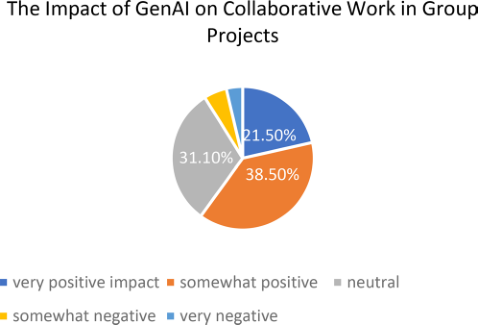
Answering the question “How would you rate the impact of generative AI on your collaborative work in group projects?”, 21.5% admitted very positive impact, 38.5% – somewhat positive, while 31.1% stated the impact was neutral, and only 8.9% of the respondents acknowledged somewhat negative (5.2%) and very negative (3.7%) impact of GenAI (see Fig. 1 below).
Figure 1: The Impact of GenAI on collaborative work in group projects.
The responses to the question “In what ways has generative AI enhanced your group project experience?” mainly included improved communication (40.7%), streamlined research (25.2%), enhanced creativity (18.5%), and increased efficiency in task completion (10.4%).
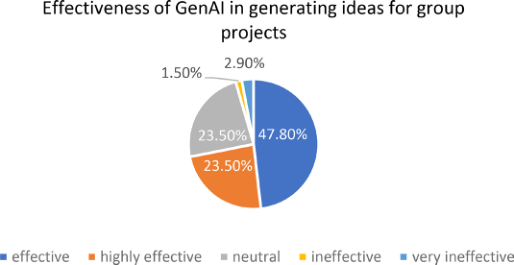
Answering the question “How effective do you find GenAI in generating ideas for group projects?” the respondents acknowledged effectiveness (47.8%) and high effectiveness (23.5%) of GenAI tools used for collaborative group projects, while 23.5% stated the effectiveness was neutral, and 6% admitted the tools they used were ineffective or very ineffective (1.5% and 2.9% accordingly) (see Fig.2 below).
Figure 2: Effectiveness of GenAI in generating ideas for group projects.
(Continued)
Generative AI as a Catalyst for Innovative Collaboration 315 Answering the question “How effective do you find GenAI in generating ideas for group projects?” the respondents acknowledged effectiveness (47.8%) and high effectiveness (23.5%) of GenAI tools used for collaborative group projects, while 23.5% stated the effectiveness was neutral, and 6% admitted the tools they used were ineffective or very ineffective (1.5% and 2.9% accordingly).
Table1: Students perceptions and practices feedback.
Not aware 33.3 Peer recommendation Very likely 11.1
Likely 33.3 Neutral 36.3
Unlikely 11.9 Very Unlikely 7.4 Formal training Received training/guidance 35.6
Did not receive training 64.4
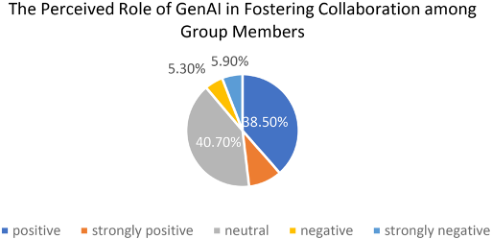
Figure 3: The Perceived Role of GenAI in Fostering Collaboration among Group Members.
The respondents revealed positive (38.5%) and strongly positive (9.6%), as well as neutral (40.7%) attitudes, with only 5.3% of the respondents admitting negative and strongly negative (5.9%) attitudes.
Based on the responses from the students, we can categorize their requests into several key themes, including training workshops and tutorials guidance on best practices, access to resources, resource libraries, AI tool recommendations, ethics and responsible use training, peer support and collaboration.
Many students expressed a desire for structured training sessions. They may have suggested hands-on workshops and online tutorials.
The students frequently indicated a need for guidance on best practices when integrating AI into group projects, including effective use cases and collaborative strategies. Therefore, information on how to appropriately utilize generative AI for brainstorming, research, and writing tasks while avoiding over-reliance on technology.
CONCLUSION
By analysing the experiences of students and educators, we have highlighted the transformative potential of generative AI tools in fostering creativity, improving communication, and facilitating effective teamwork. The findings suggest that when properly integrated, generative AI can significantly enhance collaborative learning experiences, leading to improved academic outcomes and greater student engagement (Yu et al., 2023). Key insights from the study reveal that generative AI not only streamlines collaborative processes but also empowers students to take ownership of their learning. By providing personalized feedback and facilitating the generation of ideas, AI tools create an environment conducive to exploration and innovation. Additionally, the cultural context of Saudi Arabia, characterized by a strong emphasis on collaboration, presents unique opportunities for leveraging generative AI to enhance group dynamics and collective problem-solving.
In conclusion, educators can create dynamic and engaging learning experiences that not only enhance group projects but also prepare students for the challenges of the future (Kohnke et al., 2025). The findings of this
Generative AI as a Catalyst for Innovative Collaboration 317 study serve as a foundation for further exploration and implementation of generative AI in Saudi higher education, paving the way for a more collaborative and technology-enhanced learning landscape.
ACKNOWLEDGMENT
We would like to express our gratitude to the students who participated in this study showing transparency, it wouldn’t be possible without their willingness to share their insights and perceptions.
REFERENCES
Adeleye, O. O., Eden, C. A., & Adeniyi, I. S. (2024). Innovative teaching methodologies in the era of artificial intelligence: A review of inclusive educational practices. World Journal of Advanced Engineering Technology and Sciences. https://doi. org/10.30574/wjaets.2024.11.2.0091 Allehyani, F., Albedah, F., Jamshed, M. & Warda, W. (2025). Exploring Saudi
EFL Learners’ Engagement with AI Generative Tools in Educational Settings: Perceptions, Practices, and Pedagogical Outcomes. Theory and Practice in Language Studies, 15, 1959–1966, doi: 10.17507/tpls.1506.24. Bamasoud, D. M., Mohammad, R. & Bilal, S. (2025). Adopting Generative AI in Higher Education: A Dual-Perspective Study of Students and Lecturers in Saudi Universities. Big Data and Cognitive Computing, 9(10), 264, doi: 10.3390/ bdcc9100264. BalalleGindert, M., & Muller, M. (2024). The Impact of Generative Artificial
Intelligence on Ideation and the performance of Innovation Teams (Preprint). https://doi.org/10.48550/arxiv.2410.18357 Chand, S. (2024). Constructivism in Education: Exploring the Contributions of Piaget, Vygotsky, and Bruner. International Journal of Science and Research (IJSR), 12, 274–278, doi: 10.21275/SR23630021800. Chintakrindi, S., Jordan, M., Littlepage, E., Wooley, S., Pinedo, C., Duran, M., &
Olivant, K. (2022). Beyond the numbers: Qualitative analysis of open-ended responses for identifying student success indicators. Intersection: A Journal at the Intersection of Assessment and Learning, 3(1), doi: 10.61669/001c.32398. Cress, U. & Kimmerle, J. (2023). Co-constructing knowledge with generative AI tools: Reflections from a CSCL perspective. International Journal of Computer-Supported Collaborative Learning, 18, 607–614, doi: 10.1007/ s11412-023-09409-w. Hassan, G. (2023). Technology and the Transformation of Educational Practices:
A Future Perspective. International Journal of Economic, Business, Accounting, Agriculture Management and Sharia Administration (IJEBAS), 3, 1596–1603, doi: 10.54443/ijebas.v3i1.1136. Kohnke, L., Zou, D., Wanyu Ou, A., Gu, M. (2025). Preparing Future Educators for AI-Enhanced Classrooms: Insights into AI Literacy and Integration. Computers and Education: Artificial Intelligence, 8, 100398, doi: 10.1016/j. caeai.2025.100398.
Lee, D., Arnold, M., Srivastava, A., Plastow, K., Strelan, P., Ploeckl, F., Lekkas, D. & Palmer, E. (2024). The Impact of Generative AI on Higher Education Learning and Teaching: A Study of Educators’ Perspectives. Computers and Education: Artificial Intelligence, 6, 100221, doi: 10.1016/j.caeai.2024.100221. Mahmadov, Y. (2025). Transforming Education Through Digital Learning:
Embracing the New Era of Learning. International Journal of Education and Digital Learning (IJEDL), 3, 157–166, doi: 10.47353/ijedl.v3i4.258. Marzano, D. (2025). Generative Artificial Intelligence (GAI) in Teaching and Learning Processes at the K-12 Level: A Systematic Review. Technology, Knowledge and Learning, doi: 10.1007/s10758-025-09853-7. McLeod, S. (2024). Mixed Methods Research Guide with Examples. Simply
Psychology, doi: 10.13140/RG.2.2.31329.93286. Memon, T.D. & Kwan, P. (2025). A Collaborative Model for Integrating Teacher and GenAI into Future Education. TechTrends, 69, 1192–1206, doi: 10.1007/ s11528-025-01105-w. Przegalinska, A., Triantoro, T., Kovbasiuk, A., Ciechanowski, L., Freeman, R.B. &
Sowa, K. (2025). Collaborative AI in the Workplace: Enhancing Organizational Performance through Resource-Based and Task-Technology Fit Perspectives. International Journal of Information Management, 81, 102853, doi: 10.1016/j. ijinfomgt.2024.102853. Salman, H., Aliif, M., Ibrahim, R. & Mahmood, J. (2025). Systematic analysis of generative AI tools integration in academic research and peer review. Online Journal of Communication and Media Technologies, 15, e202502, doi: 10.30935/ ojcmt/15832. Sporn, B. & Godonoga, A. (2024). Higher Education Institutions as Change Agents
in Society: Perspectives on Adaptation and Impact. European Journal of Higher Education, 14(sup1), 1–9, doi: 10.1080/21568235.2024.2412764. Wu, D. & Zhang, J. (2025). Generative Artificial Intelligence in Secondary Education: Applications and Effects on Students’ Innovation Skills and Digital Literacy. PLoS One, 20(5), e0323349, doi: 10.1371/journal. pone.0323349. Yu, J., Quentin Vidal, Q. & Vincent-Lancrin, S. (2023). Digital Teaching and Learning
Resources. In: OECD Digital Education Outlook. Towards an Effective Digital Education Ecosystem. Retrieved from https://www.oecd.org/en/publications/ oecd-digital-education-outlook-2023_c74f03de-en/full-report/digital-teaching- and-learning-resources_5651654d.html. Accessed on 9.12.2025.
LISTED IN THE AHFE DIGITAL BOOKSTORE CATALOGUE
Explore the complete digital volume
Human Interaction and Emerging Technologies (IHIET-AI 2026): Artificial Intelligence and Future Applications
Read this individual research paper free through the original publisher, or explore the full digital proceedings book.
ISBN 978-1-964867-77-9
Explore this ISBN in the AHFE Bookstore ↗Listed in the July 2026 bookstore catalogue; search by ISBN to confirm current availability · Digital book purchase optional