Kyoko Ito, Kiyokazu Ujiie (2026). An Experimental Study on Consensus Building with an AI Chatbot Across Two Topics. In: Intelligent Human Systems Integration (IHSI 2026): Disruptive and Innovative Technologies. AHFE Open Access, vol. 200, pp. 12–19. https://doi.org/10.54941/ahfe1007060
1 Department of Information and Computer Science, Faculty of Engineering, Kyoto Tachibana University, 34 Yamada-cho, Oyake, Yamashina-ku, Kyoto, 6078175, Japan ↗
2 Faculty of Life and Environmental Sciences, University of Tsukuba, Japan ↗
Consensus building is the process by which multiple people, through dialogue or negotiation, arrive at a single conclusion that all parties can accept. This study aims to experimentally examine how dialogue with an AI chat (chatbot) influences changes in human opinions. In this study, we prepare an AI that exhibits logical behavior and investigate the role it plays in consensus building with humans across two topics. Building on the further development of this line of research and its findings, we expect to derive design guidelines for AI-assisted consensus-building systems and to consider measures addressing the risk of AI inappropriately manipulating human opinions, thereby contributing to the creation of safe and trustworthy communication environments.2. MethodsThe AI chat used in the consensus-building experiment was configured as follows:•Exchange opinions with the goal of reaching a single conclusion.•Conduct the discussion for approximately 10 minutes.In addition, at the outset the AI chat indicates:•That the interaction is with an AI chat.•That the AI chat initially holds the opposite opinion to the participant’s.The dialogue topics with the AI chat comprised one familiar everyday choice and one societal issue:•Lunch: Whether to go to “Hama Sushi” (a conveyor-belt sushi restaurant) or “MOS Burger” (a burger shop).•Genome-edited crops: Whether to support or oppose their introduction into society.3. ExperimentWe conducted an experiment using the AI chat configured above. To determine whether people change their opinions after a brief exchange with the AI chat, participants engaged in consensus building with the AI chat for roughly 10 minutes. Each participant discussed one of the two topics— “Lunch” or “Genome”—with the AI chat.This experiment was approved by the Kyoto Tachibana University Research Ethics Committee. The generative AI engine used was GPT 4o.Participants were 200 men and women aged 20–69, recruited via a research firm. 4. ResultsThe experiment was conducted in February 2025, and data were obtained from all 200 participants. Among those discussing “lunch,” 29 out of 100 participants changed their opinion before and after the dialogue with the AI chat (29%). For the topic “genome-edited crops,” 27 out of 100 participants changed their support/oppose stance (27%).5. ConclusionTo examine the impact of AI chat on changes in human opinions, we conducted 10-minute dialogue experiments using an AI chat. The results showed that, after a short dialogue with AI, 29% of participants changed their view on the lunch choice (Hama Sushi vs. MOS Burger), and 27% changed their stance on the societal introduction of genome-edited crops. These findings suggest that even brief communication with AI may exert a measurable influence on human opinions.Future work includes analyses that incorporate participants’ prior awareness and level of interest in the topic, in order to further elucidate how AI affects human opinion-formation processes.
Consensus building refers to the process by which multiple individuals reach a mutually acceptable conclusion through dialogue or negotiation. From the perspectives of cognition and psychology, psychological convergence processes such as cognitive dissonance (Festinger, 1957), conformity (Asch, 1951) and group polarization (Myers and Lamm, 1976) are considered to be related. In communication theory, Habermas’s theory of communicative action emphasizes deriving conclusions that all participants can agree upon through fair and equal dialogue (Nakaoka, 2018). In decision theory, mutual benefit and compromise achieved through negotiation are key considerations (Fisher et al., 2011). In recent years, consensus-building support using ICT and AI has been increasingly expected; however, addressing ethical and social issues, such as ensuring transparency and accommodating diversity in the process, has become essential (Rahwan et al., 2019).
The purpose of this study is to experimentally examine how dialogue with an AI chatbot influences changes in human opinions. Traditionally, research on consensus building has focused primarily on human-to-human
An Experimental Study on Consensus Building With an AI Chatbot Across Two Topics 13 communication. However, with the rapid advancement of AI technologies, it is anticipated that AI will increasingly participate as a conversational partner in consensus formation processes.
This study prepares two different consensus-building themes and examines how opinions change depending on the topic. The findings of this research are expected to contribute to design guidelines for AI-based consensus-build ing support systems, and to discussions on mitigating the risks of AI inap propriately manipulating human opinions, thereby promoting the creation of safe and trustworthy communication environments.
METHOD
This study investigates whether people change their opinions after a brief exchange of views with an AI chatbot. Specifically, two topics for consensus building were prepared to examine differences in opinion change depending on the theme.
Previous research has shown that when AI adjusts its arguments based on the user’s basic information, it can demonstrate effective persuasive power (Salvi et al., 2025). It has also been suggested that the tone of explanation used by AI may influence human decision-making (Okoso et al., 2025). Furthermore, analyses of online awareness campaigns have focused on ele ments such as content, message appeal, and framing (Rumble et al., 2016).
Based on these findings, the following conditions were established for the AI-chat-based consensus-building experiment:
Participants engage in an exchange of opinions to reach one conclusion.
The discussion lasts for approximately 10 minutes.
At the beginning of the conversation, the AI chatbot informs participants that:
The dialogue partner is an AI chatbot.
The AI chatbot initially holds the opposite opinion to that of the participant.
The AI chatbot’s conversational behaviour was set as follows:
Logical condition: Responds based on objective facts and reasoning, guiding the discussion toward a rational conclusion.
EXPERIMENT An experiment was conducted using the configured AI chatbot to determine whether individuals change their opinions after a short exchange with it. Each participant engaged in a roughly 10-minute consensus-building dia logue with the AI chatbot. Two discussion topics were prepared, and each participant discussed one of them.
14 Ito and Ujiie This study was approved by the Research Ethics Committee of Kyoto Tachibana University. The procedure consisted of the following steps:
1. Pre-experiment questionnaire 2. Dialogue with the AI chatbot 3. Post-experiment questionnaire In the pre-experiment questionnaire, participants were asked about their opinions (choice1/choise2 or agree/disagree) on the given topic. The AI chat bot dialogue was conducted online. In the post-experiment questionnaire, participants were again asked about their opinions on the topic (choice1/ choise2 or agree/disagree) and their impressions of the discussion.
Two types of topics were prepared: one familiar and one social issue.
Lunch selection: “Which would you choose, Mos Burger or Hama Sushi?”
Introduction of genome-edited agricultural products: “Do you support or oppose the social implementation (e.g., sales in stores) of genome- edited crops?”
For the lunch topic, Mos Burger is a hamburger chain restaurant, while Hama Sushi is a conveyor-belt sushi chain restaurant. For clarity, the follow ing explanation was provided for the genome-editing topic: “Genome-edited agricultural products are crops whose characteristics, such as those of vegetables and fruits, have been modified using genetic edit ing technologies.”
The AI system used for the dialogues was based on the GPT-4o engine. A total of 200 participants (aged 20–69, male and female) were recruited through a research company. Each topic group consisted of 100 participants. Age distribution was evenly balanced across each decade from the 20s to the 60s (20% each), with equal numbers of men and women in each age group. Based on pre-experiment questionnaire results, participants were balanced as follows: for the lunch topic, half initially preferred Mos Burger and half Hama Sushi; for the genome-editing topic, half supported, and half opposed social implementation.
RESULT
The experiment was conducted in February 2025, and data were collected from 200 participants in total.
After the dialogue with the AI chatbot, 29 out of 100 participants changed their opinion regarding “lunch selection,” and 27 out of 100 participants changed their opinion on the “social implementation of genome-edited agri cultural products.” The respective changes are presented in Tables 1 and 2.
Table 3 shows the gender distribution of participants whose opinions changed, while Tables 4 and 5 present the percentage of opinion changes by age group.
Table 1: Opinions on lunch selection before and after the dialogue with the AI chatbot (number of people).
Table available in the original PDF paper.
Before After Number of People Mos Burger Mos Burger 37
Mos Burger Hama Sushi 13 Hama Sushi Hama Sushi 34
Hama Sushi Mos Burger 16
Table 2: Opinions on social implementation (e.g., sales in stores) of genome-edited crops before and after the dialogue with the AI chatbot (number of people).
Table available in the original PDF paper.
Before After Number of People Support Support 46
Support Oppose 4 Oppose Oppose 27
Oppose Support 23
Table 3: Gender distribution of participants whose opinions changed (number of people).
Table available in the original PDF paper.
Topic Gender Number of People Lunch selection Male 12
Female 17 Male Female
14 13
Social implementation of genome-edited crops
Table 4: Percentage of opinion changes by age group on lunch selection.
Table available in the original PDF paper.
Age group Number of People
Percentage (%) 20s 6 30
30s 9 45 40s 6 30
50s 3 15 60s 5 25
Table 5: Percentage of opinion changes by age group on social implementation of genome-edited crops.
Table available in the original PDF paper.
Age group Number of People Percentage (%) 20s 6 30
30s 9 45 40s 6 30
50s 3 15 60s 5 25
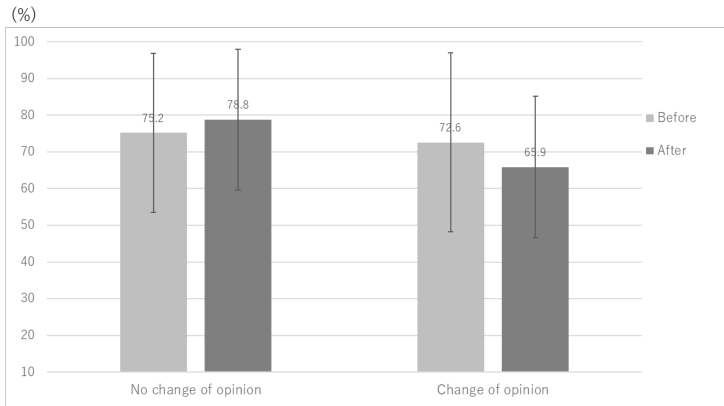
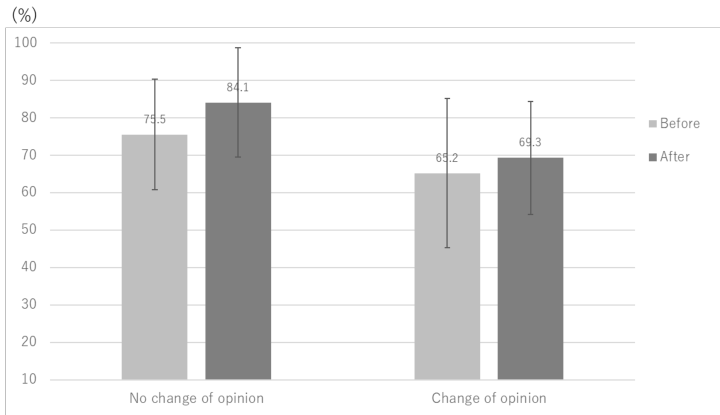
Participants were also asked to rate their confidence levels in their chosen option before and after the dialogue using a 9-point scale ranging from “1 (10%)” to “9 (100%).”
Figures 1 and 2 illustrate changes in confidence between groups whose opinions remained unchanged and those whose opinions changed after inter acting with the AI chatbot. The error bars in Figures 1 and 2 indicate the standard deviation.
According to Table 1, regarding the “lunch selection,” 26% of partici pants changed their choice from Mos Burger to Hama Sushi, while 32% changed from Hama Sushi to Mos Burger. According to Table 2, concern ing the “Social implementation of genome-edited crops,” 8% changed their opinion from support to oppose, whereas 46% changed from oppose to sup port. Table 3 shows that there would be no gender difference among par ticipants who changed their opinions for either topic “lunch selection” or “social implementation of genome-edited crops.”
From Tables 4 and 5, it was found that for both topics, the proportion of participants who changed their opinions was smaller among those in their 50s and 60s than among those in their 20s to 40s.
Figure 1: Changes in on lunch selection confidence between groups whose opinions remained unchanged and those whose opinions changed.
An Experimental Study on Consensus Building With an AI Chatbot Across Two Topics 17 For Figure 1 (“lunch selection”), paired t-tests were conducted on pre- and post-dialogue confidence scores for both the group that changed opinions and the group that did not. Only the group with no opinion change showed a significant difference (p < .05, p = 0.00). For Figure 2 (“social implementation of genome-edited crops”), a paired t-test revealed that neither the changed nor unchanged groups showed significant differences (p ≥ .05).
Figure 2: Changes in confidence on social implementation of genome-edited crops between groups whose opinions remained unchanged and those whose opinions changed.
Additionally, for Figure 1 (“lunch selection”), independent t-tests were conducted comparing confidence levels between the groups with and without opinion changes, both before and after the dialogue. In both cases, the p-val ues were below 0.05 (before: p = 0.02; after: p = 0.00). For Figure 2 (“social implementation of genome-edited crops”), a comparison showed that only the post-dialogue difference was significant (p = 0.00).
Based on these results, the influence of AI chatbot interaction on human opinions and confidence levels would appear to differ depending on the nature of the topic.
For the familiar, everyday topic of “lunch selection,” approximately 30% of participants changed their opinions after a short dialogue with the AI chatbot, suggesting a measurable effect even within a brief interaction. Meanwhile, participants who did not change their opinions showed sig nificantly increased confidence after the dialogue (p < .05), implying that discussion with the AI may have reinforced their preexisting preferences. Furthermore, the unchanged group had higher confidence both before and after the dialogue than the group that changed opinions, indicating that interaction with the AI chatbot might strengthen existing beliefs.
In contrast, for the socially and ethically oriented topic of “genome-ed ited crops,” 46% of participants shifted from disagreement to agreement,
18 Ito and Ujiie suggesting that dialogue with the AI may have influenced their opinion formation. However, overall changes in confidence were not statistically sig nificant. This may suggest that in socially complex topics involving personal values and ethical judgments, confidence levels are less likely to shift after a brief dialogue. Nevertheless, the unchanged group showed higher post- dialogue confidence than the changed group, implying that AI dialogue may have served to reinforce existing stances.
No gender differences were observed, but some age-related differences appeared: participants in their 50s and 60s were less likely to change opin ions compared to those in their 20s–40s, suggesting that older adults may be less influenced by AI chatbot interactions.
In summary, dialogue with an AI chatbot would appear to strengthen con fidence for familiar topics, while providing a trigger for opinion change in socially or ethically complex topics.
CONCLUSION
The findings of this study reveal that the influence of AI chatbot interaction on human opinion varies with topic familiarity and complexity. For everyday subjects such as lunch choices, AI dialogues primarily reinforced existing beliefs and increased participants’ confidence when opinions remained sta ble. In contrast, for socially and ethically nuanced issues like genome-edited crops, AI-driven logical explanations served as catalysts for opinion change, particularly among those initially opposed. These outcomes suggest that while AI could promote cognitive reinforcement in familiar domains, it can also act as an agent of persuasion in value-laden discussions. Furthermore, the reduced susceptibility among older participants highlights generational differences in receptivity to AI communication.
Future work should explore how factors such as the AI’s communication tone, emotional expressiveness, dialogue length, and personalization strat egies affect opinion dynamics. By deepening understanding of these mech anisms, it will be possible to design AI-assisted consensus-building systems that are both effective and ethically responsible, fostering transparent and trustworthy human–AI interaction environments.
ACKNOWLEDGMENT
This work was supported by JSPS KAKENHI Grant Number 20H01748.
REFERENCES
Asch, S. E., In Guetzkow, H., Ed. (1951). Effects of group pressure upon the modification and distortion of judgments, in Groups, leadership and men; research in human relations, Carnegie Press. pp. 177–190. Festinger, L. (1957). A Theory of Cognitive Dissonance. Stanford University Press. Fisher, R., Ury, W. L., Patton, B. (2011). Getting to Yes: Negotiating Agreement
Without Giving In, Penguin Publishing Group.
An Experimental Study on Consensus Building With an AI Chatbot Across Two Topics 19 Myers, D. G. and Lamm, H. (1976). The group polarization phenomenon,
Psychological Bulletin, Vol. 83, Iss. 4. pp. 602–627 https://doi.org/10.1037/0033- 2909.83.4.602 Nakaoka, N. (2018). Expanded Habermas: Communicative Action, Chikuma Shobo. (in Japanese). Okoso, Ayano, Yang, Mingzhe, and Baba, Yukino (2025). Do Expressions Change
Decisions? Exploring the Impact of AI’s Explanation Tone on Decision-Making, arXiv. [Online]. Available: https://arxiv.org/abs/2502.19730 Rahwan, I., Cebrian, M., Obradovich, N., et al. (2019). Machine behaviour, Nature, Vol. 568. pp. 477–486 https://doi.org/10.1038/s41586-019-1138-y Rumble, Joy N., Settle, Quisto, and Irani, Tracy (2016). Assessing the Content of
Online Agricultural Awareness Campaigns, Journal of Applied Communications, Vol. 100, Iss. 3. pp. 98-150 https://doi.org/10.4148/1051-0834.1233 Salvi, Francesco, Ribeiro, Manoel Horta, Gallotti, Riccardo, and West, Robert (2025). On the conversational persuasiveness of GPT-4, Nature Human Behaviour. https://doi.org/10.1038/s41562-025-02194-6
LISTED IN THE AHFE DIGITAL BOOKSTORE CATALOGUE
Explore the complete digital volume
Intelligent Human Systems Integration (IHSI 2026): Disruptive and Innovative Technologies
Read this individual research paper free through the original publisher, or explore the full digital proceedings book.
ISBN 978-1-964867-76-2
Explore this ISBN in the AHFE Bookstore ↗Listed in the July 2026 bookstore catalogue; search by ISBN to confirm current availability · Digital book purchase optional