Kyoko Ito, Yosuke Fukuda (2025). Classification of Food Challenges and Values Based on Open-ended Responses. In: Intelligent Human Systems Integration (IHSI 2025): Integrating People and Intelligent Systems. AHFE Open Access, vol. 160, pp. 206–211. https://doi.org/10.54941/ahfe1005826
Emerging technology refers to new, unestablished, and not widely recognized science and technology, and differs from existing science and technology that has widely penetrated society and occupies a definite position . One of the emerging technology is genome-edited crops. In terms of climate change risks and population growth, the potential of novel foods has a significant impact on food security. On the other hand, it has not been fully accepted by society at this time. In order for attitudes toward genome-edited crops to be formed in the future, it is believed that adequate information must be provided to the general public. In doing so, it is expected that providing information tailored to the orientation and values of each person, rather than providing the same information to all people, will lead to effective information provision. This study aims to analyze each person's food challenges and values considering their acceptability and knowledge of genome-edited agricultural product, and personality characteristics, and to derive findings that will lead to the provision of appropriate information.As a first step, the purpose of this study is to classify the challenges and values toward food based on the open-ended statements in the questionnaire survey and summarize the characteristics of each.2.MethodIn this study, a questionnaire survey was conducted on the following items:-Attributes (gender, age, place of residence, marital status, family composition living together, occupation)-Acceptability of genome-edited crops (8 foods)-Knowledge related to genome-edited crops (5 items)-Personality (10 items)-Food Challenges (Are there any new foods or dishes you have tried recently? Tell us about that experience)-Food Values (What factors do you think are most important in your food choices? Please be specific, indicating your own experiences) The survey was conducted on 2000 Japanese men and women in February 2024 via a research company. The age range was 20s to 60s, each comprising 20% of the total population, with half of the male and half of the female population in each age group.The respondents were asked to answer the questions “Food Challenges” and “Food Values” in free-text form, and to write at least 140 characters in Japanese.3.ResultThe two questions answered in the open-ended responses were classified using BERTopic, a natural language processing technique. BERTopic is a method of topic analysis using sentence vectors obtained with Sentence-BERT. Here, UMAP is used to reduce the dimensionality of the sentence vector and HDBSCAN is used for clustering. This allows for the creation of clusters of semantically similar responses. Here, clusters with a sample size of 5 or more were extracted. As a result, 75 and 57 clusters were obtained for “Food Challenges” and “Food Values,” respectively. Mapping in two dimensions also allowed us to identify broad categories of responses to “Food Challenges” and “Food Values,” from which 10 and 9 categories were extracted, respectively.4.Conclusion This study targeted genome-edited crops as one of the emerging technology, and aimed to provide appropriate information to promote social acceptance. Specifically, we categorized “Food Challenges” and “Food Values” based on free-response statements in a questionnaire survey of 2,000 Japanese men and women. As a result, 10 and 9 categories were found, respectively.In the future, we will analyze the results together with the results of other questionnaire items and consider how to provide information suitable for each orientation and sense of values.
Emerging technology refers to new, unestablished, and not widely recognized science and technology, and differs from existing science and technology that has widely penetrated society and occupies a definite position (Yamaguchi and Hibino, 2009). One of the emerging technologies is genome-edited crops. In terms of climate change risks and population growth, the potential of novel foods has a significant impact on food security. On the other hand, it has not been fully accepted by society at this time. In order for attitudes toward genome-edited crops to be formed in the future, it is believed that adequate information must be provided to the general public (Yamaguchi et al., 2024). In doing so, it is expected that providing information tailored to the orientation and values of each person, rather than providing the same information to all people, will lead to effective information provision.
This study aims to analyse each person’s food challenges and values considering their acceptability and knowledge of genome-edited agricultural product, and personality characteristics, and to derive findings that will lead to the provision of appropriate information.
As a first step, the purpose of this study is to classify the challenges and values toward food based on the open-ended statements in the questionnaire survey and summarize the characteristics of each.
Classification of Food Challenges and Values Based on Open-Ended Responses 207
METHOD
In this study, a questionnaire survey was conducted. The survey was on 2000 Japanese men and women in February 2024 via a research company. The age range was 20s to 60s, each comprising 20% of the total population, with half of the male and half of the female population in each age group.
The survey items are as follows:
Attributes (gender, age, place of residence, marital status, family composition living together, occupation)
Acceptability of genome-edited crops (8 foods)
Knowledge related to genome-edited crops (5 items)
Personality (10 items)
Food challenges (Are there any new foods or dishes you have tried recently? Tell us about that experience)
Food values (What factors do you think are most important in your food choices? Please be specific, indicating your own experiences) The respondents were asked to answer the questions “food challenges” and “food values” in free-text form, and to write at least 140 characters in Japanese.
RESULT
The two questions answered in the open-ended responses were classified using BERTopic (Grootendorst, 2022), a natural language processing technique. BERTopic is a method of topic analysis using sentence vectors obtained with Sentence-BERT. A multilingual model (Wang et al., 2024) was used for the sentence embedding. Next, UMAP is used to reduce the dimensionality of the sentence vector and HDBSCAN is used for clustering.This allows for the creation of clusters of semantically similar responses. Here, clusters with a sample size of 5 or more were extracted.
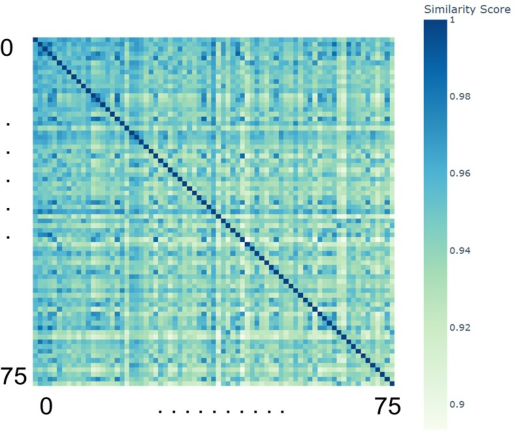
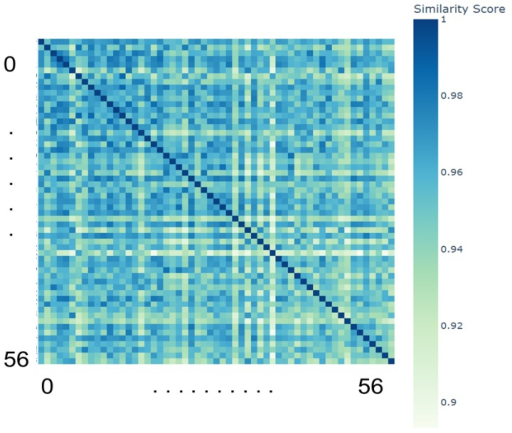
As a result, 75 and 57 clusters were obtained for “food challenges” and “food values,” respectively. Figure 1 and Figure 2 show the degree of similarity between the clusters with respect to “food challenges” and “food values,” respectively. Figures 1 and 2 indicate that some clusters have relatively large similarity.
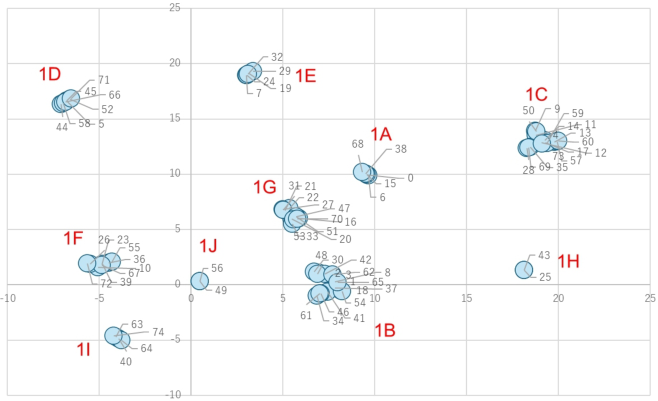
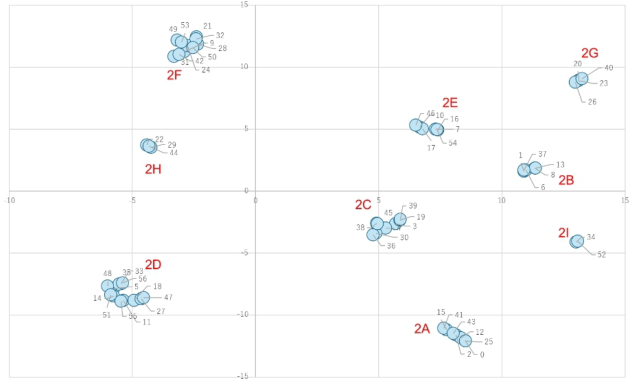
The results of the two-dimensional mapping of the clusters for “food challenges” and “food values” are shown in Figures 3 and 4, respectively. From Figure 3, 10 clusters were extracted for “food challenges” and from Figure 4, 9 clusters were extracted for “food values”. Here, for “food challenges”and “food values,” the numbers of clusters in these classifications and the main keywords in these clusters are shown in Tables 1 and 2.
Figure 3 and Table 1 show the trends in the “food challenge. The clusters of 1C and 1H in the first quadrant of Figure 3 are “nothing in particular” and “not interested, don’t eat,” respectively, with 1A being “soybean meat, fermented, almonds” and 1E being “gluten-free, oatmeal,” with relatively healthy ingredients and menus being the keywords. New and unusual items are also mentioned, with 1B being “various, foreign, new, sweets” and 1G being “new menus for eating out, ingredients”. In the second and third
208 Ito and Fukuda
quadrants of Figure 3, 1F, “Pakuchi, Vietnamese, Taiwanese, Turkish” and 1I, “Curry, Indian cuisine” are foreign food such as Asian food; 1J between 1G and 1B and 1F and 1I is “vegan”, a keyword related to vegetables. And 1D in the second quadrant of Figure 3 is “cook by myself”. In Figure 3, from right to left, the respondents went from “not particular, not interested, don’t eat” to “cook by me,” indicating the spread of “challenge to food.”
Figure 1: The degree of similarity between the clusters with respect to “food challenge”.Figure 2: The degree of similarity between the clusters with respect to “food values”.
Figure 4 and Table 2 show the trends in “food values.” Overall, “nutritional balance” and “balance” are the main keywords. In the first
Classification of Food Challenges and Values Based on Open-Ended Responses 209
and fourth quadrants of Figure 4, “deliciousness,” “taste,” and “price” are indicated. On the other hand, in the second quadrant, 2F, “dietary fiber” is listed in addition to “what I want to eat. In 2H, “protein” is listed, while in 2D, “nutrition, vegetables, and blood pressure” are listed as keywords in addition to “nutritional balance.” Overall, from right to left in Figure 4, the factors are related to health, ranging from “taste” and “deliciousness” to protein, dietary fiber, and vegetables, indicating the difference in what is important in addition to “nutritional balance.”
Figure 3: The two-dimensional mapping of the clusters for “food challenges”.Figure 4: The two-dimensional mapping of the clusters for “food values”.
210 Ito and Fukuda
Table 1. The numbers of clusters and the main keywords for the classification of “food challenges”.
This study targeted genome-edited crops as one of the emerging technologies and aimed to provide appropriate information to promote social acceptance. Specifically, we categorized “food challenges” and “food values” based on free-response statements in a questionnaire survey of 2,000 Japanese men and women. As a result, 10 and 9 categories were found, respectively. Regarding “food challenges,” the respondents were classified into categories ranging from “nothing in particular” to “cook by me,” indicating the breadth of their “food challenges.” In addition, “nutritional balance” and “balance” were the main keywords for “food values” as a whole, indicating differences in what is combined from “taste” and “deliciousness” to health-related factors.
Classification of Food Challenges and Values Based on Open-Ended Responses 211
In the future, we will analyse the results of other questionnaire items, especially in conjunction with attribute information and the acceptability of genome-edited crops and consider how to provide information suitable for each orientation and value system.
ACKNOWLEDGMENT
This work was supported by Cross-ministerial Strategic Innovation Promotion Program (SIP) (funding agency: Bio-oriented Technology Research Advancement Institution) (Grant Number JPJ012287).
Wei, Furu. (2024) “Multilingual E5 Text Embeddings: A Technical Report”, arXiv:2402.05672v1. Yamaguchi, Tomiko. Ezaki, Kazune. Ito, Kyoko. (2024) “Exploring the Landscape of Public Attitudes towards Gene-edited Foods in Japan”, Breeding Science, Vol. 24, No. 1, pp. 11–21. Yamaguchi, Tomiko, Hibino, Aiko et al. (2009) “Emerging Technology: A Sociological Approach to Advanced Science and Technology,” Kyoto: Kyoto University Press. (in Japanese).
LISTED IN THE AHFE DIGITAL BOOKSTORE CATALOGUE
Explore the complete digital volume
Intelligent Human Systems Integration (IHSI 2025): Integrating People and Intelligent Systems
Read this individual research paper free through the original publisher, or explore the full digital proceedings book.
ISBN 978-1-964867-36-6
Explore this ISBN in the AHFE Bookstore ↗Listed in the July 2026 bookstore catalogue; search by ISBN to confirm current availability · Digital book purchase optional