Kyoko Ito, Kazune Ezaki, Tomiko Yamaguchi (2024). A Methodological Examination of Attitudes Toward Emerging Science and Technology. In: Intelligent Human Systems Integration (IHSI 2024): Integrating People and Intelligent Systems. AHFE Open Access, vol. 119, pp. 230–236. https://doi.org/10.54941/ahfe1004487
Emerging science and technology refers to new, unestablished, and not widely recognized science and technology. It is different from existing science and technology that has widely penetrated society and occupies a definite position. The process of social implementation of such new science and technology and the attitudes of the general public toward the science and technology are discussed in several literatures based on the perspective of "symbiogenesis" in which science and society together influence each other. In addition, the general public itself seems to feel the need for science and technology to mutually influence each other.One of the simplest ways to ascertain how emerging science and technology will be accepted in society would be to conduct a questionnaire survey of the general public. However, with regard to such new and uncertain science and technology, the results of the questionnaire survey often indicate that the respondents "do not know" or "are not interested. Furthermore, it is assumed that these opinions have not been established as their own.Based on these backgrounds, we first conducted a questionnaire survey of the general public on emerging science and technology. In addition, in order to obtain opinions using a method different from the questionnaire survey, we conducted an online experiment targeting the general public, referring to the method for expressing opinions on emerging science and technology proposed in our previous research.This study aims to gain insight into the methods and characteristics of asking the general public for their opinions on the emerging science and technology, and to compare the results of a questionnaire survey and an online experiment as a method of investigating attitudes toward the emerging science and technology.In this study, genome-edited crops are taken as a case study as an emerging science and technology. Although social surveys related to genome-edited crops have been conducted in the past, previous studies have shown that the opinions of general public differs depending on the application of the technology. With respect to the conduct of the survey, two methods were used to investigate the public's attitudes toward genome-edited crops. One was an online survey, which included 1,111 respondents. The other was an online experiment in which groups of five people were asked to respond simultaneously and share the results, with 115 participants. Four types of questions were prepared for five genome-edited crops to compare the two methods, and the results of a total of 19 questions were compared. Responses were rated on a 6-point scale from 0 to 5.Overall, the mean of the results was greater for 18 of the 19 questions in the online experiment, with eight questions having a difference of 1.0 or greater. The degree of the differences varied.The "high-meat-volume fish" had the largest difference between "would like to try" and "commercialization," while the "allergen-free buckwheat" had the smallest difference between "would like to try" and "natural-artificial."Future work may include a detailed analysis of the similarity of the overall trends between the questionnaire survey and the online experiment in order to examine what factors are responsible for these differences. This is expected to lead to the proposal of a more appropriate methodology for surveys when emerging science and technology are implemented in society.
Emerging technologies refers to new, unestablished, and not widely recog- nized science and technology, and differs from existing science and tech- nology that has widely penetrated society and occupies a definite position (Yamaguchi and Hibino, 2009). The process of social implementation of such new science and technology and the public’s awareness and attitude toward the technology have been discussed in several study based on the perspective of “symbiogenesis,” in which science and society both influence each other (Jasanoff ed., 2006) (Jasanoff, 2006). The general public itself also seems to feel the need for science, technology, and society to mutually influence each other.
One of the simplest ways to ascertain how emerging technology will be accepted in society is to conduct a questionnaire survey of the general public.
A Methodological Examination of Attitudes Toward Emerging Science and Technology 231
However, the results of the questionnaire survey often indicate that the respondents “do not know” or “are not interested” in such a new and uncer- tain science and technology. Furthermore, it is assumed that these opinions are not established as their own. With regard to the “do not know” response regarding science and technology, Hibino explores its meaning and presents multiple characteristics (Hibino, 2019). Political ignorance (Francis, 1975), political indifference (Rapoport, 1981), and self-control (Rapoport, 1981) (Rapoport, 1982) have been offered as interpretations of the “do not know” response by several study.
Based on these backgrounds, we have first conducted a questionnaire sur- vey of the general public on emerging technology (Ezaki, et al., 2022). In addition, in order to obtain opinions using a method different from the ques- tionnaire survey, we conducted an online experiment targeting the general public (Ito, et al., 2023), referring to the method of expressing opinions on emerging technology proposed in previous studies (Yamamoto, et al., 2010) (Ito, et al., 2011).
This study aims to gain insight into the methods and characteristics of asking the general public for their opinions on the future of science and technology, and to compare the results of a questionnaire survey and an online experiment as methods for investigating attitudes toward science and technology.
In this study, we take genome-edited crops as a case study as an emerging technology. Although social research related to genome-edited crops has been conducted in the past, previous studies have shown that the general public differs depending on the application of the technology (Tachikawa, et al., 2020) (Beghin and Gustafson, 2021).
METHOD
This survey was approved by the Ethics Committee of International Christian University and the Research Ethics Committee of Kyoto Tachibana Univer- sity. The following is a description of the survey questions and the methods of the questionnaire survey and the online experiment, respectively.
In this study, we conducted a survey on attitudes toward genome-edited crops as a technology that may be implemented in society in the future. In comparing the results of the questionnaire survey and the online experiment, the following five genome-edited crops were selected from those currently under development.
Madai with high meat content
Rice with high yield
Potatoes with functional ingredients effective against dementia
Allergen-free buckwheat
Pollen-free cedar For each of the crops, a brief description was included in the questionnaire and in the online experiment. For each of the above genome-edited crops, the following four questions were asked to investigate the public’s attitude toward each of them.
Want to try them: Do you want to try them?
Natural - artificial: Do they feel natural or artificial?
Convenience: Do you feel that it makes your life more convenient?
Commercialization: Do you agree or disagree with commercialization?
Responses were rated on a 6-point scale (0-5), with each question being “not at all (0) - very much (5)”, “artificial (0) - natural (5)”, “not at all (convenience) (0) - very much (5)”, and “disagree (0) - agree (5)”.
First, regarding the questionnaire survey, an online questionnaire sur- vey was conducted using monitors. The survey targeted men and women between the ages of 18 and 70, with allocation and collection in propor- tion to the census population. It was administered to 1,111 respondents in Japan.
For the online experiment, we prepared a place for expressing opinions that enables access to the opinions of others, referring to previous studies (Rapoport, 1981; 1982). As an experimental system for this purpose, we developed SimSOL, a simultaneous opinion expression system. SimSOL is a web system for listening to opinions online and allows multiple people to answer questions simultaneously and share their answers. The following is a flow of the opinion listening process using SimSOL.
1. One group of five people will answer the questions, 2. after answering the questions, participants will share their answers with the entire group (5 people).
Each of the five respondents answered the questions regarding 1. Responses consisted of selecting a multi-step rating option and filling in the reason for the choice. Since a group of five people needed to fill in their answers at the same time in order to share their responses, the remaining time was displayed at the upper right corner of the response screen. Regard- ing 2., after the responses are made, a list of the 5 responses is displayed, and the responses are shared among the 5 respondents. To conduct the experi- ment using SimSOL, the time for each individual operation was set. The time for filling in questions was set at 75 seconds, and the time for displaying the shared screen was set at 90 seconds.
The total number of participants in the experiment was 115 men and women between the ages of 18 and 70. An online experiment was conducted with 23 groups of 5 participants per group.
RESULTS
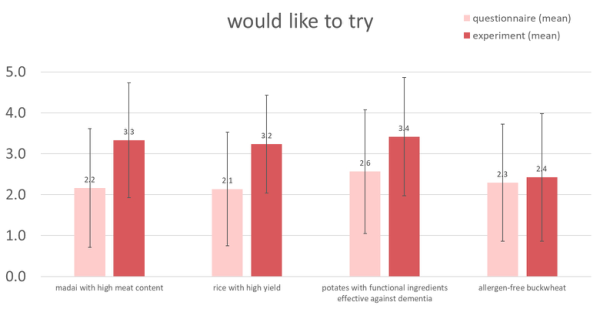
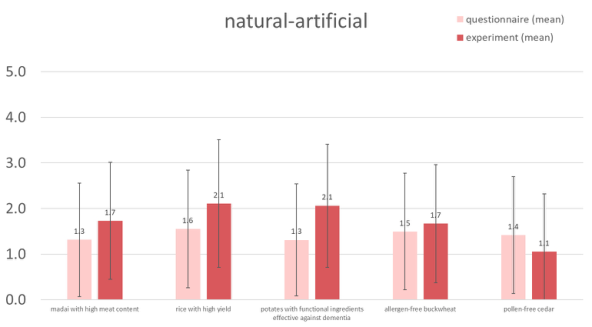
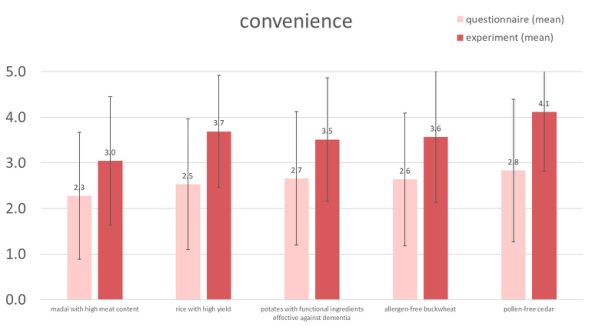
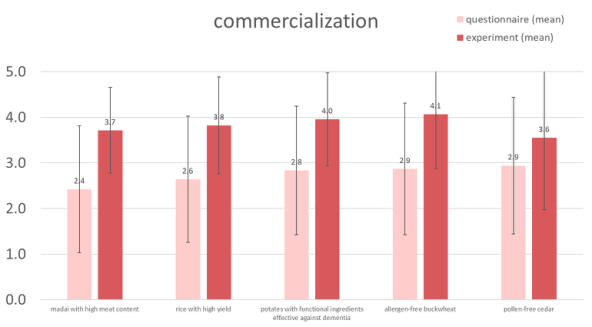
The results of the questionnaire survey and online experiment for the five crops (“Want to Try,” “Natural-Artificial,” “Convenience,” and “Commer- cialization”) are shown in Figures 1 through 4, respectively. The mean values of the respondents’ responses (on a scale of 0-5) are shown as bar graphs, and error bars indicate standard deviations. Since “pollen-free cedar” is not something to eat, respondents were not asked in the survey whether they would like to try it.
A Methodological Examination of Attitudes Toward Emerging Science and Technology 233
Figure 1: Results of responses to “would like to try it”.Figure 2: Results of responses to “natural - artificial”.Figure 3: Results of responses to “convenience”.
Of the 19 questions, 18 had larger mean values in the online experiment. The question with the larger mean value in the survey was “natural- artificial” for pollen-free cedar. The number of questions for which the difference was greater than 1.0 was 8. With respect to the four questions, the questions with larger mean values for the differences among the five (or four) genome-edited crops were, in descending order, “commercialization,” “con- venience,” “would like to try,” and “natural-artificial” for the genome-edited crops. With respect to the five genome-edited crops, in descending order from the highest mean difference for the four (or three) question items were: “rice with high yield,” “madai with high meat content,” “potatoes with func- tional ingredients effective against dementia,” “allergen-free buckwheat,” and “pollen-free cedar.”
Figure 4: Results of responses to “commercialization”.
Overall, when comparing the means of the results of the questionnaire survey and the online experiment, the magnitude of the differences varied. The smallest differences were found for “would like to try” and “natural- artificial” for “allergen-free buckwheat,” while the smallest differences were found for “convenience” and “commercialization” for “madai with high meat content” and “pollen-free cedar,” respectively. On the other hand, the genome-edited crops with the largest differences in the “would like to try”, “natural-artificial”, “convenience”, and “commercialization” cat- egories were “madai with high meat content”, “potatoes with functional ingredients effective against dementia”, and “rice with high yield.” The “nat- ural – artificial” question, for which the difference was small, had a smaller mean value than the other questions in both the questionnaire and the online experiment results.
A possible reason for the larger mean results of the online experiment compared to the mean results of the questionnaire survey and the online experiment is that the presence of others may have encouraged positive responses. Another possibility is that the presence of the experimenter who conducted the experiment at the time of the experiment may have encouraged positive responses.
A Methodological Examination of Attitudes Toward Emerging Science and Technology 235
CONCLUSION
In this study, we focused on ways to investigate the public’s attitudes toward emerging technologies when they are implemented in society, and compared the results of a questionnaire survey and an online experiment. The target technology was genome-edited crops. Two methods were used to investi- gate public attitudes toward genome-edited crops. The first was an online survey of 1,111 respondents. Another was an online experiment in which groups of five people were asked to respond simultaneously and share the results, with 115 participants. Four types of questions were prepared for five genome-edited crops to compare the two methods, and the results of a total of 19 questions were compared. Responses were rated on a 5-point scale from 0 to 5. Overall, the mean of the results was greater for 18 of the 19 questions in the online experiment, with eight questions for which the difference was greater than 1.0. The magnitude of the differences varied. The “madai with high meat content” had the largest difference between “would like to try” and “commercialized,” while the “allergen-free buckwheat” had the smallest difference between “would like to try” and “natural - artificial.”
Future work may include a detailed analysis of the similarity of the overall trends between the questionnaire survey and the online experi- ment in order to examine what may be contributing to these differences. This is expected to lead to the proposal of a more appropriate method- ology for surveys when new science and technology are implemented in society.
ACKNOWLEDGMENT
This work was supported by JPMJOP1851 and JSPS KAKENHI Grant Number 20H01748.
REFERENCES
Beghin, J. C., and Gustafson, C. R. (2021) Consumer Valuation of and Attitudes towards Novel Foods Produced with New Plant Engineering Techniques: A Review, Sustainability, Vol. 13, No. 20, 11348. Ezaki, Kazune. Yamaguchi, Tomiko. and Ito, Kyoko. (2022) Public attitudes toward
genome-edited crops and their changes: Focusing on the “indifferent” group, Proceedings of 21st Annual Meeting of the Japanese Society for Science and Technology Studies, pp. 41–42. (in Japanese) Francis, J. D. and Busch, L. (1975) What We Know about ‘I Don’t Knows’, Public Opinion Quarterly, Vol. 39, No. 2, pp. 207–218. Hibino, Aiko. (2019) Interpreting “Don’t Know” Answers in the Public Atti-
tude to Science and Technology, Japanese Sociological Review, Vol. 60, No. 4, pp. 554–569. (in Japanese) Ito, Kyoko. Yamamoto, Satoshi. Ohnishi, Satoshi. and Nishida, Shogo (2011) The Utilization of the pTAS Opinion Expression System -An Analysis Based on the Results of an Experiment about the Introduction of IC Tag Technologies to Society, Sociotechnica, Vol. 8, pp. 159–169. (in Japanese)
Ito, Kyoko. Ezaki, Kazune. and Yamaguhi, Tomiko. (2023) An Online Opinion- Learning Experiment Simulating Social Interaction on Emerging Technologies: A Case Study of Genome-Edited Crops, HCII 2023, Part II, LNCS 14016, pp. 476–487. Jasanoff, Sheila. ed. (2006) “States of Knowledge: The Co-production of Science and
the Social Order (2nd edition),” London, New York: Routledge. Jasanoff, Sheila. (2006) Transparency in Public Science: Purposes, Reasons, Limits, Law and Contemporary Problems, Vol. 69, Issue 3, pp. 21–45. Rapoport, R. B. (1981) The Sex Gap in Political Persuading: Where the Structuring
Principle Works, American Journal of Political Science, Vol. 25, No. 1, pp. 32–48. Rapoport, R. B. (1982) Sex Differences in Attitude Expression: A General Explanation, Public Opinion Quarterly, Vol. 46, No. 1, pp. 86–96. Tachikawa, Masashi. Kato, Naoko. Maeda, Tadahiko. Inagaki, Yusuke. Matsuo,
Makiko. (2020) Societal Issues of Genome Edited Animals in Agriculture, Journal of Food System Research, Vol. 26, No. 4, pp. 283–288. (in Japanese) Yamaguchi, Tomiko. Hibino, Aiko. et al. (2009) “Emerging Technology: A Sociological Approach to Advanced Science and Technology,” Kyoto: Kyoto University Press. (in Japanese) Yamamoto, Satoshi. Ito, Kyoko. Ohnishi, Satoshi. and Nishida, Shogo (2010) A
method for expressing responsible opinions toward public decision making, Proc. IEEE International Conference on Industrial Informatics (INDIN), pp. 287–292.
LISTED IN THE AHFE DIGITAL BOOKSTORE CATALOGUE
Explore the complete digital volume
Intelligent Human Systems Integration (IHSI 2024): Integrating People and Intelligent Systems
Read this individual research paper free through the original publisher, or explore the full digital proceedings book.
ISBN 978-1-958651-95-7
Explore this ISBN in the AHFE Bookstore ↗Listed in the July 2026 bookstore catalogue; search by ISBN to confirm current availability · Digital book purchase optional