Kyoko Ito, Hiroki Yoshikawa (2023). Effects of listening to sutra chanting during breaks in on-demand lecture attendance. In: Intelligent Human Systems Integration (IHSI 2023): Integrating People and Intelligent Systems. AHFE Open Access, vol. 69, pp. 102–107. https://doi.org/10.54941/ahfe1002826
On-demand lectures are characterized by the fact that students themselves can freely arrange the lecture format, such as whether or not to take breaks during the lecture. This study aims to construct an effective lecture/training method suitable for on-demand lectures. Considering the time and location constraints of on-demand lectures, this study examines ways to provide adequate relaxation and a change of pace. Therefore, we propose listening to sutra chanting as an effective method during breaks in on-demand lectures. The effects of sutra chanting are considered to be a calm mind, moderate stimulation and a change of mood. An experiment was conducted to confirm the effect of sutra chanting during breaks in on-demand lectures. The participants were 20 university students. As a result, when attending on-demand lectures, we sought changes in subjective evaluation of listening to the sutra chanting during breaks.
On-demand lectures are characterized by the fact that students can freely arrange the format of the course, including whether or not there are bre- aks during the course. Regarding the challenges of distance learning, there is a tendency for the dropout rate of students to be higher than that of face-to-face classes (Phipps and Merisotis, 1999) and for students to be iso- lated from human relationships, making them more likely to become lonely (Galusha, 1997). On the other hand, there is a report that show that the use of online video has contributed to higher grades and lower dropout rates (Nagy and Bernschütz, 2016).Therefore, there is a need for a system that effectively enables students to attend online lectures and increase their satisfaction with learning.
This study aims to construct an effective way of lecturing and attending lectures that is suitable for on-demand lectures. The purpose of this study is to obtain basic information on the differences in the state of students who take breaks during on-demand lectures through experiments.
Effects of Listening to Sutra Chanting during Breaks in On-Demand Lecture Attendance 103
Figure 1: The flow of the experiment.
Figure available in the original PDF paper.
Figure 2: The content of the Heart Sutra.
A related study is a review on how to take breaks during work (Scholz et al. 2019). The effectiveness of exercise during breaks has also been reported (Horie, 1995), as well as the proposal of multiple break methods and their effectiveness (Yoneyama et al. 1990).
In this study, we examine methods to provide adequate relaxation and a change of mood considering time and location constraints in the case of on-demand lectures. Therefore, we propose listening to sutra chanting as an effective method during breaks in on-demand lectures. The effects of sutra chanting are considered to be a calm mind, moderate stimulation and a change of mood. These effects are expected to improve the condition of attending on-demand lectures after listening to sutra chanting.
METHOD
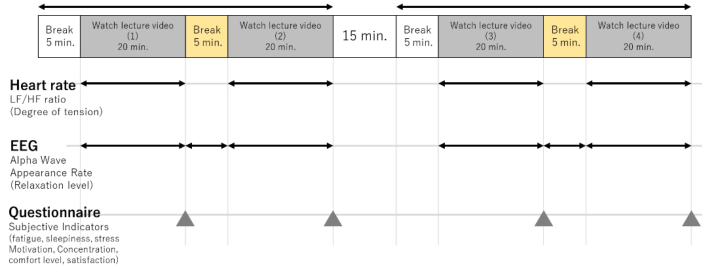
An experiment was conducted to confirm the effect of sutra chanting during breaks in on-demand lectures. The flow of the experiment is shown in Figure 1.
In the experiment, four types of lecture videos were prepared. Then, two videos were set as one set, with a 5-minute break in the middle. Each break was set to either listen to the sutra chanting or do nothing, taking the sequen- tial effect into consideration. The Heart Sutra was selected as the sutra. The Heart Sutra is one of the sutras widely read at funerals of several Buddhist sects in Japan, and it is assumed that many Japanese have heard the phrase. The content of the Heart Sutra is shown in Figure 2.
The four types of lecture video viewing were set in consideration of the order effect, and the order of the four types was set for each parti- cipant. For the selection of the four lecture videos, a preliminary video
104 Ito and Yoshikawa
Figure 3: The content of the Heart Sutra.Figure 4: Duration and timing of measurement data acquisition.
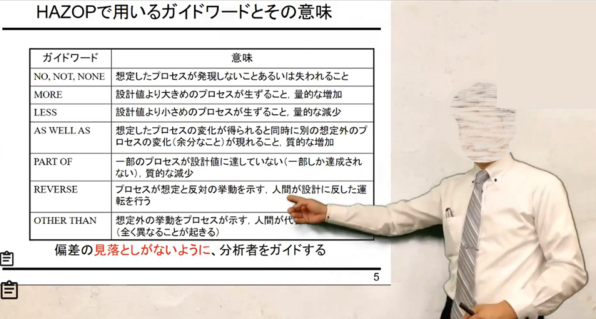
selection experiment was conducted for 10 participants in order to equalize the video contents, and four videos were selected from among seven videos. An example screen shot of the selected lecture videos is shown in Figure 3.
During the experiment, heart rate and EEG were measured as physiological indices. The heart rate EEG meter used was the Muse Brain System by Digi- tal Medic, Inc. As subjective indices, fatigue, sleepiness, stress, motivation, concentration, comfort, and satisfaction were also asked by questionnaire. The questionnaire was given on a 101-point scale from 0 to 100, with the higher the number, the greater the degree. The duration and timing of measurement data acquisition are shown in Figure 4.
At the end of each lecture video viewing, seven questionnaire items were asked as a subjective evaluation. For the heart rate, the LF/HF ratio was obtained to measure the degree of tension during lecture viewing. For the EEG, the alpha wave rate was obtained during each video viewing and during breaks to measure the degree of relaxation.
The duration of the experiment was approximately 2 hours and 30 minutes. Twenty university students participated in the experiment. This experiment was approved by the Ethics Committee of Kyoto Tachibana University.
Effects of Listening to Sutra Chanting during Breaks in On-Demand Lecture Attendance 105
Figure 5: The experimental setup.Figure 6: How to obtain the change value.
RESULTS
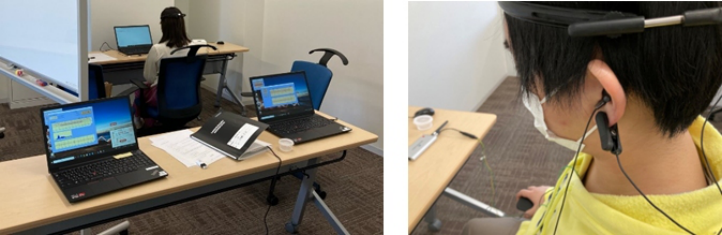
The experiment is shown in Figure 5. The picture on the left in Figure 5 shows the entire experiment, with the experimental participant positio- ned in the back and the experimenter behind the participant. The picture on the right in Figure 5 is an example of how the participant wears the electroencephalograph.
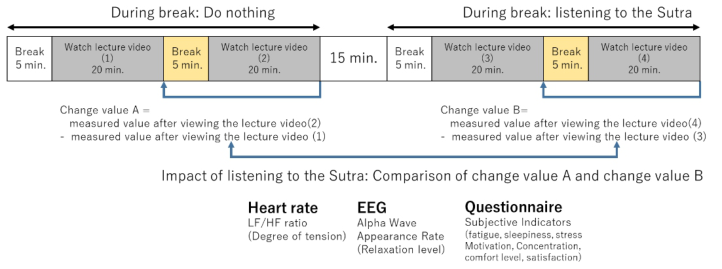
As a result, the amount of change in each item after viewing the video was compared for each case with and without viewing the sutra chanting. The method of obtaining the change values is shown in Figure 6. In one set, the video was viewed twice with a 5-minute break in between. The measured value at the end of the previous video is subtracted from the measured value at the end of the second video. In the case of a break with no activity, the value is calculated as the change value A. In the case of a break when the participants listened to the sutra chanting, it is calculated as the change value B.
Regarding the questionnaire results, data from 19 participants were inclu- ded in the analysis due to missing values in the data of one participant. The results of the questionnaire are shown in Table 1. The mean values and stan- dard deviations for the seven items are shown for the case of doing nothing (change value A) and for the case of listening to the sutra chanting (change value B). Also shown are the p-values for the corresponding t-tests and effect size d. Table 1 shows that for fatigue, the mean increase in fatigue was greater
for those with sutra chanting, p > .05. For motivation, concentration, and comfort, the mean decrease in each was greater for those with sutra, but p > .05. For stress, the mean increase was greater for those with sutra, p>.05, d = .20. For sleepiness, the mean decrease in sleepiness was greater for those with sutra, p>.05, d = .50. With regard to satisfaction, there was greater satisfaction with the sutra, p>.05, d = .30.
From the above, no significant difference in subjective evaluation was indi- cated by listening to the sutra chanting during breaks when attending the on-demand lectures.
Ten of the 20 participants were able to measure EEG and heart rate without any problems. For the data that could be measured, the alpha ratio of the EEG was calculated as an index of the degree of relaxation, and LF/HF as an index of the degree of tension. As with the questionnaire results, change values were calculated and compared, however due to the small sample size, it was not possible to properly compare the average values.
CONCLUSION
In this study, we conducted a basic examination of how to effectively attend on-demand lectures. Specifically, we focused on how to take breaks during the viewing of on-demand lectures and examined ways to provide adequ- ate relaxation and refreshment. We proposed listening to sutra chanting as an effective method for taking breaks during on-demand lectures. Liste- ning to sutra chanting was expected to calm the mind as well as provide a change of mood. An experiment was conducted to confirm the effect of listening to sutra chanting during breaks. Participants were 20 university students. As a result, when attending on-demand lectures, we sought chan- ges in subjective evaluation of listening to the sutra chanting during breaks. In the future, we would like to extract the effects indicated by physiolo- gical indices by measuring heart rate and electroencephalogram during the on-demand lectures, and to further examine effective methods of attending lectures.
Effects of Listening to Sutra Chanting during Breaks in On-Demand Lecture Attendance 107
ACKNOWLEDGMENT
This work was supported by MEXT “Innovation Platform for Society 5.0” Program Grant Number JPMXP0518071489. This work was supported by JSPS KAKENHI Grant Number 20H01748.
REFERENCES
Galusha, J. M. (1997) “Barriers to Learning in Distance Education”, Interpersonal Computing and Technology Journal, Volume 5, No. 3, pp. 6-14. Horie, Y. (1995) “A Study on Optimum Rest Pause for VDT Workers”, Journal of
Japan Industrial Management Association, Volume 46, No. 3, pp. 225–231 (in Japanese). Nagy, J. T. and Bernschütz, M. (2016) “The impact of webinar-webcast system on learning performance”, Education and Information Technologies, Volume 21, pp. 1837–1845. Phipps, R. and Merisotis, J. (1999) “What’s the Difference? A Review of Contem-
porary Research on the Effectiveness of Distance Learning in Higher Education”, Journal of Distance Education, Volume 1, No.1, pp. 102–114. Scholz, A., Wendsche, J., Ghadiri, A., U. Singh, U., Peters T., and Schneider, S. (2019) “Methods in Experimental Work Break Research: A Scoping Review”, Internati- onal Journal of Environmental Research and Public Health, Volume 16 Issue 20 p.3844, doi: 10.3390/ijerph16203844. Yoneyama, K., Komai, H., Nishiguchi, H., Okamera, T., Yokomizo Y., (1990) “Influ-
ences of rest on VDT work”, The Japanese Journal of Ergonomics, Volume 26, pp. 190–191 (in Japanese).
LISTED IN THE AHFE DIGITAL BOOKSTORE CATALOGUE
Explore the complete digital volume
Intelligent Human Systems Integration (IHSI 2023): Integrating People and Intelligent Systems
Read this individual research paper free through the original publisher, or explore the full digital proceedings book.
ISBN 978-1-958651-45-2
Explore this ISBN in the AHFE Bookstore ↗Listed in the July 2026 bookstore catalogue; search by ISBN to confirm current availability · Digital book purchase optional