Kazuki Komoriya, Munehiro Takimoto, Yasushi Kambayashi (2023). An Improved Body Operations Mitigating VR Sickness through Stepping Gaming Mat. In: Intelligent Human Systems Integration (IHSI 2023): Integrating People and Intelligent Systems. AHFE Open Access, vol. 69, pp. 94–101. https://doi.org/10.54941/ahfe1002825
Devices related to VR technology and applications using them are quite popular recently. The VR technology allows the users to perform various moving operations in the virtual space. Usually, the users use some controller devices to move in the virtual space. Since the field of vision is not linked to the physical movements of the user, only the scenes around the user changes without body movements. This mental gap between sights and bodies in the real world is said to lead VR sickness. In the previous study, we have implemented a user interface using to mitigate the VR sickness. The interface consists of a fitness device, which slides both feet to the left and right, provides moving feeling of up and down in the virtual space according to the user’s movements. In order to move forward, the users swing their arms back and forth with VR controller in both hands as if they were walking. To change direction, they swing only one arm. We have observed that this method reduces VR sickness while enhancing their immersive feeling. On the other hand, since the users’ operations are limited to gestures by legs and arms, the users cannot perform their moving operations as quick as operations using the buttons and sticks of controllers. In addition, it is hard to perform complex operations due to the nature of the fitness equipment and the acceleration of the controller held in their hands as input data. We have designed and implemented a new system that solves those problems while keeping a certain degree of immersive feeling by using a music game mat instead of fitness equipment. We have tried to extract more information from the foot movements. On the music game mat, arrows and symbols are drawn, and when the users perform stamping and apply certain pressure patterns, they can convey their wills to the system. For example, when the users want to move forward in the virtual space, they just perform stamping their right and left foot alternately on the forward-arrow symbols. The users can adjust their moving speed in the virtual space through changing the stamping frequency. If the users stamp right or left turn marks, they can change the moving directions. If the users stamp right and left initial position marks simultaneously by their feet and then release their feet after a few seconds, they can jump a certain height proportional to the stamped period. Thus, by inputting certain stamping patterns on the gaming mat, the users can perform various moving operations according to the patterns. To demonstrate the feasibility of our method, we have conducted numerical experiments on both our method and conventional methods in the same conditions. As preliminary experimental results, our method gives users more immersive feeling than conventional methods and equally excellent immersive feeling of our previous method, and to improves the response time greatly and to contribute the reduction of VR sickness as well.
Devices related to VR technology are becoming common, and the applica- tions that use them are widely spreading. The devices called Oculus Quest 2 have been sold 15 million units by June 2022 since October 2020. One of the VR services called Social VR is popular today. In order to use the service, the users wear VR head-mounted displays and communicate with others through avatars reflecting their own movements (Minhan, 2020). In a social VR, just as in the real world, the users can touch objects in the vir- tual space, approach the avatars of the other people and have conversations with them. When a user wants to move around widely in the virtual space, they can move by operating controllers in hands. In the virtual space, the range of movements is unlimited. There are many types of movement meth- ods, but VR sickness is known to occur when the field of vision does not match to the body movements in the real world. One way to match the movements of the avatar is to use walking VR equipment, such as Virtuix Omni used in amusement facilities (Sahoda and Nagao, 2020). When the user equips this device, his or her movements are conveyed to the system through walking on the sloped plate. This method is known to reduce the effects of VR sickness because the user is not only virtually moving but also actually
An Improved Body Operations Mitigating VR Sickness Through Stepping Gaming Mat 95
moving. However, the device is quite heavy, weighing more than 50 kg even for a small model. It is difficult for many users to install in their average homes.
In order to solve this problem, we propose a VR system that uses a foot- operated input mat for music games. This system allows the user to move avatar through intuitive operation. In order to demonstrate the effective- ness of our system, we conducted numerical experiments. In the experiments in which subjects moved around in a virtual space with the conventional controller and our system using the mat, and then we compared of levels of sickness using verbal ratings and the simulator sickness questionnaire (SSQ) (Kennedy et al. 1993). The SSQ is widely used to measure and to evaluate the simulator sickness. The results showed that our method redu- ces VR sickness as long as the users does not perform strenuous body movements.
BACKGROUND
There are four main types for movement methods in a VR space: controller- based, teleportation-based, motion-based, and room-scale-based (Bolet- sis, 2017). The first one is typical. This method of controls the moving speed by the degree of tilts of a controller’s stick. The second method uses the angle between a controller’s stick and the controller itself to designate the destina- tion, and teleports to that point when the stick is released (Bozgeyikli et al. 2016). Either way, the other controller, which does not contribute the move- ments, changes the direction of view. When the stick is tilted to the left or right, the field of view changes in that direction. Then, the field of vision changes without actual body movements. This cut of linkage between the view and body movements leads to the VR sickness.
A study conducted before the widespread use of VR, in which partici- pants navigated through a maze in a virtual environment, found that the method of not moving the body on the spot made less sick than moving with body actions in a virtual space (Suma et al. 2009). Recent studies have shown that using a combination of the controller and other devices while moving can reduce VR sickness (Utsumi, Takimoto, and Kambayashi 2021). Utsumi et al. built a system where the user holds the controllers in both hands and swing both arms as if walking to move forward in their virtual space, and swinging only one arm changes the direction he or she moves. In addition, they utilize a fitness apparatus that slides both feet to the left and right to implement an operation to move up and down according to the user’s movements. One problem was that their system constrains the user’s movements. The system cannot handle complex movements because their system allows fewer operations than conventional controllers. Our system attempts to overcome this problem by using a music game mat as an input device that allows complex operations. The mat has arrows and symbols drawn on it, and input is made when the user’s weight is applied on them. When the user steps a specific pattern using the mat, the operation is conve- yed to the system and the avatar moves according to the corresponding pattern.
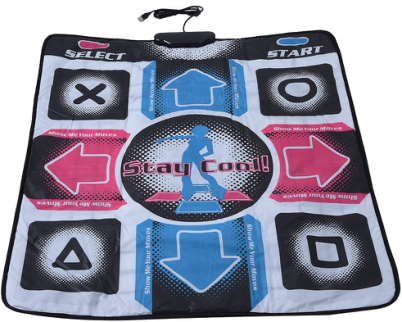
Figure 1: Music game mat used in the experiments.
IMPLEMENTATION OF MOVING METHODS We utilized Meta Quest 2 as the VR head-mounted display with an attached controller, and we took advantage of Unity to develop the system. In the case of the use of a VR controller, the users manipulate control sticks for forw- ard/backward and left/right movement; the speed is based on the degree of the tilt of the stick of the left-hand controller. Direction changes are made by rotating the right-hand controller to the left or right. To run forward, alter- nately press the triggers on the index fingers of both controllers at a certain frequency. The speed of the run is accelerated as the user press the triggers more frequently. To move up and down, simultaneously press the triggers on the index fingers of both controllers and release them simultaneously after a certain period. The distance the user jump upward depends on the period between the press and release.
In the case of using the mat, the system interprets the input patterns from the mat as the arrow key input from the keyboard via the USB port, and the user can perform various operations in the virtual space when he or she performs certain operation patterns. We utilized the music game mats (see Figure 1). When the users step the ↑↓←→marks with their feet, the system interprets the input patterns as if the keyboard arrow keys are pressed and make the users move forward/backward and left/right at a constant speed in that direction in the virtual space. To change direction, step the square mark located diagonally to the far right with the foot to rotate a certain angle to the right. When the user steps the triangle mark located diagonally to the far left, the system makes the user rotates a certain angle to the left. When the user wants to run forward, he or she steps←and →marks a certain number or more times per second. Finally, to move up and down, steps ←and →simul- taneously, then release both at the same time after a certain period to jump upward. The jumping distance corresponds to the elapsed time between the press and release.
EXPERIMENT To confirm the reduction of the VR sickness in the basic movements, we conducted experiments with fellow students. As the basic movements, we
An Improved Body Operations Mitigating VR Sickness Through Stepping Gaming Mat 97
measured VR sickness when users moving back and forth and left and right in the virtual space. We called this “Experiment 1”. In addition, we investigated VR sickness in the strenuous movement by adding jumps and dashes. We call this “Experiment 2”. We conducted Experiment 1 with seven fellow students and Experiment 2 with eight students as subjects. Verbal evaluations were made on the following scale: not feel sick = 1, a little feel sick = 2, sick = 3, seriously feel sick = 4, and almost vomiting = 5.
In Experiment 1, the subjects are instructed to move with the controller first. They use the left-hand stick to move back and forth and the right-hand stick to change direction to the left or right. After enough interval (five minu- tes), they are asked to move on the mat, step in the front, back, left, or right mark to move to the corresponding direction, and step in the right diagonal front or left diagonal front mark to change direction to the left or right. In the virtual space, we placed objects and obstacles imitating commons in town and the subjects were asked to move freely while avoiding those objects for 3-minutes. They were then asked to verbally rate their VR sickness on a 5-point scale from 1-5. In Experiment 2, in addition to the operations in Experiment 1, we added a forward running operation by alternately pressing the trigger at the index fin- ger position on the controller at regular intervals, and a time-based jumping operation by pressing the trigger for a certain period and then releasing both triggers simultaneously. With mat-based operations, we implemented addi- tional operations by stepping other marks that made other moves leftward and rightward, an operation that runs forward when stepped in alternately on the marks that made moves leftward and rightward, and a time-based jump operation when stepped in for a certain period and then released both feet at the same time.
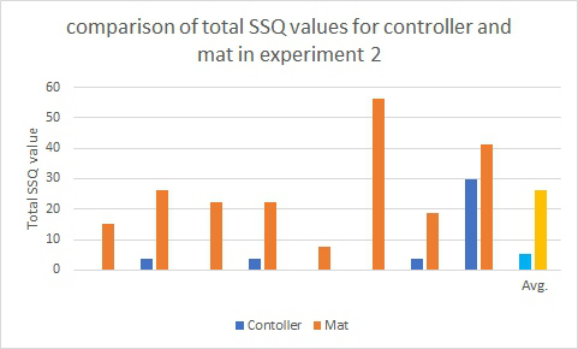
We made the subjects run through a virtual town along a certain route using both the controller and the mat. The participants are asked then to run once to memorize the route after the explanation of the operation with the controller, once more with the controller after memorizing the route, and finally once after the explanation of the operation with the mat, we mea- sured the running time. After that, the participants were asked to verbally rate the degree of sickness on a 5-point scale. In Experiment 2, we evaluated the effects of VR sickness using an additional 16-item questionnaire called the simulator sickness questionnaire (SSQ), which is used to assess simulator sickness (Kennedy et al. 1993). In the questionnaire using the SSQ, partici- pants are asked to answer to 16 item questionnaires with not at all = 0, a little = 1, moderately = 2, and a great deal = 3. The total scores, which is the sum of the 16 items, are then compared.
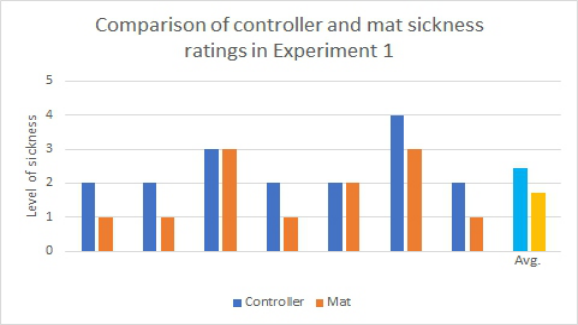
Figure 2 shows the results of Experiment 1. We can observe that everyone felt less sick on the mats than using the controllers. This result shows body movements reduce VR sickness. They are the same results as Utsumi’s inve- stigations. The operation of stepping and keeping certain positions on the mat in the direction the user wants to face may have been less uncomfortable because his or her the centre of gravity is natural, and that fact contributes stability.
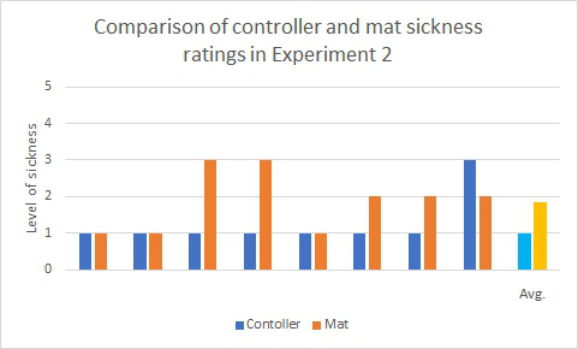
Figure 2: Comparison of controller and mat sickness ratings in Experiment 1.Figure 3: Comparison of controller and mat sickness ratings in Experiment 2.
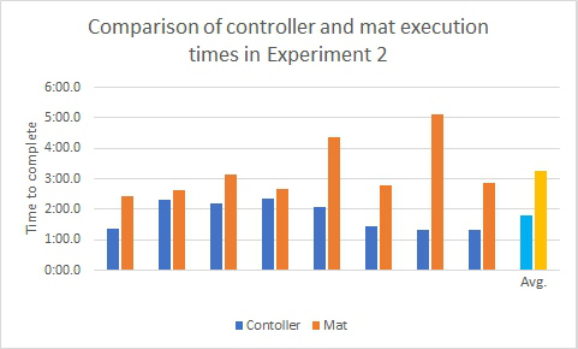
Figures 3–5 show the results of Experiment 2. As can be seen from the results, everyone was sicker on the mat than using the controller in both the SSQ and verbal evaluations. One factor contributing to this is that in Experiment 2, the experiment was conducted after first telling the partici- pants that they would be measuring time, so they would need to run all the time during the experiment. Therefore, in contrast to Experiment 1, moving with a mat requires constant stepping. This may have caused a blurring of the centre of gravity and led to feel sick. When compared in terms of exe- cution time, the controllers had shorter execution times, even on average, and there was little difference between the slowest and fastest times. On the other hand, there were many differences in the time required on the mat. This is because during the footsteps on the mat, the step shifts and unin- tentionally steps the wrong marks to change direction, which takes time to correct.
An Improved Body Operations Mitigating VR Sickness Through Stepping Gaming Mat 99
Figure 4: Comparison of controller and mat execution times in Experiment 2.Figure 5: Comparison of total SSQ values for controller and mat in Experiment 2.
DISCUSSION
Many subjects reported that moving manoeuvres with the controller made sicker than those with the mat in Experiment 1, while in Experiment 2, both verbally and in terms of total SSQs, subjects reported that manoeuvres on the mat made sicker.
The reason for this is that when subjects raise their legs alternately on the mat, it is difficult for them to stabilize the position of the centre of gravity. Simulator sickness is likely to occur in situations where there is a large move- ment of the centre of gravity (Inoue, Skaguchi and Tsuru 2020). Another reason is that the subject’s body gradually shifted during the operation of stepping on the marks on the left and right sides of the mat alternately and accidentally stepped on the mark used to change direction. In such a situa- tion, subjects must correct their direction, and this may cause a blurring of the centre of gravity, too. Adding a method to steady the centre of gravity
may help reduce sickness. Furthermore, compared to running in reality, there is no sound of wind passing through or the feeling of air hitting the body in the virtual space. Playing engine sounds and vibrations while riding in a vehicle in a virtual space is known to reduce sickness (Sawada et al. 2020). If wind is applied to the subject at the right time when he or she runs, or if the sound of shoes hitting the ground is played at the right time when he or she steps on the mat, it might help to reduce sickness. In the verbal questions, we asked the participants, between the music game mat and the controller, which was easier to use. Almost all the participants answered that they pre- ferred the controller in both Experiments 1 and 2. The reason for this can be attributed to the fact that they are accustomed to using the controller in their daily games.
Comparing the total SSQ to the perceived VR sickness, some participants reported high values for SSQ but low values for the perceived VR sickness. A few subjects who reported VR sickness had little dizziness and almost no visual effects. We have to investigate how and why the difference between the subjective impression and the objective effect is caused in the VR world.
CONCLUSION AND FUTURE WORK In this paper, we developed a VR system that mitigates VR sickness using a music game mat. The result of experiments we have conducted to compare our method that the user performs on the mat with the conventional method the user uses a controller tells us that stepping and holding the marks on the mat in the desired direction were less uncomfortable than merely using the controller, because the user’s centre of gravity is more natural and stable than the otherwise. In the running and jumping operations, results shows that users felt sicker in the VR operation on the mat than the conventional one. This is probably due to the difficulty in stabilizing the centre of gravity. By adding a method to stabilize the centre of gravity may reduce motion sickness. For future work, we plan to devise the users can check and confirm their positions. This would reduce the number of maloperations and thus prevent motion sickness.
REFERENCES
Boletsis, C. (2017), “The new era of virtual reality locomotion: a systematic literature review of techniques and a proposed typology,” in: Multimodal Technologies and Interaction, Volume 1 No. 4, pp. 1–17. Bozgeyikli, E., Raij, A., Katkoori, S. and Dubey, R. (2016), “Point & Tele-
port Locomotion Technique for Virtual Reality,” in: Proceedings of the 2016 Annual Symposium on Computer-Human Interaction in Play (CHI PLAY ‘16), pp. 205–216, Austin, United States. Inoue, H., Sakaguchi, K. and Tsuru, K. (2020), “VR sickness detection by posture fluctuation,” in: “Hinokuni - Land of Fire” Information Processing Symposium. pp. 1–7. In Japanese. Kennedy, R. S., Lane, N. E., Berbaum, K. S. and Lilienthal, M. G. (1993), “A simulator
sickness questionnaire (SSQ): A new method for quantifying simulator sickness,” International J. Aviation Psychology, Volume 3, pp. 203–220.
An Improved Body Operations Mitigating VR Sickness Through Stepping Gaming Mat 101
Minhan, W. (2020), ”Social VR: A New Form of Social Communication in the Future or a Beautiful Illusion?” in: 2020 4th International Conference on Machine Vision and Information Technology (CMVIT 2020), Volume 1518, Sanya, China. Sahoda, K. and Nagao, T. (2020), “Sensibility evaluation of virtual reality space
by walking device,” in: The 82nd National Convention of IPSJ. Vol.2020. No.1. pp. 149–150. In Japanese. Sawada, Y., Itaguchi, Y., Hayashi, M., Aigo, K., Miyagi, T., Miki, M., Kimura, T.
and Miyazaki, M. (2020), “Effects of synchronised engine sound and vibration presentation on visually induced motion sickness,” in: Scientific reports, Volume 10 No. 1, pp. 1–10. Suma, E., Finkelstein, S.L., Reid, M., Ulinski, A. and Hodges L.F. (2009), “Real walking increases simulator sickness in navigationally complex virtual environments.” in: 2009 IEEE Virtual Reality Conference (VR2009). pp. 245–246, Lafayette, Louisiana, USA. Utsumi, N., Takimoto, M. and Kambayashi, Y. (2021), “Intuitive Body Operations
Suppressing VR Sickness,” in: Human Systems Engineering and Design (IHSED 2021): Future Trends and Applications. Volume 21.
LISTED IN THE AHFE DIGITAL BOOKSTORE CATALOGUE
Explore the complete digital volume
Intelligent Human Systems Integration (IHSI 2023): Integrating People and Intelligent Systems
Read this individual research paper free through the original publisher, or explore the full digital proceedings book.
ISBN 978-1-958651-45-2
Explore this ISBN in the AHFE Bookstore ↗Listed in the July 2026 bookstore catalogue; search by ISBN to confirm current availability · Digital book purchase optional