Fusheng Jia, Xinyu Chen, Renke He (2023). Conversational Interaction Design for shopping apps: Situational awareness theory. In: Intelligent Human Systems Integration (IHSI 2023): Integrating People and Intelligent Systems. AHFE Open Access, vol. 69, pp. 925–935. https://doi.org/10.54941/ahfe1002918
Conversational interaction is crucial to the development of e-commerce. In order to meet the needs of users, more and more enterprises begin to build chatbots based on conversational interaction. Conversational chatbots are becoming more and more popular, gradually becoming the preferred way for users to communicate with enterprises. Chatbots can provide users with personalized experience and high-quality services. However, there is no complete and systematic design principle to guide the design of its new conversational interface interaction. Many designers have borrowed the methods of social chat software for their design, which is lack of pertinence and difficult to ensure the rationality of interaction. The academic research on the shopping behavior of chatbots is relatively few. Even the Taobao APP, which is frequently used at present, has not formed a good user experience in the design of conversational interaction. How to improve the experience of conversational interaction is an urgent research topic. From the perspective of user experience, the behavior mode, information expression and thinking mode displayed by conversational chatbots should conform to the thinking and behavior characteristics of users. The design of conversational interaction should pay special attention to user experience in addition to technical competition. The social shortcomings of e-commerce sites are a major obstacle to the growth of companies' online businesses, and there is a lot of distrust among users of such technologies. With the disappearance of the structure and formality of the session, the difficulty of maintaining a good user experience increases and the system loses control of the human-computer interaction experience. In most studies, the focus is on the usability of conversational interactions and the ability to identify user queries.This paper mainly discusses the application of context awareness theory in conversational interaction of shopping APP, proposes a conversational interaction design process of shopping APP based on context awareness model and KANO-AHP model, and explores and summarizes the user experience-oriented conversational interaction design strategy of shopping APP by obtaining user needs qualitatively and quantitatively. On the basis of the context awareness theory, the user's experience demand set of four dimensions of conversational interaction vision, interaction, function and emotion of shopping APP is obtained based on the context awareness model from three aspects of user context factors, product context factors and environmental context factors. The KANO model is used to screen and classify the obtained demand set. The hierarchical structure of conversational interactive user needs of shopping APP is obtained. Then combined with the analytic hierarchy process (AHP) to calculate the weight of each demand and order the importance, finally put forward the design strategy. Based on the situation perception theory and KANO-AHP model to analyze user needs, the design strategies and suggestions of conversational interactive experience of shopping APP are proposed from four aspects of user visual interface experience, functional experience, interactive experience and emotional experience. In particular, some strategies such as personality characteristics, high-context conversation mechanism and the same emotional feedback mechanism are proposed to improve the user experience and satisfaction of conversational interaction of shopping APP. However, this paper only conducts in-depth research on the user side of conversational interaction of shopping APP, and obtains various experience design principles based on users. However, in the process of shopping, it is usually the transaction between merchants and users, and the subsequent research should be carried out in combination with the experience needs of merchants, so as to balance users and merchants in terms of experience.
In the context of digital business, more and more service providers are explo- ring and using conversational interaction based on text chatbot to interact with customers of consulting information services. Conversational intera- ction is based on chatbot as the interactive entrance, using natural language to communicate with real people, assisting or replacing artificial dialo- gue, enabling the whole process of dialogue to achieve cost reduction and efficiency increase. Mobile terminal conversational application can reduce the response time and workload for enterprises, enhance customer service,
and improve satisfaction and participation. By studying the message push mechanism of conversational chatbot, scholar Dong Hao summarized the functional requirements including interaction mode, message format, infor- mation transmission and other aspects. Using cluster analysis, Tan Menghua et al. analyzed the dialogue strategies of 6 chatbots, and proposed that their dialogue strategies should follow daily expression and emotionalization, and avoid the robots to ask themselves questions and answer questions. When interacting with conversational chatbots, the accuracy of feedback informa- tion, the adaptability of prompt information and the emotionalization of expression can improve the usability and usability of chatbots.
Based on literature search, it is found that domestic scholars have done a lot of research on voice interactive robots, involving the design and implementa- tion of voice interaction, system development, interaction design experience and other aspects. However, few scholars have studied chat robots based on text conversational interaction. Currently, they still focus on deep lear- ning and key technology research. The research on shopping chatbot also focuses on the development of key technologies, and the domestic acade- mic research is basically blank and only stays in the development research stage. This study is based on the theory of situational awareness. In the first step, through the insight analysis of the conversational interaction scenarios of shopping apps and user demands, user demands in various situations are explored from multiple dimensions; in the second step, the ANO-AHP model is adopted to determine the attributes of user demands and prioritize them, providing theoretical guidance for the conversational interaction design of shopping apps.
STUDY ON CONVERSATIONAL INTERACTION OF SHOPPING APP BASED ON SITUATIONAL AWARENESS The conversational interaction process of shopping APP is mainly carried out through the conversational Interface. The conversational interaction inter- face (CUI) refers to the interface used by the text-based chatbot to interact with users. In the conversational interactive interface, the language informa- tion generated by human-computer dialogue mainly exists in the interface in the form of text. Users can input modal information such as text, voice, graphics or video, and the system can output the same modal information. In terms of the uses of conversational chatbots, scholar Sahaja et al. propo- sed in their research that conversational chatbots are usually used to serve users or obtain information and other ways. Conversational chatbots can provide real-time and personalized services under appropriate circumstances, improve users’ experience, and even provide spiritual companionship and other services. Conversational interaction of shopping apps provides users with convenient and mobile services, and its user experience involves the whole process of product use, which directly affects users’ subjective sati- sfaction and willingness to continue using the product. Scholars Luo Shijian and others proposed that user experience is a context-based activity, which needs to be realized through the “element connection” between users and the context. Specific products must be placed in a certain context for perception
Conversational Interaction Design for Shopping Apps: Situational Awareness Theory 927
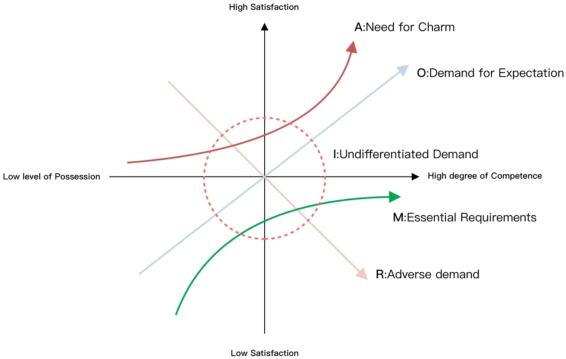
Figure 1: KANO model.
and analysis, so as to generate subjective and objective evaluation, so as to make user experience meaningful.
CONVERSATIONAL INTERACTION DESIGN METHOD OF SHOPPING APP BASED ON SITUATIONAL AWARENESS Application of ANO-AHP Model in Context Awareness
The ANO-AHP model can effectively classify and quantify user requirements, and reduce the subjective prediction of designers, which is the core step in the design stage. KANO model is mainly used to classify and prioritize vari- ous user needs, and to construct a nonlinear relationship between the degree of various user needs and user experience satisfaction. The characteristics of KANO model can be divided into five categories, including necessary demand, expected demand, charm demand, undifferentiated demand and adverse demand. As shown in Figure 2, the horizontal axis represents the degree of user demand and the vertical axis represents user experience sati- sfaction. The core of analytic hierarchy process (AHP) is based on qualitative and quantitative research. It simplifies problems with complex structures and changeable objectives, which is convenient and efficient. In the actual appli- cation process, since the initial calibration of AHP is determined by expert users, it differs from the real needs of users to a large extent, so combining AHP with KANO model can avoid such differences. Based on this model, Guo Xinming et al. analyzed the demand preferences of O2O mini program users and proposed design strategies.
Conversational Interaction Design Process of Shopping APP Based on Situational Awareness Model The design process based on situational awareness takes context as the core. The situational awareness design model proposed by Endsley divides it into three stages: perception, understanding and prediction. The perception stage
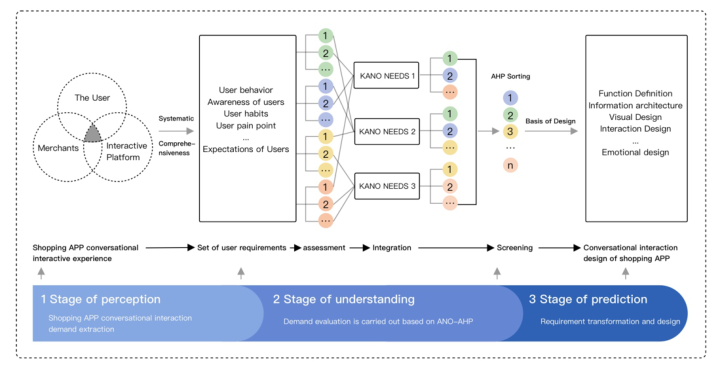
Figure 2: Conversational interaction design process of shopping APP based on context awareness model.
is to place the conversational interaction of shopping APP in the real use environment of users. By analyzing the cognitive habits and use behaviors of users, users’ expectations and demands and pain points encountered in the use process are systematically obtained, and user demand sets are formed. The understanding stage is the process of reasonably evaluating, integrating and prioritizing the set of user needs obtained from the perception stage, and is the core of the analysis of user needs. In the understanding stage, the KANO model and AHP are successively used to classify and screen the user demand set, calculate the weight of the demand, and finally prioritize the demand to obtain the user’s core demand points. The prediction stage is the process of transforming and designing the core demand points of the users after under- standing, which provides the design basis for the later design practice, and finally produces the design of the conversational interaction of the shopping APP centered on the user’s demand. The conversational interaction design process of shopping APP based on the situational awareness model is shown in Figure 3, which provides a qualitative and quantitative design method to help designers understand the mapping relationship between users’ real needs and design goals.
SITUATIONAL W\AWARENESS BASED SHOPPING APP CONVERSATIONAL INTERACTION USER DEMAND EXTRACTION Classification of Situational Factors Influencing User Needs of Shopping APP Conversational Interaction
In order to more accurately obtain the real needs of users based on situa- tional awareness, the first step must be clear which situational awareness factors have a mapping relationship with the user needs of shopping APP conversational interaction. According to the development process of con- text, context awareness includes user context, device context, task context,
Conversational Interaction Design for Shopping Apps: Situational Awareness Theory 929
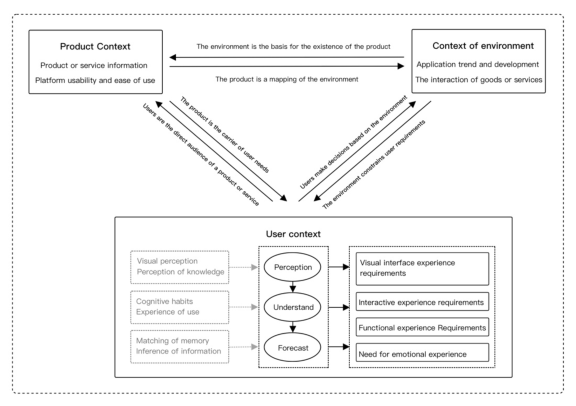
Figure 3: Influencing factors and relationships of context perception of shopping app conversational interaction.
environmental context, social context and spatio-temporal context. From the perspective of users, context awareness includes user context, tempo- ral context, social context, computational context and physical context. Dey summarized situational information into user, environment, entity, resource and time. There were differences in the definition and classification of situ- ational perception factors among various researchers, which was caused by the differences between the research objects themselves and the specific usage situations of users.
The conversational interaction use scenario of shopping APP is carried out around the user-commodity-conversational interaction platform, including three stages before, during and after the consumption of users. Situational factors at different stages will cause differences in user demands. Studies have shown that user behavior characteristics, product usability and usage environment have significant impacts on the experience of consumption platform. Luo Shijian et al. obtained user demand through human-product- environment relationship model and proved its significant effectiveness. In summary, taking user-product-environment as the overall interaction system, based on the context awareness process, the influencing factors of users’ conversational interaction situational perception of shopping apps are divided into user situational factors, product situational factors and environmental situational factors.
Shopping APP Conversational Interactive User Demand Extraction Based on the classification of influencing factors of conversational intera- ctive situational awareness of shopping apps, the situational awareness model is used to obtain users’ all-round experience needs from three aspects: user situational factors, product situational factors and environmental situational
factors. The three situational factors influence each other, and the relation- ship between situational awareness factors and situational awareness model is shown in Figure 4.
User context, including individual characteristics, cognitive ability, con- sumption behavior and social experience, is the first element of situational awareness and an important factor in design research. When users interact with shopping apps in conversational mode, their personal cognitive habits, using experience and behavioral characteristics will have an impact on their decision-making behavior. For example, different users’ personal interests and cognitive habits may lead to different demands for services. Some users are keen on tailor-made services, while others prefer popular and mainstream services. Context and product context are the channels of users’ situational perception information, and they work together on users’ situational perce- ption. Again, the situational awareness model is used to obtain the visual, interactive, functional and emotional experience needs of users in the three stages of perception, understanding and prediction, which can provide help for the construction of interactive experience strategy in the next step.
Product context includes the product or service information displayed by the conversational interaction interface and the usability and ease of use of the conversational interaction platform, which is the main bearing factor to meet user requirements. It is mapped from the user context and the envi- ronment context. For example, the higher the authenticity and usefulness of the product or service information, the higher the user’s satisfaction with the service, thus reducing the user’s decision cost. The interaction design and visual design of the conversational interactive interface of shopping apps will have a direct impact on user experience, and in some cases will also affect the way of product or service information display.
Environmental context, including macro environment and micro environ- ment, is the background of the interaction between users and products or services. The macro environment of conversational interaction of shopping APP refers to application trend, social development status, trend and public aesthetic, etc. Micro-environment refers to the state of the environment in which users interact with it. It is specifically the process in which users use conversational interactive interfaces to communicate with merchants about products or services. For example, users will pay attention to the reputation and applicability of products before consumption, while they will pay atten- tion to the specific physical characteristics such as the price, shape and color of products during consumption. Both macro and micro environments have an impact on users’ decision-making behavior.
SHOPPING APP CONVERSATIONAL INTERACTIVE USER DEMAND EVALUATION BASED ON KANO-AHP MODEL Based on the KANO questionnaire design criteria, the questionnaire was desi- gned for the user’s demand set, and the user was required to evaluate the corresponding questions from both positive and negative aspects, namely the user’s subjective feelings when the demand is met and when the demand is not met. This questionnaire was distributed online, and 168 questionnaires
Conversational Interaction Design for Shopping Apps: Situational Awareness Theory 931
were collected, 12 of which were evaluated in short time. Finally, there are 156 questionnaires that meet the research objectives. The basic information is shown in Figure 3. The ratio of male to female is close to 1:1, users aged between 20 and 35 account for 86%, students account for 37%, and those with bachelor’s degree or above account for 96%. The survey results can reflect users’ demand for conversational interactive experience of shopping apps.
Shopping APP Session Interactive User Demand Weight Results The first-level demand of users for conversational interaction of shopping APP is shown as (O) > (M) > (A) > (I). The higher the user’s expectation and demand, the higher the user’s satisfaction will be, and the necessary demand will not increase the user satisfaction with the improvement of the degree of possession. On the contrary, when the degree of possession of the neces- sary demand is low, the user experience will be reduced, while the degree of possession of the charm demand will bring users unexpected surprises and increase their satisfaction.
When designing the experience of conversational shopping APP, the first consideration should be given to the expectations and demands of users, and the focus should be on satisfying the charm needs of users, bringing surprises to users and improving their satisfaction with experience as much as possible. The top ten items of the comprehensive weight of the user’s secondary needs from high to low are: Set specific personality characteristics (professiona- lism, trust), establish emotional connection with users, improve professional degree and trust (0.244), recommend high-quality products according to user characteristics, and attach recommendation reasons, recommendation index, recommendation content is not only the latest products (0.205), natural lan- guage expression of dialogue appropriate, use pleasant tone or expression, Make the dialogue more temperature (0.181), demand information highli- ghted, provide historical information in line with the user’s memory (0.173), user selection list centralized display, Avoid only appearing in the historical information (0.171), the interface shows a strong sense of interaction (0.120), the navigation bar changes dynamically according to the user’s shopping process or context information (0.115), the robot’s warm and positive perso- nality characteristics are conducive to its specialization, which can improve the user’s tolerance for its mistakes (0.112), personalized recommendation of products. Smart shopping reminder, avoid repeated recommendation of goods (0.105), use high-context dialogue form, promote communication, more closeness (0.091).
The lightweight design of interactive interface mainly includes layout perce- ption optimization and prominent visual design elements. The performance
of conversational interactive interface is the overall layout of information content, specifically including the organization and orderly of visual infor- mation. The performance of conversational interface can be divided into functional layer and content layer during design. When users interact with a conversational interface, they expect the interface information to be easy to read and the layout to be flexible, concise, and professional. According to the principle of closure and continuity in Gestalt theory, the functional layer and the content layer are distinguished by lines, wire frames and other elements. According to the principle of similarity and proximity, the specific information in the content layer of the interface is distributed, so that users can easily perceive the relevance between similar information and detailed information.
Improve the hierarchical visual representation of information, enhance the comparison of information attributes, and differentiate similar contents. The conversational interface framework should guide users to focus on the important information, which can be arranged based on the differences of information attributes. Different color representations can also distinguish information attributes.
Shopping APP Conversational Interactive Functional Experience Design Strategy A personalized recommendation mechanism is built. The basic active recom- mendation is that after the chatbot obtains the user’s consultation informa- tion on a certain product, it directly recommends the related and similar products of the product it consults. User consultation recommendation is a product result presented based on user’s personal information and pro- duct demand information. It is a typical feature of passive selection and the most commonly used form of product recommendation for chatbots. The user consultation recommendation has the following two advanta- ges. First, the system recommends the most suitable products according to the user information and commodity demand information to realize the form of personalized recommendation. Secondly, the products recom- mended by personalized will be prioritized according to the different attri- butes of the products to realize the mechanism of commodity decision assistance.
Provide a commodity decision - making mechanism to guide users to express commodity needs. The system can guide the user to input the com- modity information, which can quickly obtain the user’s needs, reduce the user’s information input time and improve the shopping efficiency. There are several strategies to guide users to express their demand for commodities: first, focus on the description of the main characteristics of commodity infor- mation; second, prioritize the overall information of commodities. Thirdly, the digital expression of commodity information is carried out. Based on the characteristics of users’ shopping behavior, the digital expression is carried out on the praise rate, the number of likes, the recommendation heat value and the sales volume of the commodity.
Conversational Interaction Design for Shopping Apps: Situational Awareness Theory 933
Shopping APP Conversational Interactive Experience Design Strategy Improve the user’s sense of session-oriented control, and gradually transfer the dominance to the user according to the user’s usage time. With the gene- ration of multiple rounds of conversations, the user’s sense of session control will also improve.
Fault-tolerant design to build conversational chatbots’ ability to handle conflict or failure situations. The specific performance is that the system pro- cesses the demand information input by the user incorrectly, and the system cannot identify the demand information input by the user. In this case, the system needs to guide the user to communicate on a new topic, and inte- grate the emotional expression to explain the reason to the user gently. The fault-tolerant design should give the chat machine the forms of humanizing expression, positive feedback, personified interactive expression and timely guidance, so as to improve users’ tolerance for their mistakes.
Shopping APP Conversational Interactive Emotional Experience Design Strategy It is helpful for users to judge chatbot behavior by setting certain personality characteristics. The setting of personality characteristics is mainly reflected in the form of dialogue and image design. The personality characteristics that conform to the user’s cognition can strengthen the sense of trust and increase the emotional connection.
Emotional dialogue forms, in a closed interactive system, should also be involved in the emotional expression of chatbots on the premise of ensuring the accuracy of answers. For users’ input with the same semantic meaning and different tone, conversational chatbots should not only give back answers at the semantic level, but also recognize users’ current emotions, and provide information feedback according to their current emotions to improve users’ emotional experience.
Conversational chatbots should not only answer users’ questions accura- tely, but also choose corresponding feedback information adaptively accor- ding to different emotional expressions. Establish positive emotional gui- dance to improve the simplicity of interactive text information. Chatbots should use simple and understandable information to give feedback, so as to solve problems and satisfy users’ experience. Perceives semantic similarity. For example, if the user input the semantically similar text information twice in a row, the system should judge that the output feedback information does not solve the user’s problem.
With the conversation mechanism of high context, with the deepening of information dialogue, the information acquisition accuracy of both sides will gradually increase, and the external stimuli of information will also increase with the deepening of the dialogue. A more important feature is that multiple rounds of dialogue between two interacting parties lead to the increase of context-related influencing factors and the decrease of users’ accu- rate recognition rate of information. Therefore, it is necessary to improve
the efficiency of dialogue between two parties by using relevant forms of context.
CONCLUSION
The situational awareness theory is applied to the analysis of conversational interactive user experience of shopping APP, and the situational awareness model is used to obtain users’ all-round demands for conversational intera- ctive experience of shopping APP from three aspects: user situational factors, product situational factors and environmental situational factors. It inclu- des 4 demands for visual experience, 4 demands for interactive experience, 7 demands for functional experience and 9 demands for emotional experience. The KANO model was used to screen out the necessary needs, expected needs and charm needs, and the weight values of all kinds of primary and secondary needs were calculated through the analytic hierarchy process. The weights were sorted according to the obtained weight values, and reasonable and effe- ctive suggestions and design strategies were provided for visual experience, interactive experience, functional experience and emotional experience. Pro- vide effective guidance for shopping APP conversational interaction design, and gradually improve user satisfaction.
REFERENCES
Bhawiyuga A, Fauzi M A, Pramukantoro E S, et al. Design of E-Commerce chat robot for automatically answering customer question[C]//2017 International Confere- nce on Sustainable Information Engineering and Technology (SIET). IEEE, 2017: 159–162. CHU Xiao-hong. The cognition and communication of Gestalt formal aesthetics in
layout design[C]//.2019 Proceedings of the national high end Forum on education and teaching innovation and development (Volume 9). 2019:21–23. JIA Fu-sheng, HE Ren-ke. Research on experience design of shopping chat robot based on cognitive mechanism [J]. Design, 2022, 35(04):18–21. JIA Fu-sheng, HE Ren-ke. Research on user cognition oriented shopping chat robot interface design[J]. Packaging engineering, 2022, 43(16):92–100. DOI: 10.19554/j.cnki.1001-3563.2022.16.009. LUO Shi-jian, ZHU Shang-shang, YING Fang-tian, etc. Context based user expe-
rience design in mobile phone interface[J]. Computer Integrated Manufacturing Systems, 2010,16(2): 239–248. LV Han-xiao, WANG Pei-lin, XU Jun-hui, WANG Jun-xian. Analysis of College Students’ willingness to use online health information based on Technology Acceptance Model[J]. Information exploration, 2019(09):38–44. Marwade A, Kumar N, Mundada S, et al. Augmenting e-commerce product recom-
mendations by analyzing customer personality[C]//2017 9th International Con- ference on Computational Intelligence and Communication Networks (CICN). IEEE, 2017: 174–180. Purcarea I M. Digital Marketing Trends Transforming Marketing. Digital Marketing to Patients[J]. 2019. QIN Jing-yan, WANG Yun-zhao. Research on conversational voice interaction
system in high and low context [J]. Packaging engineering, 2021, 42(10):85–91. DOI: 10.19554/j.cnki.1001-3563.2021.10.012.
Conversational Interaction Design for Shopping Apps: Situational Awareness Theory 935
Rietz T, Benke I, Maedche A. The impact of anthropomorphic and functional chatbot design features in enterprise collaboration systems on user acceptance[J]. 2019. Sahaja G, Priyanka V, Preetiuppala MP, et al. Chatbot-a variety of lifestyles[J].
Journal of Applied Science and Computations, 2019, 6(1): 367–378. Setiaji B, Wibowo F W. Chatbot using a knowledge in database: human-tomachine conversation modeling[C]//2016 7th International Conference on Intelligent Systems, Modelling and Simulation (ISMS). IEEE, 2016: 72–77.
LISTED IN THE AHFE DIGITAL BOOKSTORE CATALOGUE
Explore the complete digital volume
Intelligent Human Systems Integration (IHSI 2023): Integrating People and Intelligent Systems
Read this individual research paper free through the original publisher, or explore the full digital proceedings book.
ISBN 978-1-958651-45-2
Explore this ISBN in the AHFE Bookstore ↗Listed in the July 2026 bookstore catalogue; search by ISBN to confirm current availability · Digital book purchase optional