Zelei Pan, Haiyan Wang, Jinchun Wu, Quan Chen (2023). Non-visual effects of CCT on drivers, evidence from EEG. In: Intelligent Human Systems Integration (IHSI 2023): Integrating People and Intelligent Systems. AHFE Open Access, vol. 69, pp. 1–7. https://doi.org/10.54941/ahfe1002815
Currently, the mechanisms of non-visual effects of road lighting environments on drivers are unclear. In this paper, Electroencephalography (EEG) and other measures were used to record physiological and psychological indicators during driving at different correlated color temperature(CCT) levels (3500k vs. 4500k vs. 5500k vs. 6500k), with the aim of preliminarily verifying the existence of non-visual effects of the lighting environment on drivers on urban motor vehicle roads. The results suggest that 3500k and 4500k help to improve the subjects' mood, while 5500k and 6500k are more likely to induce negative emotions in the subjects.
Road lighting conditions are a key factor in road safety (Schreuder, 1998). More than half of all traffic fatalities occur at night compared to daytime, and good lighting can significantly reduce the incidence of traffic accidents (Elvik, 1995). In the past, studies on road lighting and driving safety have mainly focused on the effects of lighting conditions on drivers’ visual performance. In 2001, a type of retinal ganglion cell called intrinsically photosensitive reti- nal ganglion cells (ipRGCs) was discovered (Brainard et al., 2001; Thapan, Arendt and Skene, 2001), which is most sensitive to blue light between 460 and 490 nm (Bailes and Lucas, 2013). It has been suggested that ipRGCs are able to trigger neural projection responses in different areas of the brain when processing light signals, which in turn affects hormone secretion, mood, alertness and other cognitive processing (Van Bommel, 2006). Over the past 20 years, a large number of studies have investigated the effects of indoor lighting on human mood and performance.
However, relatively little research has been conducted on the non-visual effects of road lighting environments on drivers. Studies have focused on the non-visual effects of CCT conditions in tunnel on drivers (Domenich- ini et al., 2017; Li et al., 2021). However, different lighting design criteria need to be met for different road types and different lighting conditions have different non-visual effects on human, so the findings of the study on the non-visual effects of tunnels lighting are not universal. When driving on out- door sections, drivers are faced with more complex driving scenarios, which
requires more effort to process various information and exposes drivers to more potential hazards. Therefore, urban motorways have been chosen as the type of roadway to be studied in this paper. Furthermore, most studies have mainly used behavioural data and subjective questionnaires as asses- sment tools, but both of them are subject to subjective factors to a certain extent, affecting the objectivity of the results. Therefore, this paper chose EEG as one of the evaluation methods, which is considered to be the most important and reliable, recording the signals from the potentials of the human scalp in real time (Kar, Bhagat and Routray, 2010).
Our team has now completed a series of studies on the non-visual effects of urban motorway lighting on driving safety. The effects of different CCT on drivers’ mood, alertness and fatigue were assessed through the collection of the EEG signals, critical flicker frequency (CFF), reaction time (RT) and the results of the subjective evaluation questionnaire. The aim of this study is to verify the existence of non-visual effects of road lighting on drivers and to summarise their specific effects, and to provide a reference basis for the establishment of a comprehensive non-visual effects evaluation system for the optimal design of urban road lighting. In this paper, the effects of the CCT of the lighting on urban motorways on the mood of the driver is the main element being discussed.
METHODS
Design A repeated-measures design was employed in the current study. Participants were exposed to 4 light conditions (CCT level:3500 vs. 4500k vs. 5500k vs. 6500k, Eye-level illumination: 3lx, control) for 50 minutes in a counterba- lanced order with 4 days interval. All participants were asked to participate in the experiment at the same time each time (19:00–20:10). This laboratory study was executed from May to August 2022.
Participants 21 healthy young volunteers with a driver license (mean (M) ± standard deviation (SD) = 23.8 ± 0.96, 16 males, 5 females) were recruited from the Southeast University. The average number of years of driving experie- nce for participants was 4.5 ± 1.01 years. All the participants had normal vision and were right-handed. According to the results of the Beck Depres- sion Inventory-II (Beck et al., 1988; Beck, Steer and Brown, 1996), all subjects were free of mood disorders, chronic diseases. Prior to the week of participa- tion, all subjects were asked to have a normal routine. All subjects followed a strict routine and avoided exposure to special light for one week prior to par- ticipation in the experiment, with sufficient sleep (about 8h) the day before the experiment and no coffee, strong tea, etc.
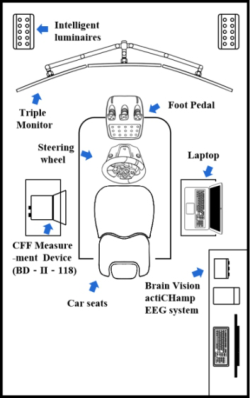
Experiment Setup and Light Manipulation A darkroom (4m*2.5m*3m) was built to meet the lighting conditions requi- red for the experiments. Except for the screen presenting the virtual driving
Non-Visual Effects of CCT on Drivers, Evidence From EEG 3
Figure 1: Top view of the layout of the laboratory.Table 1. Parameter setting for simulated light environments.
scenario, all other illuminated devices in the laboratory are covered with bla- ckout fabric. No external noise interference during the experiment and the temperature in the laboratory is 26
C.
The laboratory is equipped with a driving simulation system, which con- sists of a driving simulator and a simulated driving scenario design program. The virtual scenario was built in SACNeR Studio. A pre-experiment was con- ducted to model the lighting in the virtual driving scene with the same RGB values and equivalent luminance as the external luminaires to ensure that the simulated driving scene lighting was consistent with the actual light environ- ment in terms of visual colour and luminance perception. At the same time, the brightness of the display was adjusted to 10%.
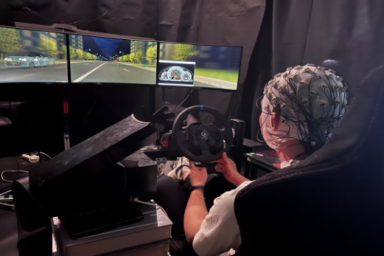
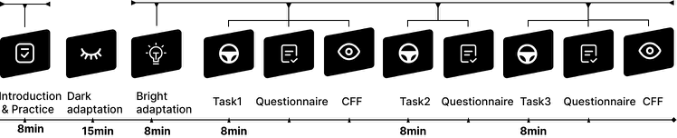
PROCEDURE Three tasks were used to assess the effects of different CCT on participants’ mood. Task 1 simulated a general driving passage scenario (no other stimu- lus targets on the road except for the surrounding traffic). During this phase, participants were asked to control the vehicle at a constant speed (60km/h, traffic density: ρ = 0.6), keep the lane constant and obey the traffic rules. This phase was used as a baseline to measure and compare the participants’ natural mood state during driving in different CCT environments. A driving scenario with frequent red lights and traffic jams was simulated in task 2 and used to measure patterns of change in participants’ mood when comparing different
Figure 2: Participant is performing an experimental task.Figure 3: Procedure of the experiment.
CCT conditions. The requirements are the same as in task 1. In task 3, partici- pants were asked to follow the target vehicle (Main task) and were required to maintain a subjective safety distance from the vehicle in front of them and not to overtake or rear-end the vehicle. At the same time, participants were asked to perform a keystroke response (Secondary task) when an acoustic stimulus (3s in duration) appeared at random (inter-stimulus interval: 50–70 s).
MEASUREMENTS The present study focused on the analysis of alpha waves (8-13 Hz) recorded in the prefrontal regions of the left and right brain (Brown, Grundlehner and Penders, 2011). The ratio of the power spectral values of the alpha waves of the left brain to those of the right brain (α(L/R)) was used as an indica- tor of mood evaluation, which reflects the confrontation between negative and positive moods generated by the subject while driving. If the ratio is lar- ger, it means that the overall mood of the subject tends to be more negative (Mathersul et al., 2008).
Acquisition and Pre-Processing of EEG Data The Physiological data were recorded with 64 electrodes placed according to the international 10–20 system with a Brain Products ActiChamp amplifier (Electrode impedances were kept below 5 kV). The EEG data were acquired at a sampling rate of 500 Hz. Cz was chosen as the reference electrode. Data from electrode channels in the prefrontal (Fp1, Fp2, AF3, AF4, F3, F4), cen- tral (Cz, C3, C4), parietal (Pz, P3, P4) and occipital (Oz, O1, O2) regions were selected for analysis., and the data was pre-processed using EEGLAB in
Non-Visual Effects of CCT on Drivers, Evidence From EEG 5
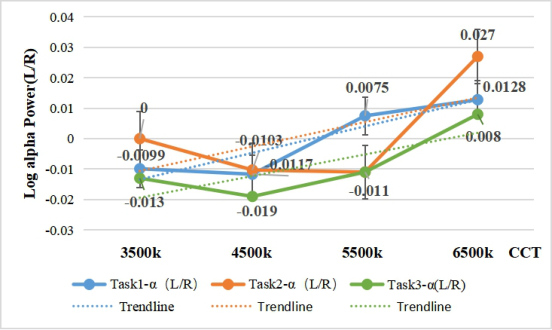
Figure 4: Mean α(L/R) at 4 CCT levels at different stages of the experimental task.
Matlab13 to remove artefactual noise before analysis. In this study, the EEG signals of each time period were converted from the time domain to the fre- quency domain using the Fast Fourier Transform (FFT) and the EEG power values were logarithmically processed to minimise any unnecessary bias and to ensure correlation between the ratios of the various EEG variables.
RESULTS
At Task 1 stage, the mean values of α(L/R) for the 4 CCT (3500k vs. 4500k vs. 5500k vs. 6500k) were −0.0099 (SD = 0.0718), −0.0117 (SD = 0.0677), 0.0075 (SD = 0.0694), and 0.0128 (SD = 0.0797) respectively. One-way repeated measures ANOVA results showed the means of α(L/R) were not significantly different (F(3,60) = 0.916, p = 0.439, >0.05, η2 = 0.044).
At Task 2 stage, the mean values of A for the 4 CCT (3500k vs. 4500k vs. 5500k vs. 6500k) were 0.0000 (SD = 0.0543), −0.0103 (SD = 0.0565), −0.011 (SD = 0.0591), 0.0270 (SD = 0.0814) respectively. The results of the one-way repeated measures ANOVA showed that the result of the Mauchly’s test of sphericity is biased (W = 0.349, p = 0.001, <0.05) and the result of the Greenhouse–Geisser correction showed that there was a significant difference in α(L/R) at the 4 CCT levels mentioned above (F(2.188, 43.756) = 4.650, p = 0.013, <0.05, η2 = 0.375). 4500k vs. 6500k, α(L/R) was significantly lower (p = 0.048, <0.05).
At Task 3 stage, the mean values of α(L/R) for the 4 CCT (3500k vs. 4500k vs. 5500k vs. 6500k) were −0.0130 (SD = 0.0130), −0.0190 (SD = 0.0080), −0.0110 (SD = 0.0080), 0.0080 (SD = 0.0130) respectively. One-way repe- ated measures ANOVA results indicated that the means of α(L/R) were not significantly different (F(3,60) = 1.521, p = 0.218, >0.05, η2 = 0.071).
DISCUSSION
The results of EEG data showed significant variability in α(L/R) across CCT in Task 1 only, suggesting that the mechanism of CCT modulation of driver mood may also be related to the driving situation or task the driver was in
at the time. The data results showed in general that the higher the CCT, the higher the negative mood arousal of the subjects, while the lowest negative mood was observed in the medium CCT (4500k) condition. These results are in line with the findings of (Smolders and de Kort, 2017). In addition, some studies have also reported that higher CCT are more beneficial in improving human mood (Mills, Tomkins and Schlangen, 2007; Viola et al., 2008). The reasons for this ambivalence are related to differences in experimental con- ditions such as lighting parameters, experimental scenarios and tasks, and duration of light (Vandewalle, Maquet and Dijk, 2009). However, this bias also suggests that the non-visual effects of road lighting on humans are not identical to those of indoor lighting, and that researchers should consider different scenarios and human biorhythms in order to conduct more targe- ted studies to verify this. In addition, the results of this study suggest that high CCT (6500k) tend to produce relatively more negative mood at specific illuminance values for road lighting. However, only 1 illuminance level was considered in this study, and in future studies, we will further compare the non-visual effects of lighting schemes with different illumination levels and CCT combinations on drivers to further validate the results of this study.
CONCLUSION
This study verifies that the CCT of urban road lighting at night does have non-visual effects on drivers. The results of this study show potential perfor- mance of α(L/R) to reflect driver mood in different CCT environments and suggest that a medium CCT (around 4500k) can help improve drivers’ mood. However, more research is needed to determine the optimal lighting settings in order to ultimately achieve a comprehensive, human-centred urban ligh- ting design evaluation system that improves the physiological, psychological and behavioural performance of drivers.
ACKNOWLEDGMENT
The authors would like to acknowledge the great guidance and assistance of Professor Haiyan Wang., Dr. Quan Chen and Dr. Jinchun Wu.
REFERENCES
Bailes, H.J. and Lucas, R.J. (2013) ‘Human melanopsin forms a pigment maximally sensitive to blue light (λ max ≈479 nm) supporting activation of Gq/11 and Gi/o signalling cascades’, Proceedings of the Royal Society B: Biological Sciences, 280(1759), p. 20122987. Beck, A.T. et al. (1988) ‘An inventory for measuring clinical anxiety: psychometric
properties.’, Journal of consulting and clinical psychology, 56(6), p. 893. Beck, A.T., Steer, R.A. and Brown, G.K. (1996) ‘Manual for the beck depression inventory-II’, San Antonio, TX: Psychological Corporation, 1(82), pp. 10–1037. Brainard, G.C. et al. (2001) ‘Action spectrum for melatonin regulation in humans:
evidence for a novel circadian photoreceptor’, Journal of Neuroscience, 21(16), pp. 6405–6412.
Non-Visual Effects of CCT on Drivers, Evidence From EEG 7
Brown, L., Grundlehner, B. and Penders, J. (2011) ‘Towards wireless emotional valence detection from EEG’, in 2011 Annual International Conference of the IEEE Engineering in Medicine and Biology Society. IEEE, pp. 2188–2191. Domenichini, L. et al. (2017) ‘Influence of the lighting system on the driver’s behavior
in road tunnels: A driving simulator study’, Journal of Transportation Safety & Security, 9(2), pp. 216–238. Elvik, R. (1995) ‘Meta-analysis of evaluations of public lighting as accident countermeasure’, Transportation Research Record, 1485(1), pp. 12–24. Kar, S., Bhagat, M. and Routray, A. (2010) ‘EEG signal analysis for the assessment
and quantification of driver’s fatigue’, Transportation research part F: traffic psychology and behaviour, 13(5), pp. 297–306. Li, X. et al. (2021) ‘The impact of CCT on driving safety in the normal and accident situation: A VR-based experimental study’, Advanced Engineering Informatics, 50, p. 101379. Mathersul, D. et al. (2008) ‘Investigating models of affect: relationships among EEG
alpha asymmetry, depression, and anxiety.’, Emotion, 8(4), p. 560. Schreuder, D.A. (1998) ‘(1998). Road lighting for safety. London, Thomas Telford’, (Translation of “Openbare verlichting voor verkeer en veiligheid”. Kluwer Techniek Deventer. Smolders, K.C. and de Kort, Y.A. (2017) ‘Investigating daytime effects of correla-
ted colour temperature on experiences, performance, and arousal’, Journal of Environmental Psychology, 50, pp. 80–93. Thapan, K., Arendt, J. and Skene, D.J. (2001) ‘An action spectrum for melatonin suppression: evidence for a novel non-rod, non-cone photoreceptor system in humans’, The Journal of physiology, 535(1), pp. 261–267. Van Bommel, W.J. (2006) ‘Non-visual biological effect of lighting and the practical
meaning for lighting for work’, Applied ergonomics, 37(4), pp. 461–466. Vandewalle, G., Maquet, P. and Dijk, D.-J. (2009) ‘Light as a modulator of cognitive brain function’, Trends in cognitive sciences, 13(10), pp. 429–438.
LISTED IN THE AHFE DIGITAL BOOKSTORE CATALOGUE
Explore the complete digital volume
Intelligent Human Systems Integration (IHSI 2023): Integrating People and Intelligent Systems
Read this individual research paper free through the original publisher, or explore the full digital proceedings book.
ISBN 978-1-958651-45-2
Explore this ISBN in the AHFE Bookstore ↗Listed in the July 2026 bookstore catalogue; search by ISBN to confirm current availability · Digital book purchase optional