Yuta Sato, Yasushi Kambayashi (2023). A rehabilitation-through-photographing support system for muscular dystrophy patients. In: Intelligent Human Systems Integration (IHSI 2023): Integrating People and Intelligent Systems. AHFE Open Access, vol. 69, pp. 108–114. https://doi.org/10.54941/ahfe1002827
We propose a system that helps patients of the Duchenne muscular dystrophy to take photos as a part of rehabilitations. Duchenne muscular dystrophy is a progressive disease. The disease makes it difficult for patients to walk as their muscles contract and their muscles progressively lose strength.Since the condition of the progresses of the disease and the experience of daily life is different from each other for variety of patients, it is important for caregiver to pay attention not only to physical functions but also to psychological aspects of the patients. Rehabilitation should be based on a holistic perspective. However, functional training tends to focus too much on physical function recovery. Thus, rehabilitation has paid little consideration to the psychological aspect. To alleviate this problem and foster a sense of self-affirmation, we designed and implemented a rehabilitation system that addresses the psychological aspects of Duchenne muscular dystrophy patients by having them act autonomic in rehabilitation. Research scientists of nursing have found that the two factors of "self-initiated subject search" and "photography based on internal evaluation criteria" are important for the quality of life of patients as well as their rehabilitations. The two factors, "subject search" and "acting based on internal evaluation criteria" bring positive psychological effects to the patients through the autonomy of the photographing. In order to elucidate the neural basis of the positive psychological effects mediated by autonomy, we used functional magnetic resonance imaging to investigate the effects of photography on the psychological mal-adjustment patients brought about by the autonomic actions. In other words, the neural basis behind the positive psychological effect of the act of photography was demonstrated. It is conceivable that the process of taking photographs, i.e., the actions of searching for a subject and pressing the shutter, can improve the psychological stability of patients with muscular dystrophy. The two actions have a combined psychological effect due to the autonomy of the action-takers. On the psychological side, patients with Duchenne muscular dystrophy can expand their range of activities for photography and develop curiosity and ambition by taking photos by his own will and force, in contrast to doing monotonic functional training. Taking photos by their own muscle help their psychological well-being as well as rehabilitate their arm and hand muscles. In addition, our system provides semi-automatic management of photos to reduce the burden on caregivers. The system consists of a device that is attached on the user’s wheelchairs to assist taking photos and an application software to send the photos to caregivers. In order to adapt to the muscular dystrophy patients that have weak muscle, we employed a home video game console controller to manipulate the camera in order to press the shutter button. We designed this device easy to use for muscular dystrophy patients to change the directions and angles of the camera and to capture the subject with their weak muscle forces. In order to demonstrate the effectiveness of our system, we have conduct experiences of the system and succeeded to obtain favorable outcome.
Duchenne muscular dystrophy is a progressive disease. The disease makes it difficult for patients to walk as their muscles contract and their muscles progressively lose strength. Recent advances in respiratory management, miniaturization of ventilators, and the introduction of non-invasive ventila- tion extend life expectancy of the patients greatly. The developments of these technologies also extend the period of patients using wheelchairs. In Japan, the training programs for Duchenne muscular dystrophy patients are fixed for each stage of the progress of the disease. The program that corresponds to each functional disability stage is determined by the classification provi- ded by the Ministry of Health and Welfare (Tatara and Shinno 2008). The condition of the progresses of the disease and the experience of daily life is, however, different from each other for variety of patients. A uniform trai- ning curriculum makes each patient’s activities over-constrained and leads to a state of ego atrophy and apathetic reaction. It is important for caregiver to pay attention not only to physical functions but also to psychological aspects
A Rehabilitation-Through-Photographing Support System 109
of the patients. Rehabilitation should be based on a holistic perspective. In Japan, however, functional training focuses too much on physical function recovery. Thus, rehabilitation in Japan has paid little consideration to the psychological aspect (Iwai 1996).
To alleviate this problem and foster a sense of self-affirmation, we designed and implemented a rehabilitation system that approaches the psychological aspects of Duchenne muscular dystrophy patients by having them act on their own in rehabilitation. Ishihara found that the two factors of “self-initiated subject search” and “photography based on internal evaluation criteria,” which are common to the two factors, “subject search” and “photogra- phy based on internal evaluation criteria,” respectively, bring about positive psychological effects through the autonomy of the photographer (Ishihara et al. 2018). In order to elucidate the neural basis of the positive psychological effects mediated by autonomy, he used functional magnetic resonance ima- ging (fMRI) to investigate the effects of photography on the psychological maladjustment brought about by the autonomy of the act of photography (Ishihara et al. 2014). In other words, the neural basis behind the positive psychological effect of the act of photography was clarified. It is concei- vable that the process of taking photographs, i.e., the actions of searching for a subject and releasing the shutter, can improve the psychological stabi- lity of patients with muscular dystrophy. The two actions have a combined psychological effect due to the autonomy of the action-takers. On the psych- ological side, patients with Duchenne muscular dystrophy can expand their range of activities for photography and develop curiosity and ambition by taking photos by his own will and force, in contrast to doing monotonic functional training (Ishihara et al. 2018). In addition, this system provides semi-automatic management of photos, thus reduces the burden on caregi- vers. In order to demonstrate the effectiveness of this system, we conducted an experiment with seven healthy people and five students from a special needs school who have muscular dystrophy. We have obtained good results.
Cameras are devices that are all around us in various forms. It is an indi- spensable device in our daily lives. They allow us to capture instantly the sceneries as we see and appreciate them. On the other hand, it is difficult for severely handicapped people with limited limbs to hold a camera, point the lens at the subject and release the shutter. Even people with severe disabilities are, however, able to operate electric wheelchairs using the little strength they have in their fingers and hands. Therefore, they should be able to take pictu- res with a camera. Nevertheless, they can only see how the camera captures the subject long after they took photos, because they place their camera on their lap. Cameras are too heavy for them to hold. It is also difficult to capture the desired photo satisfactorily because merely pressing the button requires a lot of force for them, and they have to change their position when releasing the shutter. We have to forge a different way for them to manipulate a camera from that of we use it in our daily lives.
Patients with muscular dystrophy use electric wheelchairs daily, so this is where we should focus our attention. Thus, we fixed the camera to the whe- elchair so that they could freely change the direction of the camera using a joystick similar to those used to control electric wheelchairs. Patients with
110 Sato and Kambayashi
muscular dystrophy need input devices that do not require force because muscle atrophy progresses as the disease progresses. Various input devices for muscular dystrophy patients have been proposed and developed for purposes other than photography, but they are not always easy to use. In this research, we modified the controller of a home video game device and adopted it as an input device that can control the direction of the camera.
BACKGROUND
As part of the Institute’s volunteer activities, one of the authors worked at a special needs school in Saitama Prefecture, Japan. There are special needs schools in the prefecture, and many students with muscular dystrophy attend them. One of these schools has a class where students take pictures of each season. Through the positive photo appreciation (PPA) program, Ishihara has obtained results from depressed elderly people that the act of taking pictures, selecting one of the pictures to be presented and appreciating each other’s pictures, and each of these acts increase positive emotions and improve their depression (Ishihara et al. 2018). This research aims to improve positive emotions and depression caused by the act of taking pictures in muscular dystrophy patients who have negative emotions and thoughts.
In one of the previous researches, a system has been developed to assist patients with muscular dystrophy in their daily activities by having them use a bionic arm or a robotic exoskeleton to analyse the movements they want to perform (Kostas et al. 2019). In this study, we developed a system to improve negative emotions and depression by using the patient’s muscle strength as it is, instead of the above-mentioned daily life movement support system.
The method of taking pictures involves placing a camera on the student’s lap and taking pictures. Therefore, they cannot see what they have captured in the viewfinder or display. They can only figure out what they took pictures of long after they had taken them. They have to put cameras on their laps, because they have weak muscles. It is not easy for them to point the camera lens at the subject as we do.
While volunteering, we felt that we needed a camera that could be used by people with low muscle strength and motor skills. Therefore, we designed and implemented a device that allows the user to control the direction of the camera in the same way as the electric wheelchair they normally use. By mounting this device on the wheelchair, we can reduce the burden on people with low muscle strength and mobility.
METHODS
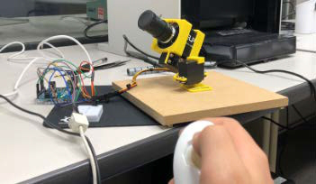
We have installed the camera and the liquid crystal display (LCD) or tablet device that displays the images on the electric wheelchair of the special needs school student who will use it. The controller is light enough for the patient can hold in the hand as shown in Figure 1. In the case of the patient’s muscle is too weak, we attached the device to the patient’s hand for operation.
There are two ways to control the camera direction: by tilting, the control- ler using the value obtained from the accelerometer, or by tilting the joystick on the controller. By pressing the button on the controller, the user can switch
A Rehabilitation-Through-Photographing Support System 111
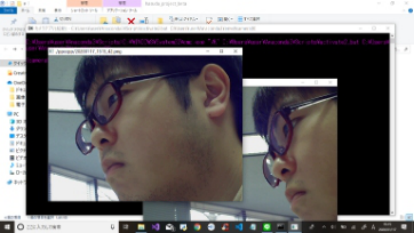
Figure 1: Camera module and controller.Figure 2: The application screen during shooting.
between joystick operation and accelerometer operation. Pressing the trigger switch on the controller let the user take a picture.
When the user launches the application, the tablet device displays an image. When the user releases the shutter, the captured photo is displayed in a new window as shown in Figure 2. The photo is displayed until the user press the icon, allowing the user to check the photo he or she has taken at their own pace.
All the photos the user takes are automatically saved in a pre-designated folder. The name of the photo will be applied to the date and time it was taken. If the system is connected to a network, the user can upload photos to other devices in the local network. Users can also share photos by specifying an external storage as the destination.
Experiment In this experiment, we obtained the cooperation of seven healthy people and five muscular dystrophy students (two of whom have intellectual disabili- ties) attending a special needs school. The muscular dystrophy students fall into stage 7 and stage 8 of the eight-stage functional disability classification proposed by Ueda as the “Japanese lifestyle-based disability stage classifica- tion” (Ohkawa et al. 2004). According to Japanese lifestyle-based disability stage classification proposed by Ueda, stage 7 patients have three chara- cteristics, while stage 8 patients have four characteristics. Stage 7 patients are characterized as “disable to walk, but they are able to crawl” “able to sit up on their own” and “require assistance with activities of daily living (ADL) except for eating and writing as manual activities”. Stage 8 patients
112 Sato and Kambayashi
Figure 3: Student from a special needs school conducting an experiment.Table 1. Experimental results with healthy subjects.
are characterized as “able to carry oneself on one’s knees”, “unable to sit up”, “always bedridden” and “requires ADL assistance” (Ueda 1968).
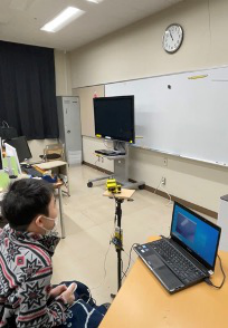
We conducted the following two experiments on seven healthy subjects and five patients with muscular dystrophy. Figure 3 shows a student from a special needs school conducting an experiment.
1. Measure the time elapsed to take a picture of a specified object. 2. Have the camera take a specified number of pictures and measure the ratio of the pictures taken that are not blurry.
The results from the experiment showed that patients with muscular dystrophy took about twice as long to take a picture of the object to be photographed as healthy subjects as shown in Tables 1 and 2. However, there was no significant difference in the percentage of patients who were able to take the specified number of pictures without blurring as also shown in Tables 1 and 2. These results suggest that our system enables patients with muscular dystrophy (stage 7 and stage 8 patients) to take pictures with the
A Rehabilitation-Through-Photographing Support System 113
Table 2. Experimental results from patients with muscular dystrophy.
same accuracy as healthy people. Taking the photographs can be expected to lead to positive emotions and improve depression. In addition, it is expe- cted that the system can improve negative emotions and depression caused by daily activities that have become impossible due to the worsening of muscu- lar dystrophy, with the same accuracy as that of healthy people, and that this can lead to a positive improvement in emotional state.
DISCUSSION
We found that our experiment improved the quality of life (QoL) of patients with muscular dystrophy. However, there were some patients who failed to improve their QoL. According to the teacher (care giver) in charge of the students at the special needs school, there were three possible reasons for this: first, the students who participated in our experiment were not only stage 7 students, but also stage 8 students, and therefore, as the second reason, these students do not play video games on a daily basis, and they are not accustomed to using a controller. The third reason was that it was difficult to check whether the intended picture was taken because the image of the camera output on the monitor was too small.
CONCLUSION
We have developed a system that allows patients with muscular dystrophy to take pictures as part of their rehabilitation. This system consists of a device attached to a wheelchair to assist in taking pictures and application software to send the pictures to caregivers. Since muscular dystrophy patients have weak muscles, we used a home video game console controller for the camera operation and manipulation. We devised a user-friendly design so that the muscular dystrophy patients can change the direction and angle of the camera with the power of their own weak muscles and take pictures of the subject. We also made it possible to semi-automatically manage the photos taken so as to reduce the burden on the caregivers.
114 Sato and Kambayashi
As a result of actual use by patients with muscular dystrophy, we found this system allows the patients to operate in the same way as a healthy people. As a result, we were able to contribute to the improvement of QoL of the patients.
As a direction for future research, we are planning to make it further easier for patients to operate the system. In addition to the current four camera orientations, we are also designing vertical movement of the camera positions as well as a large monitor for displaying photos taken by the users. We are also planning to sophisticate the automation of the photo management in the application.
REFERENCES
Ishihara, M., Saito, T., Sakurai, T., Shimada, H. and Arai, H.: Effect of a Positive Photo Appreciation Program on Depressive Mood in Older Adults: A Pilot Rando- mized Controlled Trial. Int. J. Environ. Res. Public Health, 15(7), pp. 1472–1484, (2018), DOI: 10.3390/ijerph15071472. Ishihara, M.: An fMRI study on the psychological effects of photography. PhD
Dissertation, Tohoku University, (2014) In Japanese. Iwai, K.: The process of awareness of illness and psychological support for children hospitalized with muscular dystrophy. Research in Special Pedagogy, 33(5), pp. 1–6, (1996) In Japanese. Kostas, N., Arno H. A. S., Derek G. K., Thierry, K., Dick H. P., Elliott J. R., Dario,
F., Bart F.J.M. K. and Massimo, S.: Transferrable Expertise From Bionic Arms to Robotic Exoskeletons: Perspectives for Stroke and Duchenne Muscular Dystro- phy. IEEE Transactions on Medical Robotics and Bionics, 1(2), pp. 88–96, (2019), DOI: 10.1109/TMRB.2019.2912453. Ohkawa, K., Obata, F.: Study on the Rehabilitation of the Stage 7–8 Patients of Duchenne Muscular Dystrophy. Physical and Mental Disabilities, 28, pp. 43–52 (2004) In Japanese. Tatara, K., Shinno, S.: Management of Mechanical Ventilation and Progno-
sis in Duchenne Muscular Dystrophy. Iryo, 62(3), pp. 566–571 (2008) DOI: https://doi.org/10.11261/iryo1946.62.566. In Japanese. Ueda, S.: Rehabilitation of progressive muscular dystrophy. Physical Therapy and Occupational Therapy, 2(3), pp. 14–23, (1968) In Japanese.
LISTED IN THE AHFE DIGITAL BOOKSTORE CATALOGUE
Explore the complete digital volume
Intelligent Human Systems Integration (IHSI 2023): Integrating People and Intelligent Systems
Read this individual research paper free through the original publisher, or explore the full digital proceedings book.
ISBN 978-1-958651-45-2
Explore this ISBN in the AHFE Bookstore ↗Listed in the July 2026 bookstore catalogue; search by ISBN to confirm current availability · Digital book purchase optional