Josef Pavlíček, Petra Pavlíčková, Irena Štrausová (2026). Human-Centered Harmonic Analysis of the Beatles’ Yesterday: Chord Wheel, Process Diagrams, and Eye-Tracking Insights. In: Intelligent Human Systems Integration (IHSI 2026): Disruptive and Innovative Technologies. AHFE Open Access, vol. 200, pp. 384–394. https://doi.org/10.54941/ahfe1007097
This paper presents an innovative approach to analyzing the harmony of the well-known and iconic song Yesterday by the Beatles using the chord wheel diagram in combination with BPMN-based process modeling. While classical methods of harmonic explanation rely on standard notation (including tablature) and chord symbols, our method focuses on visual and procedural representations. According to our findings, these representations reduce cognitive load and thereby improve understanding of music. They are, however, primarily intended for amateur musicians rather than trained professionals.The chord wheel diagram developed by our team provides an interactive visualization of tonal relationships, enabling users to follow the sequence of chord formation within a key, while also explaining chord progressions and their structural logic. Based on this, process diagrams modeled in BPMN formalize the sequential logic of harmonic development and its direct connection to the song’s melody. This dual representation—circular tonal mapping and algorithmic procedural modeling—offers students an accessible way to understand why the harmonic structure of Yesterday creates its characteristic expressive quality.To evaluate the usability and clarity of this approach, we conducted a qualitative study supported by eye-tracking experiments. Eye movement data revealed which parts of the diagrams were more difficult for participants to comprehend, highlighting critical points of cognitive overload. Based on this analysis, we define how process models can be refined to guide attention more effectively, reduce ambiguity, and improve the integration of harmonic and melodic information.Our findings suggest that this combination of chord wheel visualization, BPMN process modeling, and eye-tracking–driven analysis provides unique insights into how non-professional musicians interact with harmonic structures. Compared with conventional notation, participants perceived visual and process-based models as more intuitive, especially when applied to familiar repertoire such as Yesterday.We argue that integrating computational models with human-centered visualization and empirical usability testing represents a promising alternative for music education and harmonic analysis. By applying principles of human–computer interaction to music theory, this study shows how modern computer science technologies can support creativity, learning, and meaningful interaction in music.
Understanding harmony—the logical and emotional foundation of Western tonal music—has long been an essential goal of both music theory and ped agogy. Traditional approaches rely heavily on symbolic notation and chord labeling, which, although precise, often present a cognitive barrier for learn ers without formal training. In the context of human-centered education, such representations may limit engagement and accessibility, particularly for hobby musicians and self-taught learners. In recent years, the intersec tion between music theory, computational modeling, and human–computer interaction has opened new pathways for exploring how musical relation ships can be represented visually and procedurally rather than purely sym bolically. Instead of viewing harmony as a fixed system of abstract symbols, researchers are increasingly treating it as a dynamic process—a sequence of tonal decisions and chordal evolutions within a defined key (Chew, 2005; Temperley, 2001).
This paper builds upon this direction, introducing a process-based frame work for visualizing harmonic and melodic relations using Business Process Model and Notation (BPMN) in combination with an interactive Chord Wheel Diagram. These tools—originally developed for modeling workflows and complex system interactions—are adapted here to express the evolution of chords and tonal functions as procedural and relational entities. Our aim is to demonstrate how such visual logic can serve as a bridge between music cognition, computer science, and pedagogical visualization.
To test the usability and clarity of this approach, we employ a qualitative eye-tracking study focusing on learners’ visual attention when interpreting harmonic diagrams. The study complements our previous work (Pavlíček et al., 2024) and evaluates whether this human-centered modeling approach can reduce cognitive load and support intuitive understanding of harmonic progression in familiar repertoire.
LITERATURE REVIEW
Theoretical and computational modeling of harmony has evolved signifi cantly over the past decades. Early conceptualizations of tonal structure can be traced to Pythagorean mathematical interpretations of musical intervals (Riedweg, 2008) and Guido of Arezzo’s development of symbolic notation systems (Hiley et al., 2001). These foundational works formalized the rela tionship between pitch, ratio, and perception, paving the way for later theo retical frameworks such as those summarized in The Cambridge History of Western Music Theory (Christensen, 2002).
Contemporary music theory has expanded these principles through the integration of computational and visual models. Chew (2005) proposed the Spiral Array Model, describing tonal relationships geometrically, while Vogel (1993) introduced the Tonnetz, a lattice-based diagram for mapping harmonic connections. Similarly, Euler (1739) provided an early algebraic formulation of chordal relations, foreshadowing modern algorithmic approaches.
In the field of music informatics, recent works such as Bunks et al. (2022) and Harasim et al. (2022) have demonstrated the value of visual interfaces for
real-time tonal analysis and cognitive load reduction in harmonic interpreta tion. Machine learning applications have also emerged, with Paiement et al. (2005) and Hedges et al. (2014) modeling chord sequences using probabilistic and predictive frameworks. Building on this tradition, Pavlíček et al. (2024) introduced the use of BPMN process diagrams to formalize chord progres sion and harmonic transformations within a given key. Their study established that BPMN’s gateways and sequential logic can represent harmonic branch ing, parallel motion, and resolution. By combining this with the Chord Wheel Diagram, tonal relationships can be navigated intuitively, offering an alter native to symbolic notation for learners with limited theoretical background.
Furthermore, Nielsen’s (1993) usability framework supports the applica tion of human-centered design to such educational interfaces. Following this principle, our study integrates usability testing and cognitive evaluation to assess how process-based modeling enhances comprehension and reduces cognitive overload.
Overall, the reviewed literature suggests a convergence between computa tional modeling, music visualization, and educational usability—an interdis ciplinary domain that situates music analysis within the broader context of interactive systems and cognitive design.
MATERIAL AND METHODS The song Yesterday, composed by John Lennon and Paul McCartney, was selected as the analytical case study due to its worldwide recognition, simplic ity of form, and harmonic depth. Its melodic line, though concise and memo rable, is supported by a harmonic structure that provides both coherence and expressive tension. This balance makes it an ideal subject for demonstrating the capabilities of process-based modeling and tonal visualization.
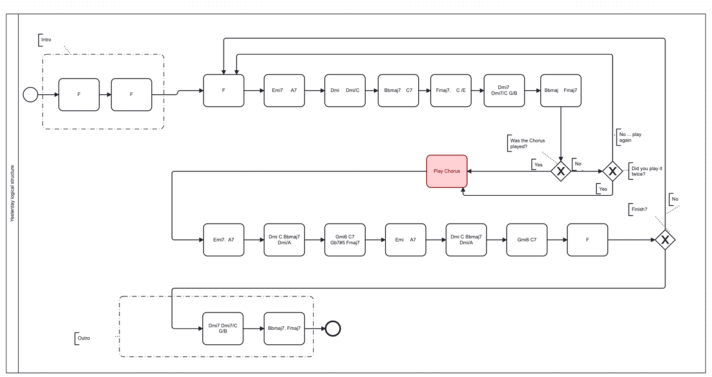
Structural Model and Process Representation To represent the musical structure of Yesterday, we created a BPMN process diagram describing the formal organization of the song (Figure 1). The com position follows a logical structure composed of an Intro, A–A–Chorus–A– Chorus–A–Outro form. The diagram models each section as a process activ ity, where XOR gateways determine the repetition or transition logic—for example, whether the chorus has been played or whether the section should be repeated twice. This formalized representation makes it possible to model the flow of the musical form procedurally, using BPMN elements such as events, activities, and gateways to describe musical decisions within the song’s timeline.
The Intro consists of two measures built on the tonic chord F, setting the tonal foundation. The first A section is repeated twice before entering the Chorus, after which a single A section follows. The second chorus leads directly to the final A and the Outro, which concludes the harmonic progres sion. This process-oriented description allows for precise visualization of the song’s logical and temporal organization—similar to a workflow model in system design, yet here applied to musical form.
Figure 1: Process model of Yesterday’s logical structure in BPMN.
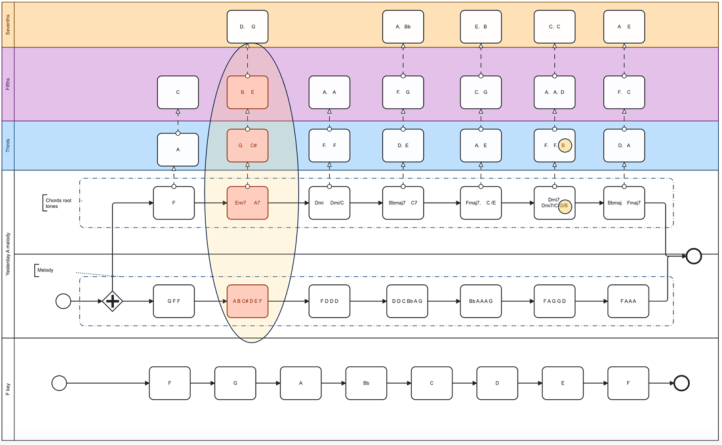
Harmonic and Tonal Analysis The second diagram (Figure 2) expands the analysis into the harmonic domain by combining the BPMN model with the Chord Wheel Diagram. This visu alization highlights the relationship between chords and tonal centers within the key of F major (F). The model differentiates between tonal and non-tonal chords, showing how brief modulations or chromatic deviations contribute to expressive color without destabilizing the overall tonal center.
In Yesterday, the key of F major is momentarily expanded through the inclusion of the chords E minor 7 (Emi7) and A7, both of which lie out side the diatonic scale. These non-diatonic chords function as the II and V degrees of the D melodic minor scale, creating a brief modulation away from F major. In this setting, A7 serves as a borrowed dominant leading to D minor (Dmi)—the melodic minor derived from the sixth degree of F major— thus producing a short tonicization of D minor before the harmony resolves back to the F major key. Although the harmonic motion departs temporarily from F major through the introduction of the tones B (instead of Bb) and C# (instead of C), the return to Dmi restores tonal balance within the parallel minor key.
Another interesting harmonic feature appears in the progression Dmi/C → G/B → Bbmaj, where the bass line moves chromatically downward from C to B (B natural) and then to Bb. Although G/B contains the non-diatonic tone B (natural), it does not function as an independent dominant or mod ulation, but rather as a passing chord that smooths the transition between the diatonic chords Dmi and Bbmaj. This chromatic bass movement creates a sense of continuous melodic motion in the harmony, preserving the overall tonal integrity of F major while adding expressive color and fluidity to the progression.
Figure 2: Tonal analysis and harmonic modelling of Yesterday in F major, showing non-diatonic relations and modal parallels by yellow ellipse and yellow circle in section A.
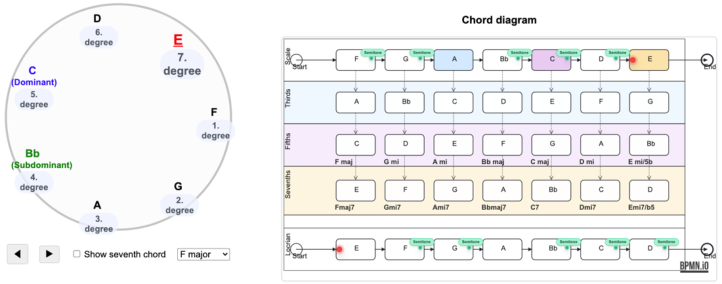
These harmonic movements are mapped in the Chord Wheel Diagram (Figure 3), where each chord’s root, third, fifth, and seventh are positioned relative to the tonal center. The diagram’s layered structure (sevenths, fifths, thirds, melody, and key lanes) allows both vertical (harmonic) and horizontal (melodic) relationships to be visualized simultaneously. The integration of BPMN modelling and the chord wheel thus enables a unified procedural and tonal interpretation of the song, bridging symbolic music theory and compu tational process logic.
Figure 3: Chord wheel diagram in the key of F major with the E minor chord highlighted.
From Figure 3, the tonal deviation in the harmony of Yesterday can be observed.
Human-Centered Harmonic Analysis of the Beatles’ Yesterday 389 The E minor chord built on the seventh degree of the F major scale cannot contain the note B natural, but rather B flat (Bb), since the key of F major is defined by a single flat in its key signature—on B. Therefore, the diatonic tone at that position is Bb. For the E minor chord to remain diatonic, it would have to feature a diminished fifth, forming Emin♭5 instead.
However, in the harmonic progression, the chord is Emin7, followed by A7, which contains the note C#. This clearly indicates a temporary modula tion into a minor key. Yet, such a key does not exist among the traditional church modes, and therefore cannot be directly represented within the Chord Wheel Diagram, as it cannot be derived from any diatonic degree of F major.
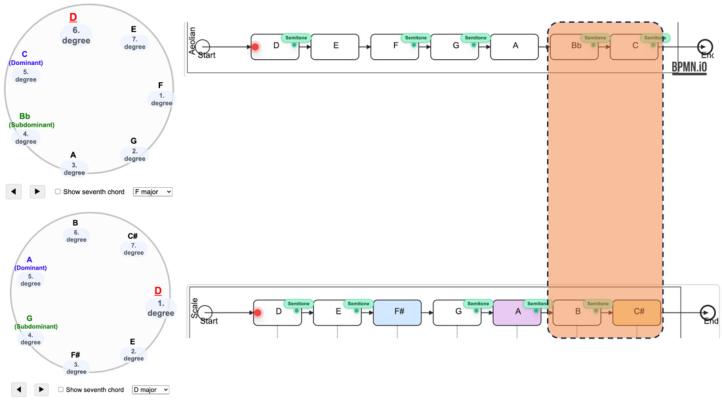
This passage instead reflects a modulation to the D melodic minor key, which includes a raised sixth (B) and raised seventh (C#). In simplified terms, it can be described as a natural minor scale (Aeolian mode)—constructed on the sixth degree of the major scale—with the final three intervals (sixth, sev enth, and octave -not visible on the diagram) borrowed from the major scale built on that same degree, in this case D major (see Figure 4).
Figure 4: Illustrative explanation of D melodic minor construction using the chord wheel diagram.
The construction, or more precisely the graphical representation of the relationships between chord tones and their corresponding key, is—as can be seen from the diagram—clearly evident. The explanation is therefore as follows: The D melodic minor scale can be understood as a transformation of the D natural minor (Aeolian) scale through the alteration of its sixth and sev enth degrees. In natural minor, the tones are:
D – E – F – G – A – Bb – C – D
In melodic minor, the sixth and seventh degrees are raised by a semitone, resulting in:
D – E – F – G – A – B – C# – D
On the Chord Wheel Diagram, this transformation can be visualized as a shift in the tonal structure derived from the parent key of F major, which shares the same key signature. However, by raising the sixth (B♭ → B) and seventh (C → C#) degrees, the scale temporarily departs from the diatonic circle of F major.
In harmonic terms, this modification enables the creation of the II–V–I progression characteristic of minor tonalities:
Emin7 (II) → A7 (V) → Dmin (I)
This progression cannot exist within F major because Emin7 and A7 intro duce non-diatonic tones (B and C#) that lie outside the key. Nevertheless, the Chord Wheel Diagram allows this modulation to be traced visually, showing how the harmony temporarily shifts away from the F major tonal center toward the region of melodic D minor, before ultimately resolving back.
Thus, the diagram illustrates not only the structural interconnection between the parent and modal scales, but also the functional relationships of the borrowed chords used in Yesterday to achieve its expressive and fluid harmonic motion.
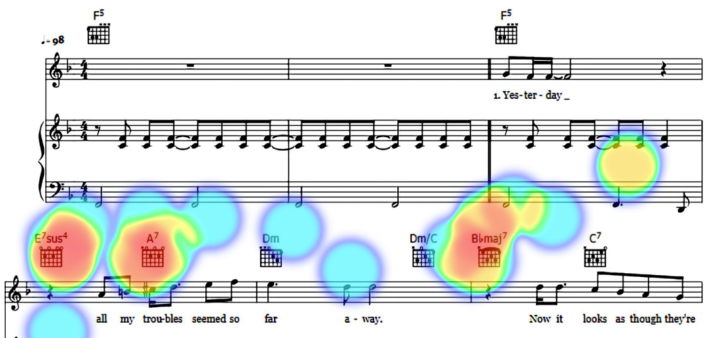
Usability and Eye-Tracking Evaluation To assess the clarity and educational impact of the proposed visual models, a qualitative usability study was conducted, supported by eye-tracking analy sis. Five participants—aged 19 to 25, with beginner to intermediate musical skills—were asked to follow the harmonic logic represented in the diagrams. Eye-tracking data (Figure 4, 5, 6) revealed areas of increased fixation and gaze duration, indicating moments of cognitive load. These regions corre sponded primarily to sections containing chromatic deviations (Emin7, A7, and G major), confirming that users devoted greater attention to harmoni cally complex transitions.
Figure 4: Yesterday – Non-diatonic chords Emi7 (or Esus4, where the third G is replaced by the fourth A, diatonic in the key of F, while B remains non-diatonic) and A7 progression captured by eye-tracking.
Human-Centered Harmonic Analysis of the Beatles’ Yesterday 391 To explore the cognitive mechanisms behind harmonic recognition, par ticipants navigated between standard musical notation, chord symbols, and the Chord Wheel Diagram. The task required them to identify relationships between the melodic line and its harmonic structure using visual cues rather than theoretical analysis. The dataset includes only selected eye-tracking samples that most clearly illustrate participants’ visual focus patterns while exploring the diagrams.
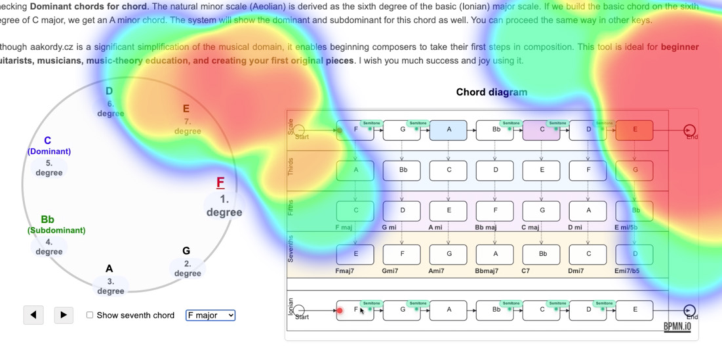
Figure 5: Selection of the key of F major and search for chord symbols within the diagram.
Participants were asked to locate chords within the Chord Wheel Diagram and to relate them to their function in the key of F major. A moment of con fusion occurred when participants noticed the absence of the A7 chord in the diagram. While this omission is theoretically correct—since A7 is a non-dia tonic (borrowed) chord—it posed a challenge for non-professional users to understand why such a chord does not appear within the diatonic structure of F major. Although this concept is self-evident to trained musicians, the aim of this study was to examine how beginners and hobbyists comprehend these relationships, with the Chord Wheel acting as an intuitive visual aid.
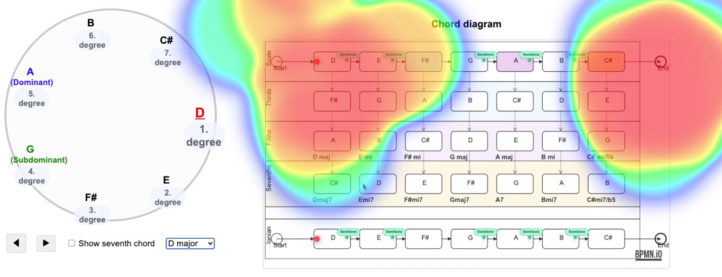
Figure 6: Switching to the key of D major and searching for the tonic-related chords A7 and Emi7.
The eye-tracking results demonstrated that most participants focused their attention on areas representing non-diatonic chords, particularly where tonal shifts occurred. This indicates that the diagrams successfully guided user attention toward harmonic irregularities, thereby supporting cognitive engagement and pattern recognition. Moreover, the data suggest that pro cess-oriented models, when combined with Chord Wheel Diagram visualiza tion, can reduce overall cognitive effort by providing a clear and sequential overview of harmonic relationships.
In summary, the integration of BPMN process diagrams and the Chord Wheel Diagram enabled participants to connect abstract harmonic func tions with visual and procedural logic, leading to improved understanding, engagement, and error awareness. These findings confirm that the proposed approach can facilitate learning for novice musicians by visualizing complex harmonic processes that are otherwise difficult to grasp through standard notation.
Results and Discussion
The eye-tracking data show that most participants concentrated their attention on the Chord Wheel Diagram while searching for harmonic correspondences. The visual traces indicate repeated fixations near the expected position of the A7 chord, confirming that participants actively sought a visual represen tation of this non-diatonic element. Interestingly, one participant correctly inferred that A7 functions as the dominant seventh chord in the key of D major, establishing a potential correlation between the borrowed A7 chord and its tonal function relative to D. This demonstrates that even without for mal theoretical training, users can infer functional harmonic relationships by reasoning visually through the Chord Wheel Diagram layout.
While none of the participants explicitly articulated this tonal relation ship, the BPMN process diagram positioned alongside the chord wheel pro vided complementary information, displaying the pitch components of the F major key and their progression across the song structure. Post-experiment interviews revealed that participants found standard notation difficult to interpret and cognitively demanding. The process diagrams were perceived as clearer and more structured, though somewhat less practical for perfor mance-related tasks.
The main outcome of the study is the observation that non-diatonic chords can be visually identified using the Chord Wheel Diagram without prior knowledge of music theory. In conventional notation, such identifi cation requires theoretical understanding, whereas the visual–procedural model enables intuitive discovery of harmonic deviations. This suggests that diagram-based representations can effectively bridge the gap between theo retical analysis and perceptual learning for novice musicians.
CONCLUSION
This study demonstrates that BPMN process modeling provides an effec tive and intuitive framework for visualizing relationships between harmony and melody. By expressing musical structure as a sequence of interconnected
Human-Centered Harmonic Analysis of the Beatles’ Yesterday 393 processes rather than static symbols, BPMN enables users—particularly beginners and self-taught musicians—to understand tonal logic and chordal relationships with greater clarity.
When combined with the Chord Wheel Diagram, the model helps illustrate how melodic movement interacts with harmonic progression. Eye-tracking analysis confirmed that visual process models enhance comprehension, reduce ambiguity, and enable the recognition of non-diatonic chords and chromatic motion without requiring formal theoretical knowledge. These findings show that process-oriented visualization can complement traditional notation by providing a more accessible path to learning harmony.
A limitation of the current approach lies in the Chord Wheel Diagram, which cannot display harmonic, melodic, or altered scales, restricting its use for advanced harmonic analysis. This limitation arises not from the theoreti cal model but from the visualization tool itself. Extending the chord wheel’s functionality would therefore significantly improve its analytical and educa tional scope.
In summary, while developing new software was not the primary aim of this research, the results confirm that combining computational modeling, human-centered visualization, and empirical usability testing can mean ingfully enhance the teaching and understanding of harmonic and melodic structures.
REFERENCES
Bunks, C., Weyde, T., Slingsby, A. and Wood, J. (2022) Visualization of Harmonic Structure: Reducing Cognitive Load in Jazz Progressions. Eurographics Proceedings. Chew, E. (2005) ‘Mathematical and Computational Modeling of Tonality: Theory
and Applications’, International Journal of Computational Mathematics in Music, 1(1), pp. 35–53. Christensen, T. (ed.) (2002) The Cambridge History of Western Music Theory.
Cambridge: Cambridge University Press. Euler, L. (1739) Tentamen novae theoriae musicae ex certissimis harmoniae prin cipiis dilucide expositae. Saint Petersburg: Academy Press. Harasim, D., Affatato, G. and Moss, F. C. (2022) midiVERTO: A Web Application to
Visualize Tonality in Real Time. arXiv preprint. Hedges, T., Roy, P. and Pachet, F. (2014) ‘Predicting the Composer and Style of Jazz Chord Progressions’, Journal of New Music Research. Hiley, D., Payne, T. B., Bent, M., Chew, G. and Rastall, R. (2001) ‘Notation: III and
IV’, in Sadie, S. (ed.) The New Grove Dictionary of Music and Musicians. 2nd edn. London: Grove. Nielsen, J. (1993) Usability Engineering (Interactive Technologies). San Francisco: Morgan Kaufmann. Paiement, J-F., Eck, D. and Bengio, S. (2005) A Probabilistic Model for Chord
Progressions. In: Proceedings of the Sixth International Conference on Music Information Retrieval (ISMIR).
Pavlíček, J., Pavlíčková, P., Brnka, M. and Rydval, J. (2024) ‘BPMN for Displaying the Progression of Musical Harmony and Chords – Case Study’, in Almeida, J.P.A., Di Ciccio, C. and Kalloniatis, C. (eds) Advanced Information Systems Engineering Workshops (CAiSE 2024). Lecture Notes in Business Information Processing, vol. 521. Cham: Springer. https://doi.org/10.1007/978-3-031-61003-5_23 Riedweg, C. (2008) Pythagoras: His Life, Teaching, and Influence. Ithaca, NY:
Cornell University Press. Temperley, D. (2001) The Cognition of Basic Musical Structures. Cambridge, MA: MIT Press. Vogel, M. (1993) Tonnetz: On the Relation of Tones, Conceptual Lattice Diagram
for Chord Relations.
LISTED IN THE AHFE DIGITAL BOOKSTORE CATALOGUE
Explore the complete digital volume
Intelligent Human Systems Integration (IHSI 2026): Disruptive and Innovative Technologies
Read this individual research paper free through the original publisher, or explore the full digital proceedings book.
ISBN 978-1-964867-76-2
Explore this ISBN in the AHFE Bookstore ↗Listed in the July 2026 bookstore catalogue; search by ISBN to confirm current availability · Digital book purchase optional