Masato Yamazaki, Reika Abe, Kimi Ueda, Hirotake Ishii, Hiroshi Shimoda, Fumiaki Obayashi (2026). The Effect of Fading-In Light Transitions to Induce Micro-Refresh on Intellectual Work. In: Intelligent Human Systems Integration (IHSI 2026): Disruptive and Innovative Technologies. AHFE Open Access, vol. 200, pp. 131–139. https://doi.org/10.54941/ahfe1007072
Enhancing intellectual productivity is a critical issue in the modern information society. Previous studies have suggested that short breaks can effectively sustain cognitive performance [1]. "Micro-refresh" (MR), a brief break of a few to several tens of seconds aimed at maintaining concentration without significantly disrupting workflow [2], can be a promising strategy. However, effective methods for inducing MR remain unclear. This study focuses on dynamic lighting changes in an office environment as a novel method to induce MR. The primary objective is to conduct a preliminary experiment to investigate whether switching between lighting environments designed for work and refreshment can induce MR and support intellectual concentration during cognitive tasks.In this study, seven university students participated in a laboratory experiment. They performed a comparison task [3] under two lighting conditions: a switch condition and a no-switch condition. In the switch condition, the lighting environment alternated through fading-in between an approximately 750 lx task-and-ambient lighting designed for concentration and a brighter, uniform ambient lighting designed for refreshment. This switch occurred for 30 seconds a 10-minute cycle. In the no-switch condition, the task-and-ambient lighting was maintained in approximately 750 lx. To assess performance, the Concentration Time Ratio (CTR), an objective measure of intellectual concentration [4], was calculated from task response times. Subjective evaluations were also collected through questionnaires assessing fatigue and concentration levels, as well as feelings of detachment and refreshment, after each task set.As a result, the CTR improved for four of the seven participants under the switch condition. The average CTR for all participants was also slightly higher in the switch condition compared to the no-switch condition. Subjective results indicated that the switch condition tended to suppress increases in fatigue and declines in concentration. Furthermore, they reported greater feelings of refreshment and a lower tendency for detachment from the task in the switch condition. Post-experiment questionnaires revealed that most participants found the lighting environment in the switching condition comfortable and the switching frequency and duration appropriate.These findings from this preliminary study suggested that dynamic lighting changed during intellectual work had the potential to enhance subjective feelings of refreshment and contribute to the maintenance of concentration. However, the effect on CTR showed considerable individual differences, and it was observed that some participants did not utilize the intended MR periods for rest. Although these results are preliminary, they are expected to provide valuable insights for designing office lighting systems that support intellectual productivity, further validation with a larger sample size and clearer instructions regarding the purpose of MR is necessary to generalize the findings.[1] Kristin, M. F., Paul, N. R., & William, S. H. (2016) Rest improves performance, nature improves happiness: Assessment of break periods on the abbreviated vigilance task. Consciousness and Cognition, 42, pp. 277–285.[2] Kitayama, K., Dianita, O., Ueda, K., Ishii, H., Shimoda, H., & Obayashi F. (2023). Micro-Refresh to Restore Intellectual Concentration Decline During Office Work: An Attempt at Quantitative Effect Evaluation. Intelligent Human Systems Integration, 69. pp. 87–93.[3] Ueda, K., Tsuji, Y., Shimoda, H., Ishii, H., Obayashi, F., & Taniguchi, K. (2016). Development of "Comparison Task" to Measure Intellectual Concentration by Room Environment. Proceedings of the 2016 International Conference Affected on Communication and Information Systems, pp. 58–64.[4] Uchiyama, K., Oishi, K., Miyagi, K., Ishii, H., & Shimoda, H. (2014). Process in Evaluation Index of Intellectual Productivity Based on Work Concentration. Lecture Note on Software Engineering, Vol.2, No.1, pp. 21–25.
In recent years, improving intellectual productivity in the information society has become increasingly important. Consequently, numerous studies have explored various approaches to improving cognitive performance and reducing mental fatigue. Many studies have examined whether taking short breaks occasionally, rather than working for long periods of time, can improve cognitive abilities and reduce mental fatigue. The duration and form of these breaks vary, such as taking a 10-minute break during an hour of work (Lim & Kwok, 2016) or exposing oneself to natural stimuli (Kristin et al., 2016), but all emphasize the importance of breaks. Studies related to microbreaks, breaks of less than 10 minutes, have shown that taking 5-minute breaks every 30 minutes or 10-minute breaks every hour can reduce errors in information technology tasks (Kopardekar & Mital, 1994) and significantly decrease sub jective physical discomfort and eye strain (Balci & Aghazadeh, 2003).
Additionally, there are several studies on short breaks involving stimuli that promote refreshment for a few seconds to several tens of seconds, known as micro-refresh (MR) (Kitayama et al., 2023; Dianita et al., 2024). This could Received September 13, 2025; Revised November 10, 2025; Accepted November 25, 2025; Available online February 1, 2026
be a promising strategy for maintaining concentration without significantly interrupting the flow of work. However, the subjective and objective effects and mechanisms of action are not yet fully understood, and few studies have attempted to identify stimuli that effectively induce MR for improving intel lectual productivity.
In this study, we focus on lighting changes as a new method to promote MR during intellectual work. Lighting is a crucial environmental factor in workspaces, and it is known that appropriate adjustments can influence cognitive abilities and subjective evaluations (Liu et al., 2024; Pradhan et al., 2024). However, few studies have examined whether dynamic lighting transitions can systematically promote micro-refresh and improve intellec tual concentration. Therefore, this study aims to explore whether lighting changes can contribute to promoting short breaks and improving intellectual productivity. Two lighting environments were developed to support intellec tual work and breaks, as well as seamless transition method between them. An experiment was conducted where participants performed cognitive tasks under both conditions—with and without lighting changes. Participants’ per formance and subjective evaluations under the two conditions were com pared to examine the effects of the designed lighting changes.
METHOD
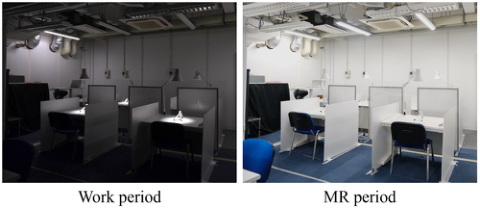
Design of Lighting Environment In this study, lighting changes were used as stimuli to promote MR. For this purpose, dimmable ceiling lights (Panasonic, NNL4600ENT RX9) were pri marily used, and two types of lighting environments were prepared for the work period and MR period, as shown in Figure 1.
Figure 1: Lighting environment during task.
The lighting environment for the work period was designed as a task-ambient lighting setup, combining a task light that spotlights the work area with dim ceiling lighting. Task and ambient lighting is said to enhance the intellectual concentration and immersion of workers in their tasks (Obayashi et al., 2016). In this lighting environment, the minimum desk surface illuminance within the range illuminated by the task lights was an average of 7.5 × 10² lx (708 lx to 771 lx).
For the MR period, the lighting environment was designed to create a bright lighting environment contrasting with the work period by turning off
The Effect of Fading-In Light Transitions to Induce Micro-Refresh on Intellectual Work 133 the task lights via a relay board and setting the ceiling lights to an 80% dimming rate. According to a study, high-intensity lighting has been shown to improve vitality and physiological arousal, and it was considered that such effects would promote a sense of refreshment (Smolders et al., 2012). The average desk surface illuminance directly under the task light in this lighting environment was 7.3 × 10² lx (706 lx to 758 lx). In addition, to reduce glare and discomfort caused by a sudden increase in overall indoor illuminance, the fade function built into the lighting control application was used. This fade function allows for smooth adjustment of the dimming ratio by first turning on the lights at 0.5% dimming rate when increasing the dimming ratio.
During dummy tasks or breaks, the ceiling lights were turned on at a 50% dimming rate to reduce eye strain while maintaining adequate visibility, and the task lights were turned off. The average illuminance on the desk surface directly below the task lights was 5.0 × 10² lx (498 lx to 510 lx).
Overview of the Experiment The purpose of this experiment was to verify whether switching lights designed to induce micro-refresh contributes to maintaining the intellec tual concentration of office workers. This experiment was conducted with the approval of the Research Ethics Committee of the Graduate School of Energy Science, Kyoto University. Participants were recruited from among students enrolled at Kyoto University and its graduate schools through the Kyoto University CO-OP. Eight Japanese-speaking university students applied to participate, and seven participated, excluding one who was absent. The laboratory experiment was conducted on 24th and 25th October 2024, with 3 to 4 participants per day. Participants performed cognitive tasks mul tiple times using tablet device and answered several questionnaires regarding subjective fatigue and concentration before and after the tasks. Additionally, after completing all cognitive tasks, participants answered a questionnaire regarding the experiment as a whole.
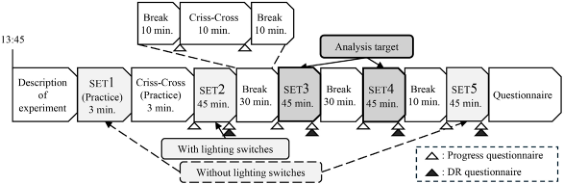
Lab Experimental Schedule The experiment was conducted according to the schedule shown in Figure 2. The term ‘SET’ in the figure refers to the period during which participants performed the comparison task, a cognitive task developed by Ueda et al. (2016). The entire experiment was conducted between 1:45 p.m. and 7:15 p.m. No clocks were installed in the experimental room, and participants were prohibited from using clocks or electronic devices, ensuring that they were unaware of the passage of time.
Figure 2: Lab experimental schedule.
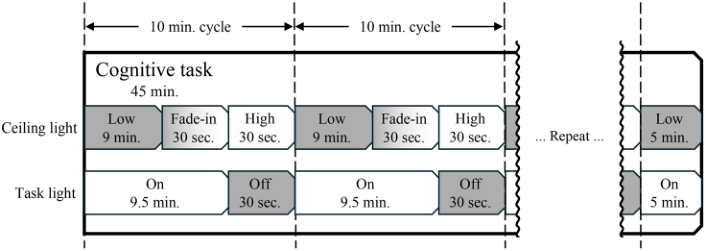
Each participant first received an explanation of the experiment and then completed two SETs that were excluded from the analysis. SET1 was admin istered to familiarize participants with the comparison task, while SET2 was intended to acclimate them to the 45-minute answering period and the lighting switches. Subsequently, the participants completed SET3 and SET4, which were included in the analysis. To counterbalance the order effect, the three participants on the first day started with the lighting change condition, while the four participants on the second day started with the no lighting change condition. To eliminate the post-lunch dip effect (Monk et al., 2005) from the analysis target SETs, the start time of SET3 was adjusted to be after 3:30 p.m. Finally, SET5 was conducted to eliminate the end effect from the analysis target SETs. In the SET with lighting switches, the lighting was switched at the timing shown in Figure 3, with the intention of a 30-second micro-refresh accompanied by a 30-second fade period within a 10-minute cycle, aiming for a frequency that would not interfere with work.
Additionally, to alleviate the monotony of the task, participants performed a Criss-Cross puzzle as a dummy task before each analysis target SET.
Figure 3: Switching schedule.
Measurements Concentration time ratio (CTR) calculated from the answer time data was used as an indicator to quantitatively evaluate intellectual concentration. This indicator represents the proportion of time spent in focused work rela tive to the total task duration, and is expressed as a time ratio (%).
To investigate the subjective fatigue and concentration levels of the partic ipants, follow-up questionnaires were conducted before and after each SET and Criss-Cross puzzle. Participants answered each question using a Visual Analog Scale with integer values ranging from 0 to 100. For the fatigue ques tion, 0 meant ‘no fatigue at all’ and 100 meant ‘so tired that I cannot continue working.’ For the concentration question, 0 meant ‘cannot (could not) con centrate at all’ and 100 meant ‘can (could) concentrate as much as possible.’ The questionnaire interface displayed each participant’s previous responses, allowing participants to refer to their previous responses while answering.
The Effect of Fading-In Light Transitions to Induce Micro-Refresh on Intellectual Work 135 It was hypothesized that the lighting change would temporarily distract participants and induce a sense of refreshment. To measure these effects, a DR (Detachment and Refreshment) questionnaire was administered after each SET. Participants responded to two questions, ‘Did your mind wander from the task during the task?’ and ‘Did you feel refreshed during the task?’ using a 5-point Likert scale.
At the end of the experiment, a post-experiment questionnaire was con ducted to ask about subjective performance and impressions of the lighting environment. The questions in the post-experiment questionnaire are shown in Table 1. Participants were instructed that the lighting environment during the work period was referred to as ‘Environment 1’ and the lighting environment during the MR period was referred to as ‘Environment 2’ in this questionnaire.
Table 1: Post-experiment questionnaire.
Table available in the original PDF paper.
No. Question Q1 In this comparison task, the lighting environment was switched to Environment 2 four times during SET2 and SETx, but was not switched during SETy. Please write down any differences you remember in the performance and concentration of the comparison task for each SET.
Q2 During the comparison task, how well were you able to concentrate in Environment 1? (6 scales) Q3 In the comparison task SET where the lighting was switched, the Environment 2 was switched for 30 seconds at a time. How did you feel about the length of time for Environment 2? (3 scales)
Q4 How did you spend your time during the comparison task in Environment 2?
Q5 In the comparison task SET where the lighting was switched, the lighting environ ment was switched to Environment 2 every 9 minutes and 30 seconds. How did you feel about the frequency of switching? (3 scales) Q6 During the comparison task, did you feel refreshed between Environments 2? (6 scales)
Q7 During the comparison task, did you feel comfortable or uncomfortable? (6 scales) Q8 Did you experience any distractions from the experimenter or other participants during this experiment? If not, there is no need to fill in anything. Example: I was distracted by noise and couldn’t concentrate on the task.
Q9 Please feel free to write any comments you may have about the experiment as a whole. If you have no comments, there is no need to write anything.
RESULT
Result of Comparison Task Table 2 shows the CTR for each condition and the difference in CTR between conditions for the seven participants. Among the seven participants, four par ticipants exhibited an improvement in CTR. In addition, the average CTR was 0.4 percentage points higher when lighting changes were applied.
Table 2: Participants’ CTR.
Table available in the original PDF paper.
Group Participant’s ID CTR With Switches No Switches
2 68.7 80.4
1
4 66.8 56.0
6 52.9 45.5
3 27.0 21.2
5 12.2 14.8
2
7 32.4 46.2
8 71.4 64.4
Average 47.3 46.9 S.D. 23.5 23.1
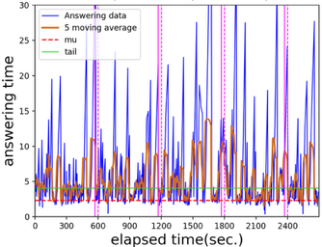
On the other hand, not all participants took breaks during the micro-re fresh period. Figure 4 shows the task response time data of ID6 under the lighting switch condition. The short intervals represented by the pink verti cal lines indicate the micro-refresh period. The blue and brown line graphs represent the changes in response time for each comparison question and the moving average of response times for the 5 questions, respectively. As can be seen from this data, some participants continued to respond without pausing, even during the designated micro-refresh periods.
Figure 4: Result of task for ID6 under the lighting switch condition.
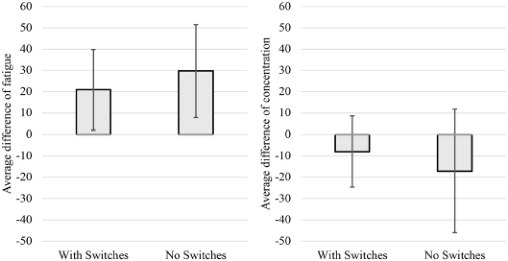
Subjective Questionnaires Regarding the progress questionnaires conducted before and after SET, we analysed the difference between the responses after SET and those before SET. Figure 5 shows the results of the progress questionnaires. Comparing the two conditions, the condition with lighting switches suppressed the increase in fatigue and decrease in concentration.
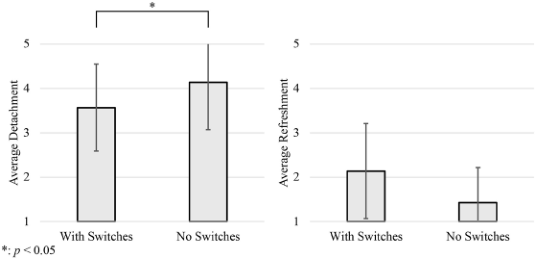
Figure 6 shows the average response values for detachment and refresh ment asked in the DR questionnaire. Comparing the two conditions, there was an increase in refreshment and a significant downward trend in detach ment in the condition with lighting changes.
In Q1 of post-experiment questionnaire, which describes the impressions of each SET, there were positive opinions regarding the lighting switch, such as ‘When there was no change, my concentration decreased halfway through’
The Effect of Fading-In Light Transitions to Induce Micro-Refresh on Intellectual Work 137 (ID6) and ‘I felt my concentration increase when switching from Environment 2 to Environment 1’ (ID8). On the other hand, there were negative opinions such as ‘Once I was able to concentrate, I was able to maintain my concentra tion’ (ID7) under the condition of no lighting switch and ‘When switched to Environment 2, I thought the task was over and my mind wandered’ (ID5).
Figure 5: Result of progress questionnaire.Figure 6: Result of DR questionnaire.
Regarding the lighting environment during the work period, Q2 offered a six-point scale ranging from 0, meaning ‘I was completely unable to concen trate,’ to 5, meaning ‘I was able to concentrate very well.’ Of the seven par ticipants, six gave a positive response of 3 or higher. Five participants chose ‘just right’ for the frequency of micro-refresh periods, and four chose ‘just right’ for the length. In addition, five participants gave three or more positive responses to both Q6 and Q7, which asked about the refreshing feeling and comfort or discomfort caused by the lighting changes.
DISCUSSION
In this experiment, CTR improved in the majority of participants under the lighting switch condition. Subjective evaluations also showed a tendency toward reduced concentration decline and fatigue, and a certain degree of refreshment was achieved compared to the non-switch condition. Although the small number of participants prevented detailed statistical analysis, these results suggest that the lighting switch presented in this experiment may act as a factor that improves subjective refreshment and intellectual concentration.
Regarding the lighting environment during the work period, most partici pants evaluated it as an environment conducive to concentration. Therefore, it can be considered effective as a basement lighting environment for intellec tual work. Additionally, there were no significant complaints about discom fort caused by glare or changes in brightness during the MR period or when switching lighting conditions. It can be said that the design achieved the goal of not causing such discomfort. Opinions on the frequency and timing of switching were centered around “just right,” so it seems that lighting switch ing does not hinder work.
On the other hand, it is necessary to consider whether the changes in con centration and refreshment among participants between conditions are truly due to lighting switching. In particular, there is considerable variation among participants in the trend of changes in CTR. Some participants had signifi cantly low CTRs throughout the experiment, so more participants need to be surveyed to discuss the impact of lighting switches on intellectual concentra tion. Furthermore, participant ID5’s comments and the observation that some participants did not take breaks during the micro-refresh period suggest that the intent of the lighting changes may not have been sufficiently conveyed. It is considered necessary to explain the intent of the lighting changes to par ticipants in advance and to make efforts to encourage them to take breaks consciously during the micro-refresh period. As a limitation of this study, the small number of participants makes it difficult to generalize the findings and to conduct detailed statistical analysis. In the future, additional experiments will be needed to further verify the effects of this lighting change method on intellectual concentration and refreshment, such as adding instructions before the experiment to encourage participants to take breaks more actively during the MR period.
CONCLUSION
This study sought to explore whether lighting switching, designed to induce micro-refresh, could affect the maintenance of concentration during intellec tual tasks. Experimental results showed that in the lighting switching con dition, CTR improved in four out of seven participants. Subjective evalua tion also showed that lighting switching suppressed increases in fatigue and decreases in concentration, and tended to improve feelings of refreshment. These results suggest that the lighting switching method used in this experi ment may enhance subjective feelings of refreshment and intellectual concen tration. However, there were significant individual differences in the effect on CTR, and some participants were unable to fully utilize the MR period as intended. Further testing is needed with a larger number of participants, with the intention of MR clearly explained.
ACKNOWLEDGMENT
This work was supported by JSPS KAKENHI Grant Number 23K24889.
REFERENCES
Balci, R., & Aghazadeh. F. (2003). The effect of work-rest schedules and type of task on the discomfort and performance of VDT users. Ergonomics, 46(5), pp. 55–65. Dianita, O., Higashimaki, T., Abe, R., Ueda, K., Ishii, H., Shimoda, H., &
Obayashi, F. (2024). The effect of systematic auditory stimuli micro-refresh on intel lectual work performance and subjective measurement. Results in Engineering, 24. Kitayama, K., Dianita, O., Ueda, K., Ishii, H., Shimoda, H., & Obayashi F. (2023).
Micro-Refresh to Restore Intellectual Concentration Decline During Office Work: An Attempt at Quantitative Effect Evaluation. Intelligent Human Systems Integration, 69. pp. 87–93. Kopardekar, P., & Mital, A. (1994). The effect of different work-rest schedules on fatigue and performance of a simulated directory assistance operator’s task. Ergonomics, 37(10), pp. 697–707. Kristin, M. F., Paul, N. R., & William, S. H. (2016) Rest improves performance,
nature improves happiness: Assessment of break periods on the abbreviated vigi lance task. Consciousness and Cognition, 42, pp. 277–285. Lim, J., & Kwok, K. (2016). The Effects of Varying Break Length on Attention and Time on Task. Human Factors, 58(3), pp. 472–481. Liu, C., Li, J., Wang, X., Zang, Q., Wang, W., & Gao, W. (2024). A review of subjec
tive evaluation, physiological indicators and cognitive performance in indoor light environment: The role of illuminance and correlated color temperature. Journal of Building Engineering, 95. Monk T. H. (2005). The post-lunch dip in performance. Clinics in sports medi cine, 24(2), pp. 15-23. Obayashi, F., Ishii, H., & Shimoda, H. (2016). Intellectual Concentration Index
and Concentration-Improving Lighting. Panasonic Technical Journal, 62(1), pp. 50–55. Pradhan, S., Jang, Y., & Chauhan, H. (2024). Investigating effects of indoor temperature and lighting on university students’ learning performance considering sensation, comfort, and physiological responses. Building and Environment, 253. Smolders, K. C. H. J., Yvonne, A.W. de Kort, Cluitmans, P. J. M. (2012). A higher
illuminance induces alertness even during office hours: Findings on subjective measures, task performance and heart rate measures. Physiology & Behavior, 107(1), pp. 7–16. Ueda, K., Tsuji, Y., Shimoda, H., Ishii, H., Obayashi, F., & Taniguchi, K. (2016).
Development of “Comparison Task” to Measure Intellectual Concentration Affected by Room Environment. Proceedings of the 2016 International Conference on Communication and Information Systems, pp. 58–64.
LISTED IN THE AHFE DIGITAL BOOKSTORE CATALOGUE
Explore the complete digital volume
Intelligent Human Systems Integration (IHSI 2026): Disruptive and Innovative Technologies
Read this individual research paper free through the original publisher, or explore the full digital proceedings book.
ISBN 978-1-964867-76-2
Explore this ISBN in the AHFE Bookstore ↗Listed in the July 2026 bookstore catalogue; search by ISBN to confirm current availability · Digital book purchase optional