Orchida Dianita, Takuto Higashimaki, Reika Abe, Kimi Ueda, Hirotake Ishii, Hiroshi Shimoda, Fumiaki Obayashi (2024). The Investigation of Systematic Micro-refresh with Auditory Stimuli on Intellectual Work. In: Human Factors, Business Management and Society. AHFE Open Access, vol. 135, pp. 163–169. https://doi.org/10.54941/ahfe1004942
Systematic micro-refresh arises as one of the recovery strategies during the intellectual work to preserve a good performance. In this study, controlled laboratory experiments were conducted to investigate the effect of auditory stimuli to induce a systematic micro-refresh on intellectual work. In this preliminary experiment, four participants’ data which demonstrated a positive effect in auditory stimuli intervention were analyzed. The average measurement of answering time resulted in a better condition after participants received the micro-refresh auditory stimuli compared to non-auditory stimuli. NASA task load index questionnaire scores show that in a condition without auditory stimuli, the score is higher which implies a higher workload in a condition without auditory stimuli intervention. The subjective symptoms questionnaire indicates that in a condition without auditory stimuli, participants feel sleepier. However, a blurriness and sluggishness score shows a slightly higher score in a condition with auditory stimuli compared to a non-auditory stimuli condition. Subjective feelings of concentration showed that the score is a little bit lower in a condition with auditory stimuli. A higher fatigue level score happened in a condition without auditory stimuli. Participants feel more detached, easily recovered, and more relaxed compared to no auditory stimuli intervention. From the total score of the attention control scale questionnaire, participants were classified as a medium-attentional group and a high-attentional group, which might imply a positive correlation to the good attentional control and micro-refresh auditory stimuli responses. This study portrays the auditory stimuli as a promising micro-refresh medium to promote recovery enhancement strategy for intellectual work.
To maintain workers’ performance during work whether in a short duration or the long run, the activity or strategy to promote recovery strategy during work is important. Up to 90% of their time, people spend in the indoor area (Almusaed and Almssad, 2018). Therefore, creating an indoor environment such as an office area that could generate workers’ productivity and maintain their well-being became the motivating basis for some research studies.
The idea of inserting stimuli in a very short time that act as a recovery inhibitor during work creates the idea of micro-refresh (MR) as a concept
of promising recovery strategies (Kitayama et al., 2023). Micro-refresh is induced during work while workers would still remain to continue their work without sacrificing the working time. Hence, this concept tries to combine the optimum remarks of maintaining productivity and individual well-being.
Auditory stimuli appear as one of the stimuli that might have the potential to act as a micro refresher. Previous studies mentioned the adoption of sound in several cognitive performance activities and its effects on physical and physiological responses. Liu et al. (2023) summarize research related to learn- ing efficiency in students associated with the acoustic environment where it was found that many important effects of sound in the experiments related to cognitive performance. Song et al. (2023) found that embracing the nature sound significantly lowers the heart rate measurement compared to the urban sound. Ge et al. (2023) stated that natural sounds could promote beneficial effects on anxiety disorder patients in terms of their level of calmness, emo- tional valence, and arousal. A systematic review of students’ learning from the effects of sound stimuli found that exposure to natural sounds could bring constructive results to their academic performance (Pellegatti, 2023).
Despite the promising attribute of sound as a recovery inhibitor, it is obscure whether its potential benefit will apply the same in the application of micro-refresh on intellectual work. Therefore, this study aims to investigate the auditory stimuli as a micro-refresh to the intellectual work.
METHODS
Participants Five participants were recruited for this preliminary study. The participants range of age between 19 to 27 years old (average = 22.4±2.97 years old, male = 3 people and female = 2 people). All the participants are Kyoto University students. Before the experiments, the participants received an explanation of the procedures for conducting the experiment. Furthermore, participants have agreed to the rules and rights that participants have as stated in the consent form.
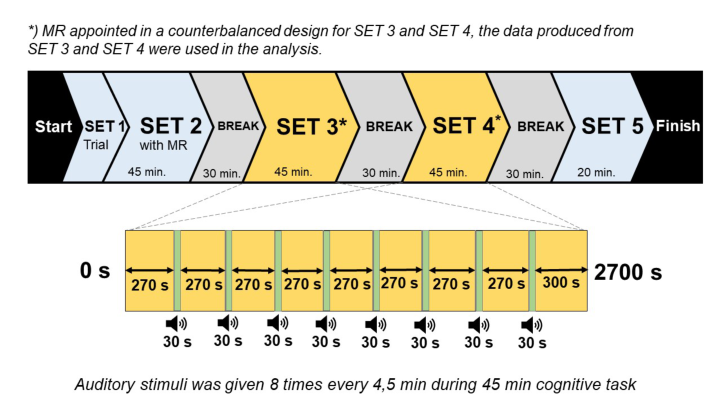
Auditory Stimuli The auditory stimuli in this experiment act as a manifestation of micro- refreshes during the work that is induced at a certain specific time. The audio volume was set at 42 dB which is categorized as a safe volume level in the office work (NIOSH, 2023). The auditory stimuli are sounded in the form of nature sounds appearing as waves and seagulls chirping resembling a beach- side situation. According to Ge et al. (2023), the two foreground natural sounds which have the greater degree of eventfulness are bird sound and water sound, and composing two natural sound sources delivers an outstand- ing subjective feeling. The duration of one playback of auditory stimuli is 30 seconds. The auditory stimuli were inserted during the task in a condition with systematic micro-refresh induction. The auditory stimuli were inserted eight times every 4.5 minutes task interval for a 45-minute task duration.
The Investigation of Systematic Micro-Refresh With Auditory Stimuli on Intellectual Work 165
Experiment Task and Procedure The experiment task adopted from previous research presents a judgment statement between two words and two numbers which should be compared (Ueda et al., 2016). Between the two words appeared, participants were asked to decide if those two words belonged to the same category or not. For exam- ple, given two words “apple” and “orange” which should be answered as the same category word for fruit. Then, a comparison between two numbers with mathematical expression connects the two, is the statement was cor- rect or not. There were four answer boxes with the four possible answers such as same word category-correct statement, same word category-wrong statement, different word category-correct statement, and different word category-wrong statement. The experiment program runs on a tablet device. The answering time for each question was automatically recorded in a.csv file. Participants have the opportunity to correct the answer by pushing the undo button on the tablet.
Each participant completed four sets of experiment tasks with a 45-minute duration for each set. Between the sets, 30-minute breaks were given. In sets 3 and 4, the auditory stimuli intervention was induced in a counterbal- anced design, and the data were used in the analysis. Several questionnaires (e.g., NASA-task load index, subjective symptoms, detachment, recovery, relaxation, fatigue, and attention control scale) were given to measure the subjective ratings. The subjective symptoms, detachment, recovery, relax- ation, and fatigue questionnaire were given before and after set 2, 3, and 4. The NASA-task load index questionnaire was given at the end of set 2, 3, and 4. Additionally, the attention control scale questionnaire was given at the end of set 5. Figure 1 illustrates the experiment procedures.
Figure 1: Illustration of the experiment procedure.
Measurements and Analysis Method In this study, the average of answering time data between conditions with auditory stimuli and without auditory stimuli is compared. Additionally, some qualitative measurements (e.g., NASA-task load index (Hart, 2006), subjective symptoms (Sasaki and Matsumoto, 2005), detachment, recov- ery, relaxation, fatigue) of the subjective ratings were also measured in both conditions. Furthermore, the attention control scale (ATTC) questionnaire adopted from Derryberry and Reed (2002) is measured which exhibits the individual’s aptitude for focusing and shifting control.
RESULTS AND DISCUSSION
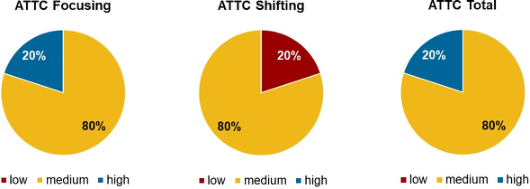
The result of the average answering time data shows that participants per- form faster in a condition with auditory stimuli compared to no auditory stimuli condition. The NASA task load index shows that in a condition with- out auditory stimuli, the score is higher compared to the auditory stimuli condition. The result of the NASA task load index indicates that a higher workload happened in a condition without auditory stimuli. The subjec- tive symptoms questionnaire of sleepiness factor shows a higher score in a condition without auditory stimuli, which indicates that participants felt sleepier without auditory stimuli. On the other hand, blurriness and sluggish- ness factors resulted in a higher score in a condition with auditory stimuli. Similar to the NASA task load index results, the fatigue score questionnaire displays a higher score in a condition without auditory stimuli, which indi- cates that participants feel more fatigue in that condition. In a condition with auditory stimuli, participants feel more detached, easily recovered, and more relaxed compared to a condition without auditory stimuli, as shown by higher scores. Additionally, the attention control scale questionnaire shows the potential attentional control among participants which is then divided into two subscales named attention focusing and attention shifting. Atten- tion control questionnaire (ATTC) scores then could be classified into “low” with a score below 19, “medium” with a range of scores between 19–27, and “high” attentional groups with a score above 27. Based on the score of attention focusing, among those five participants, four people were clas- sified into the medium attention-focusing group (80%), while one person belonged to the high attention-focusing group (20%). Subsequently, four peo- ple were classified into the medium attention-shifting group (80%), and one people classified into the low attention-shifting group (20%). Table 1 shows the average comparison data between conditions with auditory stimuli and without auditory stimuli for some measurement data (i.e., answering time, NASA task load index, subjective symptoms, fatigue, detachment, recovery, and relaxation). Table 2 shows the attention control scale score and Figure 2 shows the percentage of ATTC score classification for five participant groups.
The Investigation of Systematic Micro-Refresh With Auditory Stimuli on Intellectual Work 167
Table 1. Average data measurement between conditions with and without auditory stimuli.
Table available in the original PDF paper.
Average Data in a Condition Without Auditory Stimuli ± SE
Data Measurement Average Data in a Condition With Auditory Stimuli ± SE Answering time (second) 3.065 ± 0.28 3.338 ± 0.22 NASA task load index score 48.013 ± 3.17 53.667 ± 1.85 Subjective symptoms: sleepiness score 0.8 ± 0.37 1.8 ± 1.16 Subjective symptoms: blurriness score 1 ± 0.32 0.6 ± 0.60 Subjective symptoms: sluggishness score 2 ± 0.71 1.8 ± 1.32 Fatigue score 18.4 ± 5.57 21.2 ± 7.07 Detachment score 2.8 ± 0.58 1.8 ± 0.58 Recovery score 1.8 ± 0.37 1 ± 0.00 Relax score 2.4 ± 0.51 1 ± 0.00
Table 2. Average data measurement of attention control scale.
Table available in the original PDF paper.
Data Measurement Average Score ± SE ATTC: focusing score 24.6 ± 2.11 ATTC: shifting score 26.6 ± 2.16 ATTC: total score 51.2 ± 3.19
Figure 2: Percentage of ATTC grouping categories among five participants.
CONCLUSION
In this study, the investigation of the effect of auditory stimuli as a micro- refresh mechanism on intellectual work which was conducted in proper experimental testing, showed a promising outcome. The results among four participants portray a potential benefit of auditory stimuli as a micro-refresh to promote a recovery enhancement strategy during 45-minute intellectual work as shown by a faster answering time in a condition with auditory stim- uli compared to no auditory stimuli. Auditory stimuli also has the advantage of decreasing participants’ workload shown by the lower NASA task load index score. Furthermore, some subjective ratings resulted a positive feed- back in terms of auditory stimuli intervention which participants felt less
sleepy, more detached, easily recovered, and more relaxed. However, some of the questionnaire measurements showed a shortcoming result related to blur- riness, sluggishness, subjective concentration, and fatigue levels. Additionally, the majority of the participants carried a medium level of attentional control, and the other was classified as a high level of attentional control. This might imply that participants who have good attentional control, it is more likely that they will be able to respond well to micro-refresh auditory stimuli so that they can improve their intellectual concentration performance.
In the future, subsequent studies will be conducted with a larger num- ber of participants. It is hoped that the results of this study could enrich research related to micro-refresh auditory stimuli to maintain productivity during intellectual work.
ACKNOWLEDGMENT
This work was supported by JSPS KAKENHI Grant Number 22H03633.
REFERENCES
Almusaed, A., and Almssad, A. (2018). Introductory chapter: overview of a competent sustainable building. Sustainable Buildings-Interaction Between a Holistic Conceptual Act and Materials Properties. http://dx.doi.org/10.5772/intechopen .77176 Derryberry, D., and Reed, M. A. (2002). Anxiety-related attentional biases and
their regulation by attentional control. Journal of Abnormal Psychology, 111(2), 225–236. https://doi.org/10.1037/0021-843X.111.2.225 Ge, Y., Xie, H., Su, M., and Gu, T. (2023). Effects of the acoustic characteristics of natural sounds on perceived tranquillity, emotional valence and arousal in patients with anxiety disorders. Applied Acoustics, 213, 1–13. https://doi.org/10.1016/j.ap acoust.2023.109664 Hart, S. G. (2006). Nasa-Task Load Index (NASA-TLX); 20 Years Later. Proceedings
of the Human Factors and Ergonomics Society Annual Meeting, 50(9), 904–908. https://doi.org/10.1177/154193120605000909 Kitayama, K., Dianita, O., Ueda, K., Ishii, H., Shimoda, H., and Obayashi, F. (2023).
Micro-refresh to Restore Intellectual Concentration Decline during Office Work: An Attempt at Quantitative Effect Evaluation. Proceedings of the 2023 Intelligent Human Systems Integration. AHFE Open Access, vol 69. AHFE International, USA. http://doi.org/10.54941/ahfe1002824 Liu, C., Zang, Q., Li, J., Pan, X., Dai, H., and Gao, W. (2023). The effect of the acoustic environment of learning spaces on students’ learning efficiency: A review. Journal of Building Engineering, 79, 1–15. https://doi.org/10.1016/j.jobe.2023. 107911 Pellegatti, M., Torresin, S., Visentin, C., Babich, F., and Prodi, N. (2023). Indoor
soundscape, speech perception, and cognition in classrooms: A systematic review on the effects of ventilation-related sounds on students. Building and Environ- ment, 236, 1–17. https://doi.org/10.1016/j.buildenv.2023.110194 Sasaki, T., and Matsumoto, S. (2005). Actual conditions of work, fatigue and sleep in non-employed, home-based female information technology workers with preschool children. Industrial Health, 43(1), 142–150. https://doi.org/10.2486/in dhealth.43.142
The Investigation of Systematic Micro-Refresh With Auditory Stimuli on Intellectual Work 169
Song, I., Baek, K., Kim, C., and Song, C. (2023). Effects of nature sounds on the attention and physiological and psychological relaxation. Urban Forestry & Urban Greening, 86, 1–8. https://doi.org/10.1016/j.ufug.2023.127987 The National Institute for Occupational Safety and Health – NIOSH. (2023). Under-
stand Noise Exposure. The National Institute for Occupational Safety and Health (NIOSH) website: https://www.cdc.gov/niosh/topics/noise/ Ueda, K., Tsuji, Y., Shimoda, H., Ishii, H., Obayashi, F., and Taniguchi, K.
(2016). Development of “Comparison Task” to Measure Intellectual Concen- tration Affected by Room Environment. Proceedings of the 2016 International Conference on Communication and Information Systems, 58–64. https://doi.org/ 10.1145/3023924.3023939
LISTED IN THE AHFE DIGITAL BOOKSTORE CATALOGUE
Explore the complete digital volume
Human Factors, Business Management and Society
Read this individual research paper free through the original publisher, or explore the full digital proceedings book.
ISBN 978-1-964867-11-3
Explore this ISBN in the AHFE Bookstore ↗Listed in the July 2026 bookstore catalogue; search by ISBN to confirm current availability · Digital book purchase optional