Kakeru Kitayama, Orchida Dianita, Kimi Ueda, Hirotake Ishii, Hiroshi Shimoda, Fumiaki Obayashi (2022). Micro-refresh to Restore Intellectual Concentration Decline During Office Work: An Attempt at Quantitative Effect Evaluation. In: Human Factors, Business Management and Society. AHFE Open Access, vol. 56, pp. 191–195. https://doi.org/10.54941/ahfe1002268
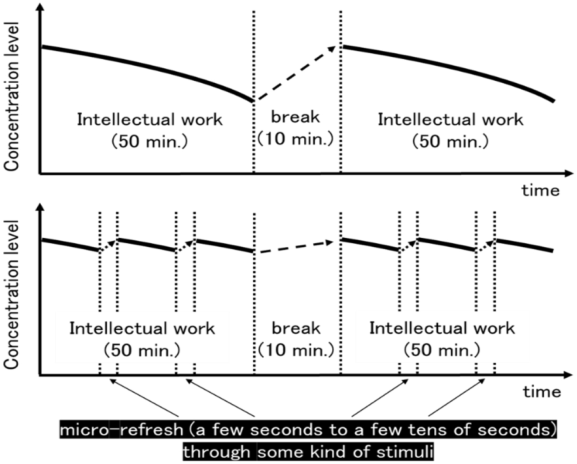
There have been many studies on improving intellectual concentration. Concentration on intellectual work such as working in office tends to decrease over time, and this needs to be prevented in order to improve intellectual work efficiency. In conventional office work, for example, a 10-minute break was taken every hour. However, in this case, their concentration is gradually getting lower by the next break. There is a possibility of suppressing the decline in intellectual concentration by interspersing short breaks of a few seconds to a few tens of seconds and give environmental stimulus to improve their refresh in a shorter cycle. In this study, we named this break "micro-refresh" and aimed to show its effect on improving intellectual concentration by experiments, and then to study the environmental control method to introduce it appropriately in the actual working environment. The "micro-refresh" differs from the conventional "microbreak" in that it effectively encourages office workers to refresh themselves in a short period of time. In other words, this research aims to actively encourage office workers to refresh themselves through some kind of stimuli, such as controlling the office room environment.As a basis for this study, therefore, it should be firstly confirmed by an experiment that the effect of micro-refresh can be measured quantitatively. Especially, short breaks of a few seconds to tens of seconds were forcibly given to the experimental participants during the cognitive task, and the difference in intellectual concentration was confirmed using objective indicators.In this measurement, a comparison problem developed by Ueda et al1). was used as a cognitive task. As a simulated micro-refresh, an experimental system has been developed in which the screen changes to all gray after an arbitrary time has passed and the answer to the problem being solved at that time is completed. The interval between the screen changing was set to 7 minutes and 30 seconds, and the time until the changed screen returned to the task was set to 20 seconds. Three university faculty members performed a 25-minute cognitive task with and without the simulated micro-refresh. Their intellectual concentration was measured as an index, “CTR (Concentration Time Ratio)”1), which expresses concentration time ratio among total working time and was calculated from response time data of the cognitive task. As a result, all three participants had higher CTR when the simulated micro-refresh was given than those without it. Although this was just a preliminary experiment and the measurement was insufficient, it suggested that the effect of micro-refresh on intellectual concentration could be measured quantitatively and that micro-refresh might be effective in improving intellectual concentration.As a future prospect, controlled experiments with a larger number of participants to show the effect of micro-refresh should be conducted, and then environmental control methods that can appropriately introduce micro-refresh in actual work environments should be studied.1) Kimi Ueda, Hiroshi Shimoda, Hirotake Ishii, Fumiaki Obayashi, Kazuhiro Taniguchi: Development of a New Cognitive Task to Measure Intellectual Concentration Affected by Room Environment, The Fifth International Conference on Human-Environment System, 2016.
There have been many studies on improving intellectual concentration. Concentration on intellectual work such as working in office tends to decre- ase over time, and this needs to be prevented in order to improve intellectual work efficiency. In conventional office work, for example, a 10-minute break was taken every hour. However, in this case, their concentration is gradu- ally getting lower by the next break. There is a possibility of suppressing the decline in intellectual concentration by interspersing short breaks of a few seconds to a few tens of seconds and give environmental stimulus to improve their refresh in a shorter cycle. We named this break “micro-refresh” and we have been trying to show its effect on improving intellectual concentration by experiments, and to examine the environmental control method to introduce it appropriately in the actual working environment.
There have been many studies that aim to improve task performance through very short breaks (micro-break). For example, it is shown that taking micro-break has improve surgeons’ subjective physical performance
and mental focus (Hallbeck, 2017). The “micro-refresh” differs from the conventional “microbreak” in that it effectively encourages office workers to refresh themselves in a short period of time. In other words, this research aims to actively encourage office workers to take micro-refresh by them- selves through some kind of stimuli, such as controlling the office room environment. The concept of micro-refresh is shown in Figure 1.
Objective in this study is, therefore, to firstly confirm that the effect of micro-refresh can be measured quantitatively by an experiment.
METHOD
An experiment was conducted to show that the effect of micro-refresh can be measured quantitatively. Short breaks of a few seconds to tens of seconds were forcibly given to the experimental participants during the cognitive task, and the difference in intellectual concentration between under the expe- rimental condition with micro-refresh and that without micro-refresh was confirmed using objective indicators.
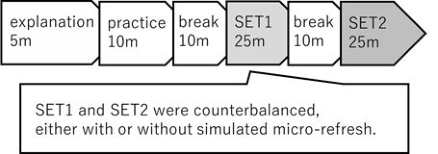
A measurement was conducted following the schedule shown in Figure 2. The experiment took place in an experimental room of Kyoto University from 10:00 to 11:00 a.m. on October 29, 2021. The participants were three faculty members from Kyoto University.
CTR (Concentration Time Ratio) CTR (Concentration Time Ratio) was used as an index to quantitatively eva- luate intellectual concentration using the response time data of a cognitive task. CTR is an indicator devised by Uchiyama et al (Uchiyama, 2013). It
Micro-Refresh to Restore Intellectual Concentration Decline During Office Work 193
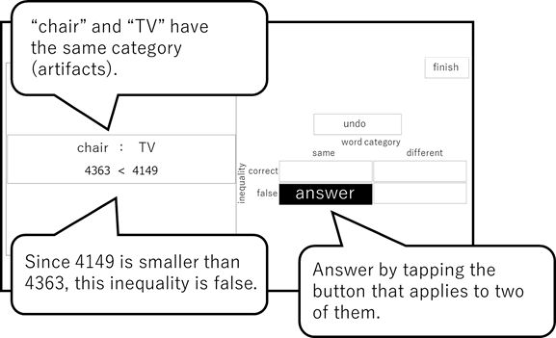
Figure 2: An experimental procedure.Figure 3: A screen of comparison task.
expresses the ratio of time spent concentrating on a task to the total work time.
Cognitive Task In order to evaluate intellectual concentration using CTR, response time data from a cognitive task consisting of multiple questions of constant difficulty is needed. Therefore, a comparison task developed by Ueda et al (Ueda, 2013), which satisfies these conditions, was used as a cognitive task to evaluate intel- lectual concentration in this experiment. Figure 3 shows the problem screen and the solution method of the comparison task. The questions are displayed on the iPad screen, and the participants answer the questions by selecting and tapping the correct button on the right side of the screen as the combination of the answer to the word category judgment question and the inequality corre- ct/false judgment question displayed on the left side of the screen. In the word category judgment, meaning categories of two words are compared. The two words belong to one of the following meaning categories: place names, artifacts, animals, and plants, and the user answer whether they belong to the same category or not. After answering one question, the next question is displayed, and the undo button allows the user to correct the previous answer.
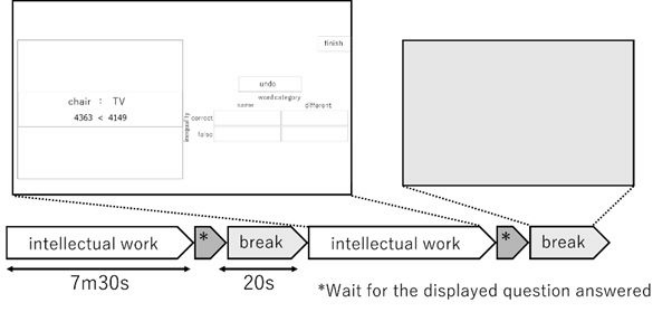
Figure 4: An overview of the experimental system.
An Experimental System An overview of an experimental system is shown in Figure 4. As a simula- ted micro-refresh, the experimental system has been developed in which the screen changes to all gray after an arbitrary time has passed and the answer to the problem being solved at that time is completed. While the screen is gray, the participants are not able to answer the cognitive task, so they take a break while the screen is turned gray. The interval between the screen chan- ging was set to 7 minutes and 30 seconds, and the time until the changed screen returned to the task was set to 20 seconds. These conditions were determined based on the previous study on improving intellectual concen- tration by controlling room airflow (Obayashi, 2019). This previous study showed that applying airflow for 20 seconds once every 10 minutes improved intellectual concentration. Since the comparison task was considered to have a higher cognitive load than the cognitive task used in the previous study, it was decided to give breaks at shorter intervals.
RESULTS
CTR was analyzed for three participants. Table 1 shows the CTR for each condition. It can be seen that all three participants had higher CTR when the simulated micro-refresh was given than those without it. Therefore, although this was just a preliminary experiment and the measurement was insufficient, it showed a possibility that the effect of micro-refresh on intellectual concen- tration could be measured quantitatively and that micro-refresh might be effective in improving intellectual concentration.
However, this could have been due to the fact that all three participants were from the same lab as the authors and they well know this study. They may have had a bias because they knew that taking micro-refresh was expe- cted to improve intellectual concentration. They also knew the time per set of tasks (25 minutes) and the interval at which the micro-refresh was prompted (7.5 minutes), and could have inferred the remaining time of the task from the number of times the screen turned gray, which may have resulted in the maintenance of motivation.
Micro-Refresh to Restore Intellectual Concentration Decline During Office Work 195
Table 1. CTR for each condition for each participant.
Table available in the original PDF paper.
Participants No. CTR with simulated
CTR without simulated
micro-refresh (%)
micro-refresh (%)
1 72.6 59.9 2 63.1 57.8 3 95.4 87.8
CONCLUSION
The purpose of this experiment was to try to measure the effect of micro- refresh quantitatively by an experiment. In the experiment, the screen of the cognitive task was changed to gray to simulate a micro-refresh. As a result of the experiment, CTR, which indicates the degree of intellectual concentration, was higher with simulated micro-refresh.
As a future prospect, it is necessary to conduct experiments on people who are not familiar with this research and do not have preconceived noti- ons about micro-refresh. In addition, since it is expected that the timing at which micro-refresh should be encouraged differs from person to person, it is necessary to investigate the effect of improving intellectual concentration when micro-refresh is encouraged at the most appropriate timing for that person. If the effects of taking micro-refresh on intellectual concentration are objectively demonstrated through these experiments, environmental con- trol methods that can appropriately introduce micro-refresh in actual work environments should be studied.
REFERENCES
Fumiaki Obayashi, Kazune Miyagi, Kyoko Ito, Kazuhiro Taniguchi, Hirotake Ishii, Hiroshi Shimoda (2019) “Objective and quantitative evaluation of intel- lectual productivity under control of room airflow”, Building and Environment, pp. 48–57. Kimi Ueda, Hiroshi Shimoda, Hirotake Ishii, Fumiaki Obayashi, Kazuhiro Taniguchi
(2016) “Development of a New Cognitive Task to Measure Intellectual Concen- tration Affected by Room Environment”, The Fifth International Conference on Human-Environment System. Kosuke Uchiyama, Koutarou Ooishi, Kazune Miyagi, Hirotake Idshii, Hiroshi Shimoda (2013) “Process of Evaluation Index of Intellectual Productivity Based on Work Concentration”, Proceedings of ICSTE 2013. M.S. Hallbeck, B.R. Lowndes, J. Bingener, A.M. Abdelrahman, D. Yu, A. Bartley, A.E.
Park (2017) “The impact of intraoperative microbreaks with exercises on surge- ons: A multi-center cohort study”, Applied Ergonomics Volume 60 pp. 334–341.
LISTED IN THE AHFE DIGITAL BOOKSTORE CATALOGUE
Explore the complete digital volume
Human Factors, Business Management and Society
Read this individual research paper free through the original publisher, or explore the full digital proceedings book.
ISBN 978-1-958651-32-2
Explore this ISBN in the AHFE Bookstore ↗Listed in the July 2026 bookstore catalogue; search by ISBN to confirm current availability · Digital book purchase optional