Giuseppe Carmosino, Andrea Ratti (2022). Smart ships and the evolution of cruise target. How smart technologies are affecting the relationship of customers with spaces and services. In: Human Factors, Business Management and Society. AHFE Open Access, vol. 56, pp. 98–106. https://doi.org/10.54941/ahfe1002257
This research investigates the evolution of spaces and services for customers in the naval and nautical sectors, through the method of case study analysis. The spread of smart technologies has deeply transformed our society in every context, generating relationships based on network systems and new forms of communication among people, objects and surrounding environments. In the cruise and yacht sectors smart technologies have affected the sea travel, leading companies to rethink spaces and services for customers. The results show how smart technologies can improve the quality of travel on board, offering new opportunities than on former ships, and at the same time indicate critical factors derived by the use of these new technologies.
The great development of smart systems since ‘90s has significantly influe- nced every economic field, both leading and minor sectors, and even the cruise sector, transforming cruise ships in a new generation of vessels: the ‘smart ships’ (Papathanassis, 2017). The cruise ship Royal Caribbean’s Quantum of seas, launched in 2014, has been defined as the first smart ship. CLIA – the Cruise Lines International Association – has outlined some impacting trends for the cruise travel: instagrammable cruise travel, on-board smart tech, gen Z at sea, achievement over experiences (CLIA, 2018), cruise line apps, weara- ble technology, and smart homes at sea (CLIA, 2020). In the tourism context, due to the increase and the transformation of mobility, travel has blurred with some activities from everyday life, generating so new phenomena of ‘bleisure tourism’, which derives from the contraction of the words “business” and “leisure” (Scullica & Elgani, 2020), of ‘neverending tourism’, which repre- sents the possibility of an extension of the tourism experience (both physical and digital) in space (not only at the destination) and time (before, during and after the travel experience) (Osservatorio Innovazione Digitale nel Turismo, 2022) and, due to the long periods of travel restrictions during covid pande- mic time, traveller’s behaviour has turned toward flexibility and last-minute
Smart Ships and the Evolution of Cruise Target. How Smart Technologies 99
planning, expressing preference for relaxing and escapist experiences (Shadel, 2020). The target of cruise passengers has evolved over time, passing from an old and wealthy tourist with a lot of spare time to a younger and more dynamic one (Penco, 2013). In addition, the worldwide demand for crui- ses, traditionally occupied mainly by North American customers, is currently undergoing a process of globalization with the slow growth of the European and Asian markets (World Tourism Organization, 2003). This context poses new challenges to the cruise industry for the future of cruise travel.
THEORETICAL BACKGROUND In the early 1970s, the first modern cruise target was represented by older people, mainly retirees, identifiable as ‘baby boomers’, health-conscious, adventurous and with a lot of time to spare. They sought ways to enrich their lives and they expected cruise travel to be customized, easy, exotic, exclusive, and with activities that are healthy and fun (Dowling, 2006). Slowly the target has turned from an elite rich class to a larger middle class, who was looking for a holiday that was affordable, economically viable and, of course, fun. So, the ‘fun-ship’ was born, making onboard entertainment the backbone of the cruise (Zaccagnino, 2014). Based on the analysis of demographic factors and cruise passenger behavior, cruise tourism analysts have developed different passenger profiles in regard to fun-ships. First CLIA identified six segments: restless baby boomers, baby boom-er enthusiasts, lovers of luxury, deman- ding buyers, explorers and boat enthusiasts (CLIA, 1995-2001). Later, CLIA elaborated new segments based on passenger behavior: family folks, want-it- alls, adventurers, comfortable spenders and cautious travelers (CLIA, 2003). Then Cruise Market Watch built the following segments: explorers, admi- rals, marines, little mermaids, escapers and souvenirs (Cruise Market Watch, 2008). Finally, and Paris provided five types of consumers on the cruising market: travelers taking part only in the voyage, travelers visiting cruise destinations, travelers keen on relaxation and respite, travelers looking for new acquaintances and friends, and travelers looking for sun and sun bath- ing (Teye & Paris, 2011). In more recent time, the increasing demand by passengers for more sophisticated and varied experienced has pushed cruise companies to develop new technologically advanced ships (Quartermaine & Peter, 2006), known as ‘smart ships’ (Papathanassis, 2017). The cruise travel has become affordable for almost all the income classes and ages, with the attraction of younger segments, coming from generations Y and Z. Though the primacy of North America, a growth of demand from Europe, with Germany as leader, and Asia have been registered in demographic statistics (Vafeidou, 2019). In the customer experience surveys elaborated by Deloitte, the new cruise passengers have been outlined as digitally connected, seekers of unique experiences, customized services and high-quality and pleasant spaces (Deloitte, 2018). In addition, the younger generations have shown a major interest and commitment toward sustainability than the older ones (Dimi- trovski et al., 2021). Based on this change of the demand, cruise analysists have developed new market segments of cruise passengers, even though with very few references to the smart experiences in the cruise travel. In regard
100 Carmosino and Ratti
to age generation, CLIA divided travelers in four groups: gen Y/millennial 1982-1998, gen X 1967-1981, baby Boomers 1948-1966, and traditionalists 1917-1947 (CLIA, 2017). Considering passengers as consumers, Kizielewicz differentiated three typologies of consumers: a consumer of type I, who is at the same time resident, excursionist and passenger of a ship, a consumer of type II, who is excursionist and passenger of a ship, a consumer of type III, who is tourist, excursionist and passenger of a ship (Kizielewicz, 2020). Finally, based on cruise travel motivations, Jiao et al. classified four main types of passengers: psychocentric tourist, traditional tourist, pioneer and sightseer (Jiao et al., 2021). The historical development of design research and practice has been grounded on a methodological approach known as ‘user-centered’ design, which aim was to guide the design process towards the development of usable artifacts designed from the features and needs of the end users (Radice, 2014). The spread of digital technologies has led ethnographers to reflect on methodologies and to redefine the fieldwork of research, including Internet as a field and object of study. The digital eth- nography has become a new research method, which contemplates three different approaches: virtual ethnography or ethnographies of cyberspace, connective or online/offline ethnographies, and ethnographies of Internet in everyday life (Ardevol & Gómez Cruz, 2013). The advent of digital commu- nication technologies has resulted in an expansion of social environments, bringing personal relationships from place-based ties to interest-based con- nections (Broadbent, 2012). The interactions among social actors go beyond the physical boundaries and define the new ‘network society’, organized around connections, in contrast to the space of places, organized around loca- lities (Castells, 2000). Cruise line websites and social networks have become widespread, allowing companies to strengthen their relationships and com- munication with customers. Cruise social media offer tourist the possibility to create contents, allow peer-to-peer communication between companies and customers, and build virtual communities, which affect people’s behavior (Tiago et al., 2018) (Zeng & Gerritsen, 2014). The rise of the internet and the spread of new organizations into groups has allowed new forms of ‘col- lective intelligence’ to emerge. The potential of collective intelligence is very high and goes beyond the creation of ‘cool’ ideas (Malone et al., 2009). The foundation and goal of collective intelligence is the mutual recognition and enrichment of people. Collective intelligence is based on culture and grows with it through ideas, languages and cognitive technologies supported by a community (Lévy, 2002). In this context, the scale and complexity of contem- porary challenges can no longer be addressed by the traditional ‘user-centred’ design approach. Nowadays Design has been regarded to be no longer about designing products for the user, but about designing experiences, involving people, communities and cultures, connected and informed as never before (Sanders, 2008). Co-design represents the last development of a trend started with user-centered design aimed at involving end users in the design process, includes many tools from user-centered design and experience design, and is a completely transparent activity in which all participants are acknowledged about the design methodologies and its goals (Radice, 2014) (Rizzo, 2009). This research aims at providing a link among cruise passengers, spaces and
Smart Ships and the Evolution of Cruise Target. How Smart Technologies 101
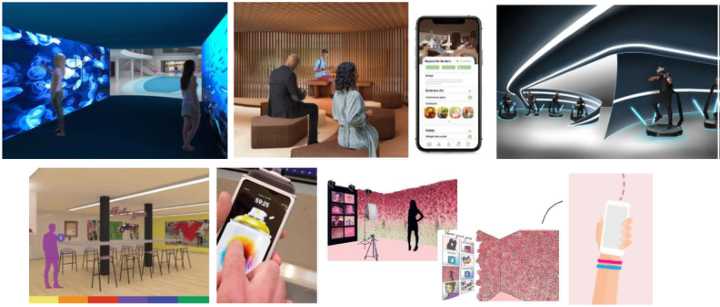
Figure 1: Selection of case studies from university projects of the Laboratorio di Sin- tesi of School of Design at Politecnico di Milano (a.a. 2020–21): (a) Scilla e Cariddi, (b) Beyond the borders, (c) Laserzone, (d) Art in the making, (e) Social Media Wall.
services, in order to guide cruise companies and designers to develop ships more respectful of the customers culture and identity, overcoming the concept of non-places.
METHODOLOGY
The research methodology is based on a qualitative analysis of case studies and tries to answer the following research question: how are smart techno- logies affecting the relationship of customers with spaces and services? The case studies collected included environments from cruise ships with smart features. This sampling has involved from 7 global cruise lines registered in CLIA (Cruise Lines International Association), 10 smart cruise ships and 25 environments, 5 of which are fictional projects from the Laboratorio di Sin- tesi held by Prof. S. Piardi within the BA degree course in Interior Design at the School of Design of the Politecnico di Milano. The case studies were collected between November 2019 and February 2022.
Case studies have been analyzed using several parameters, grouped in four categories: technologies, spaces, services and customers. The technological development measures the degree of complexity of electronic component assembly through the levels of low, medium/high or smart (Texas Assistive Technology Network, 2002). An adaption of the taxonomy of virtual rea- lity systems (Muhanna, 2015) classifies technologies in no immersive, little immersive, partially immersive and fully immersive. An adaption of the technological embodiment continuum (Flavián et al., 2019) differentiates technologies in touchless or contactless stationary external device, stationary external device with need of touch, portable external device and wearable device. With the emerging experience economy, spaces have encompassed the- atre as a model, so that can be set in six areas: backstage, stage, auditorium, proscenium, entrance, and exit (Pine II & Gilmore, 1999). Cruise travel is a complex and all-inclusive tourism product which includes a central service
102 Carmosino and Ratti
Table 1. Collection of case studies based on environments located on smart ships.
Table available in the original PDF paper.
Context Case study N. Unit of analysis Year Cruise company Smart cruise ship Environment from smart cruise ship
Spirit 01 Panedia Cruiseabout VR headset 2016
Carnival Cruise Lines
02 Magic Carpet 2018
Celebrity Cruises Celebrity Edge
2018
03 Le Petit Chef 2018 04 Access Tour app for smart mobile devices
Dream 07 Magical Porthole 2011
Costa Cruises Smeralda 05 Bellavista restaurant 2019 06 Colosseo 2019 Disney Cruise Line
Quantum of the Seas 19 Expedition TW070 2014 20 TW070° Vistarama 2014
2020
21 Scilla e Cariddi – Corridor with Interactive Ledwalls
MSC Cruises (fictional projects 1-2-3-4-5)
Meraviglia (Odissea 2.0)
2020
Meraviglia (Greenline)
22 Beyond the borders – A zone for sharing and communication among passengers thanks to technologies that highlight multiculturalism
2020
Meraviglia (Zth Sense)
23 Laser zone - A game area with platforms with equipment for virtual multi-player experience
2020
Meraviglia (Fun)
24 Art in the making - A lab area where passengers can learn how to make a work of art
UNIVERSITY
2020
Meraviglia (It’s showtime)
25 Social Media Wall - Using a phone app, passengers can share posts on an interactive totem pole
Smart Ships and the Evolution of Cruise Target. How Smart Technologies 103
Table 2. Parameters for the case studies analysis based on environments located on smart ships.
Table available in the original PDF paper.
and many peripherical services, as the ship facilities, the additional servi- ces, itinerary and destinations planning, travel arrangements and transfers, ports and terminal embarkation and disembarkation, and excursions (Penco, 2013). The levels of participation can be distinguished in spectating, intera- ction, contribution, collaboration and co-creation (Radice, 2014). Presence can manifest itself in three ways in relation to a mediated (through tech- nology) environment: physical, social and co-presence (IJsselsteijn & Riva, 2003). The increasing connectivity of users with mobile technologies has led them to repeated shifts in communication and interaction between physical and digital spaces, resulting in redefining physical space and cyberspace into a new hybrid space, which can be perceived as flowing in and out of physical space, blurring the boundaries between both (De Souza e Silva, 2006).
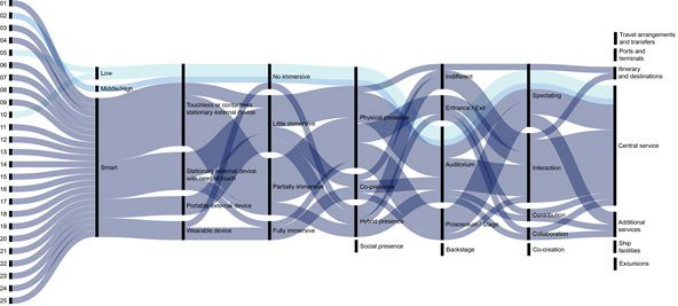
The categories that emerged from the analysis of the case studies were translated into flood diagrams in order to examine the relationships between the various classifications and assess the specific contribution of technologies in relation to spaces and services.
104 Carmosino and Ratti
Figure 2: Diagram derived from case study analysis based on environments located on smart ships.
RESULTS
The results derived from the study diagram show a great versatility of smart technologies across the various categories and confirm the recent great inte- rest of cruise lines in these new tools. The case studies with a low or medium-high level of technology show a similar behaviour, denoting basic properties with respect to the technological contribution: fixed external devi- ces with no need for touch or contact by the passenger, level of virtuality generating no immersiveness, sense of physical presence by the passenger, located in a single space of layout, which is the auditorium, basic level of par- ticipation as spectating. Case studies with a smart level of technology include various levels of technological embedding, achieve all levels of immersiveness, are located in most layout areas or may be indifferent to a defined location, may achieve different levels of user participation and may offer a variety of services. The research process has highlighted how the continuous innovation provided by smart technologies is radically changing the cruise context and specifically cruise ships. The case studies coming from the university aim to fill the gaps left by the cruise industry, suggesting to cruise lines and designers further possible improvements.
CONCLUSION
The analysis of smart technologies has highlighted multiple opportunities for development in the cruise context, but, at the same time, the emergence of critical factors. Therefore, innovation in the cruise industry should not only be driven by technologies but by a responsible attitude. As emerged from the analysis of the literature, the passengers on board come from various geographical contexts, express different cultures and demographic factors, such as age and social status. Responsible development requires attention to all social declinations, age groups, gender and social origins, through greater involvement of the various players in the cruise context in the design processes of spaces and services.
Smart Ships and the Evolution of Cruise Target. How Smart Technologies 105
REFERENCES
Ardevol, E., Gómez Cruz, E., (2013). “Digital Ethnography and Media Practices”. in: AA.VV.. The International Encyclopedia of Media Studies. Malden (MA, USA): John Wiley & Sons, Ltd. pp. 35. Broadbent, S., (2012). “Approaches to Personal Communication”. in: Horst, H.A.
and Miller, D. (Eds.). Digital Anthropology. London (UK), New York (NY, USA): Berg. pp. 127–145. Castells, M., (2000). The Rise of The Network Society. The Information Age: Economy, Society and Culture. Hoboken (NJ, USA): Wiley. p. 628. CLIA (1995–2001). The Cruise Industry: An Overview. New York (NY, USA): CLIA. CLIA, (2003). Cruise Industry Overview [online]. Available from: http://www.f-
cca.com/downloads/CIOfall2003.pdf [accessed 2nd December 2021] CLIA, (2017). Cruise travel report [online]. Available from: https://cruising.org/- /media/research-updates/research/consumer-research/2017-cruise-travel- report.ashx [accessed 2nd December 2021] CLIA, (2018). 2019 State of the Cruise Industry Outlook [online]. Available
from: https://cruising.org:443/news-and-research/research/2018/december/2019- state-of-the-industry [accessed 2nd December 2021] CLIA, (2020). 2021 State of the cruise industry outlook [online]. Available from: https://cruising.org/-/media/research-updates/research/2021-state-of-the-c ruise-industry-optimized.pdf [accessed 2nd December 2021] Cruise Market Watch, (2008). Market Segments [online]. Available from: https://cruisemarketwatch.com/market/. [accessed 2nd December 2021] De Souza e Silva, A. (2006). From Cyber to Hybrid: Mobile Technologies as
Interfaces of Hybrid Spaces. Space and Culture. Vol. 9, N. 3. pp. 261–278. Deloitte, (2018). The next generation of cruise passengers has embarked [online].
Available from: https://www2.deloitte.com/content/dam/Deloitte/us/Documents/c onsumer-business/us-cruise-industry-analysis-passenger-experience.pdf [accessed 2nd December 2021] Dimitrovski, D., Lemmetyinen, A., Nieminen, L., Pohjola, T., (2021). Understanding coastal and marine tourism sustainability - A multi-stakeholder analysis. Journal of Destination Marketing & Management. Vol. 19. N. 2. pp. 12. Dowling, R.K., (2006). Cruise Ship Tourism. Wallingford (UK), Cambridge (MA –
USA): CABI. pp. 465. Flavián, C., Ibáñez-Sánchez, S., Orús, C., (2019). The impact of virtual, augmented and mixed reality technologies on the customer experience. Journal of Business Research. Vol. 100. pp. 547–560. IJsselsteijn, W., Riva, G., (2003). “Being there: The experience of presence in medi-
ated environments”. in: Riva G, Davide F, IJsselsteijn W (Eds.). Being there: Concepts, effects and measurements of user presence in synthetic environments. Amsterdam (Netherlands): IOS Press. pp. 3–16. Jiao, Y., Hou, Y., Lau, Y., (2021). Segmenting Cruise Consumers by Motivation for an Emerging Market: A Case of China. Frontiers in Psychology. Vol. 12. p. 15. Kizielewicz, J., (2020). Typology and Models of Cruise Travellers’ Consumption in
Coastal Tourist Destinations. European Research Studies Journal. Vol. 13. N. 3. pp. 679–698. Lévy, P., (1994). L’intelligence collective. Pour une anthropologie du cyberespace.
Paris: Éditions La Découverte. pp. 252. Malone, T., Laubacher, R., Dellarocas, C., (2009). Harnessing Crowds: Mapping the Genome of Collective Intelligence. MIT Sloan School of Management, N. 4732–09, p. 21.
106 Carmosino and Ratti
Muhanna, M., (2015). Virtual reality and the CAVE: Taxonomy, interaction challenges and research directions. Journal of King Saud University. Computer and Information Sciences, Vol. 27. N. 3. pp. 344–361. Osservatorio Innovazione Digitale nel Turismo, (2022). Innovazione: il booster per
il rilancio nel travel [online]. Available from: https://www.osservatori.net/it/ric erche/infografiche/innovazione-booster-rilancio-travel-infografica [accessed 2nd December 2021] Papathanassis, A., (2017). Cruise tourism management: state of the art. Tourism
Review. Vol. 72, N. 1. pp. 104–119. Penco, L., (2013). Il business crocieristico: imprese, strategie e territorio. Milano: Franco Angeli. pp. 180. Pine II, B.J., Gilmore, J.H., (1999). The Experience Economy. Brighton (MA, USA):
Harvard Business Press. pp. 278. Quartermaine, P., Peter, B., (2006). Cruise: Identity, Design and Culture. London: Laurence King Publishing. pp. 160. Radice, S., (2014). Designing for participation within cultural heritage. Participa-
tory practices and audience engagement in heritage experience processes. Milan: Design Department (Politecnico di Milano). Available from: https://www.politesi .polimi.it/handle/10589/89798 [accessed 2nd December 2021] Rizzo, F., (2009). Strategie di co-design. Teorie, metodi e strumenti per progettare con gli utenti. Milano: Franco Angeli. pp. 144. Sanders, E., (2008). An Evolving Map of Design Practices and Design Research.
Interactions – Experiences, People, Technology. Vol. 15. N. 6. pp. 13–17. Scullica, F., Elgani, E., (2020). Time. Hybrid Spaces for Users-Bodies between Work and Hospitality. In: Anzani A. (ed.). Mind and Places. Milan: Springer. pp. 255–265. Shadel, J.D., (2020). ‘Revenge travel’ is the phenomenon that could bring back
tourism with a bang [online]. Available from: https://www.washingtonpost.com/t ravel/2020/07/29/revenge-travel -is-phenomenon-that-could-bring-back-tourism- with-bang/ [accessed 2nd December 2021] Texas Assistive Technology Network, (2002). Taking a Closer Look at Assistive Technology Devices [online]. Available from: https://assistedtechnology.weebly.com/ uploads/3/4/1/9/3419723/assistive_technology_devices.pdf [accessed 2nd Decem- ber 2021] Teye, V., Paris, C., (2011). Cruise Line Industry and Caribbean Tourism: Guests’
Motivations, Activities, and Destination Preference. Tourism Review Internatio- nal. Vol. 14, pp. 17–28 Tiago, F., Couto, J., Faria, S., Borges-Tiago, T., (2018). Cruise tourism: social media content and network structures. Tourism Review. Vol. 73, pp. 433–447. Vafeidou, M., (2019). Smart Cruise Ships: in what way Information and Com-
munication Technologies are revolutionizing the cruise experience. Thessaloniki (Greece): International Hellenic University. Available from: https://repository.ihu .edu.gr//xmlui/handle/11544/29247 [accessed 2nd December 2021] World Tourism Organization, (2003). Worldwide Cruise Ship Activity. Madrid (Spain): World Tourism Organization. p. 216. Zaccagnino, V., (2014). Storia delle crociere. Milano: Mursia. p. 209. Zeng, B., Gerritsen, R., (2014). What do we know about social media in tourism? A
review. Tourism Management Perspectives. Vol. 10. pp. 27–36.
LISTED IN THE AHFE DIGITAL BOOKSTORE CATALOGUE
Explore the complete digital volume
Human Factors, Business Management and Society
Read this individual research paper free through the original publisher, or explore the full digital proceedings book.
ISBN 978-1-958651-32-2
Explore this ISBN in the AHFE Bookstore ↗Listed in the July 2026 bookstore catalogue; search by ISBN to confirm current availability · Digital book purchase optional