Giuseppe Carmosino, Arianna Bionda, Andrea Ratti (2023). The Design of Human Smart Ships. How design-driven approach can foster future development and innovation in the cruise sector. In: Design for Inclusion. AHFE Open Access, vol. 75, pp. 27–37. https://doi.org/10.54941/ahfe1003324
The radical transition from 'fun ships' to 'smart ships' is a complex phenomenon, involving technological, social and design aspects, which require systemic and complex thinking. The theoretical investigation of this research aims to fill an existing gap in design processes applied to cruise ships by providing a 'service + spatial’ perspective in the interpretation of the smart phenomenon, integrated in a multidisciplinary approach with ICT and Social Sciences. The new concepts of customer experience, cultural diversity, immersive technologies, cyber-physical systems and environmental commitment denote a strong connection of spaces and services with users and related human factors. In this sense, design has a collaborative and human-centered approach, as it considers users' experience and involves them as an active part of the design process. The results of this research show how a design-driven approach, rather than a technology-push or market-pull one, can drive towards radical changes in designing innovative and more sustainable ships through a better use of human capital and the multicultural richness of cruise passengers. Guidelines for design-driven research in the cruise industry can help companies move from closed and low transparent to new holistic approaches to innovation, guided by a critical attitude towards radical changes in the industry.
The cruise activity is a relevant part of the ‘sea tourism’, which is an area resulting from the intersection of broader economic fields, such as tourism, travel and transport. Like other sectors in the market, cruise business has its own strategic business area based on three dimensions: needs/functions, customers and technology. The needs/functions are represented by the offer of a multi-destination travel, customers are essentially the users of the servi- ces offered by the cruise line, and technology concerns the way in which the cruise company creates its product, namely the typology of the ves- sel (e.g. budget, contemporary, premium, luxury ships) (Penco, 2013). In particular, the “cruise tourism is a socio-economic system generated by the interaction between human, organizational and geographical entities, aimed
at producing maritime-transportation-enabled leisure experiences” (Papath- anassis & Beckmann, 2011). This definition reveals the multidimensional nature of cruise tourism, which includes many different disciplinary conne- ctions (e.g. economics, sociology, humanities…) and so explains the high level of difficulty for academics to investigate such a complex phenomenon (Vafei- dou, 2019). In addition, the citation of the geographical entities reminds the economic value created by the cruise business on territory (Quartermaine & Peter, 2006). Several cruise lines with Bahamas/Caribbean itineraries feature a ‘private island’ day (Ward, 2019).
A bibliometric analysis of the scientific literature around the keyword ‘cruise interior design’ was conducted to obtain an initial overview of the academic debate in the field. Forty-seven contributions were collected and organised in three different bibliographic repositories, revealing the different levels of scientific impact: web of science/scopus, google scholar and no inde- xed. The selection revealed a very recent interest on the side of the academic community, in fact most of the contributions were produced from 2008 onw- ards, a fragmentation of the research, given by very few co-authorships and co-citations among the main contributors, and very diverse characteristics and forms of publication. In regard to the disciplinary fields, literature has revealed three approaches: monodisciplinary (i.e. cruise interior design, cruise spatial design), interdisciplinary (i.e. cruise vessel design, which is based on engineering and design theoretical frameworks) and multidisciplinary (i.e. cruise interior design & human-computer interaction, cruise service design & human-computer Interaction, cruise vessel design & passive design, cruise interior design & passive design, cruise interior design, emotional design & biophilic design, cruise interior design & emotional design, cruise inte- rior design & yacht design, cruise vessel design & business, and technology, economics & design). This first overview of disciplinary fields showed how interior design in the cruise industry received influences from the fields of technology and business/management.
In regard to design research, this work aspires to supply an original, rele- vant e reliable contribution for scientific design community, whereas, as regards design practice, it seeks to generate an available knowledge for cruise companies and designers, to provide meaningful and theoretical support for practice (Jonas, 2007).
THEORETICAL FRAMEWORK For many years most innovation management models did not explicitly mention design in innovation process, either using it only in R&D or in conception phases (Acklin, 2010), or attributing to design essentially the role of ‘form giver’ (Cautela & Rampino, 2019). So, the idea of design connected to innovation is quite recent among practitioners and scholars, starting fir- stly from technology-push, then moving toward market pull, or user-centred innovation, and finally to design-driven innovation (Verganti, 2008). Com- pared to the two former innovation strategies, the design-driven innovation implies radical changes in the meaning of products, which are determined by a series of factors. Among these it’s possible to highlight:
The Design of Human Smart Ships 29
– the constitution of a network of external key interpreters, – the passage from a linear to an iterative design process, – the shift from information-driven to open for co-creation process, – the necessity to bring stakeholders and their understand in design process (Ana et al., 2018).
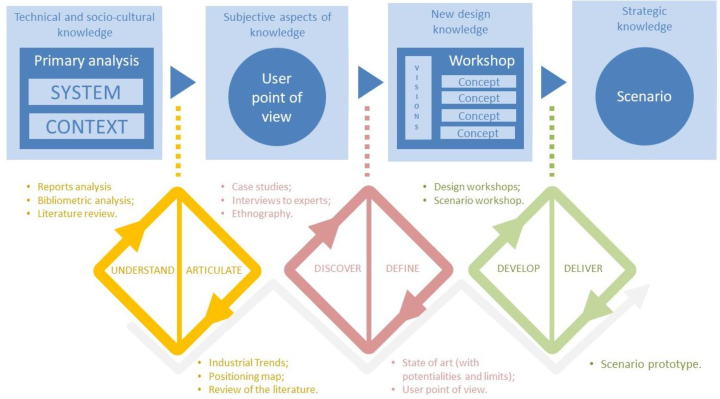
The lever of technology-push innovation is a new technological capability, whereas the lever of market-pull innovation is a new need (Martin, 1994). The levers of design-driven innovation process are a new product form, a new product mode of use or a new product technology, whereas results are aesthetic innovation, innovation of use, meaning innovation or typological Innovation (Rampino, 2011). This new kind of innovation has precise featu- res in its process, which differs it from a user-centred innovation: a networked research process, it spans widely outside the boundaries of firm, including users, it is based on sharing of knowledge, and it includes an action to influe- nce and modify the firm’s sociocultural regime (Verganti, 2008). In particular, the research unit innovation process is organized in a first step of analysis, regarding the system and the context, a second step of analysis, aiming to understand the user point of view, and a third step, with the visions for inno- vation as a design tools and the scenario as final result of research (Ingaramo e Rampino, 2004), before the prototype of a new product design.
Nowadays design has shown that it can play a significant role in business and social innovation, producing positive results in a tangible way. In this context, cities are relevant laboratories of social innovation, where design can create or enhance precious networks among products, service, people and organizations (Mortati, 2015). Based on these reflections, this research hires in particular a design approach, in order to let the human factors emerge in the analysis of the phenomenon and to build a innovation not merely technology-push or market-pull, but also able to capitalize the potential value which could be driven focusing more on human needs and experiences.
METHODOLOGY
This research is placed between the two categories of ‘research for design’, which has the purpose to inform a design outcome and to use design as a research method, and ‘research through design’, planning to produce a design problem framing and a series of artifacts to drive the study reflection (Fray- ling, 1993; Volonte’ et al., 2016). The several stages include various forms of collaboration and feedbacks with different actors, who play a specific function, from the orientation or co-creation to the validation. The research methodology is based on a design-driven approach and tries to answer the following research question: how design-driven approach can foster future development and innovation in the cruise sector?
The research unit innovation process is based on the complementary approaches of Service and Spatial Design. In particular, the Double Diamond Process from Service Design has been used to offer an overview of the flow of the process, opening up in exploratory phases and narrowing down in definition phases (De Rosa, 2019; Sasso, 2018).
Figure 1: The Research Unit innovation process (Ingaramo & Rampino, 2004) & Research Unit of the Phd thesis.
The first phase includes, as research tools, report analysis, bibliometric analysis and literature review, and aims to build the system and context for the research, expressed in terms of industry trends, positioning map and lite- rature review. The second includes, as research tools, case studies, interviews to experts and ethnography, and aims to qualitatively define the state of the art of the smart evolution in the cruise sector, indicating potential and limits, and the user’s point of view. The third includes, as research tools, design workshops and scenario workshops and aims to prototype a cruise ship scenario, grounded in today context and co-designed with stakeholders.
LITERATURE REVIEW
A systematic literature review was conducted, through the following parame- ters of analysis: aims, definitions, theoretical background, method, findings, limitations and future research. The resulting objectives were organized in data, education, history, method/process, theory and outputs, revealing mar- ket research and technical contributions as the main purposes of research. About market research, interesting aspects are given by the search of new market segments and the growing consciousness of geographical expansi- ons, such as Asian areas. The collected definitions were organized in society, cruise sector, design and industry, among which ‘design-driven innovation’ emerged as the most recurring concept. The theoretical background sho- wed multiple approaches, emphasising the fragmentation of theory, among which Interior Design, Systems Engineering, Human machine/computer Interaction and Design-driven Innovation were the most recurrent. The analysis of methodologies revealed the choice alternatively of quantitative (i.e. experimental, causal-comparative, descriptive, surveys) or qualitative (i.e. case studies, grounded theory, phenomenological, design workshops,
The Design of Human Smart Ships 31
ethnography, historical, scenario workshop, participatory action research) strategies, among which experimental, case studies, design workshops and participatory action research were the most used. In particular, quantitative methods were employed from the background of technology fields (e.g. engi- neering and human-machine interaction), while qualitative methods from the design and business background. Findings were organized in design, indu- strial, services, spatial and user implications. Design-related findings have highlighted the beneficials of a multidisciplinary approach to cruise design (McCartan & Kvilums, 2014; McCartan et al., 2015), the potentials of an emotional design framework (McCartan et al., 2013), the positive effects of introducing complexity drivers and aspects in early design phase (Ebrahimi et al., 2018), the benefits of human-centered approach as complementary to technology-centered (Gernez et al., 2018), and finally the usefulness for cruise design of external stimuli for innovation from yacht and entertain- ment fields (Piardi, 2007; Musio-Sale & Zignego, 2020). Technology-related ones have shown the positive effects of data-driven methods and of intelli- gent decision-making and machine learning models (Brett et al., 2018), and the positive contributions of artistic multimedia installations for the cruise interior design (Piardi et al., 2012). Industrial-related ones have pointed out the opportunities of new market expansions (McCartan & Edens, 2013; McCartan & Kvilums, 2013), and agent-based models for safety simulati- ons (Cotfas et al., 2023). Service-related ones have disclosed the emergent contribution of experience (Ahola et al., 2015; Musio-Sale e Zignego, 2018; Musio-Sale & Zignego, 2020) and the usefulness of virtual reality in cruise service design (Hollanti, 2020). Spatial-related ones have indicated new deve- lopments in aesthetics (Dawson, 2000; McCartan et al., 2015; Piardi & Paiva Ponzio, 2015; He et al., 2021), in environmental aspects (McCartan & Kvi- lums, 2014), in layout (Cashman, 2012; Bong & Yoon, 2013; Zignego, 2015; Piardi et al., 2017), in materials (Byun, 2006) and in shape (Zignego, 2015). Finally, user-related ones have expressed ergonomic and safety-risk issues for the crew (Gernez et al., 2018) and the cruise experience explained through the actor-network-theory (Ahola et al., 2015). Limitations were organized in data collection, process and theory, revealing critics to the consolidated Ship design spiral & System engineering approaches, the lack of a unified and coherent theoretical framework and miscommunication in design process. In addition to that, future research was organized in users-, design-, education- and industry-related. In particular, design-related future research has inclu- ded interest in keeping on the research on process, market, digital innovation and sustainability.
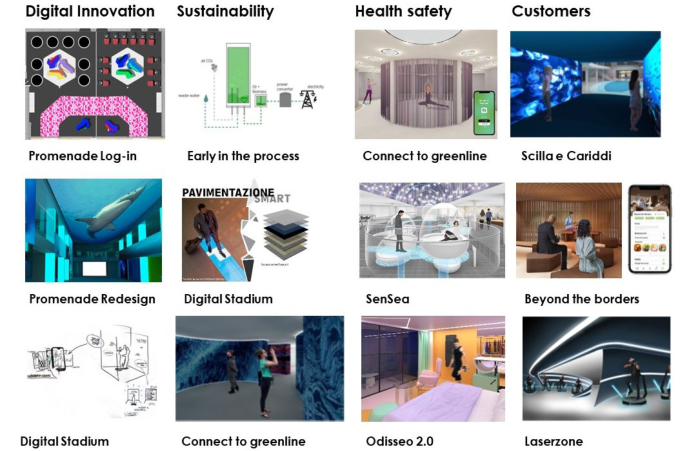
CASE STUDIES AND DESIGN WORKSHOPS Case studies from Cruise Industry were collected in a theoretical sampling (Eisenhardt, 1989), which included cruise ships with smart features, and subsequently analysed according to specific clusters of study: digital inno- vation, environmental sustainability, health safety and customer behaviour. The university projects from didactic experience (developed within the bach- elor’s degree in interior design at the School of Design in Politecnico di
Figure 2: Selection of university projects developed within the Laboratorio di Sintesi at the School of Design of the Politecnico di Milano (a.a.. 2019-20; a.a. 2020–21: a.a. 2021-22).
Milano, at the Master of Science in Yacht and Cruising Vessel Design in La Spezia) were used in research process as the levers for the activation of the design-driven process, indicating in the case studies analysis potential further development of spaces and services on cruise ships, and representing visions for the construction of scenarios.
ETHNOGRAPHY The ethnography tool was used with the purpose of understanding the user point of view in the smart phenomenon, and was planned as both digital, translating the traditional concepts and methods of ethnography into digital research environments, and field observation.
Field ethnography was carried out in terms of participant observation of cruise spaces and passenger behaviour, and semi-structured interviews with passengers during the on-board experience. Digital ethnography allowed to observe remotely people acting in spatial contexts through digital media and social networks (Pink et al., 2015).
SCENARIO WORKSHOP Rather than main scenarios, built to describe ‘alternative possible futures’ and developed in the areas of Future Studies and Strategic Planning (Manzini & Jégou, 2004), in this research the scenario tool has been intended here as real-world narrative grounded in today context, aiming at exploring potential further developments of design aspects under a sustainable perspective.
The Design of Human Smart Ships 33
RESULTS
The literature review on the scientific contributions in cruise interior design showed many similarities with the literature review on cruise tourism studies, which revealed a fragmentation and managerialism in cruise tourism resea- rch, a research design that mainly serves and a lack of critical analysis to the development of the industry (Papathanassis & Beckmann, 2011; Papa- thanassis et al., 2012). Furthermore, reflections on future research in cruise tourism studies have expressed the need for further research on passenger experiences (Aggett, 2011), the need for innovations focused on a possible better use of human capital (Schemmann, 2012) and the proposal for more sustainable strategies also by educating tourists to respect the environment and the land (Tizzani, 2014).
Case studies and design workshops showed several impacts of smart tech- nologies on cruise spaces and services. Spatial-related ones mainly consisted of high level of integration of digital technologies into the physical setting of spaces, greater spectacularization and dematerialization of spaces, resul- ting in more reached experiences offer and more flexible functions of spaces, ‘adaptive environments’, which have the ability to adapt to physical factors (e.g. light or temperature) and to the interacting user, virtual expansion or shift of physical spaces. Service-related ones displayed how digital technolo- gies are not replacing physical services but often accompanying them in the form of a pre-visit of the ship or destination, or in the form of an augmented visit (by digital/virtual functions).
Ethnography revealed mostly a market-pull innovation approach by cruise industry, given by the willingness of cruise industry to attract younger mar- ket segments, coming from generations Y and Z, and to become affordable for all classes. In market research surveys compiled by Deloitte (2018), new cruise passengers were delineated as digitally connected, seeking uni- que experiences, personalized services and pleasant, high-quality spaces. In addition, younger generations showed more interest and commitment to sustainability than older ones (Dimitrovski et al., 2021). So, to offer the sophisticated and varied experiences demanded by modern passengers, cruise ships have become technologically advanced leisure and entertainment venues (Quatermaine & Peter, 2006).
The scenario workshop confirmed the systemic relationship between spa- ces and services along the cruise user’s journey, the value of design workshops as concrete visions for scenarios, the development of cruise travel as an experiential product and itself as a place for co-design among relevant stakeholders, inside and outside cruise companies.
CONCLUSION
The evolution of cruise ships implies opportunities and, at the same time, the appearance of critical factors, such as the lack of a defined geographi- cal and cultural reference, the lack of reference for historical development of interior design (Piardi & Paiva Ponzio, 2015), and little relationship with surroundings and the environment (Musio-Sale& Zignego, 2018). These
disruptive market conditions require a new direction for cruise ships develo- pment (Brett et al., 2018), and design has shown that it can play a significant role in innovation, producing positive results in a tangible way, creating pre- cious networks among products, service, people and organizations (Mortati, 2015). However, interior design on its own can produce mostly incremental, but not radical innovations, necessary to deal with radical changes in cruise sector. The interdisciplinary dialogue between service and spatial design beco- mes more fundamental, productive and important (Bianco, 2021), offering a codified framework capable of representing a complete design solution pre- viously fragmented (De Rosa, 2019). In this sense, service and spatial design can produce a decentralised and networked model of innovation, which overcomes the obsolete centralised and hierarchical model; it can develop design research, which transforms researchers from solitary experts to pro- cess facilitators; it can develop non-linear thinking, which becomes cyclical and iterative; and it can build open, rather than closed and in-house inno- vation systems. All these aspects can produce radical changes in meaning, transforming the socio-cultural models of cruise companies and thus applying real design-driven innovation in the sector.
REFERENCES
Acklin, C. (2010) ‘Design-Driven Innovation Process Model: Design and the Innovation Process’, Design Management Journal, 5(1), pp. 50–60. Available at: https: //doi.org/10.1111/j.1948-7177.2010.00013.x. Aggett, M. (2011) ‘Cruise Passengers’ Complaints: An Analysis of Online Revi-
ews’, in P. Gibson, A. Papathanassis, and P. Milde (eds) Cruise Sector Challenges: Making Progress in an Uncertain World. Wiesbaden: Gabler Verlag, pp. 147–161. Available at: https://doi.org/10.1007/978-3-8349-6871-5_9. Ahola, M., Salovuori, H. and Lehtonen, M. (2015) ‘Exploring cruise experience through actor-networks of the cruise ship environment’, International Journal of Marine Design, 157, pp. 1–12. Available at: https://doi.org/10.3940/rina.ijm d.2015.c1.36. Ana, K. K., Holmlid, S. and Lia, P. (2018) ‘Bridging design-driven and service inno-
vation: Consonance and dissonance of meaning and value’, in. ServDes.2018 Conference, 18–20 June, Milano, Italy. Bianco, A. (2021) S+S glossary. A linguistic reflection on the emerging service + spatial design transdisciplinary approach. Master’s thesis. Politecnico di Milano, Design School. Available at: https://www.politesi.polimi.it/handle/10589/175038. Bong, S. and Yoon, J. (2013) ‘A Study on the Characteristics and Satisfaction on the
Interior Design of Asian Cruise Ship - Focused on the interior space of Costa Victo- ria -’, Korean Institute of Interior Design Journal, 22(1), pp. 328–338. Available at: https://doi.org/10.14774/JKIID.2013.22.1.328. Brett, P. O. et al. (2018) ‘Disruptive market conditions require new direction for vessel design practices and tools application’, in Marine Design XIII, Volume 1. CRC Press. Cashman, D. (2012) ‘Popular Music Venues on Cruise Ships as Touristic Spaces of
Engagement’, International Journal of Event Management Research, 7, pp. 26–46.
The Design of Human Smart Ships 35
Cautela, C. and Rampino, L. (2019) ‘Design Innovation Typologies. A critical Analysis of a Complex Relationship’, AGATHÓN | International Journal of Arch- itecture, Art and Design, 5, pp. 127–136. Available at: https://doi.org/10.19229/ 2464-9309/5142019. Cotfas, L.-A. et al. (2023) ‘An agent-based model for cruise ship evacuation con-
sidering the presence of smart technologies on board’, Expert Systems with Applications, 214, p. 119124. Available at: https://doi.org/10.1016/j.eswa.2022. 119124. De Rosa, A. (2019) S+S. Dialogues on the relationship between spatial design and service design. Disclosing the fundamentals for a transdisciplinary approach. PhD thesis. Politecnico di Milano, Design Department. Available at: https://www.poli tesi.polimi.it/handle/10589/145189. Deloitte (2018) The next generation of cruise passengers has embarked. Deloitte.
Available at: https://www2.deloitte.com/content/dam/Deloitte/us/Documents/con sumer-business/us-cruise-industry-analysis-passenger-experience.pdf Dimitrovski, D. et al. (2021) ‘Understanding coastal and marine tourism sustainability - A multi-stakeholder analysis’, Journal of Destination Marketing & Management, 19(2), p. 12. Available at: https://doi.org/10.1016/j.jdmm.2021. 100554. Dawson, P. S. (2000) Cruise Ships: An Evolution in Design. Conway Maritime. Ebrahimi, A., Brett, P. O. and Garcia, J. J. (2018) ‘Managing complexity in concept
design development of cruise-exploration ships’, in Marine Design XIII, Volume 1. CRC Press. Eisenhardt, K. M. (1989) ‘Building Theories from Case Study Research’, The Academy of Management Review, n. 14(4), pp. 532–550. Frayling, C. (1993) ‘Research in Art and Design’, Royal College of Art Research
Papers, 1(1). Available at: https://researchonline.rca.ac.uk/384/. Gernez, E. et al. (2018) ‘Human-centered, collaborative, field-driven design—a case study’, in Marine Design XIII, Volume 1. CRC Press. He, J., Li, Q. and Wang, J. (2021) ‘Cruise color analysis system for interior color
scheme under complicated ocean lighting conditions’, in Maritime Technology and Engineering 5 Volume 1. CRC Press. Hollanti, J. (2020) Design Thinking and Virtual Reality in the Cruise Industry.
Master’s thesis. Metropolia University of Applied Sciences. Ingaramo, M. and Rampino, L. (2004) ‘Design research for inno- vation: integrating creativity and product development processes’, in. Available at: https://www.semanticscholar.org/paper/DESIGN- RESEARCH-FOR-INNOVATION%3A-INTEGRATING-AND-Ingaramo- Rampino/1433fff9b935f9018e4f05d4c96da0b05fac5489. Jonas, W. (2007) ‘Design Research and its Meaning to the Methodological Development of the Discipline’, in R. Michel (ed.) Design Research Now: Essays and Selected Projects. Basel: Birkhäuser (Board of International Research in Design), pp. 187–206. Manzini, E. and Jégou, F. (2004) ‘Design degli scenari’, in E. Manzini and P. Bertola
(eds) Design multiverso. Appunti di fenomenologia del design. edizioni polidesign. Martin, M. (1994) ‘Managing Innovation and Entrepreneurship in Technology Based Firms’. McCartan, S., Verheijden, R. and Roy, J. (2013) ‘Design-driven innovation of a high
speed art deco superyacht coastal cruiser for the Chinese market’, in. Available at: https://doi.org/10.13140/2.1.3217.8565.
McCartan, S. and Edens, J. (2013) ‘Design-driven innovation: A new luxury maritime leisure sector between cruising and superyacht charter’, in RINA, R. Inst. Nav. Archit. - Int. Conf. Des. Constr. Super Mega Yachts. International Conference on Design and Construction of Super and Mega Yachts, Genoa: Royal Institution of Naval Architects, pp. 53–64. McCartan, S. and Kvilums, C. (2013) ‘Next generation ultra-luxury cruise ship: a
passive design eco-luxury cruise ship for the Mediterranean’, in. Available at: https://doi.org/10.13140/2.1.3021.2487. McCartan, D. S. and Kvilums, C. (2014) ‘Development of interior design strategies as an integral part of a marine passive design methodology for passenger vessels operating within the Mediterranean’, RINA, Royal Institution of Naval Architects - Marine Design, Papers, pp. 143–167. McCartan, S. et al. (2015) ‘Design-driven innovation: a new design meaning for
superyachts as a less egocentric user experience’, in Marine Design 2015. Marine Design 2015, London, p. 18. Mortati, M. (2015) ‘A framework for design innovation: Present and future discussions’, Design issues, 31(4), pp. 4–16. Musio-Sale, M. and Zignego, M. I. (2018) ‘Innovative concepts for next cruise-
ship generations’, in SORTA 2018. 23th Symposium on Theory and Practice of Shipbuilding SORTA 2018, Split (Croatia), pp. 416–422. Musio-Sale, M. and Zignego, M. (2020) ‘New visions for future cruise ship vessels’, INTERNATIONAL JOURNAL OF INTERACTIVE DESIGN AND MANUFA- CTURING - IJIDEM, 14(1), pp. 19–33. Papathanassis, A. and Beckmann, I. (2011) ‘Assessing the “poverty of cruise theory”
hypothesis’, Annals of Tourism Research, 38(1), pp. 153–174. Papathanassis, A., Matuszewski, I. and Brejla, P. (2012) ‘The “Cruise Ship Railing Dance”: Conducting Academic Research in the Cruise Domain’, in A. Papathanas- sis, T. Lukovic, and M. Vogel (eds) Cruise Tourism and Society: A Socio-economic Perspective. Berlin, Heidelberg: Springer, pp. 173–192. Available at: https://doi.or g/10.1007/978-3-642-32992-0_13. Penco, L. (2013) Il business crocieristico: imprese, strategie e territorio. Milano:
Franco Angeli. Piardi, S. (2007) ‘Funny ship, fun design.’, in Guerrini, L., Design degli interni.
Contributi al progetto per l’abitare contemporaneo. Franco Angeli. Piardi, S., Pasina, I.and Tieghi, S.(2012) ‘Reflections on the sidelines of a shipwreck.’, in NAV 2012 17th International Conference on Ships and Shipping Research. NAV 2012 17th International Conference on Ships and Shipping Research. Avai- lable at: https://www.atenanazionale.it/NAV/index.php/NAV/NAV2012/paper/vi ew/48 Piardi, S. and Paiva Ponzio, A. (2015) ‘Exercises in style’, in M. Altosole and A. Fra-
ncescutto (eds) NAV 2015. 18th International Conference on Ships and Shipping Research 2015, Stromness (Scotland): The European Marine Energy Centre Ltd, pp. 858–868. Piardi, S. et al. (2017) ‘New Concept Design for an Event Cruise Ship’, Journal of Shipping and Ocean Engineering, 4, pp. 174–179. Available at: https://doi.org/doi 10.17265/2159-5879/2017.04.005. Pink, S. et al. (2015) Digital Ethnography: Principles and Practice. SAGE. Quartermaine, P. and Peter, B. (2006) Cruise: Identity, Design and Culture. London:
Laurence King Publishing. Rampino, L. (2011) ‘The Innovation Pyramid: A Categorization of the Innovation Phenomenon in the Product-design Field’, in. Available at:
The Design of Human Smart Ships 37
https://www.semanticscholar.org/paper/The-Innovation-Pyramid%3A-A-Categ orization-of-the-in-Rampino/b7ac4fbb04d19d971f1c2f47b87217bc05b65180. Sasso, G. (2018) S+S : framing the relationship between spatial and service design disciplines. An explored intersection through the analysis of their process and tools. Master’s thesis. Politecnico di Milano, Design School. Schemmann, B. (2012) ‘User-Driven Innovation Concepts and the Cruise Industry’,
in, pp. 153–169. Available at: https://doi.org/10.1007/978-3-642-32992-0_12. Tizzani, G. (2014) La sostenibilità ambientale nel settore crocieristico. Master’s degree thesis in Management strategico e corporate governance. Università degli studi di Genova. Vafeidou, M. (2019) Smart Cruise Ships: in what way Information and Com-
munication Technologies are revolutionizing the cruise experience. MSc Thesis. International Hellenic University. Verganti, R. (2008) ‘Design, Meanings, and Radical Innovation: A Metamodel and a Research Agenda*’, Journal of Product Innovation Management, 25(5), pp. 436–456. Available at: https://doi.org/10.1111/j.1540-5885.2008.00313.x. Volonte’, P. G., Rampino, L. R. E. and Colombo, S. (2016) ‘Basics of a design rese-
arch epistemology’, in Proceedings of the 11th International Conference of the European Academy of Design. The Value of Design Research, Paris, p. 12. Zignego, M. I. (2015) ‘Public Ares of Cruise Ships’, in M. Altosole and A. Francescutto (eds) NAV2015. 18th International Conference on Ships and Shipping Research, Stromness (Scotland): The European Marine Energy Centre Ltd, p. 12.
LISTED IN THE AHFE DIGITAL BOOKSTORE CATALOGUE
Explore the complete digital volume
Design for Inclusion
Read this individual research paper free through the original publisher, or explore the full digital proceedings book.
ISBN 978-1-958651-51-3
Explore this ISBN in the AHFE Bookstore ↗Listed in the July 2026 bookstore catalogue; search by ISBN to confirm current availability · Digital book purchase optional