Michela Benente, Valeria Minucciani, Paolo Dabove (2023). Technology as a tool to study visitor behaviour in museums: positioning and neuropsychological detection to identify physical & cognitive barriers. In: Design for Inclusion. AHFE Open Access, vol. 75, pp. 114–121. https://doi.org/10.54941/ahfe1003332
Inclusive communication projects in museums and cultural sites often start from generically applicable assumptions referring to the principles of accessible and inclusive design, without considering the peculiarities of a cultural experience.It therefore seems important to study the audiences’ behaviour in museums, with particular attention to the different types of visitors: regular audiences with appropriate backgrounds; occasional audiences with very different backgrounds; and disaffected audiences who do not consider cultural experiences important or rewarding.It is precisely the latter that an inclusive design must carefully target, with the aim of understanding the reason for this exclusion and thus overcoming it, hence it is important that such studies do not observe only the first two types of audience, whereas this is often the case.The experiments the authors are carrying out monitor movements, times and stops of the public within the museum, in relation to the exhibits, the spatial features of the rooms, and the communication and display solutions, relating them to information resulting from ad hoc surveys.From the positioning point of view, one of the main problems is represented in tracking people in indoor environments, where the GNSS is not available, and there are often cramped spaces. Besides, if the number of people to be tracked is high, the level of difficulties increases dramatically. The problem of positioning even large numbers of people within closed and delimited spaces presents some difficulties and technical criticalities. On the other hand, the restitution of such data requires accentuated reliability: the behaviour and reactions recorded in the public during the experiment must be related to precise spatial positions, since the emotional responses of the public can vary in a very short time.At present, the aim of these experiments is not to consider the behaviour of numerous groups of people but to study individual visiting experiences. The system developed by the research team is briefly described and commented on in the paper.The technological challenge in these contexts goes beyond mere technical effectiveness. Indeed, the instrumentation required to track individual visitors, in certain solutions, risks influencing people's behaviour because it is moderately ostrusive: conversely, the challenge at present is to integrate the various sensing devices into compact and unobtrusive solutions. The Authors have implemented a Python code on a portable Raspberry device that guarantees the users’ location by exploiting signals coming from beacon devices. Communication systems between the device detecting neurophysiological reactions and monitoring physical movements can be implemented and optimised, fusing this technology with another one related to positioning purposes, exploiting electromagnetic signals such as ultra-wide-band technologies or Bluetooth, which guarantees the possibility of reaching positioning solutions even in indoor environments without afflicting the signals for neurophysiological parameter estimations.
Technology as Tool for Studying Visitors’ Behaviour 115
INTRODUCTION
Studying human behaviour during cultural experiences, and in particular in visiting museums is a very complex issue but nowadays several studies are carried out on this, although, usually, in laboratory or in non-ecological conditions.
Conversely, Authors have just completed a measurement session of neuro- physiological responses in museums, in completely ecological conditions (i.e., monitoring visitors from the entrance to the exit, being the museum’s doors open).
From the museological and museographical point of view, it was crucial to identify where and when the emotional involvement increased or decrea- sed, to connect them to typology of spaces, displayed objects and narrative contents.
Authors believe that managing these aspects can improve inclusive soluti- ons, as emotional involvement can reach every sectors of public.
As studying and interpreting visitors’ behaviour in museums is becoming an increasingly important issue and an increasingly necessary support for inclusive and effective solutions, the positioning in indoor spaces is nowadays crucial.
EXPERIMENTAL POSITIONING DURING NEUROPHYSIOLOGICAL MEASUREMENTS IN MUSEUMS Due the complexity of the analysis, a simplified approach was necessary. Visi- tor monitoring records the parameters during the visit by referring them to the crossing points considered significant. The data collected by the positi- oning system will allow the evaluation of various information. From simple total and partial dwell times, to the relationship between responses to pre- and post-visit survey questionnaires and the visit itself.
While there are certainly many variables that affect visitors, conducting experiments that address the many variables in simpler steps will allow cri- tical and significant aspects to be defined. Decomposition by elements of the various components that contribute to the museum experience proves neces- sary. The measurement of an initial baseline will be interpreted and will be the reference for subsequent measurements, for the choice of focal points to investigate further, for the choice of stimuli (multisensoral, acoustic, tactile, visual, textual and narrative, graphic, virtual, spatial, digital elements) that enrich the visitor experience. Monitoring the visitor in space and time in relation to the cultural heritage to which they relate will allow the visitor response to be verified. Such knowledge will allow a deeper understanding of the effectiveness of mediation methods and tools (spatial, narrative, etc.) and to define strategies that allow for greater involvement, not only emoti- onal, of individuals (Benente and Minucciani, 2020). This will also allow a greater understanding of the values of cultural heritage.
Within this framework The authors have developed an indoor localization system and tested it in a specific museum: data analysis is an ongoing pro- cedure involving several research groups. In addition, the technology chosen for indoor localization (beacon) is promising and cheaper than others.
USERS POSITIONING AND LOCALIZATION IN INDOOR ENVIRONMENTS In the last few years, indoor positioning has become one of the most inte- resting research activities from a geomatics point of view (Dabove et al., 2018), both at commercial and academic scales (Zafari et al., 2019). Indoor positioning refers to the ability to locate people or objects within an indoor environment, typically using a combination of technologies such as Wi-Fi, Bluetooth, RFID (Zhu and Xu, 2019), and sensors. Unlike outdoor positio- ning systems such as Global Navigation Satellite System (GNSS), which rely on satellite signals, indoor positioning systems need to use other methods to determine location.
There are several methodologies used for indoor positioning, including:
1. Fingerprinting: This approach involves creating a radio map of the envi- ronment, where the signal strength of Wi-Fi (Mahiddin et al., 2012; Liu et al., 2020) or Bluetooth beacons (Chawathe, 2008; Bai et al., 2020; Takagi and Kushida, 2023) is measured at different locations in the buil- ding. This map is then used to identify the location of a user based on the strength of signals received from nearby beacons. 2. Trilateration: This approach uses distance measurements from multiple beacons to calculate the user’s location (Teoman and Ovatman, 2019). By knowing the distance from at least three beacons, the user’s position can be determined using mathematical algorithms. 3. Sensor fusion: This approach combines data from multiple sensors, such as accelerometers, gyroscopes, and magnetometers, to estimate the user’s position (Karlsson et al., 2015) Han et al., 2016). By using data from different sensors, the system can compensate for errors and improve accuracy. 4. Computer vision: This approach uses cameras and image processing techniques to identify and track objects within an indoor environment (Naggar et al, 2019; Morar et al., 2020). This can be used to locate people, track assets, and even navigate robots.
The choice of methodology depends on the specific requirements of the application, as well as various factors such as the accuracy and precision required, the type of infrastructure available, the cost, and the scalability. Different combinations of methodologies may also be used to improve overall accuracy and robustness (Di Pietra et al., 2020).
One of the most prominent technology is represented by Ultra-wideband (UWB). This methodology is based on a wireless communication protocol that uses short-range, high-frequency radio waves to accurately measure distance and location. UWB has gained popularity in recent years as a technology for indoor positioning due to its high accuracy and reliability.
One of the key advantages of UWB is its ability to measure distance with high precision. UWB systems typically use Time of Flight (ToF) measurements to determine the distance between a transmitter and receiver. By measuring the time, it takes for a UWB signal to travel between devices, UWB systems can accurately determine the distance between them with an error margin of
Technology as Tool for Studying Visitors’ Behaviour 117
just a few centimeters. It has been demonstrated (Di Pietra et al., 2019) that UWB technology can be used for a wide range of indoor positioning applica- tions, such as asset tracking, indoor navigation, and location-based services. UWB can work in a variety of environments, including complex indoor envi- ronments with obstacles and multi-path interference, where other positioning technologies may struggle to achieve accuracy. UWB systems can also be com- bined with other technologies, such as inertial sensors or visual recognition systems, to further enhance accuracy and reliability. However, UWB has some limitations, such as limited range and susceptibility to interference from other radio sources.
All the previous indoor positioning methodologies can be used for a wide range of applications, from helping people navigate complex indoor envi- ronments such as airports and shopping malls, to enabling location-based services and tracking assets within buildings. It can also be used for safety and security purposes, such as tracking the movement of people during emergencies or monitoring users inside closed areas, such as museums.
Considering this last case, the employment of BLE technology can be used to track the movement of visitors throughout the space (Spachos and Plata- niotis, 2020) and gather information about their behavior and preferences (Rubino et al., 2013). Starting from these previous experiences, the auth- ors have developed a system based on beacons and Raspberry-Pi. This is a cheaper solution for creating low-cost, custom indoor positioning systems. Beacons are small Bluetooth devices that can be placed throughout a buil- ding to transmit signals to nearby devices, such as smartphones or Raspberry Pi devices. Raspberry Pi is a small, affordable computer that can be easily programmed to receive signals from beacons and perform location calculati- ons. This makes it an ideal platform for building custom indoor positioning systems, which can be tailored to the specific requirements of the applica- tion. This system has been implemented and tested in the National Etruscan Museum of Villa Giulia (Rome, Italy) to perform preliminary analyses. These basic steps have been performed:
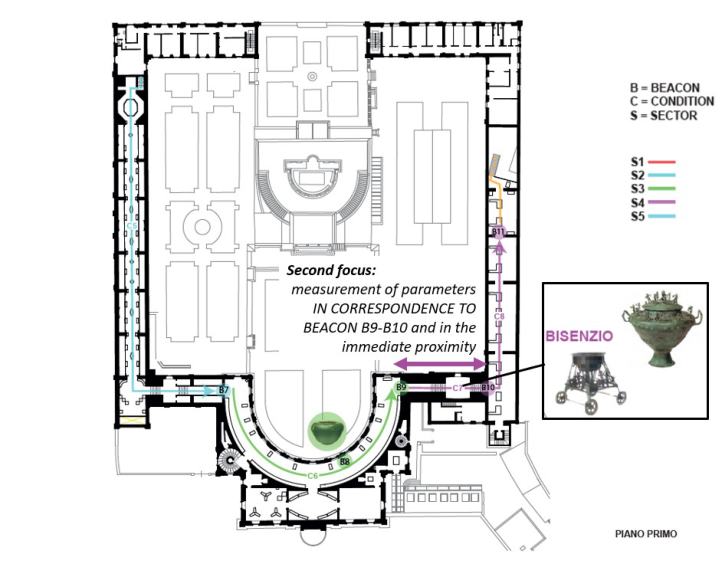
1. a Bluetooth low-energy (BLE) dongle has been installed on the Raspberry Pi to allow it to receive signals from beacons. 2. the beacons have been set up in the indoor environment by placing them at fixed positions throughout the museums’ areas (Fig. 1). 3. the Raspberry Pi has been programmed to receive signals from the beacons and calculate the user’s position based on the received signal strength. 4. the user’s position has been visualized on a map using a specific applica- tion developed by the authors.
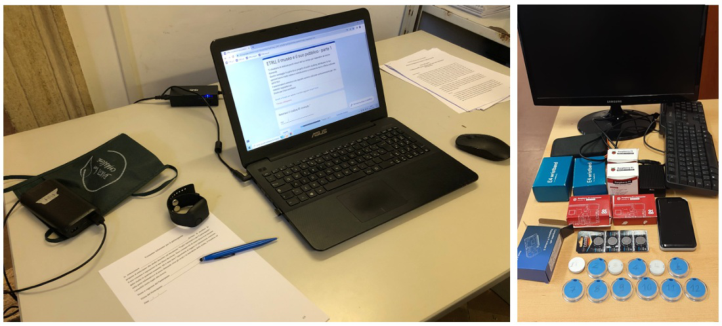
After this setup, about 60 users were involved in the experiments: each of them answered a questionnaire before and after the visit and wore both a dedicated bracelet for measuring specific neuropsychological parameters and a Raspberry Pi during it to determine its position. All this information has been stored in a dedicated database and can be used to infer their emotional state (Fig. 2). The data processing is quite long, and it takes months, but by connecting the users’ positions and their neuropsychological parameters,
Figure 1: Etruscan Museum of Villa Giulia, Roma 2022: plans from the experiment’s design to check positions of participants during the neurophysiological measurements.
Technology as Tool for Studying Visitors’ Behaviour 119
Figure 2: Etruscan Museum of Villa Giulia, Roma 2022: devices used for experimenta- tions (survey, neurophysiological measurements, positioning).
it will be possible to perform spatial analyses, such as verifying if visitors spend more time in areas that they find engaging or emotionally impactful. For example, if a visitor spends a significant amount of time in front of a particular work of art, it can be assumed that the artwork has had a strong emotional impact on the visitor.
CONCLUSION
Positioning in indoors environments is becoming a critical piece of complex systems to help resolve system designs.
While the accuracy of a beacon-based positioning system may not be as high as some other technologies, such as UWB, it can be an affordable and scalable solution for a wide range of indoor positioning applications. It can also be easily customized and adapted to the specific needs of the application, making it a popular choice for prototyping and experimentation.
Additionally, beacons can be used in conjunction with other technologies, such as sensors and mobile devices, to gather data on visitors’ physiological responses, such as heart rate, skin conductance, and facial expressions. This data can then be combined with information about the visitor’s location and behavior within the museum to get a more comprehensive picture of their emotional state. Since 2022, the introduction of UWB sensors inside smart- phones has become a reality: thus, the use of UWB in smartphones opens up new markets for indoor positioning applications. For instance, museum managers could use UWB to track users’ movements in exhibition areas and offer personalized experiences and visits. At the same time, this could gua- rantee users’ tracking and monitoring, improving safety and guaranteeing privacy.
ACKNOWLEDGMENT
The authors would like to acknowledge The Polytechnic of Turin for the financial support granted for research, which has not been directly funded
by other organisations or competitive entities. The choice recognises the freedom of research and demonstrate Polytechnic’s confidence in its resea- rchers, who are aware of their privileged position from this point of view. The authors would also like to thank the National Etruscan Museum of Villa Giulia (Rome, Italy) in the person of its director and staff for their support in carrying out the experiments.
REFERENCES
Benente, M., Minucciani, V., (2020), Inclusive Museums: From Physical Accessibility to Cultural Appropriation. In Di Bucchianico, G. et al. (Eds.): AHFE 2020 (pp. 189–195). Springer. https://doi.org/10.1007/978-3-030-51194-4_25 Benente, M., D’Agostino, G. and Minucciani, V (2022) Contents Accessibility in
Archaeological Museums and Sites: A Proposal for a Neuropsychological Appro- ach In Di Bucchianico, G. et al. (Eds.): AHFE2020 (pp. 159–165). Springer https://doi.org/10.54941/ahfe1001881 Bai, L., Ciravegna, F., Bond, R., Mulvenna, M. (2020). A low cost indoor positioning system using bluetooth low energy. Ieee Access, 8, 136858-136871. Booher, Harold, ed. (2003). Handbook of human systems integration. New Jersey:
Wiley. Booher, H. R., Minninger, J. (2003) “Human systems integration in army systems acquisition”, in: Handbook of human systems integration, Booher, Harold (Ed.). pp. 663–698 Chapanis, A. (1996). Human factors in systems engineering. Wiley Series in Systems
Engineering and Management. Andrew Sage, series editor. Hoboken, NJ: Wiley. Chawathe, S. S. (2008). Beacon placement for indoor localization using bluetooth. In 2008 11th International IEEE Conference on Intelligent Transportation Systems (pp.980–985). IEEE. Dabove, P., Di Pietra, V., Piras, M., Jabbar, A. A., Kazim, S. A. (2018). Indoor
positioning using Ultra-wide band (UWB) technologies: Positioning accuracies and sensors’ performances. In 2018 IEEE/ION Position, Location and Navigation Symposium (PLANS) (pp.175–184). IEEE. Di Pietra, V., Dabove, P., Piras, M., Lingua, A. (2019). Evaluation of positioning and ranging errors for UWB indoor applications. In IPIN (Short Papers/work-in- Progress Papers) (pp. 227–234). Di Pietra, V., Dabove, P., Piras, M. (2020). Seamless Navigation using UWB-
based Multisensor System. In 2020 IEEE/ION Position, Location and Navigation Symposium (PLANS) (pp. 1079–1084). IEEE. Folds, Dennis. Gardner, Douglas and Deal, Steve. (2008). Building Up to the Human Systems Integration Demonstration, INCOSE INSIGHT Volume 11No. 2. Friedenthal, S. Moore, A. Steiner, R. (2008) A Practical Guide to SysML: The Systems
Modeling Language, Morgan Kaufmann; Elsevier Science. Folds, Dennis. Gardner, Douglas and Deal, Steve. (2008). Building Up to the Human Systems Integration Demonstration, INCOSE INSIGHT Volume 11No. 2. Han, D., Jung, S. H., Lee, S. (2016). A sensor fusion method for Wi-Fi-based indoor
positioning. ICT Express, 2(2), 71–74. Honour, Eric C. (2006) “A Practical Program of Research to Measure Systems Engineering Return on Investment (SE-ROI)”, proceedings of the Sixteenth Annual Symposium of the International Council on Systems Engineering, Orlando, FL.
Technology as Tool for Studying Visitors’ Behaviour 121
Karlsson, F., Karlsson, M., Bernhardsson, B., Tufvesson, F., Persson, M. (2015). Sensor fused indoor positioning using dual band WiFi signal measurements. In 2015 European control conference (ECC) (pp. 1669–1672). IEEE. Liu, F., Liu, J., Yin, Y., Wang, W., Hu, D., Chen, P., Niu, Q. (2020). Survey on WiFi-
based indoor positioning techniques. IET communications, 14(9), 1372–1383. Mahiddin, N. A., Safie, N., Nadia, E., Safei, S., Fadzli, E. (2012). Indoor position detection using WiFi and trilateration technique. In The International Conference on Informatics and Applications (ICIA2012) (pp. 362-366). Meilich, Abe. (2008) INCOSE MBSE Initiative Status of HSI/MBSE Activity (Pre-
sentation). Morar, A., Moldoveanu, A., Mocanu, I., Moldoveanu, F., Radoi, I. E., Asavei, V., Butean, A. (2020). A comprehensive survey of indoor localization methods based on computer vision. Sensors, 20(9), 2641. Naggar, Y. N., Kassem, A. H., Bayoumi, M. S. (2019). A Low Cost Indoor Positi-
oning System Using Computer Vision. International Journal of Image, Graphics and Signal Processing, 10(4), 8. Rubino, I., Xhembulla, J., Martina, A., Bottino, A., Malnati, G. (2013). Musa: Using indoor positioning and navigation to enhance cultural experiences in a museum. Sensors, 13(12), 17445–17471. Spachos, P., Plataniotis, K. N. (2020) BLE beacons for indoor positioning at an
interactive IoT-based smart museum. IEEE Systems Journal, 14(3), 3483–3493. Takagi, Y., Kushida, T. (2023). Accurate Indoor Positioning Based on Beacon Weighting Using RSSI. In Internet of Things: 5th The Global IoT Summit, GIoTS 2022, Dublin, Ireland, June 20–23, 2022, Revised Selected Papers (pp. 17–28). Cham: Springer International Publishing. Taubman, Philip. (2008) Top Engineers Shun Military; Concern Grow. The New
York Times Website: http://www.nytimes.com/2008/06/25/us/25engineer.html. Teoman, E., Ovatman, T. (2019). Trilateration in indoor positioning with an uncertain reference point. In 2019 IEEE 16th International Conference on Networking, Sensing and Control (ICNSC) (pp. 397–402). IEEE. Zafari, F.; Gkelias, A.; Leung, K. K. (2019). A Survey of Indoor Localization Systems
and Technologies. IEEE Commun. Surv. Tutor. 2019, 21, 2568–2599. Zhu, J., Xu, H. (2019). Review of RFID-based indoor positioning technology. In Innovative Mobile and Internet Services in Ubiquitous Computing: Proceedings of the 12th International Conference on Innovative Mobile and Internet Servi- ces in Ubiquitous Computing (IMIS-2018) (pp. 632–641). Springer International Publishing.
LISTED IN THE AHFE DIGITAL BOOKSTORE CATALOGUE
Explore the complete digital volume
Design for Inclusion
Read this individual research paper free through the original publisher, or explore the full digital proceedings book.
ISBN 978-1-958651-51-3
Explore this ISBN in the AHFE Bookstore ↗Listed in the July 2026 bookstore catalogue; search by ISBN to confirm current availability · Digital book purchase optional