Valeria Minucciani, Michela Benente, Francesco Paganelli (2025). How to design inclusion in Cultural Heritage: an innovative approach. In: Design for Inclusion. AHFE Open Access, vol. 169, pp. 74–83. https://doi.org/10.54941/ahfe1006156
This paper will present the procedures and outcomes of experimentation carried out in the framework of the national research project PRIN-Neuromuseum. The set of experiments implemented in an ecological environment, saw the involvement and support of the neurosciences.In the perspective of Cultural Heritage, the Neuromuseum project promotes growth and integration, social inclusion and well-being; the project investigates new forms of "cultural learning" in museums, focusing on the museum environment to examine visitors' responses by comparison of neuropsychological and cognitive processes. The main objectives are to identify, via an experimental activity and studying different publics, “empathic design” principles to develop and create engaging cultural experiences with long-lasting effects at personal level.The carried out activities regard the experimental stage and its interpretation and assessment, relative to the design of different museum set-ups and implementation the Pilots. This paper presents the first outcomes and results of experiments carried out in three national cultural institutions and museums: Fondazione Museo delle Antichità Egizie di Torino - Torino, Museo Nazionale Etrusco di Villa Giulia – Roma and Necropoli Etrusca della Banditaccia – Cerveteri, Roma.Experiments were designed to delve into the visitors’ experience by proposition either of different narrations or design solutions; the use of wearable devices allowed the monitoring of the bodily response during the experience, later followed by a questionnaire aimed at the assessment of the rational and cognitive response to the testing experience.The neurophysiological lens will provide an instrument to assess the efficacy in producing emotion in visitors to be compared to the conscious self-assessment data provided through the questionnaires filled out by participants. This paper showcases an array of trends that highlight differences of parameters (e.g. Cognitive Effort, Pleasant Index) according to the different set-ups subjects were proposed. The different scenarios were design aiming to induce an emotional response that would better stimulate the cognitive process based on the cultural values and meaning of the selected artifacts in museums collections. Aforementioned data acquired shall implement the research and development of guidelines and best practices to enhance the impact of Cultural Heritage on people.
Based on the current definition of a museum, and assuming that the communication of heritage is not so much intended to transmit a large amount of data but to transform and encourage reflection among people, the Neuromuseum project (undertaken within the framework of the PRIN- PNRR 2022 research frame), coordinated by Polytechnic of Turin, also involves the University of Rome Sapienza. It is grounded in transdisciplinary collaboration between museography, conservation and enhancement of Cultural Heritage (Turin), and psychology and neuroscience (Rome).
How to Design Inclusion in Cultural Heritage: An Innovative Approach 75
Neuromuseum project focuses on how cultural communication and mediation can promote growth and integration, social inclusion and well-being. Investigating new forms of “cultural learning” in museum environments, it examines visitors’ responses by comparing neuropsychological and cognitive processes. In particular, the main objective is to identify, via an experimental activity and involving different publics, “empathic design” principles to develop and create engaging cultural experiences with long-lasting effects at personal level.
Based on the starting assumption that emotional involvement makes the cultural experiences more memorable and its effects more durable, as well as being accessible to all individuals regardless of their cultural background, it aims to deepen ways to achieve this.
In the frame of this project, the research team implemented a set of experiments in ecological environment, to test different communicative solutions in archaeological museums.
With the support of the neurosciences, the experiments tested and compared the emotional impact and the cognitive (rational) one on the participants, in response to different stimuli from an exhibition and narrative perspective.
The experiments selected the archaeological heritage, as the most difficult to understand, and have been carried out in three very significant sites: Fondazione Museo delle Antichità Egizie of Turin; Museo Nazionale Etrusco di Villa Giulia in Rome; Necropoli Etrusca della Banditaccia at Cerveteri (near Rome). Experiments were designed to delve into the visitors’ experience by proposition either of different narrations or design solutions.
EXPERIMENTS PROTOCOL AND IMPLEMENTATION In a transdisciplinary perspective, the experiments required that the Heritage disciplines merge with the neuroscience method, in order to be “scientifically” correct. It implied that:
- Tools and measurement parameters were selected for both cognitive/rational and emotional/unconscious responses:
questionnaires pre and post visit were developed to monitor and “measure” the conscious effect of museum visit; they required minimal personal data (age, gender, education level, and attitude towards cultural heritage). Then, in the pre-visit section, they investigated expectations and requested a self-assessment of the emotional state, while in the post- visit section they asked for feedback on interest and satisfaction, as well as another self-assessment of the emotional state;
wearable devices (an headset and some finger-rings; in some cases, also eye-tracker glasses) allowed the monitoring of the bodily response during the experience, by measuring several neurophysiological parameters: brain waves, skin conductance.
- Different cultural stimuli were developed and presented to participants, to check their conscious and unconscious responses. The stimuli were specifically designed to evoke different reactions: in particular, an empathic
response (which induces self-identification but also actualization) versus a response of more or less detached interest towards “neutral” data and information. The research hypothesis is that the emotional response would better stimulate the cognitive process based on the cultural values and meaning of the selected artifacts in museums collections.
- To be scientifically faultless, the procedure planned submitting variants one at a time to participants, to ensure that any differences in responses could be attributed to a single element.
The experimental sessions were shared and planned with museums directors and staff, recruiting volunteers to represent different user sectors. The first experimental sessions, carried out at the Egyptian Museum, was focused on two sections: the Sarcophagi Gallery and the funerary treasures of Kha and Merit’s grave.
The first experiments were devoted to detect the emotional responses in front of vetrines with different exhibits: only a sarcophagus; a sarcophagus with the mummy extracted and placed higher; a sarcophagus with the mummy inside; and a showcase with three mummies (three sisters) still inside their sarcophagi, one of which has its head partially unwrapped due to the desecration by tomb raiders, and which is quite striking.
The aim was to monitor the emotional impact in the presence of human remains.
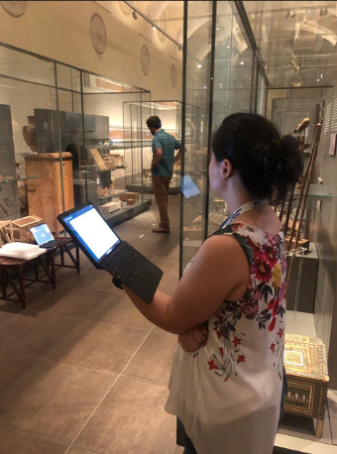
Figure 1: Egyptian museum experiment: experimentations on the Kha and Merit treasure (July 2024).
The second experimental session was devoted to test the effect of different narrative tones (including silence) on the emotional engagement and cognitive response of participants. Audio tracks were developed that commented on two different display cases: the first showcases a “black” mummy, that is the
How to Design Inclusion in Cultural Heritage: An Innovative Approach 77
body of a princess that had been unwrapped and desecrated, revealing the torso and head in their impressively altered state due to time; the second case exhibits part of the funerary equipment of Kha and Merit, a wealthy couple consisting of the pharaoh’s architect and his wife, including several objects and accessories for makeup, as well as an extraordinarily well-preserved, large wig. Both the subjects are tied by a reflection on the beauty: the lost beauty (black mummy) and its preservation and care.
The audio tracks consisted of three parts: the first part featured one minute of silence, during which the participant could only observe the artefacts and reflect autonomously; the second part (one minute) presented a series of information, namely neutral data related to the objects (material, use, any other information aimed at stimulating intellectual interest); and finally, the third part (one minute again) was specifically crafted to provoke personal reflection and empathy. The goal was to measure emotional reactions during the three different narratives and to determine which of the three situations was remembered most strongly.
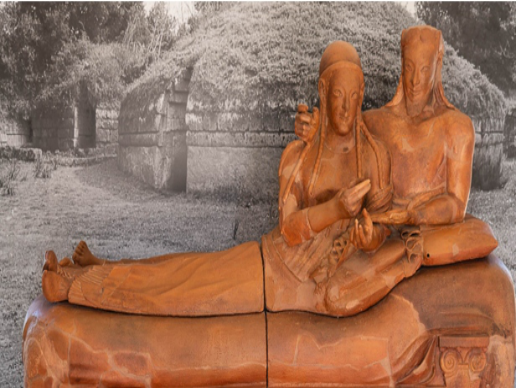
A very similar approach has been applied to the experiments at Necropoli della Banditaccia (Cerveteri) and at ETRU museum, after discussing with curator and staff on possible themes to be proposed to volunteers. As a copy of the famous “Sarcofago degli Sposi di Cerveteri” has been made and placed in the Necropoli, the experimental core focused on the importance of contextual ties: actually, it is placed where the famous piece had been found. The relation object/contest is a major issue in the field of archaeological heritage, where findings are removed far away from their original site. At the same time, an equally interesting theme is the observing of a copy: it is well known that the original object/artwork always engenders emotions associated with the so-called “aura”: in this case the copy has a much lower emotional impact, but is balanced by the opportunity of being in the original place of discovery.
On the contrary, at ETRU Museum the original can be immediately related to the whole, cultural context reassembled and reordered by museum curators: but not with the physical place. Then both cases have been studied jointly, to verify the difference between original object and copy; cultural and physical context; museum and natural environment.
In Cerveteri a double-tone (informative/emotional) narration has been proposed, like in the Egyptian Museum case of “black mummy” to trigger reflection on death and after death images. In the same way, at ETRU a double tone (informative/emotional) narration has been proposed to elicit reflection on equality/inequality between men and women. In both experimentations the same sample have been involved.
In these experimentations the aim was to assess how different narrative audio recordings (rational vs emotional audio narrations) may affect empathy and engagement with artefacts in a museum setting, also compared to the absence of comments, i.e. silent observation.
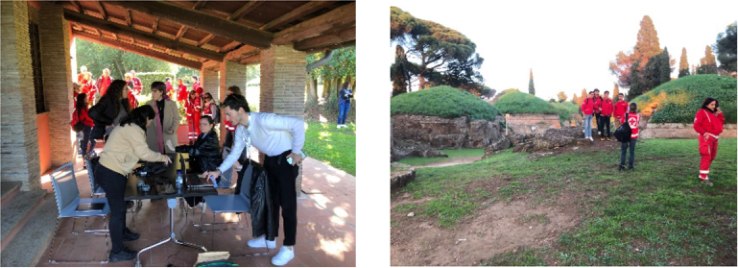
The participants stood in front of the copy, observed it for 30 seconds in silence and then listened to both the informative/descriptive and emotional audio commentary. In particular, the last one was aimed to provoke reflection and emotional involvement on the theme of death and life beyond death.
In order to confirm the importance of the connection with the original, physical context of the artefact, a detail of the volunteers’ behaviour was observed: that is, if they, as soon as they left the room displaying the copy of the sarcophagus, went to look in the necropolis for the very tumulus where the sarcophagus had most probably been placed. Two questionnaires, pre and post experiment, investigated on expectations, reflections and rational responses to proposed stimuli.
Such a multi-modal approach was designed to enable a comprehensive analysis of how different stimuli and contexts influence both cognitive and emotional aspects of visitor experiences.
The sample consisted of volunteers from the Red Cross, which given their support to the project through a letter of interest and represented a vary heterogeneous audience.
Figure 2: Necropolis of Banditaccia (Cerveteri, near Rome): “Sarcofago degli Sposi” (copy).
Experiments Procedure The Approach Withdrawal (AW) has been observed: it is related to the attractiveness of the observed object, which is expressed in an approach/avoidance response. Positive values correspond to a higher approach, negative values to a higher withdrawal.
Moreover, the Workload (WCL: related to intellectual effort) and the Skin Conductance Level (SCL: related to emotional response) have been measured. Only statistically significant variations in these indexes have been taken into account, however, trends that are clearly identifiable even if below the threshold of statistical representativeness will be considered for further experimentations.
Participants were pre-selected based on age group and gender to ensure a balanced representation. Appropriate procedures have been followed to
How to Design Inclusion in Cultural Heritage: An Innovative Approach 79
ensure the data anonymisation. During the experiments, participants were wearing a headset “Mindtooth” (measuring EEG) and “Shimmer” finger- rings (measuring galvanic response). Before and after the experiments, participants answered the above mentioned questionnaires.
During the experiments, as said, participants and were asked to stand in front of the exhibit first in silence, then listening to an informational audio, and finally listening to a more emotional audio. As a final stimulus, the audio presented a question aimed at encouraging personal reflection on a specific topic, standing still for another twenty seconds.
The second experimentation focused on the “Sarcofago degli Sposi” involved the original piece, displayed at the ETRU Museum.
Figure 3: Experiments in Cerveteri, (November 2024).
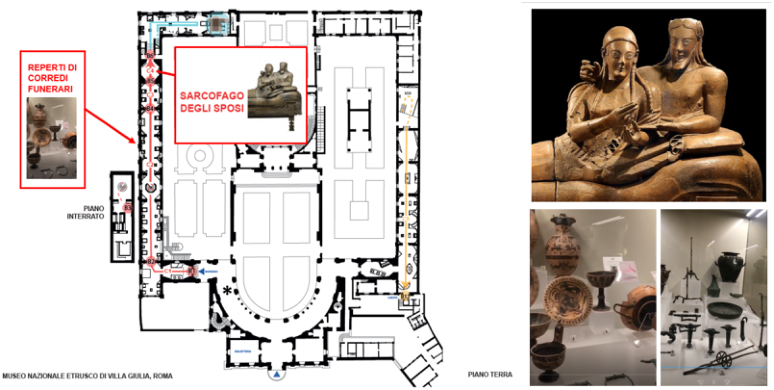
At ETRU the volunteers visited the room before the Sarcophagus, then observed it for 30 seconds in silence, and then again listened to an audio commentary (first informative then emotional), focused on the role of women in the ancient Etruscan world: in this case, the audio aimed to underline the cultural ties with the other objects on display (and not to the geographical ones). Actually, the audio description related the sarcophagus to the funerary goods of men and women, which demonstrated a climate of equality.
In the ETRU experimentation the sample was made up of the same people than in Cerveteri case, so it was possible to compare the reactions in front of the copy (displayed but in the original context of the necropolis), and in front of the original (displayed but in the museum context) of the “Sarcofago degli Sposi”.
The aim was to examine how different types of audio narration influence visitor engagement and emotional arousal. More specifically, the aim was to assess how different narrative audio recordings (rational vs emotional audio narrations) may affect empathy and engagement with artefacts in a museum setting, compared with a similar experience in the necropolis site. And, above all, to verify that emotional engagement is a really inclusive tool able to overcome the differences among visitors.
The audio aimed to engage participants by adopting the perspective of the couple represented in the “Sarcofogo degli Sposi”, humanizing the artifact
to provoke reflections on mortality (Cerveteri) and the woman’s role in the Etruscan world.
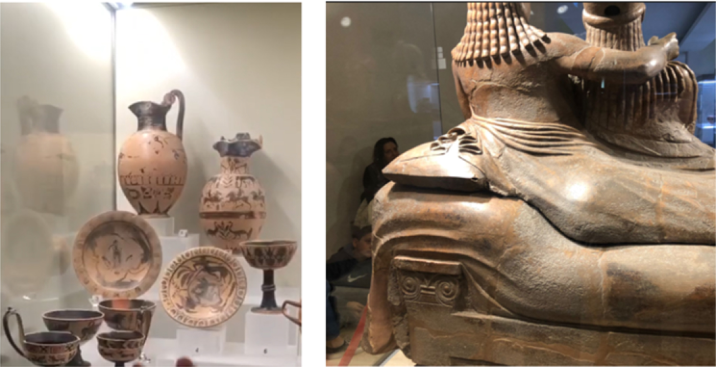
Figure 4: Experiments at ETRU museum, (November 2024).Figure 5: Experiments at ETRU museum, (November 2024): funerary goods and detail of Sarcophagus back.
At the end, in Cerveteri, the participants were asked whether they wanted to move on to the original tumulus of the Sarcophagus or to the most beautiful tomb in the entire necropolis, while at ETRU museum they were asked whether they wanted to move on to museum visit or whether they were willing to go back to the previous room to observe more in depth funerary objects belonging to the Etruscan men and women.
How to Design Inclusion in Cultural Heritage: An Innovative Approach 81
First Results and Discussion After collecting data, the analysis step has been undertaken: the first results relate to Egyptian museum experimentations on mummies/sarcophagi.
The interpretation of the data returned these results:
1. From the neurophysiological perspective:
if there is only a sarcophagus without a mummy, the cognitive effort is lower;
if there is a mummy, the cognitive functions are more involved;
emotions are not significantly different is there is a mummy or not;
on 32 subjects, based on eye-tracker, 8 didn’t looked at the mummy face, although partially disembowelled;
when the visitor’s gaze intercepts the partially cleared face of the mummy, the emotion rises (although one cannot distinguish whether it is positive or negative).
2. From the rational/cognitive perspective:
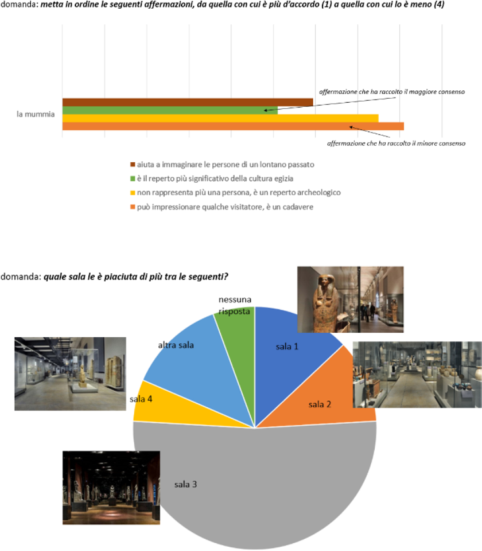
almost one quarter of visitors perceive the mummy as an artistic find;
more than half of the sample judged that the immersive and scenic set was significantly more involving than the others.
Figure 6: Some graphic displaying the sample’s trends (ETRU).
Some reflections, based on first results and discussions, have been developed among the Research teams (Turin and Rome). Summing up, two directions are under development:
the narrative apparatus: narration can change significantly the objects/contexts perception; a didactic presentation can overshadow personal reflection;
the spatial solutions: showcases features can, under different perspectives, affect the emotional involvement, as well as architectural components and choices.
About the analysis of the emotional impact, the first evaluations following experiments carried out at Egyptian Museum, albeit not yet complete, focused on possible differences among target groups. A first result shows that there is not a significant difference between unconscious responses of women and men.
The sample seems to have a very intellectual and rational approach to the exhibits, in search of a large number of information: and in fact considers captions and panels as very useful to the visit.
CONCLUSION
Albeit provisional, some conclusions can already be outlined.
With the support of neuroscience, the communication of Cultural Heritage can be enriched with new observations and methods. Aiming to promote individual growth and social inclusion, the Neuromuseum project scientifically and experimentally examines how Heritage communication can focus not only on the transmission of knowledge (intended as seemingly neutral and objective data) but also on how, regardless of their prior knowledge level or other individual components, visitors can find inspiration for an inner transformation based on reflection, empathy, and actualization.
Therefore, new forms of cultural learning are possible, transcending the fundamental problem of expert communication opposed to communication for individuals with fewer cultural resources. By focusing not only on increasing knowledge as mastery of information but also on emotional and personalized engagement, the project opens up new perspectives for study and communication.
Experimental observations demonstrate that often the visitors themselves are not fully aware of the transformative effect (or lack thereof) that a visit to a museum or cultural site has on them. Conscious-level responses are not always confirmed by bodily-level responses.
Thus, from these observations, more open and inclusive communicative approaches may emerge, as well as a series of good practices to uphold. The sensitivity of the curator and cultural mediator becomes very important, as does their creative attitude in offering unexpected stimuli and (also) unconventional narratives that can transcend differences within the audience.
While respecting diversity, the opportunity to offer intellectual stimuli along with emotional ones allows for the inclusion of a much larger segment of the public.
How to Design Inclusion in Cultural Heritage: An Innovative Approach 83
ACKNOWLEDGMENT
This paper is part of the research conducted in the framework of NEUROMUSEUM [P2022F72NJ -NEUROaesthetic bridge between minds and Museums: the Use of Spatial cognition and Emotions for the accessibility, inclusivity and Understandability of the Meaning of cultural heritage – NextGenerationEU, M4C2, inv. 1.1] funded by the European Union within the PRIN 2022 PNRR program (D.D.1409 del 14/09/2022 Ministero dell’Università e della Ricerca). This manuscript reflects only the authors’ views and opinions and the Ministry cannot be considered responsible for them.
REFERENCES
Crenn, G. & Vilatte, J-C. (2020). “Introduction”, in: Culture & Musées. Muséologie et recherches sur la culture 36. Damasio, A. (1994). Descartes’ Error: Emotion, Reason, and the Human Brain,
New York, Avon Books. Falk, J. H. & Dierking, L. D. (1992). The Museum Experience. Washington D. C., Whalesback Books. Gallese, V. (2003), The Roots of Empathy: The Shared Manifold Hypothesis and the
Neural Basis of Intersubjectivity, in ≪Psychopatology≫, 36. Goldman, A. (2006), Simulating Minds: The Philosophy, Psychology, and Neuroscience of Mindreading, Oxford: Oxford University Press. Hooper-Greenhill, E. (2007). Museums and Education: Purpose, Pedagogy, Performance (Museum Meanings). New York: Routledge. Lehmbruck, M. (1974). “Psychology: perception and behaviour”, in: Museum, XXVI, 3/4. Lord, B. (2007). “What is Museum-Based Learning?”, in: The Manual of museum
Learning, ed. Barry Lord, Lanham MD, AltaMira Press. Eidelman, J., Gottesdiener, H. and Le Marec, J. (2013). “Visiter les musées: Expérience, appropriation, participation”, in: Culture & Musées. Muséologie et recherches sur la culture, Hors-série: La muséologie : 20 ans de recherches. Lemmings, D. & Brooks, A. (2014). “The emotional turn in the humanities and
social sciences”, in: Emotions and Social Change: Historical and Sociological Perspectives, London, Routledge. Lipps, T. (1913). “Zur Einfühlung.” In Psychologische Untersuchungen. Vol. 2.
Leipzig: Engelmann. Paul, L. A. (2020). “Who Will I Become?” In: Becoming Someone New: Essays on Transformative Experience, Choice, and Change. Edited by: Enoch Lambert and John Schwenkler, Oxford University Press. Varutti, M. (2020). “Vers une muséologie des émotions”, in: Culture & Musées.
Muséologie et recherches sur la culture 36.
LISTED IN THE AHFE DIGITAL BOOKSTORE CATALOGUE
Explore the complete digital volume
Design for Inclusion
Read this individual research paper free through the original publisher, or explore the full digital proceedings book.
ISBN 978-1-964867-45-8
Explore this ISBN in the AHFE Bookstore ↗Listed in the July 2026 bookstore catalogue; search by ISBN to confirm current availability · Digital book purchase optional