Valeria Minucciani, Michela Benente (2026). How to design for inclusion in Cultural Heritage: the relation between object and context. In: Universal Design and Design for Inclusion. AHFE Open Access, vol. 209, pp. 61–71. https://doi.org/10.54941/ahfe1008019
This paper presents the experiments carried out in the framework of the national research project PRIN-Neuromuseum, funded by the European Union within the PRIN 2022 PNRR program (D.D.1409 del 14/09/2022 Ministero dell’Università e della Ricerca). The set of experiments implemented in an ecological environment, saw the involvement and support of the neurosciences.In order to make the Cultural Heritage accessible to all, the research team intended to improve the so called “intimate appropriation” of cultural contents in involving both rational and bodily responses. In investigating new forms of "cultural learning" in museums, the neuropsychological and cognitive processes have been compared in different museum conditions. In particular, in this paper the experiments carried out in Neuromuseum project are shortly described and the theoretical development of results is summarized.The guidelines for an “empathic design” able to trigger empathic responses in including all visitors, no matter their difficulties, are discussed.
INTRODUCTION: PREMISES AND STARTING ASSUMPTIONS The Neuromuseum Project (funded by the Ministero dell’Università e della Ricerca, in the frame of the PIANO NAZIONALE DI RIPRESA E RESILIENZA, PNRR) is based on an innovative transdisciplinary approach to the cultural heritage in general and museums in particular. It has been carried out by Polytechnic of Turin as coordinator and Sapienza University of Rome.
Its basic premises that can be summarised as follows. Now that the museum communication as unidirectional process has been overcome, today we prefer to refer to “individual and transformative encounters” (Paul, 2014) and “personal appropriation” (Benente, Minucciani, 2020): emphasising the emotional side of the person, and not just the rational and cognitive one, these concepts are based on theoretical and experimental developments. In short, recognising that emotions play a crucial role in cognitive processes (Culture & Musées, 2020), scholars have shown that what moves visitors will be remembered more vividly (Reisberg, Hertel, 2003) and therefore processed internally, becoming a personal and lasting asset (Chen et al., 2018).
62 Minucciani and Benente Since one of the major challenges facing contemporary cultural communication is to go beyond the usual concept of accessibility and inclusion as the possibility for everyone to enjoy the same cultural experience (which is not possible in itself), and instead consider them as the possibility for everyone to enjoy their own personal experience in relation to cultural heritage (Benente and Minucciani, 2020), it is also extremely interesting to note that emotions are capable of overcoming differences, eliminating cultural gaps and difficulties, and are therefore, so to say, “inclusive tools”.
The project therefore focuses on the museum environment and the different levels of interaction with visitors, monitoring their reactions during the visit at both a cognitive and neurophysiological level. By investigating how our bodies, as well as our minds, respond to cultural stimuli, the project aims to focus on access to heritage by reversing the perspective centred on disability and overcoming the related barriers (physical or cognitive). Instead, it proposes an approach that, rather than merely mitigating difficulties, focuses on potential and abilities: among which the ability to feel emotion is common to all.
Therefore, external stimuli can be transformed into internal and bodily experiences. Finally, Neuromuseum intends to investigate the role of empathy in the cultural museum experience: that is, an unconscious response that the brain processes into a conscious feeling capable of generating identification and actualisation. How can we evaluate, amplify and make good use of empathic reactions to cultural stimuli? Empathy was chosen because it brings together people from the most diverse backgrounds and does not depend on cultural or economic level, prior knowledge, gender, or age (which does not mean that these different user groups react in the same way: it is undeniable, however, that they do react in some way, and the capacity for empathy is a human disposition).
The project refers to Keen’s Narrative Empathy Theory, which explores the positive consequences of human empathy (Sunier, 2017). Keen argues that specific narrative techniques can elicit a spontaneous sharing of the emotional state of another person about whom one has only heard or read. The “empathic museum” expression can encompass different approaches, but here it refers specifically to the relationship between the visitor/user and the exhibited object or heritage, as well as on more targeted dynamics of communication and mediation.
A collaboration between different disciplines such as museography and heritage enhancement on the one hand, and neuroscience and geomatics on the other, is the answer that the project proposes from a methodological point of view to investigate how actually we react to cultural stimuli in term of emotions and empathy.
In the Neuromuseum, experiments were conducted in ecological conditions (albeit controlled), i.e. in real conditions as they normally occur. The research sought to examine a cultural encounter experience, not simply the contemplation of a work or a place. Therefore, it considered narration and setting; cognitive and emotional load; conscious feedback paired with the unconscious (bodily) one (Sunier, 2017; Canepa, 2022; Dorrian, 2014).
THE EXPERIMENTAL CONTEXT The project, which aims to study visitor behaviour (or rather, their emotional and rational responses) in all its complexity, revolves around three case studies of museums/archaeological sites: the Egyptian Museum in Turin; the National Etruscan Museum of Villa Giulia in Rome; the Banditaccia necropolis in Cerveteri, where famous pieces displayed in the Villa Giulia Museum were found.
In addition to the agreements signed by the directors of the three museums involved, the project has attracted interest and willingness to collaborate from other organisations and institutions, primarily the National Red Cross.
The project focused on the above case studies, identifying, with the support of directors and curators, some particularly significant objects on which to carry out the experiments.The main idea behind the project crosses three domains: the person (the visitor) in their entirety, the emotional space in the broadest sense, and the objects with their narratives.
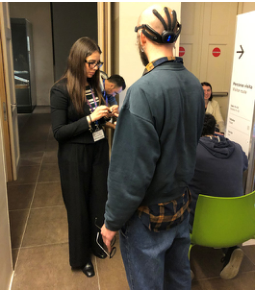
Monitoring was conducted on two fronts: neuropsychological and rational. The first measured the parameters that express cognitive effort and emotional load in our bodies: this is a sort of unconscious feedback provided by quantitative data derived from EEG and skin conductance (measured by wearable devices). The second represented the conscious feedback that visitors expressed by responding to targeted questionnaires (consisting of a first part, before the experience, to profile them and verify their expectations; and a second part, after completing the experiment, to verify their cognitive response and get their immediate feedback and returned qualitative data).
Figure 1: Wearable devices.
All the experiments were characterised by this dual, complementary reading across all audiences.
Moreover, the subjects were asked to complete questionnaires consisted of a first part, before the experience, to profile them and verify their expectations; and a second part, after completing the experiment, to verify their cognitive response and get their immediate feedback.
Finally, experimental protocols were studied with a transdisciplinary approach. The experiment at the Egyptian Museum in Turin focused on two important themes: the relationship (cognitive and emotional) with the human
64 Minucciani and Benente remains on display in the museum, and the relationship between objects, historical circumstances and actualising narration.
In the case of the National Etruscan Museum of Villa Giulia in Rome, the observation focused on the relationship between masterpieces, space and links with the cultural context (as illustrated in the museum). Two rooms of the museum were the subject of a Virtual Reality experiment, which focused on the role of the exhibition layout (proposing to participants three different spatial settings). Finally, in the Archaeological Park of Cerveteri and Tarquinia, the role of the original context and its relationship with the copy of the masterpiece were investigated.
In detail, the methodology was based on four pillars, which in turn corresponded to research approaches: the definition of an initial hypothesis and a specific research question; a continuous process of disciplinary exchange and cross-fertilisation; the consideration of the context and target audience, according to different scenarios; the combination of quantitative and qualitative observations, both through specific instruments and through careful empirical observation of the behaviour of the participants in the experiments.
Experiments’ Description: Egyptian Museum in Turin Two experimental sessions were conducted. Here the second one is discussed: it focused on narrative tone and on the object–context relationship.
The experimental sample was composed by 43 subjects, involving men and women mainly under 35. Participants were then profiled based on their knowledge of the museum and their cultural habits. Particular attention was paid to trying to also involve public who did not regularly visit museums: a difficult group to reach.
The activities were carried out when the museum was closed in order to reduce the number of variables and disturbances during the measurement phases. For similar reasons, the subjects did not interact with each other during the experiment.
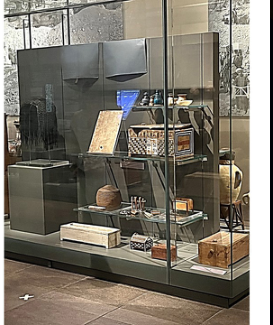
Three different forms of audio narration were proposed: the first consisted of silence, the second of a purely informational commentary, and the third was emotional in nature and particularly focused on empathy. While grounded in factual information, the latter went beyond it in order to engage the visitor on a personal level through an emotional charge (positive or negative). The experiment involved two vitrines (Fig. 2), linked by the concept of beauty, albeit expressed in very different terms. The informational panels were temporarily covered.
The first vitrine presents several items from the funerary assemblage of Merit, the wife of Kha, architect to the Pharaoh. In particular, it includes objects related to the care of beauty. The second vitrine exhibits the desecrated and unwrapped mummy of Princess Ahmose, partially concealed by a textile covering, along with the remaining elements of her looted funerary equipment. The artifact is striking and demonstrates how carefully cultivated beauty has been irretrievably lost.
Figure 2: Merit’s funerary assemblage vitrine (left) and the mummy of Princess Ahmose (right).
In both cases, the viewing experience began with one minute of silence, followed by the two narrative sequences played in succession, and concluded with a question designed to prompt personal reflection.
During the study, the sample was evenly distributed by randomizing the order in which the two display cases were experienced. The selection of informational content, developed in collaboration with the museum’s curators, was designed to provide more general information in the first block of each sequence, followed by a deeper exploration in the second block of themes related to beauty and body care: beauty as a value of great importance in ancient Egypt as well as today; its transience; and, finally, the persistence of the individual beyond physical appearance and time.
Experiments’ Description: National Etruscan Museum of Villa Giulia (ETRU) and the Banditaccia Necropolis in Cerveteri In this case, the research team sought to explore the effectiveness, in terms of visitor identification and actualisation, of the relationship with the context in which the artefact (or artefacts) is displayed. On this occasion, observations and reflections were also made on the different impact of encountering the original object rather than its copy. The experimental protocol was very similar to the previous one, as it also presented the three narrative modes in sequence.
Once again, consultation with museum staff was essential. The theme of empathy and the desire to explore the relationship with the context certainly influenced the choice of the Sarcophagus of the Spouses, a masterpiece and icon of Etruscan civilisation and of the museum (Fig. 3).
Dealing with this particular artefact offered the opportunity to investigate, in addition to the relationship with the human figure, the possible emotional impact of viewing the artefact in a museum rather than in the place where it was found, as well as to assess the influence of encountering the original artefact and its copy.
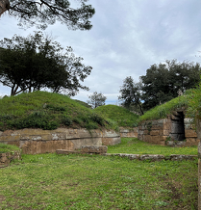
Figure 3: ETRU: the sarcophagus of the Spouses (left); cerveteri: tumulus tombs (center) and the experiment conducted in front of the replica of the sarcophagus (right).
In the museum, the narratives focused on gender equality, also evidenced by the very similar funerary assemblages for men and women displayed in other rooms. In the necropolis, they instead focused on life after death. On both occasions, the aim was to explore the connection with the context: in the first case, to observe whether the commentary prompted a desire to look more closely at the previous vitrines featuring funerary assemblages; in the second, whether it aroused curiosity to visit first the tomb where the sarcophagus was most likely originally located.
The two experimental activities (at ETRU and the necropolis) involved the same group of subjects, who underwent the experiments in a randomised manner. The sample, consisting of 28 subjects, was recruited thanks to the involvement of the Italian Red Cross and the Rome Metropolitan Area Committee in the project. The decision to randomise the sample served as a control group with respect to the experience of encountering the masterpiece in the two contexts.
RESULTS AND DISCUSSION
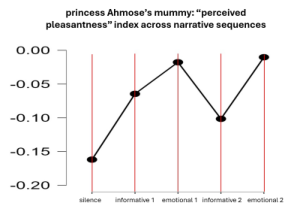
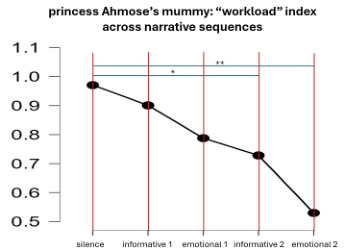
Egyptian Museum, Turin. In the case of the mummy of Princess Ahmose, the results show that narrative is appreciated more than silence, and that emotional narration is preferred over rational, informational narration. As expected, this pattern is reversed when cognitive load is examined: it is highest during the silent phase and decreases with the introduction of narration. Not only is it higher during rational narration than during emotional narration, but it also declines fairly rapidly over the course of the minutes, regardless of the type of narration (Fig. 4).
The trend in perceived “pleasantness” for the vitrine featuring Merit’s funerary assemblage does not follow that of the previous case. Rather than increasing steadily, it decreases during the first narrative block and then rises again, reaching its maximum during the second emotional narration. Notably, pleasantness during the silent phase is not low at all. When examining cognitive effort in the Merit display case, the data again show a different pattern. During the silent phase, cognitive load is markedly high—higher than in all other phases—presumably because the vitrine displays numerous objects whose functions are not always immediately identifiable, thus requiring attention and concentration during observation. Cognitive
How to Design For Inclusion In Cultural Heritage: The Relation 67 load decreases, though not substantially, during the first informational and rational narration; this may be attributed to the effort required to connect the audio information to the different objects in the display. It then drops sharply during the first emotional narration, before rising again to an intermediate level and remaining stable during the second emotional narration (Fig. 5).
The neurophysiological parameters are equally revealing when compared across the two exhibition contexts. When cognitive effort is compared, it is consistently higher for the Merit display case, with the exception of the first emotional narration. Cognitive load during the silent phase is significantly higher for the Merit vitrine than for the Ahmose one, most likely due to the larger number of objects on display. Even during informative narration, cognitive effort remains considerably higher for the Merit vitrine, as understanding the information and identifying the objects to which it refers once again demands attention and focus.
Emotional narration clearly moderates this effort to a significant extent; however, unexpectedly, during the second emotional narration the difference in workload between the two display cases becomes pronounced once more, to the point of being statistically significant.
Overall, these results suggest, in general terms, avoiding the display of too many objects within a single case. Differently from the Merit’s case, the Ahmose vitrine, in addition to being much smaller in size, presents everything that remains of the princess’s looted funerary assemblage, alongside her, resulting in a more unified and intellectually less demanding reading of the display.
68 Minucciani and Benente Despite its limitations, this experiment appears to confirm that visitors better understand objects or such object assemblages as to convey a coherent narrative when they are properly contextualized.
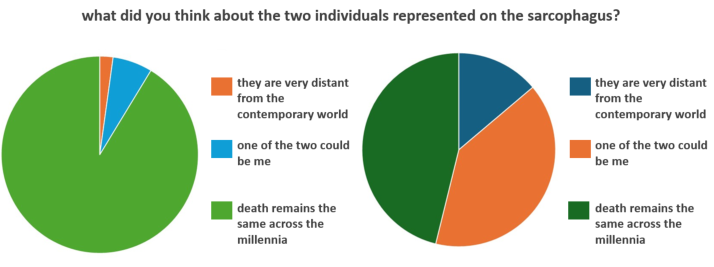
Figure 6: Responses to the same question in the on-site survey at the National Etruscan Museum of Villa Giulia (left) and at the Banditaccia Necropolis in Cerveteri (right).
ETRU and Banditaccia Necropolis. As regards the reflections and impressions aroused by viewing the same artefact, the Sarcophagus, in the two different contexts, the conscious responses of the participants differed, starting from a set of closed answers proposed in the questionnaires. The answers tended to guide reflection towards identification and empathy.
Although there were some constants, the two sites elicited different responses to the same questions, as can be seen in Fig. 6. The results of the questionnaires and the trends observed in the neurophysiological parameters demonstrate the influence of context, in addition to the narrative itself.
Contrary to expectations, in Cerveteri the fact that visitors were facing a replica proved to be the least impactful piece of information.
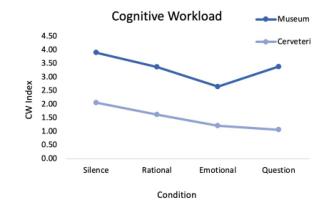
With regard to the neurophysiological parameters, the aim was to assess participants’ responses in relation to the exhibition context and to determine the extent to which the audio narratives influenced them. In this case as well, a higher cognitive load was observed during the silent condition. The main effect of the site was also found to be significant, due to an increase in cognitive load during the museum visit compared to the visit to the Cerveteri necropolis. The former is in fact very rich in visual and cognitive stimuli, namely objects and information, whereas in Cerveteri the Sarcophagus is positioned against a white wall, in a large hall usually used for different activities and conferences. The interaction between “condition” and “site” was found to be significant.
By contrast, the mean values of the approach–withdrawal index reveal a slight different pattern compared to the previous one. At both sites, a significant motivation to approach the stimulus was observed during the silent condition. Both results are summarized in Fig. 7.
Figure 7: Comparison of workload (left) and approach-withdrawal (right) across different conditions at the National Etruscan Museum of Villa Giulia the Banditaccia Necropolis in Cerveteri.
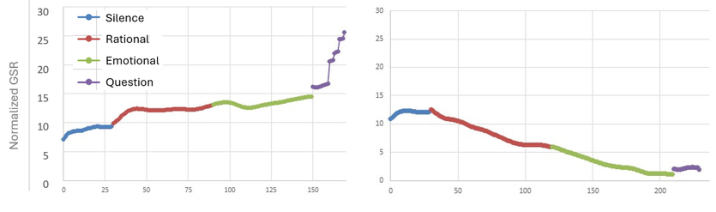
Finally, with regard to the mean values of the emotional index, the condition–site interaction is statistically significant: across the different levels of narration, from the silent condition to the question condition, emotional engagement increases in the museum, whereas in Cerveteri the trend was the opposite (Fig. 8).
Figure 8: Emotional index over time at the National Etruscan Museum of Villa Giulia (left) and the Banditaccia Necropolis in Cerveteri (right).
Thus, the context is not neutral: the museum setting appears to generate a higher cognitive effort and mixed emotional responses. The narrative also seems to exert a greater influence in the museum context.
CONCLUSION
Neuromuseum’ experiments investigated different visitor profiles, highlighting the crucial role of emotions and empathy in museum experiences.
From the experimental results, several design principles emerge.
1. Objects may carry controversial meanings as well as positive or negative emotional charges. While contextualization can modulate these effects; however, relying solely on text proves less effective from an emotional standpoint. 2. Different narrative modes produce distinct responses, and their alternation appears to foster inclusion.
70 Minucciani and Benente The experiments suggest that activating personal, affective connections and encouraging identification with the ancient people and stories are particularly effective in eliciting empathy. Allowing unresolved questions (whenever possible unexpected and with personal implications) and maintaining small areas of indeterminacy, can stimulate further questions, encourage interpretation and reflection, elicit empathic identification. Avoiding unidirectional communication, and promoting a deep personal appropriation of cultural heritage emerge as key guideline for empathic and inclusive museum design: not only because truth has multiple facets, but also because the active role of visitors increase their knowledge, satisfaction and confidence, leaving room for empathy.
In conclusion, empathic response can be activated or facilitated in all audiences through different strategies; therefore, a general recommendation is to: update content as much as possible after appropriate contextualization; include stories of real people; balance positive and negative emotions; facilitate and encourage personal responses; address visitors through direct questions; create opportunities for individual reflection, taking diversity into account; invite visitors to provide feedback and comments, preferably in a form that is visible to others.
As expected, the experimental results did not yield definitive or unambiguous answers. Differences among audience groups are clearly reflected in the findings: in particular, gender—and even more so age— affect reflective attitudes, emotional engagement, and levels of interest. For example, women tended to engage more positively than men, while older visitors were more inclined toward contemplation and related more easily to silence than younger ones.
At a general level, it is important to consider the actual accessibility of presentations that rely exclusively on informational and so-called neutral communication. Not all visitors are equally equipped to understand, acquire, and process information presented in this way. Data speak only to those who are able to interpret them—who can compare them, relate them to other data, and place them within a broader framework.
It is also important to recall that no single approach can be universally effective; rather, awareness of this variability and the inclusion of diversity remain essential.
The research field that brings together heritage sciences, museography, and neuroscience is currently laying its foundations, in search of methodological guidelines, experimental setups, tools, and specific competencies. It is a highly promising area of investigation, and projects such as Neuromuseum not only point toward possible directions but also demonstrate how much work remains to be done to fully understand the scientific and practical implications of these methods as applied to the communication and enhancement of cultural heritage.
At the same time, they once again show that this approach offers significant potential for further development, particularly in relation to well-being, inclusion, and spatial cognition.
ACKNOWLEDGMENT
This paper is part of the research conducted in the framework of NEUROMUSEUM [P2022F72NJ -NEUROaesthetic bridge between minds and Museums: the Use of Spatial cognition and Emotions for the accessibility, inclusivity and Understandability of the Meaning of cultural heritage – NextGenerationEU, M4C2, inv. 1.1] funded by the European Union within the PRIN 2022 PNRR program (D.D.1409 del 14/09/2022 Ministero dell’Università e della Ricerca). This manuscript reflects only the authors’ views and opinions and the Ministry cannot be considered responsible for them.
REFERENCES
Benente, M., Minucciani, V., (2020), Inclusive Museums: From Physical Accessibility to Cultural Appropriation. In Di Bucchianico, G. et al. (Eds.): AHFE 2020 Springer. Canepa, E. (2022) Architecture is atmosphere, Ariccia (RM): Mimesis International. Chen et al. (2018) Cultural tourism: An analysis of engagement, cultural contact,
memorable tourism experience and destination loyalty. In Tourism Management Perspectives 26. Culture & Musées N° 36/2020. L’émotion dans les expositions. https://journals.
openedition.org/ culturemusees /5382. Dorrian, M. (2014). Museum atmospheres: Notes on aura, distance and affect, in the Journal of Architecture, 19(2) 12. Paul, L.A. (2014). Transformative Experience, Oxford University Press. Reisberg, D., Hertel, P. (2003). Memory and Emotion, Oxford University Press. Sunier, S. (2017). L’émotion au service de la narration. Réflexions sur les expositions
du Musée international de la Croix-Rouge et du Croissant-Rouge, in Musées, 33, Récits et dialogues au musée.
LISTED IN THE AHFE DIGITAL BOOKSTORE CATALOGUE
Explore the complete digital volume
Universal Design and Design for Inclusion
Read this individual research paper free through the original publisher, or explore the full digital proceedings book.
ISBN 978-1-964867-85-4
Explore this ISBN in the AHFE Bookstore ↗Listed in the July 2026 bookstore catalogue; search by ISBN to confirm current availability · Digital book purchase optional