Valeria Minucciani, Michela Benente, Francesco Strada, Andrea Bottino (2024). Virtual Reality for Cultural Heritage: emotional involvement and Design for all. In: Design for Inclusion. AHFE Open Access, vol. 128, pp. 12–22. https://doi.org/10.54941/ahfe1004786
Virtual Reality (VR) is emerging as a powerful tool in the cultural heritage sector, offering unprecedented opportunities for integration and accessibility. Applying the principles of "design for all" in VR is critical to unlocking these opportunities while addressing the associated challenges to ensure that these digital experiences are democratic and accessible to all. At its core, VR technology provides an immersive way to experience existing and lost or inaccessible sites, for various reasons such as conflict, environmental hazards or simply the ravages of time. VR democratizes access to these experiences and overcomes physical, economic and geographic barriers. This not only promotes cultural understanding and appreciation, but also bridges the gap between different cultures and histories. However, the integration of VR into cultural heritage is not without its challenges. The digital divide and the specific needs of different user groups, including older people and people with disabilities, present significant barriers. There is a need to design VR experiences that are not only technologically advanced but also cater to the different abilities and needs of users. This includes considering different sensory modalities for input and output (visual, auditory, haptic) and creating interfaces that are intuitive and adaptable. Features such as customizable user interfaces and navigation metaphors, personalized auditory explanations and varying degrees of complexity are designed to meet the different needs and preferences of different target groups. This ensures that VR experiences are not only visually appealing, but also suitable for users with different abilities. Improving accessibility and inclusivity also serves as a foundation for deeper exploration of emotional engagement in virtual heritage. The immersive cultural experience in VR goes beyond mere playfulness. It has the potential to evoke profound cultural and emotional responses. In particular, this paper explores how VR can engage users emotionally so that a visit to a virtual heritage site is as enriching and engaging as a visit to a real site. It emphasizes the importance of understanding how all users interact emotionally with virtual environments, as this is key to designing empathic VR experiences. Ongoing research into measuring the body's emotional responses in VR environments is a cornerstone of this work. This paper explores these aspects to contribute to the development of VR experiences that are not only technologically advanced, but also emotionally engaging and accessible to a wide range of users. In this way, the role of VR in the field of cultural heritage can be strengthened, becoming not only a tool for education, but also for empathy and cultural exchange.
In the field of cultural heritage (CH), museums are turning to innovative technologies to enhance their educational and communicative impact and transform the visitor experience (Digital Readiness, 2020). This technologi- cal shift is not just a response to current trends, but a strategic move to appeal to a wider audience. Virtual reality (VR) in particular is an important tool to support this digital revolution. Its ability to create immersive, interactive environments that incorporate three-dimensional reconstructions and com- pelling narratives offers a novel way to experience and interact with cultural collections. As a result, this technology not only enhances the educational value of museums (Tsita et al., 2023), but also redefines the way visitors — especially the younger generation — engage with and understand history and art.
Virtual Reality for Cultural Heritage: Emotional Involvement and Design for All 13
However, Virtual Heritage (VH), i.e., the integration of VR and CH, also brings with it several challenges. The digital divide and the different needs of all potential user groups, including older people and people with disabilities, present significant barriers. Accessibility and inclusion in virtual environ- ments present unique issues that may differ from those in the physical world. While one environment may be a barrier for some people, the other may facil- itate inclusion, and what is accessible in one world may be a barrier in the other. It is therefore crucial in VH to apply the principles of ‘Design for All’ (Dudley, 2023). This is a design philosophy that aims to create accessible and usable products and environments for all people, regardless of age, ability or status. This approach is key to unlocking the possibilities of VH while over- coming the challenges involved to ensure that these digital experiences are not only visually appealing, but also democratic, accessible and, above all, emotionally engaging for all users. Therefore, Design for All involves con- sidering various sensory modalities (visual, auditory, haptic) for input and output and developing interfaces that are both intuitive and adaptable. It also involves making conscious design decisions that take into account per- sonal identification factors such as ethnicity, economic status, language, age and gender.
Then, as museums use VR to enhance the visitor experience, it is impor- tant to understand not only how these technologies are changing the way we interact with cultural artifacts, but also how they affect our emotional and cognitive responses. This understanding is critical to creating VR experiences that are more than just visually impressive.
Based on these premises, this paper discusses how the principles of Design for All and a focus on the emotional dimension of the exhibit can guide the creation of VR experiences whose educational and emotional impact is accessible to a diverse audience and offers a new paradigm for engaging and interacting with CH. The Neuro Museum project is presented as a case study to illustrate how VR can be used effectively to enrich the CH experience for all visitors and to highlight our contribution to the body of knowledge in this area.
MUSEUMS AND VIRTUAL REALITY Over the past decade, museums have increasingly used VR to extend their reach and deepen audience engagement. The following examples show that the use of VR in museums represents a dynamic intersection of technology, art and education ranging from VR experiences integrated in physical museum spaces to fully virtual museums.
In 2016, the Franklin Institute in Philadelphia offered virtual instal- lations that allowed visitors to immerse themselves in different environ- ments, from the depths of the oceans to the complexity of the human body. The Tate Modern in London further exemplified this trend with the 2017/18 Modigliani retrospective, where visitors were allowed to visit the artist’s studio in Paris (see Figure 1) that only partially still exists.
Figure 1: Alongside the Modigliani retrospective in 2017/18, Tate modern visitors were able to experience the 3D model of the artist’s Paris studio.
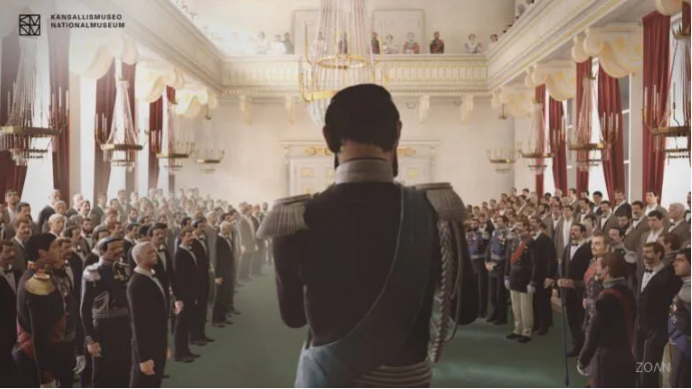
The 2018 exhibition at the National Museum of Finland proposed a time travel: Using VR headsets, visitors were able to immerse themselves in a paint- ing from 1863 and interact with the depicted characters, in three dimensions (see Figure 2).
Figure 2: Visitors explore 1863, in Ekman’s painting “The Opening of the Diet 1863 by Alexander II”, and they can interact with painted people (National Museum of Finland).
In the same year, the Smithsonian Institution’s exhibition, “No Spectators: The Art of Burning Man” featured a VR application that immortalized tran- sient art installations from the Nevada desert festival, demonstrating VR’s ability to preserve preserving what cannot physically remain.
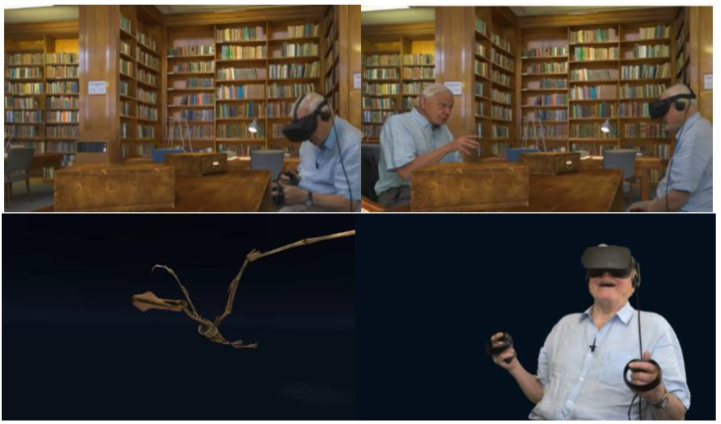
Again in 2018, the National Museum of Natural History in Paris used VR for the first time in a permanent exhibition, presenting the “Cabinet of Virtual Reality” on the evolution of species, and the Natural History Museum in London featured “Hold the World” (a VR experience in which visitors could take a close look at rare specimens from its collection under the guidance of Sir David Attenborough, see Figure 3).
Virtual Reality for Cultural Heritage: Emotional Involvement and Design for All 15
Figure 3: The Natural History Museum in London: “Hold the World”, meeting Sir David Attenborough and his collection.
The Louvre’s Leonardo da Vinci exhibition in 2019 included “Mona Lisa: Beyond the Glass”, a multilingual VR experience to explore the painting, while in 2021 the Victoria and Albert Museum’s “Curious Alice” exhibition in 2021 immersed visitors in the fantastical world of Lewis Carroll.
At the same time, entirely virtual museums emerge: the Kremer Museum, for example, exists solely as a VR experience. It opened in 2017 and was designed by the architect Johan van Lierop of Studio Libeskind. It displays Dutch and Flemish paintings from the 17th century with high-resolution vir- tual models. Kremer’s vision was to make high-quality works of art accessible to a wider audience using unique possibilities of VR, such as viewing the back of paintings.
VR, ACCESSIBILITY AND INCLUSION: A CRITICAL ANALYSIS VR in museums has opened new doors for accessibility, allowing people with mobility issues or people who do not want to or cannot travel, to experience exhibitions from the comfort of their own home. However, a crit- ical analysis reveals a complex landscape of challenges to make VR a truly inclusive and accessible technology: technical challenges (headset design, navigation interfaces) and experiential challenges (emotional engagement, cultural inclusivity).
While VR democratizes access to CH, the cost of VR equipment and of the design, development, maintenance and upgrades of the VH applications can represent a significant barrier. In addition, after the 2019 COVID pandemic, wearable devices in museums must be thoroughly cleaned for hygiene reasons or disposable masks must be provided, adding to the operational challenges and costs.
Another crucial aspect of VR in museums is the diversity of the audience. Inclusion must encompass not only physical, but also cultural and genera- tional differences. Depending on age, cultural background or geographical origin, audiences may appreciate heterogeneous approaches, different nar- rative styles and varying degrees of realism of experiences. However, VR technologies are often problematic for people with disabilities, especially those with visual impairments (Zhao et al., 2019). These technologies offer a variety of opportunities but also present significant barriers (Boyd et al., 2018; Creed et al., 2023; D’Cunha et al., 2019; Gerling et al., 2020; Gerling & Spiel, 2021; Mott et al., 2020; Motti, 2019; Zhao et al., 2019; Zheng & Motti, 2018). Fundamental challenges include the difficulty of wearing VR headsets, the risk of tripping over cables and the use of physical controllers, which can be cumbersome for some users (Mott et al., 2020). At the same time, also people with hearing impairments can suffer difficulties in VR: bar- riers related to inability to lip read, poor rendering of facial expressions in avatars, particularly important in social and collaborative settings not using sign language (Creed et al., 2023).
Cognitive impairments also pose barriers to VR. Issues such as lack of personalization, difficulties in interpreting spatial interactions and sensory overload can lead to confusion, anxiety and misinterpretation of virtual envi- ronments (Creed et al., 2023). In addition, challenges with voice activation, accessible menus (see the text fonts, e.g., user-friendly for dyslexic people), sensory overload and challenges with the usability of haptic interactions highlight the need for more user-friendly and adaptable interfaces.
Moreover, the digital divide is a problem that some researchers believe will be exacerbated in the context of the Metaverse (Macdonald & Clayton, 2013). In addition, the disjunction between the physical body and the vir- tual world can lead to physical discomfort such as headaches, eye fatigue, dizziness and nausea, especially for first-time users.
However, not enough progress has been made in addressing these chal- lenges for developing more inclusive VR experiences. The study by Creed et al., which involved seminars with various stakeholders including people with disabilities and representatives from schools with special needs students, highlights the obvious barriers. These include compatibility issues of VR headsets with visual aids, difficulties experienced by wheelchair users and people with dyslexia when playing VR games, challenges associated with voice commands, problems experienced by users with cognitive disabilities when interpreting virtual spaces, and coping with visual and information overload. In fact, commercial VR devices and VR applications are often designed without considering the needs of people with disabilities.
On the positive side, VR can also make it easier for users with disabilities to experience cultural content. For example, experiences that are physically demanding in reality can become more accessible in VR. People with motor impairments can benefit from a variety of navigation metaphors in VR that do not require physical movement. VR experiences can be paused at any time to give users a break when physically or emotionally overwhelmed by the visit. In addition, VR can support people with visual impairments by reducing the risks of physical navigation and integrating voice description
Virtual Reality for Cultural Heritage: Emotional Involvement and Design for All 17
systems that are conveyed through the headset’s headphones, enhancing the experience without disturbing other visitors.
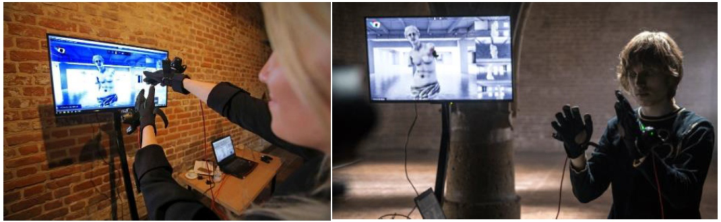
An interesting experiment to improve the inclusion of these visitors is the “Touching Masterpieces” exhibition at the National Gallery in Prague (2018), where users were able to virtually touch 3D models of famous statues using gloves with tactile feedback. This experience represents a pio- neering approach to making sculptural works accessible to blind or visually impaired people who traditionally rely on scaled-down physical reconstruc- tions or audio descriptions. The technology of tactile feedback in VR offers a more detailed and immersive understanding of these artworks and could potentially revolutionize the way museums communicate sculptural art to all visitors, not just those with visual impairments.
Figure 4: The National Gallery in Prague (2018), exhibition touching masterpieces: people virtually touch famous masterpieces.
A crucial aspect of VR in museums is its influence on the social component of the visit. Traditionally, museum experiences are shared activities, often enjoyed with family or friends. However, VR tends to create individualized experiences, potentially isolating visitors from this communal aspect. It is important to recognize that social interaction during a museum visit is signif- icant for many, as it allows for the sharing of thoughts, feelings and questions. Therefore, museums should integrate immersion in virtual worlds with con- nections to the real world to prevent visitors, especially younger ones who are used to a network of virtual relationships and communication, from being taken out of their social context. Improving social interaction in virtual envi- ronments has become a focus of current research (Bombari et al., 2015). This area aims to enable users to make meaningful connections across physical boundaries and encourage engagement that enriches the virtual experience with social depth.
In addition to physical accessibility, museums must also consider cul- tural accessibility and the inclusion of different target groups. This includes addressing the issues of cultural learning, heritage engagement and inter- pretation. By integrating the principles of Design for All with those of Universal Design for Learning (CAST, 2018), museums can develop immer- sive environments that are accessible to all. VR should be seen not just as a technology, but as a new form of knowledge and communication that puts people at the center of the experience. A key challenge is to develop
diverse and inclusive content that reflects different perspectives and identities. This includes respecting different communication styles and needs, enhancing personalization.
Studies have highlighted the effectiveness of VR as an interactive learning tool (Kalyvioti & Mikropoulos, 2012; Kast et al., 2007). Some museums are already integrating VR with interactive games, such as the Archeological Museum of Naples with its video game “Father and Son”. This game invites visitors to embark on a narrative journey that enhances engagement with the museum’s offerings (Nesti, 2017).
Creating fully virtual museum environments offers the opportunity to over- come physical barriers and manipulate and interact with objects in ways that are not possible in traditional environments. Indeed, functionalities can be added to customize certain museum features, such as adjusting brightness, viewpoint height, and text size on panels to meet the specific needs of visitors (Campitiello et al., 2022).
Finally, VR can be used not only to change specific functions, but also the overall physical design of museum spaces. These virtual adjustments, which are difficult and costly to implement in the real world, are easier to implement in VR and allow museums to adapt to the different needs of their audiences. This flexibility shows that VR has the potential to revolutionize the way museums engage with and involve their visitors, ultimately improving the accessibility and inclusivity of cultural experiences (Houston, 2023).
STRATEGIES FOR INCLUSIVE VR DESIGNS The concept of “inclusive immersion” introduced in (Dudely et al., 2023) focuses on maximizing user accessibility and enjoyment in VR environments. A well-known example of successful inclusive design is “Notes on Blindness”, a VR project that has been praised for its sensitive and accessible audio design that appeals to both sighted and visually impaired users (Notes on Blindness, 2016). The inclusive immersion approach is driven by several key factors: the need to make technological advances accessible to all, the proven value of VR as assistive and rehabilitative technology, the possibility to reach a broad user base, and the general observation that good design often leads to better usability for all users, including those who are situationally impaired.
To address the different user groups, inclusive VR design should include the following key strategies: (i) user-centered design: including a variety of user groups in the design process helps address specific needs and make the VR experience more adaptable); (ii) customizable experiences: features such as customizable settings and alternative control schemes improve accessibility for users with different abilities; (iii) multimodal interaction: the use of visual, auditory and tactile interactions ensures that when one mode is less accessible, the others can provide the necessary interaction (Dudely et al., 2023).
However, the problems of inclusive design lie in coping with increased complexity and cost, as well as designing for different needs. In addition, there is a need for detailed and generalizable design guidelines for inclusive immersion, similar to the W3C’s Web Content Accessibility Guidelines.
Virtual Reality for Cultural Heritage: Emotional Involvement and Design for All 19
DECODING HUMAN REACTIONS IN VIRTUAL REALITY: THE ROLE OF NEUROSCIENCE Understanding the complexity of human reactions in VR environments is a major challenge. This understanding is especially crucial in the context of CH, where the goal is not just to showcase artifacts and sites, but to create a deep cultural and emotional connection with them. While VR technology has made significant steps forward in its capability of creating visually immersive spaces, comprehensively capturing and understanding the emotional, cogni- tive and physiological responses of individuals to these virtual worlds remains a nuanced task. However, this understanding is crucial for VH experiences capable of creating an emotional connection with users and reflecting the depth of engagement found in physical visits to cultural sites.
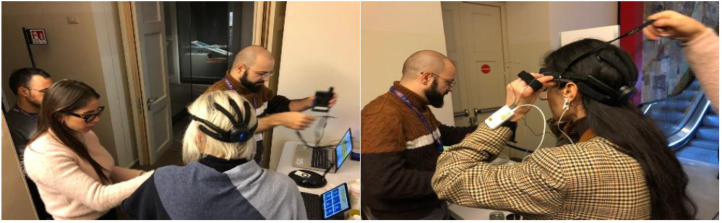
The field of neuroscience offers a promising solution to this challenge. With its tools and methods, neuroscience can decode the subtleties of human responses in VR. By integrating these insights, VR experiences can be refined to ensure that they are not only immersive and engaging, but also meaning- ful and emotionally impactful to users. In this context, the Neuro-Museum project (see Figure 5) emerges as a relevant initiative. This project, led by the authors of this work, is the result of a collaboration between the Polytechnic of Turin and the Sapienza University of Rome and is funded by the Italian Ministero dell’Università e della Ricerca under the PNRR 2023.
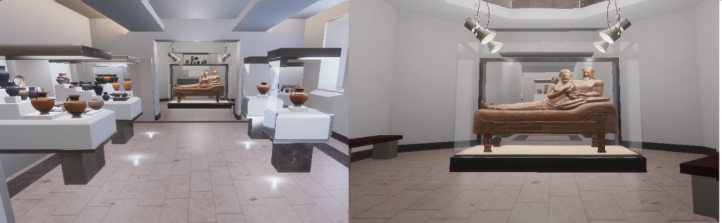
Figure 5: Torino, Neuro-Museum project: neuroscientific monitoring of visitors’ responses in physical museum environment (2024).Figure 6: VR reconstruction (in progress) of two rooms at Museo Nazionale Etrusco di Villa Giulia in Rome, by polytechnic team of Neuro-Museum project (2024).
The project focuses on exploring how VR can mimic the emotional rich- ness of physically visiting a CH site. The aim is to decode and understand the full spectrum of visitor responses – emotional, cognitive and physiological – when immersed in virtual recreations of CH environments. This exploration is not just about technological innovation, but also about fostering a deeper, more emotional connection to CH through VR.
By conducting experiments in environments that recreate parts of the National Etruscan Museum of Villa Giulia in Rome, the project aims to provide valuable insights into the emotional involvement of users. These experiments will use different VR environments, each designed to evoke and study the physiological, emotional and cognitive responses of visitors. The aim is to go beyond traditional notions of accessibility and inclusion and delve into the depths of emotional engagement that VH can offer. In this context, VR is not a mere entertainment medium, but a gateway to profound cultural and emotional experiences.
The Neuro-Museum project will be carefully designed to appeal to a wide range of audience profiles. Some VR scenarios will emphasize strong emotional components, enriched with carefully selected texts and sounds to captivate a broad and diverse audience. Others will emphasize the informa- tional aspect and target visitors with a strong cultural interest. And then there will be scenarios that focus on the experiential aspect, offering immersive journeys based on narratives and surprising sequences.
In particular, the project focuses on exploring how VR can mimic the emo- tional richness of a physical visit to a CH site. Understanding how users interact emotionally with physical and VR environments is critical to devel- oping empathetic and engaging experiences. This research is not just about the technological possibilities, but also about creating a VR experience that can engage a wide range of users on an emotional and empathic level.
The main objectives of the Neuro Museum project can be summarized as follows:
Using neuroscience tools to analyze in detail the emotional, cognitive and physiological responses of visitors as they engage with different VR recreations of heritage sites.
Improving the VR design by incorporating the results of these analyses into the design and ensuring that the VR is not only visually engaging, but also emotionally engaging and cognitively stimulating.
Compiling a set of guidelines to show curators how to create VR environ- ments that are both engaging and accessible to different audiences.
This innovative project has the potential to help museum curators develop immersive and emotionally engaging experiences and adapt exhibits to the needs of different target groups, thus making an important contribution to cultural and virtual heritage.
CONCLUSION
VR technology is already revolutionizing access to CH. It offers an immersive way to experience sites that have been lost, are inaccessible or are difficult
Virtual Reality for Cultural Heritage: Emotional Involvement and Design for All 21
to visit for various reasons, such as conflict, environmental hazards or the ravages of time. VR allows a wide audience to experience places that are crit- ical, unsafe or economically problematic to reach. By democratizing access to these experiences, VR promotes cultural understanding and appreciation. Research in this field requires a truly interdisciplinary approach. It is imper- ative that technical experts fully grasp the communicative goals of museums, just as it is essential for curators to understand the enormous potential of technological solutions.
Ongoing experiments to capture people’s emotional responses in VR envi- ronments highlight the importance of understanding the emotional engage- ment of all users with virtual environments. This understanding will be fundamental to designing VR experiences that are not only emotionally involving but also transformative. In this way, the role of VR in CH can be significantly enhanced by using it not only as a tool for educational purposes, but also as a medium for empathy and cultural exchange.
So while it accomplishes certain goals, VR also brings new challenges to light and creates open problems for research, debate and experimental design. It is a field full of possibilities for innovation and exploration, further pushing the boundaries of interaction with and understanding of our CH.
ACKNOWLEDGMENT
This study was carried out within the NEURO-MUSEUM project – funded by European Union – Next Generation EU within the PRIN 2022 PNRR pro- gram (D.D.1409 del 14/09/2022 Ministero dell’Università e della Ricerca). This manuscript reflects only the authors’ views and opinions and the Ministry cannot be considered responsible for them.
REFERENCES
Bombari, D. et al. (2015) Studying social interactions through immersive virtual environment technology: virtues, pitfalls, and future challen. In Frontiers in Psychology Vol. 6, 24 June. Boyd, LE. et al. (2018). Leveling the playing field: Supporting neurodiversity via
virtual realities, in Technology & Innovation, 20 (1). Campitiello, L. et al. (2022). Maximising accessibility in museum education through virtual reality: an inclusive perspective, in Italian Journal of Health Education, Sports and Inclusive Didactics–Year 6 no. 4, Oct–Dec. Cast (2018). Universal Design for Learning Guidelines, Version 2.2. www.cast.org. Creed, C. et al. (2023). Inclusive Augmented and Virtual Reality: A Research Agenda,
in International Journal of Human–Computer Interaction, Taylor & Francis, published online 27 Aug 2023. D’Cunha, N. M. et al. (2019). A mini-review of virtual reality-based interventions to promote well-being for people living with dementia and mild cognitive impairment. In “Gerontology”, 65(4)2. Digital Readiness and Innovation in Museums. A Baseline National Survey (2020
October 2020 https://knightfoundation.org/wp-content/uploads/2020/10/Digita l-Readiness-and-Innovation-in-Museums-Report.pdf.
Dudley, J., et al. (2023). Inclusive Immersion: a review of efforts to improve accessibility in virtual reality, augmented reality and the metaverse. In Virtual Reality 27. Gerling, K. et al. (2020). Virtual reality games for people using wheelchairs. In
Proceedings of the 2020 CHI Conference on Human Factors in Computing System. Gerling, K., & Spiel, K. (2021). A critical examination of virtual reality technology in the context of the minority body. In Proceedings of the 2021 CHI Conference on Human Factors. Hutson, J., & Hutson, P. (2023). Museums and the Metaverse: Emerging Technolo-
gies to Promote Inclusivity and Engagement. Llamazares De Prado, J. E. & Arias Gago, A. R. (2023). Education and ICT in Inclusive Museums Environments. In International Journal of Disability, Development and Education, 70:2. Macdonald, S. J., & Clayton, J. (2013). Back to the future, disability and the digital
divide. In Disability & Society. Mott, M., et al. (2020). Just went into it assuming that I wouldn’t be able to have the full experience- Understanding the Accessibility of Virtual Reality for People with Limited Mobility. In ASSETS 2020–22nd International ACM SIGACCESS Conference on Computers and Accessibility. Motti, V. G. (2019). Designing emerging technologies for and with neurodiverse
users. In SIGDOC 2019 - Proceedings of the 37th ACM International Conference on the Design of Communication. Richardson, J. (2023). Virtual Reality is a big trend in museums, but what are the best examples of museums using VR? In https://www.museumnext.com/article/h ow-museums-are-using-virtual-reality/. Rodrıguez-Cano, S., et al. (2022). Development areas for intervention in dyslexia: A
virtual reality proposal. In Ocnos. Revista de Estudios Sobre Lectura, 21(1). Tsita C., et al. (2023). A Virtual Reality Museum to Reinforce the Interpretation of Contemporary Art and Increase the Educational Value of User Experience. In Heritage, 6(5): pp. 4134–4172. Zhao, Y. et al. (2019). SeeingVR: A set of tools to make virtual reality more accessible
to people with low vision. In Proceedings of the 2019 Conference on Human Factors in Computing Systems. Zheng, H., & Motti, V. G. (2018). Assisting students with intellectual and developmental disabilities in inclusive education with Smartwatches, in Proceedings of the 2018 CHI Conference on Human Factors in Computing Systems, April, 1–12.
LISTED IN THE AHFE DIGITAL BOOKSTORE CATALOGUE
Explore the complete digital volume
Design for Inclusion
Read this individual research paper free through the original publisher, or explore the full digital proceedings book.
ISBN 978-1-964867-04-5
Explore this ISBN in the AHFE Bookstore ↗Listed in the July 2026 bookstore catalogue; search by ISBN to confirm current availability · Digital book purchase optional