Within the sustainable design experiences involved in the Functional Diversities, there is a need to establish workshops that make direct and concise reference to the different moments in which participants understand the dynamics of the other, their capacities and aspects to improve, and to solve needs from the understood perspective of the said being and not from a supposition of the designer and creator. That goal is part of the project workshops, which are based on the teaching methods used with different tools from different models in the field. These workshops turn Universal Design (UD) or Design for All (DA) into a more connected experience with Inclusive Design (ID), while also using empathy-based teaching methods to improve physical and/or digital design objects, which is similar to v This text seeks to highlight these dynamics and explicit guides under the guidelines of the various functionalities to be able to match and understand the needs from the initial phases of the project, but not as the only final validation.
In product design, the value of involving users (direct and indirect) in the design process increases not only the Functional–Operative, Aesthetic– Communicative and Morpho–productive aspects of the design object but also the perception and emotional response of the user, which result from the interaction with the product. This aspect is called “user experience” (ISO, 2010), and this approach is of paramount importance in product design for people with functional diversity. Approaches such as universal design, design for all, and inclusive design have developed methodologies, methods, and techniques for the development of products (including devices, equipment, instruments, technology, and software) manufactured specifically to prevent, compensate, control, mitigate, or neutralize deficiencies, activity limitations, and participation restrictions (ISO, 2022).
In the framework of design for people with functional diversity, the designer must change the perspective of participation from a vertical design process to a horizontal one. In vertical design processes (from top to bottom),
the designer exercises control and has the power of decision-making in all stages of the process, resulting in a lower speed to effectively define the real needs of the user and a simple motivation for the user to participate by not considering his or her opinions or ideas in solving the design problem. On the other hand, in the horizontal design process (equal to equal), the designer is closer to the users, their activity environment, and their needs and wishes. The process is framed in more collaborative and cooperative environments, with higher levels of communication between the members of the design team and greater participation by the user in decision-making processes. In this sense, designers must involve effective strategies in the design process to develop the ability to understand the needs, feelings, and emotions of another per- son and try to experience objectively and rationally what they are feeling to efficiently translate this information into project requirements. Empathic design is an approach that offers designers the opportunity to develop greater understanding and knowledge to support more effective, efficient, secure, and user-satisfied design results (Henao-Santa, 2021), as well as a financial, sustainable approach that gives rise to products established by the circular economy (Franco Cuartas, 2020). The objective of the project workshops is to establish a collaborative and inclusive design process that emphasizes empathy and understanding of the needs and perspectives of different users. The workshops will incorporate pedagogical methodologies and tools from various design models, such as Universal Design (UD) and Design for All (DA), to improve the physical and/or digital design objects that address the specific needs of diverse users. The workshops will aim to create inclusive and accessible design solutions.
EMPATHIC DESIGN Empathy is a broad concept that refers to the ability of a person to put himself in the place of another and thus understand his feelings, emotions, desires, and needs, all of this to be able to respond in a positive way (Miranda & Daturi, 2021). Empathy is a social skill that allows you to connect with other people and understand their perspectives. This helps to be understand- ing, as it allows you to see things from the point of view of others and to understand their experiences and feelings in a situation (Altuna, 2018). Addi- tionally, empathy allows for better communication with others, as it adapts language (to the extent of the concept) to ensure that you understand the particularities of that person.
However, empathy and education are closely related (UNICEF, 2019) (Miranda & Daturi, 2021). Empathy is a quality that can be fostered and developed through education. In the educational context, education plays an important role in creating an inclusive and respectful environ- ment for difference. When the educational environment develops empathy skills, it promotes values such as respect, understanding, and tolerance. Students who develop empathy are more likely to understand and accept the differences of others in all personal dimensions, which contributes to positive and healthy human development for society (UNICEF, 2019) (Rentería & Hincapié, 2019).
Developing Empathy in Design Workshops for Functional Diversities 131
The training of empathy is currently at the forefront of design educa- tion (Mattelmäki et al., 2014) (French & Teal, 2016) (Chang-Arana, 2020) (Afroogh et al., 2021), as, since the mid-1990s, the teaching of cognitive sci- ences has increased its articulation in higher design education in countries such as Canada, the United Kingdom, and the United States, as well as in schools in many countries around the world (Bialystok & Kukar, 2018). The development of empathy is more common today than ever. Cognitive learning is now recognized as an important part of design students’ learning (Koskinen et al., 2003) (Stepien & Baernstein, 2004) (Zhou, 2022).
Afroogh et al., (2021) argue that education for design engineering train- ing requires an inclusive, effective, and resilient pedagogical approach, and this can only be achieved by integrating empathic design into pedagogi- cal practice. Engineering pedagogy must be human-centric, individual- and community-sensitive, justice-oriented, and values-consistent. In their paper, they explain the integration of three types of empathy into pedagogical strategies: cognitive, affective, and conative empathy, and how these play a central role in creating an inclusive and effective approach to commu- nity resilience. Finally, they analyse empathic education through learning theories and analytical skills to develop empathy in engineering education. Cultivating empathy in engineering education, they conclude, could help pro- mote the impact and contribution of engineering to the social well-being of a community.
Chang-Arana et al., (2021) claim that empathic design emphasizes the rel- evance of understanding users and their circumstances to good design results. However, quantitative methods based on theory, which can be used to eval- uate user understanding, are difficult to find in the scientific literature of design. The authors introduce a method validated and used in social psy- chology research (the method of empathic precision), for design serves to explore how well two or more designers perform in a project task, relying also on the analysis of the performance of empathetic accuracy of each ver- sus the synchronization between the two (or the set) and a group of users to thus predict the success of designers in two objective realization projects. As a conclusion, they were able to correctly identify that approximately 50% of the user-reported mental content was not very accurate. There, they found no significant correlation between individual empathic accuracy in their (1) performance in design tasks and (2) physiological synchronization with users. However, the method of empathic precision is promising in its attempts to quantify the effect of this on design because it tends to improve the communication capacity between projectors and the groups to deal with.
Zhu & Luo (2023) establish that, in the early stages of the design process, designers explore opportunities by discovering unmet needs and develop- ing innovative concepts as possible solutions. From a people-centered design perspective, designers need to develop empathy with people to truly under- stand their needs. However, developing it is a complex and subjective process that depends heavily on the ability of the designer. Thus, the development of empathic understanding is intuitive, and the discovery of the underlying needs is usually random. They provide information from artificial intelligence (AI) research to indicate the future direction of human-driven design, considering
132 Zuleta-Montoya and Sevilla-Cadavid
the essential role of empathy. Specifically, they conducted interdisciplinary research in research areas such as data-based user studies, empathic under- standing development, and artificial empathy. Based on this, they discuss the role that artificial empathy can play in human-centric design and propose a framework for analysis to be consolidated, which, starting from the mech- anisms behind empathy, leads to the knowledge of design research, so the authors intend to break down the rather complex and subjective concept of empathy into components and modules that can potentially be modelled computationally. They also discussed the expected benefits of developing such systems and identified current research gaps to foster future research efforts. In human-centered design, empathic design involves developing a deep and comprehensive understanding of people’s circumstances and experi- ences to foster empathy and discover knowledge (Téllez & González-Tobón, 2019) (Koskinen et al., 2004). Design researchers tend to consider empathy as a type of knowledge and, therefore, empathic understanding as a form of knowledge-building (Koskinen et al., 2004) (Mattelmäki et al., 2014). According to literature (Willmott, 2019) (Schatz, 2022), designers can learn from people in three different ways: by listening to what they say, by watch- ing what they do and wear, and by discovering what they know, feel, and dream. Different forms lead to different levels of knowledge about people. The authors emphasize the importance of understanding what users need, feel, and dream, and with this level of empathy, designers can gain a deeper understanding and tacit knowledge of the user’s psychological and emotional dimensions. However, it is not enough to know the user’s affective feelings, as much of the empathic understanding comes from the cognitive aspect, which depends on the designer’s ability to take perspective and inference. This cognitive understanding can be inferred from explicit and observable knowledge, paying special attention to various evidence to develop underly- ing design patterns. However, the ability to take perspective needs training to develop. Existing design methods that support perspective-taking include role-playing, where designers represent the lives and experiences of others, as well as simulating analogy or digital experiences.
The role of empathy in design learning is relevant because it helps stu- dents understand and connect with user reality. Empathy allows students to put themselves in the place of another person and see the world from their perspective. This can be useful in the workshops to be conducted, as it is beneficial for students to understand the motivations behind users in situ- ated contexts, full of socio-economic, technological, psychological, complex, etc. In addition, empathy can help students connect with people of different cultures and backgrounds, or with functional diversity, which can be valu- able in an inclusive and diverse society. By fostering empathy, students can develop a deeper appreciation for the unique challenges and experiences that individuals from diverse backgrounds face. This understanding can lead to more inclusive and equitable design solutions that cater to the needs of a wider range of users. Furthermore, empathy enables students to anticipate potential barriers or biases that may arise during the design process, allow- ing them to proactively address these issues and create more user-friendly products or services.
Developing Empathy in Design Workshops for Functional Diversities 133
EMPATHIC DESIGN IN THE DESIGN WORKSHOP FOR DIVERSE FUNCTIONALITIES The workshop “Design for Diverse Functionalities” in the Institutions was implemented in the design programs of the Institución Universitaria ITM and Institución Universitaria Pascual Bravo in the last year (both univer- sities located in Medellín-Colombia), set as its objective the development of support products for people with functional diversity. Within its users can be counted persons with disabilities, older adults, and all those popula- tion groups who present some type of permanent, temporary, situational, or changing disability that affects all, or some kind of limitation in their func- tions and bodily structures, or in their activities and participation (OMS, 2001). Therefore, the products designed within this workshop open all the product categories proposed by ISO 9999 “Assistive Products: Classification and Terminology” (2022), due to the possibilities of the user and its context. These refer to a type of product specially designed for people with functional diversity to optimize functioning and reduce disability in the performance of day-to-day life activities. The classification includes products that require the assistance of another person for their functioning and those needed for caregivers based on their interaction.
For the above, the workshop shows design students that functional diver- sity is a topic relevant to the project, as it is about understanding the experiences lived and seeks to solve complex, perverse problems anchored to the Sustainable Development Goals (UN, 2015), the consequence of which is the design of a more friendly and inclusive environment. While the subject addresses critical theory and aspirations for collective life, it is often seen as a field requiring checking and meeting requirements, or worse, a delicate sub- ject plagued with obsolete terms and outdated thinking habits. Typical design routines do not always consider the variety of contexts and their constituent beings, something that is being revised in the so-called smart cities, as the benefits for improving the quality of life of the population must be raised from the universal and inclusive (Lopera-Quiroz, 2019).
The workshop aims to connect product design with the theme of disability from an epistemological point of view by looking at groups of disabled peo- ple, like the Independent Living (IL) movement, whose members talked about the design process and proved that it can be done without having a direct con- nection with the disabled people (Shreve, 2011). His motto “Nothing about us without us” (from the Latin Nihil de nobis, sine nobis) is an expression used to express the feeling that a process, an action, a project, or a plan can- not be decided without the full and direct participation of the members of the group affected by the proposal (Costanza-Chock, 2021). Thus, present- ing the dynamics to be established within the workshop in question, held, or carried out, the defined procedures are presented below.
Methodology of the Design Workshop for Various Functionalities There are two processes supporting the workshop “Design for Diverse Func- tionalities”: a road map (general process) and the design methodology (individual process). Each of them has a concrete vision and work to develop,
134 Zuleta-Montoya and Sevilla-Cadavid
as well as some strategies to use. The research methodology for this applica- tion will involve a combination of qualitative and quantitative approaches. Data will be collected through interviews, observations, and surveys with design students and participants from diverse backgrounds. A purposive sam- pling method will be used to select participants who have experience with empathic design and can provide valuable insights. The data will be analysed using thematic analysis to identify common themes and patterns in the par- ticipants’ experiences and perspectives. The findings will be triangulated to ensure the validity and reliability of the results.
Course Road Map The general methodology of the course (road map) is a perspective view of all the general stages of the workshop. This begins with the thematic definition and the delimitation of the general problem. The subject and problem must be structured under the concept of perverse problems and delimited under the design approach for transitions. In a second phase, a search for the strategic ally is carried out. The company, organization, or other entity that will work alongside the members of the workshop (students and teachers) to achieve the proposed objective. The third phase is called empathizing, which is dedicated to the observation of users (primary, secondary, and collateral) to identify the needs of the people we want to address and what is important to them. The fourth and fifth phases are development and design, where the team is deployed in a project process for the development of alternatives or solutions that have previously been socialized with users. And the sixth and final stage is the delivery of the product to be used in the real context, giving validity or not to the established work.
Design Methodology It is established as a design methodology like the one raised by the Faculty of Industrial Design of the Pontifical Bolivarian University (UPB), which con- sists of three basic stages. The initial stage of information is where the design problem is defined, and some integral theories are stipulated to solve it. The ontological system is observed, analysed, and characterized (user, product, context, and activity). This information translates into design requirements for the next phase. The second stage of formalization uses design require- ments as a fundamental resource for generating design concepts and models in response to the design problem. Finishing these in the conformation phase, which is the moment where ideas are materialized through various manufac- turing processes, prototyping, etc. Validations are carried out to ensure the functionality, operationality, and productivity of the idea.
Strategies for Developing Empathy in the Design Workshop Experiential Learning Pedagogically, the integration of empathy in design teaching is done through experiential learning. This learning model proposes that knowledge is acquired through the experience of students. Nidhi Bindal (2022) defines experiential learning as the process of creating and transforming experience
Developing Empathy in Design Workshops for Functional Diversities 135
into knowledge, skills, attitudes, values, emotions, beliefs, and senses. This is based on the paradigm of constructivism and emphasizes that students reflect on their experience of a situation and, after gaining a general understanding of the concepts found during the experience, test this general understanding in a new situation. In this way, the previous information is transformed into knowledge by being applied and reapplied continuously, based on the pre- vious experiences and knowledge of a person (Bindal, 2022). Accordingly, the design workshop is based on the development of support products for a population of people with functional diversity in a specific and real situation and seeking the resolution of problems through the application of everyday situations (Figure 1).
Figure 1: Foundation of aula five senses as a real learning environment. Own photo.
As an alternative methodology, the concept of experiential learning involves some criticism of the traditional methods of the design workshop. This criticism is based on three premises: on the one hand, it relativizes the importance of formal learning structures, calling into question the protago- nist figure of the teacher as the only channel of knowledge and the classroom as the main context of learning. Secondly, learning ceases to be understood as an end, giving greater relevance to the building of knowledge through inter- action with the environment. Finally, the third criticism addresses the current pedagogical strategies oriented towards memorizing the design process as the sole educational objective by ignoring the idea that knowledge is contextual and, therefore, is strongly influenced by the activity, the agents, the elements of the environment, and the culture where it takes place. This pedagogical approach is transversal to the entire design process.
Shared Language The ability to communicate with others and express ourselves is an impera- tive need for every designer. As we develop our understanding of the design
136 Zuleta-Montoya and Sevilla-Cadavid
problem, depending on the process, the perspective and the way designers communicate may differ from those of our users. Commitment and interac- tion with users are fundamental parts of the product development process. It is the responsibility of the designer to ensure that he or she is under- stood as intended. Shared language refers to people developing understanding among themselves based on language (e.g., spoken or text) to help them communicate more effectively (Whitehouse et al., 2021).
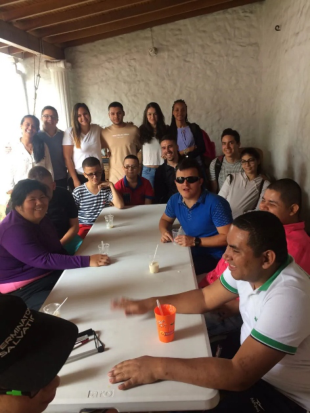
The key to understanding language is first to notice and be aware of its way of communicating. Developing a shared language is a continuous process that requires intention and time, resulting in better understanding. Shared language is key to collaboration, and collaboration is key to design. Designers need to be in tune with users to improve their understanding of challenges and problems, as well as what paths to take to address such chal- lenges (Thomas y McDonagh, 2013). To reach this point, there is a critical need for all stakeholders to establish a common language so that work can be based on a shared understanding of key and outstanding fundamental concepts for the design process. Creating a shared language requires going beyond simple definitions and requires users and design teams to engage in meaningful conversations about what terms represent and mean conceptually for stakeholders (Figure 2).
Figure 2: Dialogs to find common languages with real users (persons with functional diversity and companions). Own photo.
For many people, engaging in conversations on some of the key concepts with people with functional diversity is extremely difficult. It is not uncom- mon to feel unprepared to discuss difficult or unknown topics and terms. As with all inclusion processes, awareness-raising must begin. You must enter that space knowing that it will be a challenge and that, to some extent, discomfort, resistance, and conflict are inevitable. Becoming a strong ally requires each participant to share personal, vulnerable experiences, thus ques- tioning assumptions, listening to understand (not to defend), and committing to the difficult path of personal and professional growth. This strategy puts the designer in commitments to:
Developing Empathy in Design Workshops for Functional Diversities 137
A. Be informed about the problems (social, emotional, economic, techno- logical, etc.) of people with functional diversity.
B. Listen to the different voices of those affected by these problems (persons with functional diversity, their companions, relatives, support staff, pro- fessionals, etc.) and try to understand the causes and consequences of the problem.
C. Recognize and accept that both users and designers have prejudices, stereotypes, and assumptions regarding the theme of functional diversity.
D. Try to understand feelings of defensive attitude, guilt, and shame if they arise.
E. Commit to changing imaginaries, practices, and structures that can generate inequality at the personal and disciplinary levels.
F. Center the voices and experiences of historically minority groups. Remember that you must listen to understand, not respond.
G. The shared language must be fostered throughout the design process, and the guidelines of the workshop road map must be followed.
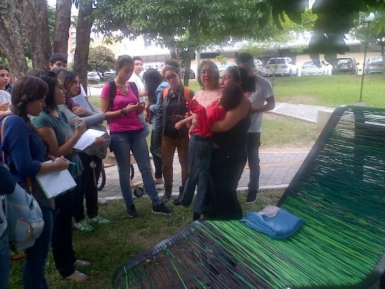
Participant Observation In the information stage, the first strategy for developing empathy in the design student is participatory observation. This is a research tool in which the designer plunges into an environment or social group of people with functional diversity, observing the behaviours, interactions, and practices of participants (Rekalde et al., 2014). This is a valuable method for any design project that seeks to understand the experiences of individuals or groups in a particular social and activity context (Figure 3).
Figure 3: Participant observation. Analysis of daily life activities. Own photo.
In this strategy, the designer is called a participating observer, which means that he participates in the activities of the group and at the same time observes and analyses the behaviour and interactions of its members. There is flexibil- ity in the level of participation, ranging from non-participative (the weakest) to full participation (the strongest but most intensive) (Josiles, 2018). The aim here is to gain a deep understanding of the day-to-day dynamics, culture, beliefs, and practices of the group (Figure 4). This strategy is linked to the information and conformation stages of the design process.
138 Zuleta-Montoya and Sevilla-Cadavid
Figure 4: Participant observation. Analysis of household spaces. Own photo.
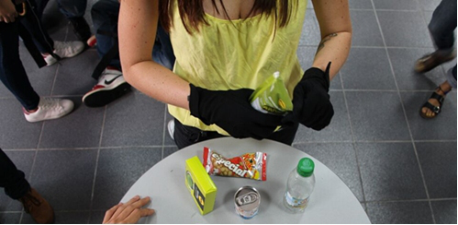
Simulation Some authors point out that simulation is a teaching method designed to bring students closer to situations and elements like reality, but in an artifi- cial way, in order to train them in practical and operational skills when they encounter them in the real world (Bradley, 2006) (Litwin, 2008) (Figure 5). With this technique, situations or experiments are recreated with greater feasibility, thanks to the visualization of the physical system and the con- nection between the abstract and reality, allowing an interactive learning environment and a dynamic exploration of the students throughout the ped- agogical process. Simulation allows you to expose and illustrate a specific topic easily and quickly, using it as a tool of support and collaborative learn- ing to establish the necessary conceptual foundations or reinforce what has been learned in class (Monterrey, 2010); acquiring greater motivation and participation from the educated while developing skills to visualize the con- sequences of their actions; and applying theoretical knowledge in a practical way (Fingermann, 2010).
While within the design and development of products, simulation tools and techniques are implemented in the conceptualization and testing stages, it is important to add them from the early stages as well as in the search and analysis stage of user-product-context information, as they are the instance of the project where higher demands are imposed on the project and there are more opportunities for change (Sorensen et al., 2017). According to Michelle Zhu (2020), using “simulation” as a pedagogical strategy within the design process allows the designer or student to: (i) highlight what is learned at the research or problem definition stage and translate all information as design inputs, reacting predictively to what would happen in a real context; (ii) obtain realistic data during the exercise; (iii) frame the User-Context-Object system that is intended to be analysed, based on the experience and percep- tion of the designer in putting himself in a situation that simulates reality; (iv) greater determination in the objectives of the activity; (v) replicability of the experience; (vi) standardization of the process; (vii) implementation of didactic exercises; (viii) evaluation of reality-related criteria; (ix) estab- lishment of evaluative criteria; (x) development of a much wider and more
Developing Empathy in Design Workshops for Functional Diversities 139
representative range of problems, depending on the design case; (xi) verifi- cation of student performance. This strategy is linked to all information and formalization stages of the design process, if required.
Figure 5: Simulation activity: “Put yourself in the shoes of”. Own photo.
Collaborative Design Co-design is a collaborative approach to the workshop, involving users as active participants in the design process. In the case of persons with func- tional diversity, physical and cognitive limitations and restrictions are not addressed as a monolithic category but as a spectrum of experiences, skills, and challenges that vary according to context, environment, and situation (Sarmiento-Pelayo, 2015). Users with functional diversity may have different types of limitations, such as visual, auditory, cognitive, motor, or speech. They can also have different levels of severity, duration, and appearance. Some may use personal mobility support products, prosthesis and orthesis, communication, and information products, while others may not. Therefore, it is important to understand the diversity of disabilities and avoid making assumptions or generalizations about users (Figure 6).
Figure 6: Co-design session with children with cognitive disabilities from the Lupines Foundation. Own photo.
140 Zuleta-Montoya and Sevilla-Cadavid
To co-design with users with functional diversity, it is necessary to invite them through organizations for people with disabilities or personal networks. Accessibility and convenience of the process of linking to the design pro- cess should also be considered, as should providing alternative formats, clear instructions, and flexible options. You must also respect the privacy and con- sent of users and follow ethical guidelines and regulations (Quintero, 2020). Co-design involves various methods and tools to involve users in the process; interviews, workshops, surveys, prototypes, or people are some examples that are frequently used. However, not all methods and tools are accessible or suitable for users with functional diversity. Therefore, it must adapt its co-design methods and tools to suit the needs and preferences of its users.
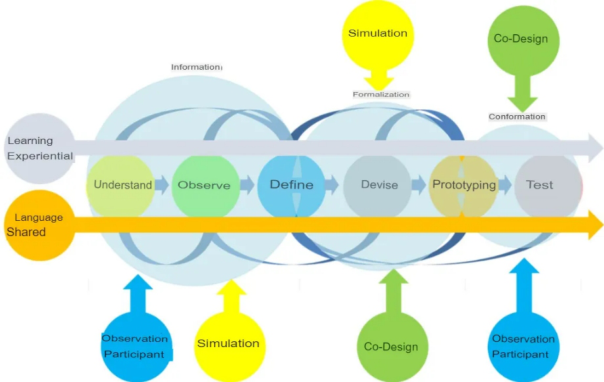
Co-design is not an isolated event but a continuous practice that requires reflection and improvement. You should review and optimize your co-design practice with users with disabilities by evaluating the outcomes, impacts, and challenges of the co-engineering process. You can use various methods and tools to collect and analyse data, where the important thing will be to be able to make a consensual study with them for the approach of a solution. They can also involve users with disabilities in the process of evaluating, improving, and seeking their opinions or comments, which feeds the project. You should document and share your co-design experiences, lessons, and best practices with others and learn from other facilitators and experts on the topics. This strategy is linked to the formalization and conformation stages of the design process (Figure 7).
Figure 7: Linking empathy strategies in the design process. Own design.
CONCLUSION
When developing projects whose users are people with functional diversity, thinking carefully to create good conditions for understanding so that par- ticipants feel safe and comfortable is the dynamic. It is relevant to have the
Developing Empathy in Design Workshops for Functional Diversities 141
capital to share knowledge and ideas and connect with others. It is also impor- tant to consider the quality of the physical space chosen for the work sessions in terms of area, lighting, access to services, and exits. The kindness and atti- tude of the designers and the level of cooperation in the study group help to make the participants feel secure and have a positive attitude when par- ticipating in the design process. Since the previous interactions of the team will be reflected in the development of the workshop or the dynamics to be established.
To create harmony among participants, it is important that designers develop understanding between themselves and others and have good com- munication skills, especially for listening and responding. It is important to emphasize the use of communication skills to enable co-design activities, as by involving groups of users in the design process, you can effectively com- municate the purpose of the project. By involving groups of users in the design process, it is possible to effectively communicate the purpose of the project, involving them all through appropriate, entertaining, and analytical questions and stimulating ideas.
Reflection is the key to understanding empowerment in the design work- shop for diverse functionalities. Designers should be aware that users should feel safe sharing their personal experiences or creative projects without any fear. Taking these thoughts and feelings into account can help companions and family members reassure users with functional diversity. By choosing words carefully, listening, and responding, designers can create a construc- tive partnership in which they foster a secure environment in which they can innovate so that each response is useful to the process.
Education strategies for and from empathy in design learning environ- ments consist of going beyond traditional research approaches and methods, where the designer is objective and distant from the subject. Here, the integra- tion of empathy involves the projector (researcher) and the user (subject) as collaborators, who together develop knowledge and understanding to gener- ate appropriate solutions for real needs. For the above, the design workshop for diverse functionalities recognizes that people with some different abilities, their companions, and their families are at the heart of the design process. Due to demographic changes and emerging populations that do not always fit a universal user ideal, designers must be promoters and receptive to the heterogeneity and changing needs of society. With these kinds of pedagogi- cal scenarios, significant changes are expected to occur in the personal and social commitment of professionals in the areas of design. Focusing on user experiences offers designers, creators, healthcare specialists, and architects an important resource to bridge the gap between existing product solutions and future design results, which have the potential to enhance innovation and greatly improve the quality of life for everyone. Understanding people and addressing their desires, needs, and desires offers a new competitive advantage by integrating the distant voices of end users; furthermore, prod- uct developers of tomorrow are encouraged to question their personal values and beliefs, as from there they will gain invaluable knowledge, awareness, and sensitivities.
142 Zuleta-Montoya and Sevilla-Cadavid
In the case of design, using empathic strategies is a way to encourage the development of more effective products and services. This approach can also serve to further develop and deepen the humanist approach to the education of health professionals. Remembering that empathy is a way to access the voice of end users who have been marginalized is of great relevance for the final reflection translated into physical or virtual products. The “why”builds product integrity and inspires people to accept their incorporation, where empathic research strategies do not consist of looking for solutions but of finding problems in diverse training realities.
It is important to acknowledge that this study has certain limitations. Firstly, the sample size may be relatively small, which could limit the gen- eralizability of the findings. However, efforts will be made to ensure diversity within the sample to capture a range of perspectives. Secondly, the study will focus on design students and participants from a specific geographic location, which may limit the applicability of the findings to other contexts. Lastly, there is a possibility of bias in the data collection and analysis process, as the researchers themselves have a background in design. However, steps will be taken to minimize bias, such as using a reflexive approach and involving multiple researchers in the data analysis process.
Text result of the research <Systems design thinking: transdisciplinary interrelationships between the components of the Design and Materials Research Line of the ITM>, code in the Investigations Directorate PCI-23205.
ACKNOWLEDGMENT
The authors would like to acknowledge Ángela Echeverri Jaramillo for her participation in different workshops of the research.
REFERENCES
Afroogh, S. Esmalian, A. Donaldson, and J. Mostafavi, A. (2021). Empathic Design in Engineering Education and Practice: An Approach for Achieving Inclusive and Effective Community Resilience. Sustainability, 13, pp. 1–20 Altuna, B. (2018): Empatía y moralidad: las dimensiones psicológicas y filosóficas
de una relación compleja. Revista de Filosofía, 43 (2), pp. 245–262. Bialystok, L. Kukar, P. (2018). Authenticity and empathy in education. Theory and Research in Education, 16(3), pp. 23–39. Bradley, P. (2006). The history of simulation in medical education and possible future
directions. Medical Education, 40(3), pp. 254–62. Chang-Arana, A. Piispanen, M. Himberg, T. Surma-aho, A. Alho, J. Sams, M. Hölttä- Otto. K. (2020). Empathic accuracy in design: Exploring design outcomes through empathic performance and physiology. Design Science, 6, pp. 1–34. Costanza-Chock, S. (2021). Design Justice. Community-Led Practices to Build the
Worlds We Need. MIT Press. Fingermann, H. (11 de 11 de 2010). La guía. Recuperado el 9 de 06 de 2016, de Educación, Técnicas de simulación: https://educacion.laguia2000.com/estrategia s-didacticas/tecnica-de-simulacion Franco Cuartas, F. (2020). Economía del comportamiento, circular y colabora-
tiva, tríptico virtuoso para Medellín como ecociudad. En Ecociudadaes; Una experiencia urbana. Lopera Quiroz, C. A., I. U. Pascual Bravo, p. 48.
Developing Empathy in Design Workshops for Functional Diversities 143
Henao Santa, J. D. (2021). El design thinking y el mapa de empatía con énfasis social en proyectos de ingeniería: proyectos de diseño en soluciones bajo metodologías ágiles de la Institución Universitaria Pascual Bravo (Disertación, Universidad EAFIT). ISO. (2022). ISO 9999. Assistive products — Classification and terminology. Inter-
national Organization for Standardization. ISO. (2010). ISO 9241–210. Ergonomics of human-system interaction — Part 210: Human-centered design for interactive systems. International Organization for Standardization. Jociles, M. (2018). La observación participante en el estudio etnográfico de las
prácticas sociales. Revista colombiana de antropología, 54(1), pp. 121–150. Koskinen, I. Battarbee, K. Mattelmäki, T. (2003). Empathic design. IT Press. Litwin, E. (2008). El oficio de enseñar. Condiciones y contextos. Paidos. Lopera-Quiroz, C. A. (2019). Ciudad inteligente y sostenibilidad: un análisis bibliométrico. Sostenibilidad, cultura y sociedad, 212. Mattelmäki, T., Vaajakallio, K., & Koskinen, I. (2014). What happened to empathic
design? Design issues, 30(1), 67–77. Miranda, M. Daturi, D. (2021). La empatía y su trascendencia en la educación. La Colmena, (112), pp. 51–62. OMS. (2001). Clasificación Internacional del Funcionamiento, de la Discapacidad y
de la Salud. OMS. Quintero, C. (2020). A review: accessible technology through participatory design.
Disability and Rehabilitation: Assistive Technology. https://repositorio.ucaldas.ed u.co/bitstream/handle/ucaldas/17388/Producto02.pdf?sequence=2&isAllowed=y Rekalde, I. Vizcarra, M. Macazaga, A. (2014). La observación como estrategia de investigación para construir contextos de aprendizaje y fomentar procesos participativos. Educación XXI, 17 (1), pp. 199–220. Rentería-Vera, J. A., & Hincapié-Montoya, E. M., (2019). Modelo de coorde-
nadas curriculares para el sistema educativo colombiano: una propuesta para el desarrollo humano sostenible. Sostenibilidad, cultura y sociedad, 149. Ap. 6. Sarmiento-Pelayo, M. (2015). Co-design: A central approach to the inclusion of people with disabilities. Revista de la Facultad de Medicina, 63, Supl. 1, pp. 149–154. Schatz, S., Thai, K. P., Criag, S. D., Schoenherr, J. R., Lis, J., & Kolodner, J. (2022).
Human-Centered Design Tools. In Learning Engineering Toolkit (pp. 279–301). Routledge. Shreve, M. (2011). The Independent Living Movement: History and Philosophy to Implementation and Practice Social Change for the Integration and Inclusion of All People with Disabilities Into Society. https://www.ilru.org/sites/default/files/r esources/il_history/IL_Movement.pdf Sorensen, J. Ostergaard, D. LeBlanc, V. Ottesen, B. Konge, L. Dieckmann, P. Van der
Vleuten, C. (2017). Design of simulation-based medical education and advantages and disadvantages of in situ simulation versus off-site simulation. BMC Medical Education, 17(20), pp. 2–9. Stepien, K. Baernstein, A. (2004). Educating for Empathy. J Gen Intern Med, 21(5), pp. 524–530. Tellez, F. & Gonzalez-Tobon J. (2019, November). Empathic design as a framework
for creating meaningful experiences. In Conference Proceedings of the Academy for Design Innovation Management (Vol. 2, No. 1, pp. 908–918). Thomas, J. McDonagh, D. (2013). Shared language: Towards more effective communication. Australas Med J. 6(1), pp. 46–54.
144 Zuleta-Montoya and Sevilla-Cadavid
UNICEF. (2019). Seamos amigos en la escuela. Una guía para promover la empatía y la inclusión. UNICEF. Whitehouse, M. Rahm, H. Wozniak, S. Breunig, S. De Nardi, G. Dionne, F. Fujio,
M. Graf, E. Matic, I. McKenna, C. Steiner, F. Svi¸ke, S. (2021). Developing shared languages, The fundamentals of mutual learning and problem solving in transdisciplinary collaboration. AILA Review, 34(1), pp. 1–18. Willmott, T. (2019). A five-step Human-Centered Design Process. Griffith University. Zhu, M. Johnson, M. Dutta, A. Panorkou, N. Samanthula, B. Lal, P. Wang, W. (2020).
Educational Simulation Design to Transform Learning in Earth and Environmen- tal Sciences, IEEE Frontiers in Education Conference (FIE), Uppsala, Sweden, 2020, pp. 1–6. Zhu, Q. Luo, J. (2023). Toward artificial empathy for human-centered design: a framework. Singapore University of Technology and Design. file:///C:/Users /000085379/Downloads/2303.10583.pdf Zhou, Z. (2022). Empathy in education: A critical review. IJ-SoTL, 16(3), pp. 1–12.
LISTED IN THE AHFE DIGITAL BOOKSTORE CATALOGUE
Explore the complete digital volume
Design for Inclusion
Read this individual research paper free through the original publisher, or explore the full digital proceedings book.
ISBN 978-1-964867-04-5
Explore this ISBN in the AHFE Bookstore ↗Listed in the July 2026 bookstore catalogue; search by ISBN to confirm current availability · Digital book purchase optional