Suvipra Singh, Charlotte E. Geary (2026). Latency, Sensitivity & Optimizing Workload in Drone Control: Neuroergonomic and Neurodiverse Insights for Equitable, Therapeutic, and Inclusive Action. In: Intelligent Human Systems Integration (IHSI 2026): Disruptive and Innovative Technologies. AHFE Open Access, vol. 200, pp. 444–455. https://doi.org/10.54941/ahfe1007103
As small Unmanned Aerial Systems (sUAS) become vital beyond industries into therapeutic contexts, understanding how control interface parameters, like latency and joystick sensitivity. affect neurodiverse users is critical. Unoptimized interfaces can exacerbate stress, cognitive overload, and social alienation among individuals with ADHD, Autism, or Dyslexia. This study examines how varying latency and sensitivity influence cognitive workload, task performance, and psychological outcomes, integrating neurophysiological and behavioural data to inform inclusive sUAS design. Using real-time EEG to measure theta, alpha, and beta brainwave activity, results reveal that low latency and medium sensitivity yield optimal performance for neurotypical users, while neurodiverse individuals exhibit unique workload thresholds. Findings emphasize the importance of EEG-driven adaptive interfaces to mitigate cognitive strain and personalize control configurations. This neuroergonomic framework advances equitable, cognitively sustainable drone systems, promoting therapeutic potential, enhanced accessibility, and safer human–machine interaction for neurodiverse populations.
The rise in popularity and usage of small Unmanned Aerial Systems (sUAS), more commonly known as drones, prompts questions about the application of drones beyond their current industries. To move forward with developing novel applications for sUAS, it is critical to understand how control interface parameters, specifically latency and joystick sensitivity, affect the individuals piloting drones. Drones are currently designed with an interface suited to neurotypical individuals, and unoptimized interfaces can exacerbate stress, cognitive overload, and social alienation in individuals with ADHD, Autism, or Dyslexia.
Latency, Sensitivity & Optimizing Workload in Drone Control 445 This study examines how shifts in latency and joystick sensitivity influence the cognitive workload, task performance, and psychological outcomes; by analyzing neurophysiological and behavioral data, inclusive sUAS design is informed. As drone technology and usage becomes more advanced and integrated with daily life, the more information available to inform an equitable and inclusive design for all pilots is possible, paving the way for sUAS to be employed as a means of therapeutic treatment. Real-time EEG data is employed to measure theta, alpha, and beta brainwave activity, revealing low latency and medium sensitivity yield optimal performance for neurotypical users. Neurodiverse individuals exhibit unique workload thresholds and demonstrate a need for a reevaluation and optimization of drone control interfaces. The importance of EEG-driven adaptive interfaces to mitigate cognitive strain and personalize control configurations is emphasized. This neuroergonomic framework allows for the advancement of equitable, cognitively sustainable drone systems to promote therapeutic potential, enhanced accessibility, and safer human-machine interaction in neurodiverse populations.
BACKGROUND
Introduction to sUAS and Their Applications Small Unmanned Aerial Systems (sUAS) are increasingly utilized across various industries, including aerial photography, environmental monitoring, search-and-rescue missions, agriculture, healthcare, and logistics (Gregorio et al., 2021). Their versatility and efficiency have revolutionized traditional practices, yet optimizing human-machine interaction remains crucial for maximizing performance and safety. Understanding the interplay between control interface design and cognitive workload is particularly important for enhancing operational efficiency in dynamic environments. Control interface design significantly influences operator performance and cognitive workload. Adjustments to latency and joystick sensitivity impact the flight performance of sUAS and as such play a role in cognitive workload. Zhang, Liu, and Kaber examined how interface design impacts cognitive workload in UAV control, revealing that complex interfaces increase cognitive demands, affecting operator accuracy and response time (Zhang, Liu, and Kaber, 2024).
Neurodiversity and Mental Health Neurodiversity encompasses the idea that individuals can experience and interact with the world in a myriad of ways, beyond the perceived cultural and social norms of a society. “Neurotypical” individuals are defined as those who think and process information within the historically defined social “norm” of their culture while “neurodivergent” individuals process and behave in ways that vary from the actual or perceived norms of their culture (Chellappa, 2023). A phenomenon known as “neurodivergent psychological inertia” is recognized as the inertia (a lack of motion) in
446 Singh and Geary an individual’s attention and thinking and its relation to neurodivergent differences in motor skills, emotional arousal, and executive control. Three traits accompany each other in neurodivergent inertia: difficulty with motor initiation, low emotional arousal, and difficulty with executive function. Mental health problems faced by neurodivergent individuals are linked to this inertia, with mental disorders such as anxiety and depression occurring at extremely high rates. (Chellappa, 2023). The correlation between mental health and neurodiversity through this inertia suggests the need for a reevaluation of current systems and design processes to better support neurodivergent individuals.
Current medical education and treatment are lacking when it comes to neurodiversity, especially in students. The system relies on external perspectives of those with ADHD, Autism, or Dyslexia and contains very little input from neurodiverse individuals. As a result, the research surrounding neurodiversity comes from a deficit perspective and leads to a tendency to make neurodivergent individuals adapt to neurotypical systems, rather than adjust neurotypical systems to better suit neurodivergent individuals (Shaw et al., 2024). Through this, the research and rhetoric surrounding neurodivergence expands towards one from an internal perspective, providing authentic and accurate representations of the neurodiverse experience, specifically in relation to cognitive load.
Workload and Cognitive Performance Researchers associate cognitive workload in neurotypical populations with task, environment, and subject characteristics, like cognitive abilities. Conversely, neurodivergent individuals and populations (often characterized by working memory deficits) the interaction between task demands, environmental factors, and individual factors could play a significant role in the task-invariant and task-specific aspects of cognitive workload in neurodivergent populations (Le Cunff et al., 2024). Recent studies have explored multimodal interfaces combining speech and visual gestures, highlighting the benefits of intuitive controls but also revealing cognitive overload issues under high-stress conditions (Abioye et al., 2022). Cognitive workload influences human performance, decision-making, and safety in dynamic sUAS operations and is essential for designing optimized interfaces for user performance without causing cognitive overload. Cognitive workload can be measured through both physiological and performance-based metrics using EEG monitoring.
EEG Monitoring and Neuroergonomics Hebbar and colleagues demonstrated the correlation between EEG metrics and cognitive workload, providing insights into how mental demands fluctuate during complex UAV tasks (Hebbar et al., 2021). EEG is particularly effective for real-time cognitive workload assessment, with
Latency, Sensitivity & Optimizing Workload in Drone Control 447 alpha and theta wave fluctuations linked to different cognitive states (Li et al., 2016). Utilizing EEG to monitor workload during sUAS operations enables adaptive interfaces that respond to operator fatigue or stress, enhancing safety and efficiency. Neuroergonomics integrates brain activity monitoring with ergonomic design to optimize human performance. In sUAS operations, neuroergonomic approaches enhance operator performance by adapting HMI designs to cognitive workload fluctuations in real time (Lim et al., 2017). By leveraging EEG data, neuroergonomics enables the development of adaptive systems that enhance user experience and safety under varying operational conditions, opening the door for optimization and new discoveries.
Research Gaps and Opportunities: Bridging the Divide Though extensive research on cognitive workload and HMI design has been conducted, several gaps remain, such as there being a limited number of studies examining the impact of latency and sensitivity on neurodivergent individuals. Furthermore, inadequate exploration of real-time EEG monitoring for cognitive workload in sUAS operations and insufficient focus on neuroergonomics for adaptive HMI designs tailored to specific sUAS mission profiles permeate throughout the industry. This study aims to bridge these gaps by evaluating the impact of latency and sensitivity using real-time EEG monitoring in VR simulated sUAS operations. By categorizing cognitive workload into six emotional and psychological parameters (Attention, Engagement, Excitement, Interest, Relaxation, and Stress), the study provides actionable insights into optimizing HMI designs for enhanced performance and safety concerning neurodivergent users.
METHODS
This study investigates the comparative effects of latency and joystick sensitivity on cognitive workload and emotional responses during small Unmanned Aerial System (sUAS) operations. Nine participants were recruited through voluntary response sampling from neurodiversity advocacy groups and drone pilot communities. All participants were between 18 and 30 years of age and had normal or corrected vision. Three participants self-identified with Attention Deficit Hyperactivity Disorder (ADHD), three with Autism Spectrum Disorder (ASD), and three with Dyslexia. Informed consent was obtained from all participants prior to experimentation. This stratified sampling was intentionally designed to explore how variations in control latency and sensitivity influence cognitive workload, behavioral performance, and emotional regulation across distinct neurodiverse profiles.
The experimental environment utilized the VelociDrone Simulator, selected for its industry-grade flight dynamics and precise replication of real-world sUAS physics. Two interface parameters, latency and joystick sensitivity, were systematically manipulated to create controlled test conditions. Latency was
448 Singh and Geary varied across three levels (low, medium, high), corresponding to real-world transmission delays of 10 ms, 50 ms, and 100 ms respectively. Joystick sensitivity was similarly adjusted to low, medium, and high thresholds, determined by controller response curves calibrated within the simulator. Each latency– sensitivity pairing was validated through pilot trials to ensure discernible differentiation while maintaining flight stability and operational feasibility. Participants operated all conditions using the DJI FPV Remote Controller 3, ensuring consistent ergonomics and haptic feedback representative of real- world drone systems.
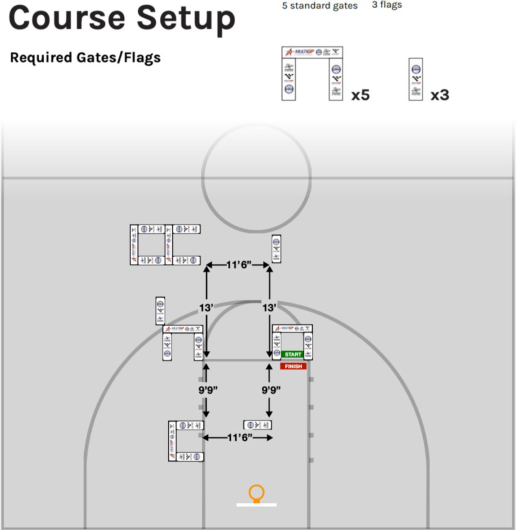
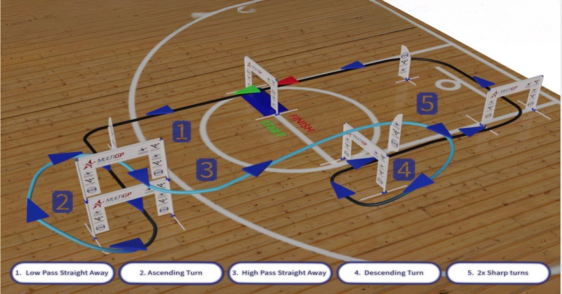
Flight tasks were adapted from the Multi-GP 2024 Virtual Race National Championships to preserve ecological validity and maintain technical challenge across conditions. Each mission consisted of five sequential flight segments, Low Pass Straightaway, Ascending Turn, High Pass Straightaway, Descending Turn, and Dual Sharp Turns, chosen to assess sustained attention, precision maneuvering, spatial orientation, and timing under progressively increasing cognitive load (Figures 1 & 2). Every participant completed the full mission sequence under each latency and sensitivity configuration, enabling a comprehensive comparative analysis of performance and workload.
To measure cognitive workload, the Emotiv Insight 5 EEG headset was employed for continuous real-time acquisition of neural activity. Data collection focused on theta (4–7 Hz), alpha (8–13 Hz), and beta (13–30 Hz) frequency bands, corresponding respectively to working memory load, attentional engagement, and active concentration. EEG signals were processed using Emotiv Pro software, which computed normalized power spectral densities and extracted cognitive and affective indices such as attention, engagement, stress, interest, relaxation, and excitement across each task condition. The EEG headset was fitted according to manufacturer specifications, and signal quality was continuously monitored during trials to ensure data integrity.
The study adopted a within-subjects experimental design, allowing all participants to experience each of the nine latency–sensitivity combinations. The order of conditions was counterbalanced using a Latin square approach to mitigate potential confounding effects from learning, fatigue, or order bias. Each participant completed two full mission runs per configuration to ensure consistency and reliability of performance and physiological data. Before each flight, participants were allotted two minutes to acclimate to the control settings, enabling adaptation to the specific latency–sensitivity pairing. Each mission lasted approximately five minutes, followed by a one- minute rest interval between conditions to prevent cognitive carryover and mental fatigue.
Figures 1 and 2 illustrate the experimental setup, including the participant’s point of view within the simulation and the EEG monitoring configuration. Figure 1 depicts the operator seated at the control station, equipped with the Emotiv Insight headset and DJI FPV controller, while Figure 2 provides a schematic representation of the test environment and flight trajectory layout.
Figure 1: Drone race track setup (adapted from MultiGP Drone Racing League, 2024).Figure 2: Drone flight path (adapted from MultiGP Drone Racing League, 2024).
RESULTS
Participants with ADHD exhibited the greatest cognitive and emotional variability across latency and sensitivity conditions, consistent with their sensitivity to both stimulation and temporal feedback timing. The EEG data reflected heightened beta power under fast-response configurations, denoting strong attentional activation but also frequent over-arousal when stimulus pace or control reactivity exceeded manageable thresholds.
Table 1: ADHD group — relative changes from baseline (low latency + medium sensitivity).
Table available in the original PDF paper.
Latency (ms)
Sensitivity Attention (%)
Engagement (%)
Interest (%)
Excitement (%)
Stress (%)
Relaxation (%) Low −9 −8 −7 −7 −7 +6
Low (10) Medium Baseline Baseline Baseline Baseline Baseline Baseline High +6 +5 −2 +6 +12 −8
Low −11 −10 −9 −8 +4 +3
Medium (50) Medium −4 −4 −3 −4 +5 −1 High +3 +3 −5 +2 +8 −6
Low −13 −12 −10 −9 +9 +2
High (100) Medium −7 −6 −6 −5 +10 −3 High +1 0 −8 +1 +15 −8
Low Latency (10 ms) Low latency produced the most optimal balance of cognitive engagement and emotional regulation. When paired with medium sensitivity (baseline), attention and excitement peaked (+15% to 16%) with only minimal stress increases (+3%), sustaining immersion without overload. However, pairing low latency with high sensitivity caused hyper-stimulation, attention climbed to (+21%) but stress spiked by (+15%), and relaxation declined by (−9%). The immediate controller response increased perceived control precision but also demanded continuous micro-adjustments, raising mental effort. Conversely, low sensitivity reduced cognitive strain and improved relaxation (+6%) but also dulled interest (−7%) and attentional vigor (−9%), indicating under-stimulation.
Medium Latency (50 ms) Medium latency introduced slight temporal delay, disrupting real-time feedback loops essential for ADHD participants to maintain rhythm and focus. EEG theta activity increased, suggesting elevated working-memory demand as participants compensated for lag-induced unpredictability. Attention and engagement declined by (+4% to 11%) from baseline, while stress rose (+5% to 8%). This subtle desynchronization reduced “flow state” efficiency, participants often described feeling “one step behind” their intended maneuvers.
High Latency (100 ms) High latency (100 ms) generated significant performance degradation and emotional dysregulation. Attention dropped by up to (−13%), and stress increased sharply (+15%), the highest recorded across all ADHD conditions. Relaxation fell to its lowest (−8%), indicating sustained frustration. Participants described the control as “sluggish” and “mentally draining,” reflecting cognitive overcompensation to correct delayed drone feedback.
Table 2: Autism group — relative changes from baseline (low latency + medium sensitivity).
Medium (50) Medium −2 −2 −2 −1 +3 −1 High −3 −3 −3 0 +8 −4
Low −7 −6 −5 −4 +2 +1
High (100) Medium −4 −3 −4 −2 +6 −3 High −5 −4 −7 −3 +12 −6
Autistic participants showed strong preferences for predictable temporal structure, steady control feedback, and visual stability. Their responses were marked by high sensitivity to latency fluctuations, consistent with sensory integration challenges observed in ASD. EEG recordings showed reduced alpha suppression (indicating calm focus) under stable, low-latency conditions and elevated beta spikes when latency increased, or sensitivity became erratic.
Low Latency (10 ms) Low latency supported optimal engagement and comfort. Under medium sensitivity (baseline), attention and interest rose (+10%) with stress remaining minimal (+3%). Participants demonstrated precise control and smooth navigation patterns, benefiting from consistent cause-effect feedback. Lower sensitivity within this latency range further enhanced relaxation (+6%) but at the cost of reduced excitement (−2%). Conversely, high sensitivity triggered sensory unpredictability, stress increased (+7%), and relaxation fell (−5%) as participants struggled to anticipate controller responses.
Medium Latency (50 ms) At medium latency, perceptual and motor asynchrony emerged. EEG theta and beta co-activation suggested divided attention and increased cognitive load due to mismatch between intent and system output. Engagement decreased (−2% to 4%), and stress rose (+3% to +8%), particularly when sensitivity exceeded moderate levels. Participants often reported mild discomfort, describing movements as “jerky” or “off-beat,” confirming a preference for smoother, predictable input curves.
High Latency (100 ms) High latency produced the most pronounced sensory strain. Stress rose sharply (+12%) with reduced attention (−7%) and relaxation (−6%). High sensitivity in this condition exacerbated discomfort, amplifying vigilance and
452 Singh and Geary hyper-arousal. Participants visually overcorrected during delayed control response intervals, leading to frustration and disengagement. However, when paired with low sensitivity, some stability returned relaxation improved slightly (+1%), and stress lessened, indicating that sensory simplicity partly offsets temporal delays.
Table 3: Dyslexia group — relative changes from baseline (low latency + medium sensitivity).
Medium (50) Medium −3 −2 −1 −1 +3 −2 High −4 −1 −3 0 +6 −3
Low −10 −8 −6 −5 +4 0
High (100) Medium −6 −4 −4 −3 +5 −3 High −7 −3 −5 −2 +9 −5
Participants with Dyslexia demonstrated acute sensitivity to timing inconsistencies and visual-motor synchronization, echoing established challenges in temporal sequencing and spatial integration. EEG readings revealed that delayed feedback elevated theta activity, reflecting working- memory strain, while high-sensitivity configurations increased beta-band oscillations linked to corrective visual processing.
Low Latency (10 ms) At baseline (low latency + medium sensitivity), Dyslexic participants exhibited their highest cognitive efficiency and emotional equilibrium. Attention, engagement, and excitement each improved by (+10% to 12%), with mild stress (+5%) and high relaxation (+6%), reflecting strong control comfort. Under low sensitivity, cognitive load decreased further, and relaxation peaked (+8%), but engagement declined (−4%), as overly smooth input reduced challenge and arousal. In contrast, high sensitivity increased reaction demand, excitement stayed high (+11%) but stress rose (+9%), and participants reported “visual jitter” during fine maneuvers, indicating overcorrection fatigue.
Medium Latency (50 ms) Medium latency reduced overall performance stability. Attention fell (−3% to 8%), and stress increased (+3% to 6%) as participants compensated for timing errors. Alpha desynchronization indicated rising visual strain. When combined with high sensitivity, these effects intensified, forcing reactive control adjustments. Participants described “choppy control” and “off- timed visuals,” reflecting growing temporal misalignment between sensory feedback and proprioceptive expectation.
Latency, Sensitivity & Optimizing Workload in Drone Control 453 High Latency (100 ms)
At high latency, Dyslexic participants faced the greatest spatial-motor breakdowns. Attention declined (−10%), interest dropped (−6%), and stress peaked (+9%). Reaction timing errors increased due to the delay between input and drone response, taxing working memory, and spatial prediction. EEG data confirmed elevated theta power and suppressed alpha rhythms, consistent with cognitive overload. Though some relaxation (+1% to 2%) was preserved under low sensitivity, participants reported a “lagged” sense of movement that undermined flow and control confidence.
DISCUSSION
This study extends prior research in drone human–machine interaction by examining how latency and joystick sensitivity influence cognitive workload, emotional regulation, and performance in neurodiverse drone operators with ADHD, Autism Spectrum Disorder (ASD), and Dyslexia. Latency was the primary workload driver: increasing from 10 ms to 100 ms elevated theta activity, indicating greater mental effort as users compensated for feedback delay, most notably in ADHD and Dyslexia, where timing desynchronization disrupted flow and spatial control. Low latency and medium sensitivity produced stable alpha and moderate beta activity, reflecting optimal focus and manageable workload. In contrast, high sensitivity intensified beta rhythms and stress, while high latency induced compensatory theta dominance and inefficiency. These effects varied by neurotype, ADHD and Dyslexia showing hyper-arousal under overstimulation, ASD displaying stress from unpredictability. The findings define a clear neuroergonomic gradient, underscoring the need for adaptive drone interfaces that dynamically regulate latency and sensitivity to sustain engagement and cognitive balance.
ADHD participants responded strongly to immediate feedback, with rapid sensorimotor coupling enhancing focus but causing alternating hyper-beta activation and theta rebound, cycles of over-focus and fatigue. Excessive sensitivity or delay amplified this instability, underscoring the need for dynamic workload regulation. Autistic participants showed calm, sustained focus marked by low-beta and high-alpha coherence under optimal conditions, but stress rose sharply with latency or unpredictable sensitivity, reflecting loss of temporal predictability. Dyslexic participants displayed elevated theta–beta coupling under high latency, indicating working- memory strain and disrupted temporal sequencing, while low latency and moderate sensitivity supported smooth visuomotor coordination. Across groups, engagement and excitement paralleled beta activation, relaxation aligned with alpha, and stress increased when sensory input became erratic. These physiological-behavioral links highlight drones as both cognitive and emotional environments, emphasizing the value of adaptive interfaces that optimize latency and sensitivity to sustain focus, comfort, and neurodiverse inclusion.
CONCLUSION
These findings outline principles for next generation neuroadaptive drone interfaces that combine real-time neurophysiological monitoring with adaptive control. Continuous tracking of theta (workload), alpha (relaxation), and beta (attention) can guide algorithms to dynamically adjust latency or sensitivity, maintaining operators within optimal activation ranges. Personalized latency compensation should automatically correct delays beyond individual tolerance, while adaptive sensitivity scaling can reduce responsiveness when beta activity or heart-rate variability indicate hyper- arousal. For Autistic users, predictable interfaces with visual grounding and temporal smoothing minimize perceptual stress. A neuroergonomic calibration framework should map each user’s EEG profile to latency– sensitivity pairings, tailoring control settings to cognitive resonance zones. Integrating these adaptive mechanisms transforms drones into cognitively responsive tools that enhance performance, reduce stress, and support emotional regulation. Future work should include multimodal feedback, larger neurodiverse samples, and therapeutic validation, advancing drones as platforms for cognitive training and neurorehabilitation.
REFERENCES
Abioye, A. O., Prior, S. D., Saddington, P. and Ramchurn, S. D. (2022). The Performance and Cognitive Workload Analysis of a Multimodal Speech and Visual Gesture (mSVG) UAV Control Interface. Robotics and Autonomous Systems, 147, p. 103915. doi: https://doi.org/10.1016/j.robot.2021.103915. Booher, H.R., Minninger, J. (2003) “Human systems integration in army systems
acquisition”, in: Handbook of human systems integration, Booher, Harold (Ed.). pp. 663–698 Booher, Harold, ed. (2003). Handbook of human systems integration. New Jersey: Wiley. Chapanis, A. (1996). Human factors in systems engineering. Wiley Series in Systems
Engineering and Management. Andrew Sage, series editor. Hoboken, NJ: Wiley. Chellappa, S. L. (2023, July). Neurodiversity, psychological inertia and mental health. Neuroscience & Biobehavioral Reviews, 150. https://doi.org/10.1016/j. neubiorev.2023.105203 Folds, Dennis. Gardner, Douglas and Deal, Steve. (2008). Building Up to the Human
Systems Integration Demonstration, INCOSE INSIGHT Volume 11 No. 2. Friedenthal, S. Moore, A. Steiner, R. (2008) A Practical Guide to SysML: The Systems Modeling Language, Morgan Kaufmann; Elsevier Science. Gregorio, M. D., Romano, M., Sebillo, M., Vitiello, G., and Vozella, A. (2021).
Improving Human Ground Control Performance in Unmanned Aerial Systems. Future Internet, 13(8), p. 188. doi: https://doi.org/10.3390/fi13080188. Honour, Eric C. (2006) “A Practical Program of Research to Measure Systems Engineering Return on Investment (SE-ROI)”, proceedings of the Sixteenth Annual Symposium of the International Council on Systems Engineering, Orlando, FL. Le Cunff, A.-L., Dommett, E., & Giampietro, V. (2024, January). Neurophysiological
measures and correlates of cognitive load in attention-deficit/hyperactivity disorder (ADHD), autism spectrum disorder (ASD), and dyslexia: A scoping review and research recommendations. European Journal of Neuroscience, 59(2), 256-282. 10.1111/ejn.16201
Latency, Sensitivity & Optimizing Workload in Drone Control 455 Li, X., Jiang, Y., Hong, J., Dong, Y. and Yao, L. (2016). Estimation of Cognitive
Workload by Approximate Entropy of EEG. Journal of Mechanics in Medicine and Biology, 16(06), p. 1650077. doi: https://doi.org/10.1142/ s0219519416500779. Lim, Y., Ramasamy, S., Gardi, A., Kistan, T. and Sabatini, R. (2017). Cognitive Human-Machine Interfaces and Interactions for Unmanned Aircraft. Journal of Intelligent & Robotic Systems, 91(3-4), pp. 755–774. doi: https://doi.org/ 10.1007/s10846-017-0648-9. Meilich, Abe. (2008) INCOSE MBSE Initiative Status of HSI/MBSE Activity
(Presentation) Shaw, S. C.K., Brown, M. L.E., Jain, N. R., George, R. E., Bernard, S., Godfrey-Harris, M., & Doherty, M. (2024, November 19). When I say … neurodiversity paradigm. Medical Education, 59(5), 466-468. https://doi.org/10.1111/medu.15565 Taubman, Philip. (June 25, 2008) Top Engineers Shun Military; Concern Grow. The
New York Times Website: http://www.nytimes.com/2008/06/25/us/25engineer. html Zhang, W., Liu, Y. and Kaber, D. B. (2024). Effect of Interface Design on Cognitive Workload in Unmanned Aerial Vehicle Control. International Journal of Human-Computer Studies, 189, pp. 103287–103287. doi: https://doi.org/ 10.1016/j.ijhcs.2024.103287
LISTED IN THE AHFE DIGITAL BOOKSTORE CATALOGUE
Explore the complete digital volume
Intelligent Human Systems Integration (IHSI 2026): Disruptive and Innovative Technologies
Read this individual research paper free through the original publisher, or explore the full digital proceedings book.
ISBN 978-1-964867-76-2
Explore this ISBN in the AHFE Bookstore ↗Listed in the July 2026 bookstore catalogue; search by ISBN to confirm current availability · Digital book purchase optional