Suvipra Singh (2025). Optimizing Human-Machine Interfaces for Neuroergonomics: Cognitive Workload and Performance in sUAS Operations. In: Human-Computer Interaction & Emerging Technologies. AHFE Open Access, vol. 195, pp. 92–102. https://doi.org/10.54941/ahfe1006227
The growing prevalence of small Unmanned Aerial Systems (sUAS) or Drones across industries, particularly, aerial photography and surveying, results in a need for a deeper understanding of how control interface design impacts operator cognitive workload and performance. This study evaluates the effects of gyroscopic and traditional joystick-based control systems on the operator’s cognitive workload as well as their mission performance under diverse environmental conditions. Participants perform standardized sUAS tasks while real-time electroencephalography (EEG) monitoring tracks cognitive workload via theta and alpha wave activity. Results indicate that gyroscopic controls, though intuitive, increase cognitive workload under high stress, whereas joystick controls provide more stability. Performance metrics show greater consistency with traditional controls, especially in demanding conditions. Insights from this study inform ergonomic improvements, tailored training, and real-time physiological monitoring for adaptive systems. By integrating neuroergonomics with human-machine interface design, this research advances sUAS usability, optimizing operator performance and safety in dynamic environments.
The rapid advancement of unmanned aerial systems (UAS) has transformed numerous industries, such as agriculture, healthcare and logistics. Small Unmanned Aerial Systems (sUAS) are emerging as versatile tools for applications like aerial videography, environmental monitoring, and search- and-rescue missions. However, the interplay between cognitive workload and human-machine interfaces, especially in dynamic environments, remains insufficiently explored in sUAS operations. This study addresses this gap by investigating the impact of different human-machine interfaces– specifically gyroscopic controls vs. traditional joystick controls– during routine drone maneuvers that are synonymous with the industry. Through neuroergonomic analysis using electroencephalography (EEG) of a virtual reality (VR) simulated flight, the research quantifies cognitive workload variations by categorizing the fluctuations of alpha and theta brain waves
Optimizing Human-Machine Interfaces for Neuroergonomics 93
into the following six emotional and psychological parameters: Attention, Engagement, Excitement, Interest, Relaxation and Stress. The findings aim to provide actionable insights regarding the efficacy of different human-machine interfaces (HMIs) for different contemporary sUAS mission profiles, resulting in an enhancement in operator performance and safety and improvement in human-machine interface (HMI) designs for sUAS systems.
BACKGROUND
Introduction to sUAS and Their Applications Small Unmanned Aerial Systems (sUAS) are increasingly utilized across various industries, including aerial photography, environmental monitoring, search-and-rescue missions, agriculture, healthcare, and logistics (Gregorio et al., 2021). Their versatility and efficiency have revolutionized traditional practices, yet optimizing human-machine interaction remains crucial for maximizing performance and safety. Understanding the interplay between control interface design and cognitive workload is particularly important for enhancing operational efficiency in dynamic environments. Control interface design significantly influences operator performance and cognitive workload. Traditional joystick controls are known for their stability and precision, whereas gyroscopic controls provide a more intuitive, motion- based experience. However, these interfaces may yield different cognitive demands depending on environmental stressors and task complexity. Zhang, Liu, and Kaber examined how interface design impacts cognitive workload in UAV control, revealing that complex interfaces increase cognitive demands, affecting operator accuracy and response time (Zhang, Liu, and Kaber, 2024).
Cognitive Workload in Human-Machine Interface of in sUAS Recent studies have explored multimodal interfaces combining speech and visual gestures, highlighting the benefits of intuitive controls but also revealing cognitive overload issues under high-stress conditions (Abioye et al., 2022). These findings underscore the need to tailor HMIs to specific sUAS tasks and environmental demands. Cognitive workload influences human performance, decision-making, and safety in dynamic sUAS operations. Understanding cognitive workload is essential for designing interfaces that optimize user performance without causing cognitive overload. Cognitive workload can be measured through both physiological and performance- based metrics. Hebbar and colleagues demonstrated the correlation between EEG metrics and cognitive workload, providing insights into how mental demands fluctuate during complex UAV tasks (Hebbar et al., 2021). EEG is particularly effective for real-time cognitive workload assessment, with alpha and theta wave fluctuations linked to different cognitive states (Li et al., 2016). Utilizing EEG to monitor workload during sUAS operations enables adaptive interfaces that respond to operator fatigue or stress, enhancing safety and efficiency. Neuroergonomics integrates brain activity monitoring with ergonomic design to optimize human performance. In sUAS operations, neuroergonomic approaches enhance operator performance by adapting
94 Singh
HMI designs to cognitive workload fluctuations in real time (Lim et al., 2017). By leveraging EEG data, neuroergonomics enables the development of adaptive systems that enhance user experience and safety under varying operational conditions.
Neuroergonomics and Performance Metrics in sUAS Operations The application of neuroergonomics in aviation has shown that adaptive displays can improve performance and reduce cognitive workload by presenting information contextually (Liu et al., 2012). This principle can be extended to sUAS HMIs to create context-aware interfaces that enhance operator focus and decision-making. Performance metrics for sUAS operations include precision in object centering, mission completion time, error rates, and operational consistency under dynamic environmental conditions. Traditional joystick controls have shown greater consistency in demanding scenarios due to their stability and precision (Zhang, Liu, and Kaber, 2024). Conversely, gyroscopic controls, while more intuitive, tend to increase cognitive workload under high-stress conditions (Abioye et al., 2022). Balancing cognitive workload with performance metrics is critical for optimal HMI design. Effective interfaces should minimize cognitive demands while maintaining high levels of accuracy and efficiency. The integration of neuroergonomics can support this balance by enabling real-time cognitive state monitoring and adaptive interface adjustments.
Challenges and Limitations in Previous Cognitive Workload Studies Despite advancements, several challenges remain in understanding cognitive workload in sUAS operations. One key challenge is accurately measuring cognitive workload in dynamic environments. Traditional subjective measures like the NASA-TLX are prone to biases and may not reflect real-time cognitive demands (Hebbar et al., 2021). Physiological measures, particularly EEG, offer real-time monitoring but require advanced data interpretation techniques to correlate brainwave patterns with cognitive states (Li et al., 2016). Additionally, the complexity of sUAS tasks and diverse environmental conditions pose challenges for generalizing findings. Zhang and colleagues highlighted the need for standardized protocols to evaluate cognitive workload across different UAV interfaces, emphasizing the importance of context-specific assessments (Zhang et al., 2016).
Research Gaps and Rationale for Study Though extensive research on cognitive workload and HMI design has been conducted, several gaps remain, such as there being a limited number of studies comparing the efficacy of gyroscopic and joystick controls in especially dynamic and diverse environments. Furthermore, inadequate exploration of real-time EEG monitoring for cognitive workload in sUAS operations and insufficient focus on neuroergonomics for adaptive HMI designs tailored to specific sUAS mission profiles permeate throughout the industry. This study aims to bridge these gaps by evaluating gyroscopic and traditional joystick controls using real-time EEG monitoring in VR simulated
Optimizing Human-Machine Interfaces for Neuroergonomics 95
sUAS operations. By categorizing cognitive workload into six emotional and psychological parameters (Attention, Engagement, Excitement, Interest, Relaxation, and Stress), the study provides actionable insights into optimizing HMI designs for enhanced performance and safety.
METHODS
This study investigates the cognitive workload and performance impacts of using gyroscopic versus traditional joystick-based control systems for small Unmanned Aerial Systems (sUAS) operations in a virtual reality (VR) flight simulation. Three participants were recruited, each representing distinct levels of flight experience: one novice with no prior flying experience, one intermediate pilot with two years of sUAS experience, and one expert pilot with five years of competitive drone racing experience. This stratified sampling was designed to capture how cognitive workload and performance vary with experience when using different control interfaces.
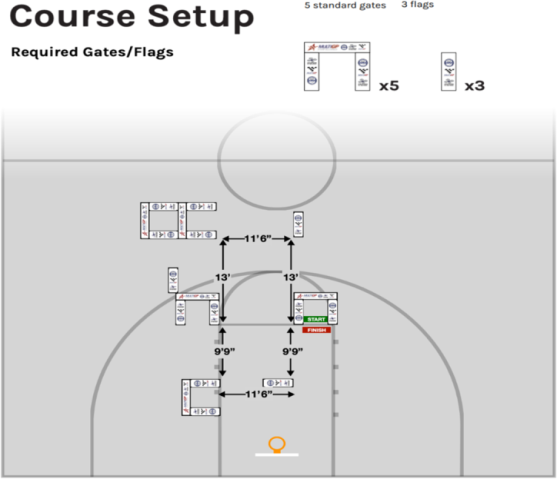
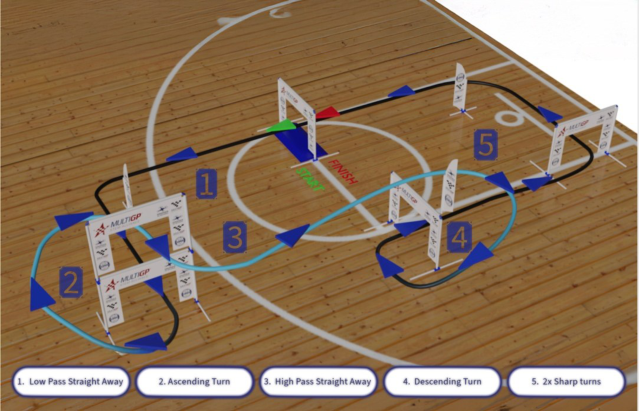
The experiment employed the VelociDrone Simulator, selected for its industry-standard physics model and photo-realistic VR environment, closely replicating real-world flying conditions. The simulation track was sourced from the Multi-GP December 2024 Virtual Race National Championships, ensuring the tasks were both relevant and sufficiently challenging. The track comprised five specific segments: Low Pass Straight Away, Ascending Turn, High Pass Straight Away, Descending Turn, and two Sharp Turns, each varying in complexity. These segments were chosen to evaluate cognitive workload and performance under diverse operational demands (Figures 1 & 2). Participants navigated the track using two distinct control systems. The first was the DJI RC Motion 3, which utilizes a gyroscopic control mechanism allowing for motion-based navigation. The second was the DJI FPV Remote Controller 3, a traditional joystick-based system offering precise manual control. Both control systems were integrated with DJI Goggles N3 for an immersive VR experience, providing first-person view (FPV) perspectives that closely simulate real-world sUAS operations.
To monitor cognitive workload, the Emotiv Insight 5 EEG headset was used, capturing real-time brain wave data to measure six cognitive parameters: Attention, Engagement, Excitement, Interest, Relaxation, and Stress. The EEG data was processed using Emotiv Pro software, allowing for detailed analysis of cognitive fluctuations during each flight task. Performance metrics, including object-centering precision, mission completion time, error rates, and operational consistency, were recorded for each track segment. These metrics were analyzed in conjunction with EEG- derived cognitive workload data to evaluate how control system type and task complexity influenced performance outcomes.
The study followed a within-subjects design, where each participant completed the flight tasks using both control systems. The order of control system usage was counterbalanced to reduce learning effects. Each participant navigated all five track segments twice per control system, ensuring comprehensive data collection for comparative analysis. Figure 2 illustrates the experimental setup, including the participant’s view through
96 Singh
the DJI Goggles N3 and the corresponding EEG monitoring configuration. The inclusion of specific track segments from the Multi-GP December 2024 Virtual Race National Championships enhances the study’s ecological validity, ensuring the findings provide actionable insights into optimizing human-machine interface designs for competitive sUAS operations.
Figure 1: Drone race track setup (adapted from multiGP drone racing league, 2024).Figure 2: Drone flight path (adapted from multiGP drone racing league, 2024).
Optimizing Human-Machine Interfaces for Neuroergonomics 97
RESULTS
The point values showcase the percent increase or decrease in the parameter in the utilization of a gyroscopic control interface instead of traditional joystick-based controls.
Table 1: Cognitive workload change for beginner pilots.
Gyroscopic controllers significantly enhance cognitive workload distribution and emotional responses for beginner pilots across all track segments. Attention levels show the highest increase, especially in challenging areas like sharp turns (+18%), descending turns (+15%), and ascending turns (+13%), indicating heavy reliance on gyroscopic stabilization for precise control. Engagement also rises notably in high-demand sections, such as sharp turns (+14%) and ascending turns (+11%), enhancing immersion.
Excitement peaks at +16% during sharp turns, reflecting increased pilot confidence and the thrill of dynamic movements with reduced risk. Interest consistently grows, particularly in precise maneuvering areas (+12%), reinforcing that improved handling boosts focus and confidence. Relaxation improves but remains moderate due to the learning curve, with the highest levels in straightaways (+8%) and declines in complex sections.
Stress reduction is the most significant benefit, with the sharpest decreases in demanding segments like sharp turns (−12%) and descending turns (−9%), where gyroscopic assistance corrects pilot errors, easing cognitive strain. These findings demonstrate that gyroscopic controllers enhance attention, engagement, and confidence while reducing stress, making them particularly beneficial for beginners adjusting to high-speed flight dynamics.
Table 2: Cognitive workload change for intermediate pilots.
For intermediate pilots, gyroscopic controllers enhance cognitive workload distribution and emotional responses, but with less extreme shifts than seen in beginners. Attention increases across all track segments, peaking in challenging maneuvers like sharp turns (+13%) and descending turns (+11%). This indicates continued reliance on gyroscopic stabilization, though to a lesser extent than beginners. Engagement also rises, particularly in sharp turns (+10%) and ascending turns (+8%), reflecting increased immersion and control but with more balanced engagement due to the pilots’ advanced skills.
Excitement moderately increases, peaking at +12% in sharp turns, as pilots experience satisfaction from mastering dynamic maneuvers. Interest also grows in demanding sections, especially in sharp and descending turns, supported by the controller’s stabilization for smoother handling. Relaxation improves more than in beginners, particularly in straight sections (+7%), as enhanced control reduces the cognitive strain of complex maneuvers.
Stress reduction is most evident in sharp turns (−10%), where gyroscopic assistance minimizes overcorrections, preventing cognitive overload. Overall, intermediate pilots benefit from smoother handling and reduced stress, particularly in challenging segments, while maintaining balanced control and engagement. This highlights the controller’s effectiveness in refining skills without overwhelming cognitive demands.
Table 3: Cognitive workload change for advanced pilots.
Optimizing Human-Machine Interfaces for Neuroergonomics 99
For advanced pilots using gyroscopic controllers, cognitive workload and emotional responses show subtle yet meaningful changes, reflecting their high skill level and familiarity with complex maneuvers. Attention modestly increases across all track segments, with the most significant rises in sharp turns (+10%) and descending turns (+8%). This indicates that gyroscopic assistance enhances focus without imposing substantial cognitive demands, complementing advanced pilots’ existing attentional control.
Engagement slightly improves, particularly in complex maneuvers like sharp turns (+8%) and descending turns (+7%), maintaining interest and immersion through fluid control. However, the increase is less pronounced compared to beginners and intermediates, as advanced pilots are more accustomed to dynamic flight. Excitement levels also rise but are more controlled, peaking in dynamic sections due to the satisfaction of mastering precision without novelty.
Interest follows a similar trend, highest in intricate maneuvers like sharp turns (+7%) and descending turns (+6%), driven by enhanced precision rather than challenge. Relaxation reaches its peak for advanced pilots, especially in straight sections (+7%), reflecting effortless control with minimal cognitive load. Stress levels decrease slightly across all segments, most notably in sharp turns (-3%), as gyroscopic stabilization prevents overcorrection. These findings highlight that gyroscopic controllers support advanced pilots by refining precision and fluidity while maintaining low cognitive strain and balanced emotional responses.
Table 4: Performance metrics for pilots.
Table available in the original PDF paper.
Metric Gyroscopic Traditional
Gyroscopic Traditional
Gyroscopic Traditional
(Beginner) (Beginner)
(Intermediate) (Intermediate)
(Advanced) (Advanced)
Average Lap 19.4 sec 20.3 sec 17.6 sec 16.3 sec 16.5 sec 14.7 sec Time Average ±0.053
±0.039
±0.031 ±0.016
meters meters
±0.046 meters
±0.033 meters meters
meters
Ideal Race Line Deviation Average
66% 63% 72% 83% 84% 93%
Turn Precision Average
79% 76% 81% 87% 86% 93%
Straightaway Stability Average 252ms 278 ms 220 ms 243 ms 211 ms 229 ms Reaction Time
Drift
18% 21% 12% 15% 9% 6%
Tendency in Sharp Turns The performance analysis of gyroscopic versus traditional controllers reveals distinct advantages and disadvantages across different pilot skill levels. For beginners, gyroscopic controllers demonstrate improved lap times (19.4s vs. 20.3s) and better stability in straightaways (79% vs. 76%), suggesting they enhance ease of control. They also reduce drift
100 Singh
tendency (18% vs. 21%) and improve reaction time (252ms vs. 278ms), which can be beneficial for new pilots learning to navigate racecourses. However, these benefits diminish as pilots progress. Intermediates see marginal improvements in reaction time and drift reduction, but gyroscopic controllers fall short in race-line precision (± 0.046m vs. ± 0.033m) and turn accuracy (72% vs. 83%). This suggests that while gyroscopic control aids in smoother handling, it does not necessarily translate to precision improvements at higher skill levels. For advanced pilots, the limitations of gyroscopic controllers become more evident. While they do provide some assistance with reaction time (211ms vs. 229ms), traditional controls outperform them in every other key metric, including lap time (16.5s vs. 14.7s), race-line deviation (± 0.031m vs. ± 0.016m), turn precision (84% vs. 93%), and straightaway stability (86% vs. 93%). The reliance on fine motor adjustments and refined muscle memory at advanced levels makes traditional controls the superior choice. Ultimately, gyroscopic controllers serve as a useful tool for beginners, offering a smoother and more stable experience, but they become a hindrance for competitive pilots who require precision and control for optimal performance.
DISCUSSION
Using a gyroscopic controller improves pilot focus and stabilization during turns and maneuvers, reducing effort and increasing attention across all skill levels, with beginners benefiting the most. It enhances engagement by delivering smoother control and a more immersive flying experience, particularly for beginners who find handling easier. Excitement levels rise due to more dynamic flying potential, with the most significant impact on beginner and intermediate pilots, while advanced pilots experience more regulated excitement. Interest increases, especially during complex maneuvers like sharp turns, as enhanced control boosts confidence, particularly among beginners. Relaxation improves as the gyroscopic controller reduces drifting and enhances flight stability. Beginners feel more at ease navigating challenges, while advanced pilots enjoy the highest relaxation from increased control with minimal effort. Stress levels decrease with the gyroscopic controller’s intuitive handling. Beginner pilots experience the most significant stress reduction due to error compensation, while advanced pilots maintain low, controlled stress levels compared to traditional controllers. Overall, the gyroscopic controller enhances focus, engagement, excitement, interest, relaxation, and stress management, benefiting pilots of all skill levels.
CONCLUSION
This study demonstrates that using a gyroscopic controller enhances pilot focus, engagement, excitement, interest, relaxation, and stress management across all skill levels, with beginners experiencing the most significant benefits. These findings underscore the potential of gyroscopic controllers to improve human-machine interaction, especially in complex aerial tasks.
Optimizing Human-Machine Interfaces for Neuroergonomics 101
The efficacy of the gyroscopic controller in each track segment correlates to industry-specific applications. In Low Pass Straight Aways, it improves stability and precision relevant to aerial mapping, crop surveying, and wildlife surveying. For Ascending Turns, enhanced maneuverability supports building inspections. In High Pass Straight Aways, increased control aids pipeline inspection and search & rescue. For Descending Turns, smoother navigation benefits fire observation, while improved agility in Sharp Turns is crucial for drone deliveries.
Environmental factors, such as lighting and wind conditions, were kept consistent throughout the simulation to ensure reliable comparisons between control systems. Future research should explore real-world environmental variations, including wind turbulence, changing light conditions, and obstacles, to validate these findings in practical applications.
Implementing gyroscopic controllers in industry-specific scenarios would provide valuable insights into their effectiveness and reliability in dynamic, real-world environments.
REFERENCES
Abioye, A. O., Prior, S. D., Saddington, P. and Ramchurn, S. D. (2022). The Performance and Cognitive Workload Analysis of a Multimodal Speech and Visual Gesture (mSVG) UAV Control Interface. Robotics and Autonomous Systems, 147, p. 103915. doi: https://doi.org/10.1016/j.robot.2021.103915. Gregorio, M. D., Romano, M., Sebillo, M., Vitiello, G. and Vozella, A. (2021).
Improving Human Ground Control Performance in Unmanned Aerial Systems. Future Internet, 13(8), p. 188. doi: https://doi.org/10.3390/fi13080188. Hebbar, P. A., Bhattacharya, K., Prabhakar, G., Pashilkar, A. A. and Biswas, P.
(2021). Correlation between Physiological and Performance-Based Metrics to Estimate Pilots’ Cognitive Workload. Frontiers in Psychology, 12. doi: https:// doi.org/10.3389/fpsyg.2021.555446. Lercel, D. and Andrews, D. H. (2021). Cognitive Task Analysis of Unmanned Aircraft System Pilots. The International Journal of Aerospace Psychology, pp. 1–24. doi: https://doi.org/10.1080/24721840.2021.1895797. Li, X., Jiang, Y., Hong, J., Dong, Y. and Yao, L. (2016). Estimation of
Cognitive Workload by Approximate Entropy of EEG. Journal of Mechanics in Medicine and Biology, 16(06), p. 1650077. doi: https://doi.org/10.1142/ s0219519416500779. Lim, Y., Ramasamy, S., Gardi, A., Kistan, T. and Sabatini, R. (2017). Cognitive Human-Machine Interfaces and Interactions for Unmanned Aircraft. Journal of Intelligent & Robotic Systems, 91(3-4), pp. 755–774. doi: https://doi.org/ 10.1007/s10846-017-0648-9. Liu, D., Guarino, S., Roth, E. M., Harper, K. A. and Vincenzi, D. A. (2012). Effect of
Novel Adaptive Displays on Pilot Performance and Workload. The International Journal of Aviation Psychology, 22(3), pp. 242–265. doi: https://doi.org/10.1080/ 10508414.2012.691040. O’Hare, D. (2006). Cognitive Functions and Performance Shaping Factors in Aviation Accidents and Incidents. The International Journal of Aviation Psychology, 16(2), pp. 145–156. doi: https://doi.org/10.1207/ s15327108ijap1602_2.
102 Singh
Zhang, W., Feltner, D., Shirley, J., Manida Swangnetr and Kaber, D. (2016).
Unmanned Aerial Vehicle Control Interface Design and Cognitive workload: a Constrained Review and Research Framework. doi: https://doi.org/10.1109/ smc.2016.7844502. Zhang, W., Liu, Y. and Kaber, D. B. (2024). Effect of Interface Design on Cognitive Workload in Unmanned Aerial Vehicle Control. International Journal of Human-Computer Studies, 189, pp. 103287–103287. doi: https://doi.org/ 10.1016/j.ijhcs.2024.103287.
Read this individual research paper free through the original publisher, or explore the full digital proceedings book.
ISBN 978-1-964867-71-7
Explore this ISBN in the AHFE Bookstore ↗Listed in the July 2026 bookstore catalogue; search by ISBN to confirm current availability · Digital book purchase optional