Suvipra Singh (2026). Therapeutic Applications of Remote Aviation for Neurodiverse Individuals (TARA-ND): A Neuroergonomic Approach to Strength-Based Therapy for Neurodivergence. In: Neuroergonomics and Cognitive Engineering. AHFE Open Access, vol. 207, pp. 46–57. https://doi.org/10.54941/ahfe1007394
Publisher statistics will load when you open Metrics.
AHFE OPEN ACCESS OPEN ACCESS CONFERENCE PROCEEDINGS PAPER
Therapeutic Applications of Remote Aviation for Neurodiverse Individuals (TARA-ND): A Neuroergonomic Approach to Strength-Based Therapy for Neurodivergence
Contemporary advances in affective computing, neurodiversity-affirming practice, and remote aviation reveal how technologically mediated sensorimotor engagement can support cognitive–affective regulation. Building on these convergences, TARA-ND (Therapeutic Applications of Remote Aviation for Neurodiverse Individuals) is proposed as a novel neuroergonomic framework. The framework reconceptualizes small unmanned aerial systems (sUAS) as adaptive therapeutic and skill-building environments for individuals with Autism Spectrum Disorder, ADHD, dyslexia, and dyspraxia. While prior work has examined drone operation in relation to workload measurement, performance optimization, and situational awareness, comparatively little attention has been given to its neurodiversity-affirming therapeutic potential. TARA-ND addresses this gap by positioning remote aviation not as a corrective intervention, but as an embodied human–machine interaction that supports executive function, social navigation, and positive neurodivergent identity formation. The framework is organized around five pillars: Sensory-Safe Flight Design, Executive Function Flight Scaffolding, Aerial Regulation Loop, Strength-Based Mission Identity, and Social Navigation & Co-Pilot Collaboration. Together, these pillars align sensory conditions, therapeutic experience, mission identity, and collaborative roles with the participant’s specific neuroprofile. Contrary to just normalizing neurodivergence, TARA-ND modulates the environment around it, allowing therapeutic change to arise through agency, interaction, and strengths-based engagement. In doing so, it proposes remote aviation as a novel, testable pathway for inclusive neuroergonomic intervention.
Advances at the intersection of neuroergonomics, affective computing, human–machine interaction, and remote aviation are increasingly challenging traditional assumptions about how cognition, emotion, attention, and behavior are regulated within technologically mediated environments. Emerging perspectives suggest that regulation is co-constructed through Received May 18, 2026; Revised June 1, 2026; Accepted June 16, 2026; Available online July 20, 2026
Therapeutic Applications of Remote Aviation for Neurodiverse Individuals 47 dynamic interactions between the individual, sensory conditions, bodily action, and responsive technological systems as opposed to solely relying on an internal verbally mediated process. This shift is significant because it expands therapeutic design beyond verbal reflection and internal self- control toward adaptive environments that can support regulation through interaction itself. Despite this progress, many applications of adaptive technologies remain focused on performance, efficiency, workload reduction, and task optimization, rather than on therapeutic growth, self-understanding, and quality of life.
This gap is especially significant for individuals with Autism Spectrum Disorder, ADHD, dyslexia, and dyspraxia, whose challenges often emerge from a mismatch between nervous-system capacity and environmental demands. Traditional therapeutic and educational models are frequently verbal, static, clinic-bound, and structured around neurotypical expectations of attention, communication, and emotional expression. While these approaches may be effective in many contexts, they can be limiting for individuals who experience sensory overload, attention variability, executive dysfunction, as they may find articulating internal states through language alone more difficult. For many neurodivergent individuals, difficulty emerges from environments that fragment attention, constrain movement, and frame cognitive difference as deficit rather than designing conditions conducive to therapeutic growth.
Regulation may therefore be more accessible through visuospatial engagement, graded challenge and embodied control than through introspection or verbal processing alone. Simultaneously, research on small unmanned aerial systems has made significant strides in tailoring drone operation to pilots’ situational awareness and workload management needs. Remote aviation combines perception–action coupling, visual immersion, motor coordination, environmental perspective-taking, and immediate feedback within a system whose sensory intensity, task complexity, and control demands can be precisely adjusted. These features make drone-based interaction uniquely suited to neurodiversity-affirming therapeutic design. When organized around the participant’s neuroprofile instead of neurotypical normalization, remote aviation can become more than a technical skill; it can become a validating and empowering experience instead of a deficit-focused intervention.
SCIENTIFIC FOUNDATIONS TARA-ND is an interdisciplinary framework grounded in neuroergonomics, affective computing and positive psychology operationalized through neurodiversity-affirming practice, collaborative learning, and strengths-based development. Shifting away from drawing from these domains independently, the framework aims to synthesize their core principles into a unified adaptive model for cognitive–emotional regulation. Within this model, remote aviation becomes more than a technological activity; it becomes a structured regulatory environment in which perception, movement, attention, feedback, and meaning making operate together.
48 Singh For individuals with Autism Spectrum Disorder, ADHD, dyslexia, and dyspraxia, this is especially significant because regulation is often shaped by the fit between the nervous system and the surrounding environment. Traditional educational and therapeutic spaces can unintentionally amplify difficulty by relying on prolonged verbal processing, rigid pacing, unpredictable sensory demands, or narrow definitions of performance. TARA-ND responds by shifting the site of support from correction of the individual to redesign of the interaction itself. Drone-based tasks can be paced, simplified, stabilized, intensified, or reframed in real time, allowing the system to meet the participant’s current cognitive, sensory, and motor capacity while still preserving challenge, agency, and growth.
Neuroergonomics and Neurodiverse Cognitive Regulation Neuroergonomics serves as the methodological backbone through which TARA-ND reframes therapeutic support as an adaptive interaction ecology, where regulation emerges through carefully designed relationships between the participant, the interface, the task, and the environment. In neurodiversity-affirming practice, this perspective is especially important because cognitive, emotional, sensory, and motor challenges are understood as outcomes shaped by the relation between the individual nervous system and the surrounding environment. This is achieved by examining the dynamic relationship between brain function and behavior in real-world environments, with particular emphasis on how cognitive processes can be measured and supported through neurophysiological signals (Parasuraman & Rizzo, 2007; Ayaz et al., 2012). Advances in portable, lightweight EEG systems have enabled real-time inference of cognitive states, demonstrating the sensitivity of neural activity to task demands, environmental complexity, and sensorimotor interaction (Makeig et al., 2009; Baldwin & Penaranda, 2012). Within this perspective, cognition is understood as a function continuously shaped through interaction with the participant’s surroundings.
Regulation for neurodivergent individuals may therefore depend less on forcing attention, compliance, or verbal self-monitoring, and more on designing environments that reduce overload, scaffold action, and support agency. Regulation, accordingly, can be interpreted as an emergent property of brain–environment coupling, in which attentional dynamics, cognitive load, sensory processing, and motor planning are distributed across task structure and interface design instead of being governed solely by internal, deliberate control. TARA-ND elaborates on this paradigm by repositioning neuroergonomics within an inclusive therapeutic and developmental context. Through Sensory-Safe Flight Design, the flight environment is intentionally built around predictability, choice, and adjustable stimulation. These design choices create a sense of nervous-system safety before challenge is introduced.
Affective Computing and the Aerial Regulation Loop Building upon neuroergonomic principles of brain–environment coupling, affective computing provides the computational foundation through which
Therapeutic Applications of Remote Aviation for Neurodiverse Individuals 49 human emotional and physiological states can be detected, interpreted, and adaptively supported in real time. Instead of treating emotion as separate from cognition, affective computing recognizes that arousal, attention, stress, engagement, and regulation are continuously reflected through behavioral and physiological signals. Contemporary approaches increasingly leverage multimodal inputs such as heart rate variability (HRV), galvanic skin response (GSR), and EEG to infer emotional arousal, cognitive load, and engagement with growing precision (Fairclough, 2009; D’Mello & Kory, 2015). These developments have enabled closed-loop biofeedback systems in which continuously monitored user states inform system responses, allowing technology to become responsive to the participant’s changing cognitive– affective condition. Traditionally, however, affective computing has relied on feedback-centric designs in which users are made explicitly aware of their internal states and guided toward regulation through visualizations, prompts, and structured training protocols (Picard, 1997; Peper et al., 2009).
While feedback-centric biofeedback systems have demonstrated value, they often require conscious self-monitoring, and deliberate regulatory effort. For neurodivergent individuals this reliance on explicit introspection may inadvertently increase cognitive demand, particularly when sensory overload, attentional variability, language-processing challenges are already a factor. In contrast, TARA-ND refines affective computing into a neuroergonomic, environment-mediated model of regulation. Through the Aerial Regulation Loop, physiological and behavioral indicators are used to adapt the interaction environment itself rather than presenting those signals to the participant as information they must consciously decode. Flight parameters can be dynamically adjusted in response to signs of overwhelm, disengagement, and emerging fatigue. In lieu of instructing neurodivergent participants to regulate internally and conform to rigid therapeutic demands, TARA-ND externalizes regulation by embedding support within the perception–action loop. In this formulation, stabilization arises implicitly through curated interaction, allowing the participant to move toward psychophysiological coherence without constant self-surveillance.
Neurodiversity-Affirming Practice Neurodiversity-affirming practice reframes neurological differences as natural variations in human cognition as opposed to deficits requiring normalization (Singer, 1999). This perspective does not deny disability, support needs, or real-world barriers; on the contrary, it shifts therapeutic and educational design away from correcting the individual and toward reshaping environments, expectations, and systems so that diverse cognitive profiles can participate meaningfully. The double empathy problem further supports this shift by demonstrating that social misunderstanding often emerges relationally, through reciprocal differences in communication and interpretation, rather than from one-sided impairment alone (Milton, 2012). TARA-ND is built upon this premise by refusing to define success through compliance, masking, or symptom reduction alone.
50 Singh Instead, it operationalizes neurodiversity-affirming practice through Strength-Based Mission Identity, where traits associated with Autism Spectrum Disorder, ADHD, dyslexia, and dyspraxia are treated as functional design assets within drone-based interaction. ADHD-related rapid scanning, novelty seeking, and creative route finding can support dynamic mission environments; autistic pattern recognition, systems thinking, and deep focus can strengthen structured flight control and mission planning; dyslexic visual- spatial reasoning and big-picture navigation can enhance aerial perspective- taking; and dyspraxic participants can build motor confidence through simulator-first practice, graded controller sensitivity, and low-risk repetition. In this way, accommodation is embedded as a foundational design principle through which competence, agency, and positive neurodivergent identity are actively reinforced.
Collaborative Social Navigation and Co-Regulation This same neurodiversity-affirming logic extends into Social Navigation and Co-Pilot Collaboration, where overcoming is reframed through shared purpose, structured roles, and flexible communication in place of unstructured social performance. Collaborative learning research suggests that shared tasks can support interaction, problem-solving, and skill development when roles, expectations, and goals are clearly organized (Johnson & Johnson, 2009). Within TARA-ND, pilot and co-pilot roles, mission briefings, collaborative mapping, supported turn-taking, nonverbal communication options, and post-flight reflection create opportunities for teamwork without requiring participants to conform to neurotypical conversational norms.
The drone mission provides a shared attentional object, reducing the pressure of direct social evaluation and allowing communication to occur through gestures, visual signals, written prompts, role cards, or verbal coordination according to individual preference. This structure also generates a cumulative success effect: when neurodivergent participants see peers with similar cognitive, sensory, or motor profiles succeeding within the same mission environment, the therapeutic impact can be amplified through identification, social modeling, and shared confidence. Success becomes more than an isolated achievement; it becomes collective evidence that people like them can navigate challenge, contribute meaningfully, and develop mastery. As these experiences accumulate, TARA-ND strengthens regulation and skill acquisition, along with belonging, self-efficacy, and sustained confidence.
Positive Psychology and Growth-Oriented Development Shifting from immediate stabilization to sustained developmental growth, positive psychology provides TARA-ND with a framework for understanding regulation as part of a broader trajectory of competence, resilience, meaning, and self-efficacy. As an alternative to defining psychological well-being only through the reduction of distress, positive psychology emphasizes the cultivation of strengths and the capacity to engage meaningfully with challenge (Seligman & Csikszentmihalyi, 2000). Flow theory is especially
Therapeutic Applications of Remote Aviation for Neurodiverse Individuals 51 relevant within this context, as flow states emerge when task demands are appropriately matched to an individual’s skill level, producing deep engagement, intrinsic motivation, heightened focus, and an increased sense of control (Csikszentmihalyi, 1990). For individuals with Autism Spectrum Disorder, ADHD, dyslexia, and dyspraxia, this balance between challenge and capacity is particularly significant. When environments are too rigid, overstimulating, verbal, or deficit-oriented, participants may experience repeated failure, avoidance, or diminished confidence. When tasks are calibrated to their sensory, cognitive, and motor profiles, however, challenge can become a site of mastery as opposed to a threat.
In this sense, regulation and growth are not separate outcomes; stabilization creates the conditions for engagement, while successful engagement strengthens self-efficacy and adaptive persistence over time (Bandura, 1997). TARA-ND extends this developmental logic through reflection, transfer, and identity formation. Growth is framed as cultivating agency and competence within one’s own neurodivergent profile, while navigating limitations imposed by inaccessible environments and support mismatches. The Aerial Reflection Studio supports this process by transforming drone footage, mission data, and participant reflections into visual journals, confidence reels, regulation strategy videos, and social-story style mission reviews. These artifacts allow participants to revisit moments of challenge, adaptation, and success from a concrete visual perspective, strengthening the connection between action, emotion, strategy, and self-understanding. Over time, repeated evidence of capability can counter deficit-based self-perceptions and support a more coherent sense of competence. Within TARA-ND, positive development therefore emerges from accumulated experiences of embodied mastery, reflective integration, and transferable self-knowledge.
Toward Neurodiversity-Affirming Environment-Mediated Regulation Taken together, these scientific foundations converge on a central premise: neurodiverse regulation and growth can be supported through adaptive environments that are sensory-safe, predictable, strengths-based, and socially accessible. In this formulation, TARA-ND positions drones as programmable and responsive vantage spaces through which participants can regulate, navigate, and rise. The framework makes three primary contributions. First, it adapts therapeutic remote aviation into a specialized model for Autism Spectrum Disorder, ADHD, dyslexia, and dyspraxia. Second, it translates common neurodiverse barriers into concrete design responses through the five-pillar TARA-ND framework. Third, it establishes a testable pathway for future research into how adaptive drone-based environments may support cognitive–emotional regulation, executive function, confidence, collaboration, and real-world skill transfer.
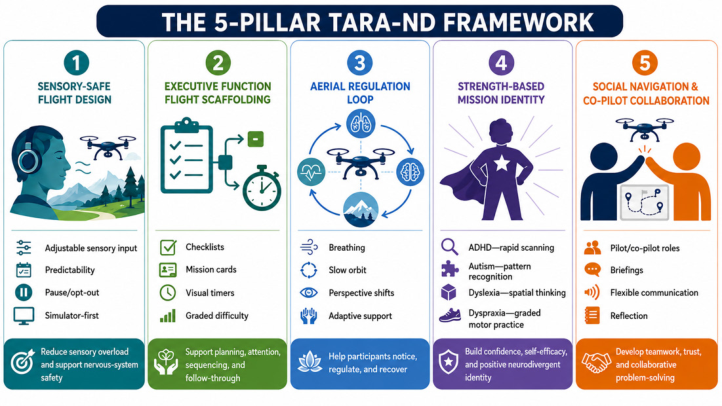
THE FIVE-PILLAR TARA-ND FRAMEWORK TARA-ND is organized around a five-pillar framework consisting of Sensory-Safe Flight Design, Executive Function Flight Scaffolding, the Aerial Regulation Loop, Strength-Based Mission Identity, and Social
52 Singh Navigation and Co-Pilot Collaboration. Each pillar represents a distinct functional layer within the system, collectively structuring how sensory safety, attentional support, emotional regulation, identity formation, and collaborative engagement are coordinated through drone-based interaction. In lieu of operating as separate components, these pillars form an integrated neurodiversity-affirming architecture in which the participant, interface, task, and environment are continuously adapted to one another.
Figure 1: The five pillar TARA-ND framework.
Sensory-Safe Flight Design Sensory-Safe Flight Design establishes nervous-system safety as the prerequisite for meaningful engagement, recognizing that sound, lighting, screen brightness, visual complexity, motion speed, and environmental unpredictability can profoundly shape participation for neurodivergent individuals. Across Autism Spectrum Disorder, ADHD, dyslexia, and dyspraxia, sensory and perceptual demands may destabilize functioning. When stimulation exceeds the individual’s regulatory capacity, difficulty may be misinterpreted as refusal, disengagement, or noncompliance, when it more accurately reflects a mismatch between the sensory environment and the nervous system.
TARA-ND responds by designing flight environments around predictability, choice, and adjustable stimulation rather than fixed therapeutic conditions. Low-sensory settings reduce unnecessary overload while preserving meaningful challenge, recognizing that an overwhelmed participant cannot meaningfully engage with the therapeutic process. In this formulation, sensory safety is not a preliminary accommodation but the enabling condition for regulation itself. Once the participant feels secure enough to remain engaged, drone flight can shift from a potential source of threat into a structured
Therapeutic Applications of Remote Aviation for Neurodiverse Individuals 53 space for exploration. In doing so, TARA-ND creates the conditions in which attention, confidence, and skill-building can emerge.
Executive Function Flight Scaffolding Executive Function Flight Scaffolding transforms drone operation into a structured practice environment for planning, sequencing, attention, cognitive flexibility, and follow-through. Executive function includes the cognitive processes that allow individuals to initiate tasks, hold information in working memory, organize steps, inhibit distractions, adapt to changing demands, and complete goal-directed action. For neurodivergent individuals executive function variability often becomes most visible when tasks are open-ended, multi-step, time-sensitive, verbally overloaded, or emotionally demanding. TARA-ND reframes these challenges as indicators that the environment requires stronger scaffolding.
Through pre-flight checklists, mission cards, visual timers, step-by-step instructions, pause–plan–fly routines, and graded difficulty levels, the system externalizes cognitive demands, so the participant does not need to retain every action sequence internally. The mission structure becomes a cognitive partner, organizing attention, reducing uncertainty, and supporting task completion through visible, manageable progression. Because drone flight naturally requires preparation, monitoring, adjustment, and reflection, it provides an embodied context in which executive skills can be practiced through purposeful action.
Aerial Regulation Loop Aerial Regulation Loop functions as the adaptive regulation layer of TARA-ND, translating internal cognitive–affective states into responsive flight-based modulation. Emotional regulation is often framed as an internal process requiring verbal labelling, reflective insight, and deliberate control; however, for neurodivergent individuals, regulation may be more accessible through rhythm, movement, visual focus, environmental predictability, and structured interaction. TARA-ND therefore situates regulation within the flight environment itself. Before take-off, participants may engage in brief breathing, grounding, or mission-preview routines that establish orientation and readiness.
The external attentional anchors of flight provide participants with a pathway through which regulation can emerge through perception and action in contrast to than prolonged verbal processing. Furthermore, physiological and behavioral indicators can guide adaptive modulation of task difficulty: when signs of overwhelm emerge, the system may simplify the mission, reduce sensory intensity, stabilize visual feedback, or introduce a recovery interval; when the participant appears engaged and regulated, complexity can gradually increase. In this way, the Aerial Regulation Loop establishes a closed-loop therapeutic environment that adapts to the participant’s state, in place of requiring the participant to conform to a fixed therapeutic demand. Such adaptability may reduce rapid cognitive fatigue, difficulties in sensory
54 Singh filtering, anxiety associated with performance pressure, and negative self- perception shaped by repeated experiences of “failure” within conventional therapeutic settings.
Strength-Based Mission Identity Strength-Based Mission Identity is a central tenet of TARA-ND’s refusal to define neurodivergence through deficit alone. Many traits that are pathologized in conventional educational or therapeutic settings may become functional advantages when the environment is designed to recognize and mobilize them. As a result, TARA-ND uses flight to generate lived moments of competence that challenge internalized narratives of inadequacy. Mission success, post-flight reflection, visual journals, and confidence reels allow participants to see themselves as capable operators, problem-solvers, collaborators, and learners.
A participant who struggles in a conventional therapeutic setting may discover unexpected strength in spatial navigation; a participant who finds social communication difficult may thrive in a clearly defined co-pilot role; and a participant with anxiety or motor uncertainty may gain confidence through repeated experiences of safe control. This identity-based dimension is essential because therapeutic transformation depends on how participants come to understand their own cognitive and sensory profiles. Through supported, successful flight experiences, TARA-ND helps neurodivergent individuals reinterpret difference as part of a meaningful strength profile.
Social Navigation and Co-Pilot Collaboration Social Navigation and Co-Pilot Collaboration is a layer of TARA-ND that supports communication, trust, teamwork, and shared problem-solving by placing social interaction within a structured mission environment as opposed to leaving it dependent on unstructured conversation. For many neurodivergent individuals, social difficulty is intensified by ambiguity, implicit expectations, rapid verbal exchange, or pressure to perform neurotypical forms of interaction. TARA-ND reduces this burden by organizing collaboration around clear roles, shared goals, and flexible communication pathways. Pilot and co-pilot roles, mission briefings, collaborative mapping, nonverbal signals, written prompts, visual cues, and post-flight reflection allow participants to coordinate action in ways that match their communication preferences. The drone mission becomes a shared attentional anchor, shifting social engagement from abstract interpersonal performance to purposeful co-regulation and joint problem-solving. In this conception, rather than collaboration being imposed as a therapeutic demand, it is designed as an accessible pathway through which participants can experience trust, contribution, and collective success.
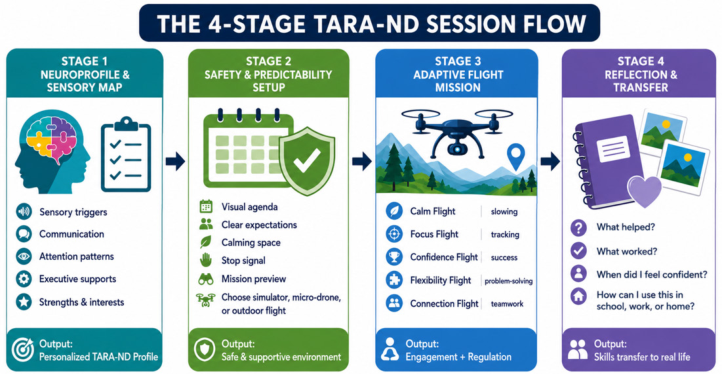
THE FOUR-STAGE TARA-ND SESSION FLOW The five-pillar framework is further operationalized through a four-stage session flow that begins with neuroprofile and sensory mapping, moves into safety and predictability setup, continues through adaptive flight missions,
Therapeutic Applications of Remote Aviation for Neurodiverse Individuals 55 and concludes with reflection and transfer, allowing mission pace, sensory stimulation, flight parameters, and confidence-building outputs to be personalized over time.
Figure 2: The 4 Stage TARA-ND session flow.
Stage 1: Neuroprofile and Sensory Map The session begins with an individualized mapping process that identifies the participant’s sensory triggers, preferred communication style, attention patterns, executive function supports, anxiety or transition challenges, strengths, and special interests. This stage produces a personalized TARA-ND profile that informs every later decision, including mission type, pacing, communication format, sensory adjustments, and level of support. In lieu of beginning with a standardized task, TARA-ND begins with the person, ensuring that the flight experience is shaped around the participant’s nervous system, capacities, preferences, and strengths.
Stage 2: Safety and Predictability Setup The second stage establishes the conditions necessary for safe and confident participation. A visual agenda, clear rules, calming space, stop signal, mission preview, and choice of simulator, indoor micro-drone, or outdoor drone are introduced to reduce uncertainty and support a sense of control. This stage is especially important for participants who experience sensory overload, anxiety, transition difficulty, or reduced tolerance for ambiguity. By making the environment predictable and giving the participant meaningful choice, TARA-ND creates the regulatory foundation required for engagement, learning, and exploration.
Stage 3: Adaptive Flight Mission The third stage is the core interaction phase, in which the participant engages in a flight mission aligned with their current goals, capacity, and regulatory state. Calm Flight may use slow, predictable movement to support regulation; Focus Flight may involve hovering, target tracking, and sustained attention; Confidence Flight may introduce small challenges with built-in success; Flexibility Flight may incorporate route changes or problem-solving tasks; and Connection Flight may use pilot and co-pilot teamwork to support collaboration. Each mission is adapted in real time through pacing, difficulty, stimulation level, controller sensitivity, and recovery breaks, allowing the participant to remain engaged without being pushed into overload.
Stage 4: Reflection and Transfer The final stage transforms the flight experience into self-understanding and real-world application. Guided reflection is essential because it connects mission success to the participant’s broader life, helping them recognize the strategies, strengths, and supports that made regulation and achievement possible. The ultimate goal is to translate the experience into confidence, self-awareness, and transferable skills.
CONCLUSION
By embedding regulation and skill development within remote aviation, TARA-ND establishes a novel pathway for supporting individuals with Autism Spectrum Disorder, ADHD, dyslexia, and dyspraxia through embodied engagement, adaptive challenge, and strengths-based identity formation. Future research should empirically evaluate TARA-ND across diverse neurodiverse populations and settings. Studies may examine changes in stress, confidence, executive function, attention stability, sensory tolerance, collaboration, and real-world transfer. Further development should also refine the TARA-ND Adaptive AI system, NeuroFly-ND Dashboard, and Aerial Reflection Studio to ensure that personalization remains ethical, transparent, and user-centered. Ultimately, TARA-ND points toward a future in which assistive and therapeutic technologies are built around responsive environments that help individuals regulate, navigate, and rise.
REFERENCES
Ayaz, H., Shewokis, P. A., Bunce, S., Izzetoglu, K., Willems, B., & Onaral, B. (2012).
Optical brain monitoring for operator training and mental workload assessment. NeuroImage, 59(1), 36–47. https://doi.org/10.1016/j.neuroimage.2011.06.023 Baldwin, C. L., & Penaranda, B. N. (2012). Adaptive training using an artificial neural network and EEG metrics for within- and cross-task workload classification. NeuroImage, 59(1), 48–56. https://doi.org/10.1016/j.neuroimage.2011.07.047 Bandura, A. (1997). Self-efficacy: The exercise of control. W. H. Freeman. Csikszentmihalyi, M. (1990). Flow: The psychology of optimal experience. Harper
& Row.
Therapeutic Applications of Remote Aviation for Neurodiverse Individuals 57 D’Mello, S. K., & Kory, J. (2015). A review and meta-analysis of multimodal affect
detection systems. ACM Computing Surveys, 47(3), Article 43. https://doi. org/10.1145/2682899 Fairclough, S. H. (2009). Fundamentals of physiological computing. Interacting with Computers, 21(1–2), 133–145. https://doi.org/10.1016/j.intcom.2008.10.011 Johnson, D. W., & Johnson, R. T. (2009). An educational psychology success story:
Social interdependence theory and cooperative learning. Educational Researcher, 38(5), 365–379. https://doi.org/10.3102/0013189X09339057 Makeig, S., Gramann, K., Jung, T.-P., Sejnowski, T. J., & Poizner, H. (2009). Linking brain, mind and behavior. International Journal of Psychophysiology, 73(2), 95–100. https://doi.org/10.1016/j.ijpsycho.2008.11.008 Milton, D. E. M. (2012). On the ontological status of autism: The “double empathy
problem.” Disability & Society, 27(6), 883–887. https://doi.org/10.1080/096875 99.2012.710008 Parasuraman, R., & Rizzo, M. (Eds.). (2007). Neuroergonomics: The brain at work.
Oxford University Press. Peper, E., Harvey, R., & Takabayashi, N. (2009). Biofeedback: An evidence-based approach in clinical practice. Japanese Journal of Biofeedback Research, 36(1), 3–10. Picard, R. W. (1997). Affective computing. MIT Press. Seligman, M. E. P., & Csikszentmihalyi, M. (2000). Positive psychology: An
introduction. American Psychologist, 55(1), 5–14.https://doi.org/10.1037/0003- 066X.55.1.5 Singer, J. (1999). “Why can’t you be normal for once in your life?” From a “problem with no name” to the emergence of a new category of difference. In M. Corker & S. French (Eds.), Disability discourse (pp. 59–67). Open University Press.
LISTED IN THE AHFE DIGITAL BOOKSTORE CATALOGUE
Explore the complete digital volume
Neuroergonomics and Cognitive Engineering
Read this individual research paper free through the original publisher, or explore the full digital proceedings book.
ISBN 978-1-964867-83-0
Explore this ISBN in the AHFE Bookstore ↗Listed in the July 2026 bookstore catalogue; search by ISBN to confirm current availability · Digital book purchase optional