Ravneet Kaur (2025). Emotional Intelligence as a Neuroergonomic Buffer in High-Pressure Professional Environments. In: Human Factors in Design, Engineering, and Computing. AHFE Open Access, vol. 199, pp. 147–155. https://doi.org/10.54941/ahfe1006827
Technical and business professionals increasingly operate in cognitively demanding, high-pressure environments that require sustained attention, adaptive regulation, and effective collaboration. Professionals such as software engineers, product managers, and business leaders routinely face complex incidents, accelerated release cycles, and human–AI collaboration scenarios that place heavy demands on cognitive and emotional regulation. This paper presents a theoretical model integrating Emotional Intelligence (EI) and neuroergonomics to explain how emotional regulation influences neural efficiency and cognitive stability under stress. The framework positions EI as a neuroergonomic buffer, a moderating mechanism that mitigates the impact of stress and workload, measured through electroencephalography (EEG) workload indices. Drawing on human factors and organizational psychology, the model proposes that EI competencies, self-awareness, self-regulation, empathy, and relationship management, enable professionals to maintain neural stability and cognitive efficiency in high-pressure situations. The framework explains how Emotional Intelligence influences EEG based workload responses by enhancing emotional and stress regulation, promoting neural efficiency, and facilitating faster recovery after demanding tasks. The paper concludes by outlining implications for leadership development, human technology systems design, and future neuroergonomic research on emotional regulation and performance in complex professional environments. By bridging Emotional Intelligence and neuroergonomics, this framework provides a conceptual foundation for empirical studies and organizational applications that integrate emotional competence development with neurophysiological feedback to enhance human performance, resilience, and well-being in cognitively demanding work environments.
High-pressure professional environments, spanning from incident management in technology operations to leadership in fast-paced business ecosystems, demand continuous attention, rapid decision-making, and emotional management. Professionals today work in settings characterized by information overload, time pressure, and constant technological interaction. Under these conditions, performance failures are often not
due to a lack of technical skill but rather due to cognitive overload and emotional dysregulation (Parasuraman & Rizzo, 2008).
Neuroergonomics, the interdisciplinary study of brain and behavior in work settings, offers a scientific approach to understanding how mental workload, stress, and fatigue affect performance. By combining cognitive neuroscience with human factors, it seeks to optimize how people interact with technology, automation, and complex systems. Through neural measures such as electroencephalography (EEG), neuroergonomics provides insight into how humans allocate cognitive and emotional resources under pressure.
Parallel to this, Emotional Intelligence (EI), defined as the ability to recognize, understand, and regulate emotions in oneself and others (Mayer & Salovey, 1997; Boyatzis, 2018), provides a psychological framework for managing these same pressures. While neuroergonomics focuses on the neural mechanisms of performance, EI explains the emotional and cognitive strategies individuals use to adapt and self-regulate under demanding conditions.
Despite their shared focus on performance and regulation, EI and neuroergonomics have rarely been integrated into a single model. This paper proposes that Emotional Intelligence acts as a neural buffer within a neuroergonomic framework, helping professionals sustain performance under pressure by stabilizing EEG workload patterns and enhancing cognitive control. Integrating these two fields offers a comprehensive framework for understanding how emotional regulation interacts with cognitive workload, providing new pathways for designing emotionally intelligent and neuroergonomically informed workplaces of the future.
LITERATURE REVIEW
Emotional Intelligence and Performance Research consistently shows that Emotional Intelligence (EI) enhances leadership effectiveness, teamwork, and stress management (Mayer, Caruso, & Salovey, 2016; Boyatzis, 2018). Individuals with high EI demonstrate greater resilience, self-regulation, and adaptability in volatile or uncertain contexts. Evidence from organizational psychology suggests that Emotional Intelligence is a stronger predictor of job performance than cognitive intelligence, particularly, in roles requiring teamwork, communication, and interpersonal problem-solving where social coordination and emotional regulation are critical.
From a neurobiological perspective, EI is associated with prefrontal– amygdala regulation pathways that govern automatic responses to stress (LeDoux, 2000). Individuals with stronger emotional regulation skills maintain composure under pressure, observable through stable EEG patterns indicating balanced neural workload and efficient cortical regulation (Puma et al., 2018). Thus, EI influences not only how people feel but also how their brains and bodies regulate stress. These regulation mechanisms represent neuroergonomic phenomena that directly affect cognitive performance under workload, illustrating that higher EI promotes
Emotional Intelligence as a Neuroergonomic Buffer 149
better stress regulation, greater neural stability, and improved cognitive performance.
Neuroergonomics and Cognitive Workload Neuroergonomics connects neuroscience with human factors to study how the brain functions during real-world tasks (Parasuraman & Rizzo, 2008). It examines the neural and physiological mechanisms that underpin mental effort, attention, and stress in work environments. Tools such as EEG allow researchers to assess cognitive load through changes in brainwave activity, where increased frontal theta and decreased parietal alpha power are reliable indicators of higher workload (Puma et al., 2018). In other words, these changes suggest that the brain is exerting greater effort to maintain focus and process information when tasks become more demanding.
Recent studies integrate these measures to predict human performance in domains like aviation, cyber operations, and healthcare (Fatolitis & Masalonis, 2021; Bhaskar, 2023). However, while these studies reveal how much workload the brain is experiencing, they do not explain why some individuals cope more effectively than others. This is where EI can contribute. Professionals with higher EI tend to show milder neural workload patterns, such as reduced theta activation and less alpha suppression, indicating more efficient self-regulation and adaptive cognitive control under pressure.
Emerging work has underscored the importance of integrating emotional and cognitive adaptation as joint determinants of neural resilience. This perspective is supported by foundational contributions in neuroergonomics and human systems integration (Ayaz & Dehais, 2019; Karwowski, Ahram, & Taiar, 2021).
CONCEPTUAL FRAMEWORK: EMOTIONAL INTELLIGENCE AS A NEUROERGONOMIC BUFFER Overview
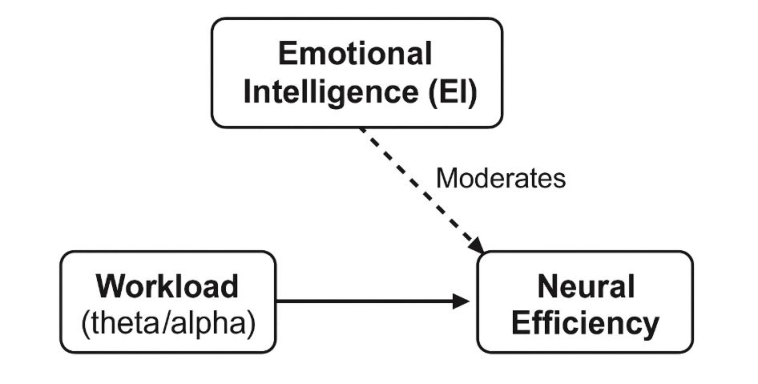
This section introduces the Neuroergonomic Model of Emotional Intelligence (NEM-EI), a conceptual integration of emotional, cognitive, and neural processes that together explain how professionals sustain performance under cognitive load. Drawing from neuroergonomics, Emotional Intelligence (EI), and organizational psychology, the model proposes that EI moderates the relationship between EEG workload indicators and neural efficiency by influencing how individuals detect, interpret, and regulate stress in high- pressure environments.
Neuroergonomic studies reveal that cognitive load manifests through measurable changes in EEG spectral power, particularly in frontal theta and parietal alpha activity (Parasuraman & Rizzo, 2008; Puma et al., 2018). However, these measures alone do not explain why some individuals maintain composure and clarity under stress while others experience cognitive breakdown. Emotional Intelligence provides that missing interpretation - the capacity for self-awareness, regulation, and empathy allowing individuals to manage emotional arousal and sustain cognitive efficiency under demand.
150 Kaur
The NEM-EI framework therefore positions EI as a neuroergonomic buffer: a dynamic moderator that influences how the brain responds to escalating workload, mitigating stress-related performance degradation.
Figure 1 illustrates the Neuroergonomic Model of Emotional Intelligence (NEM-EI), where the arrows represent moderating pathways through which EI influences neural efficiency by reducing workload intensity (theta/alpha ratio) and accelerating recovery following high cognitive demand.
Figure 1: Neuroergonomic model of emotional intelligence (NEM-EI).
Theoretical Foundation The proposed NEM-EI posits that EI moderates the relationship between EEG workload indicators and neural adaptation outcomes.
Professionals with higher EI engage in earlier stress detection (self-awareness), adaptive response (self-regulation), and constructive communication (empathy and relationship management). This combination reduces the cognitive cost of emotion, allowing more effective use of working memory and attentional resources during demanding tasks.
Mechanisms of Buffering EI exerts its buffering influence through four primary mechanisms that connect emotion regulation with cognitive stability:
1. Self-awareness - enables early recognition of rising arousal, activating prefrontal control systems to prevent emotional escalation. 2. Self-regulation - maintains efficient EEG activation patterns (moderate theta increase and stable alpha) under stress. 3. Empathy and relationship management - support cooperative task engagement, minimizing distractive neural activity associated with social tension. 4. Cognitive reframing and mindfulness - facilitate faster return to baseline EEG states following high-stress tasks, conserving neural resources.
Emotional Intelligence as a Neuroergonomic Buffer 151
Together, these mechanisms translate emotional competence into neurophysiological efficiency.
Conceptual Summary The NEM-EI model integrates three core constructs:
1. Emotional Intelligence – awareness, regulation, and empathy. 2. Neuroergonomic Processes – brain behavior workload dynamics. 3. Neural Outcomes – changes in EEG activity that reflect cognitive stability and adaptive control.
By linking emotional regulation to workload management, EI transforms physiological adaptation into a cognitive advantage.
PROPOSED METHODS To translate the conceptual Neuroergonomic Model of Emotional Intelligence (NEM-EI) into an empirically testable framework, this section outlines a proposed research method for examining how Emotional Intelligence moderates EEG based workload responses under cognitive stress. The design integrates quantitative neuroergonomic measurements with validated EI assessments in simulated professional environments.
Research Design A within-subject experimental design is proposed to minimize between- participant variability in neural workload responses. Participants will perform high-pressure decision-making or monitoring tasks under two workload levels (moderate vs. high) while their neural responses are continuously recorded.
Independent variable: Workload intensity (low, high). Moderator: Emotional Intelligence (EI) score from MSCEIT or EQ-i 2.0.
Dependent variables: EEG indices - frontal theta (4–7 Hz), parietal alpha (8–12 Hz), and the derived theta/alpha ratio as a validated workload metric.
Participants and Tasks A sample of 30–50 professionals or graduate students in technology, business, or management programs will be recruited. Participants will first complete a standardized EI assessment and be grouped into high- and low-EI subsamples. Experimental tasks will simulate realistic professional conditions, such as time-critical system monitoring, multi-source information integration, or alert-response coordination, representing dynamic decision contexts that require sustained attention and emotional regulation. Ethical clearance will be obtained from the institutional review board, and written informed consent will be collected prior to participation. Participants will be debriefed about EEG recording, confidentiality, and voluntary withdrawal rights.
152 Kaur
Measurements EEG: Neural Workload Measurement
Electroencephalography (EEG) records electrical brain activity via scalp electrodes, capturing real-time oscillations produced by cortical neurons. In workload studies, EEG is particularly sensitive to frontal theta (4–7 Hz) and parietal alpha (8–12 Hz) frequency bands.
Frontal theta increases with greater mental effort, reflecting heightened cognitive control and working memory demand.
Parietal alpha decreases when attention is engaged and mental resources are exhausted. The theta/alpha ratio is therefore a validated index of mental workload (Raufi & Longo, 2022).
High Load (High-EI Group) Note: EEG spectral power is expressed in microvolts squared (µV2), representing the signal energy within the theta (4–7 Hz) and alpha (8–12 Hz) frequency bands. Higher µV2 values indicate greater oscillatory activity in the corresponding neural region.
Interpretation: Both groups show increased theta and decreased alpha under high load, but high-EI participants maintain a lower theta/alpha ratio, indicating greater neural efficiency and reduced cognitive strain.
Procedure
1. Baseline Phase: 5-min rest, EEG recording to establish reference values. 2. Moderate Workload Phase: For 5-min participants perform a cognitive task with manageable attentional demand. 3. High Workload Phase: For 5-min participants perform another task such that the task complexity, time pressure, or concurrent demands are increased to elevate load. 4. Recovery Phase: 3-min post-task EEG recording to assess neural return to baseline.
Data Analysis Approach Linear mixed-effects models and moderation analyses will test whether EI buffers the relationship between workload and EEG responses. Primary analyses will examine Workload and EI interactions for frontal theta and parietal alpha. Recovery slopes will quantify post-task regulation. Exploratory connectivity analyses (e.g., frontal-parietal coherence) may
Emotional Intelligence as a Neuroergonomic Buffer 153
Ethical and Practical Considerations Implementing EEG monitoring in organizational settings must respect privacy and informed consent. Data anonymization, voluntary participation, and clarity about non-evaluative use are essential to maintain ethical alignment with human factors research standards.
High-EI participants will show smaller theta increases and less alpha suppression, indicating greater neural efficiency and effective emotional regulation under stress.
Integrated Interpretation EI is expected to act as a neuroergonomic buffer by reducing the magnitude of neural activation required for task performance and enhancing recovery speed. This pattern demonstrates EI’s role in maintaining EEG stability, preserving attentional control, and optimizing resource allocation during high-pressure conditions.
Hypothesis It is hypothesized that individuals with higher Emotional Intelligence will exhibit lower theta/alpha ratios, indicating reduced mental strain, and faster EEG recovery slopes following high workload conditions, compared to lower-EI participants.
PRACTICAL AND DESIGN IMPLICATIONS The following section outlines how the proposed EEG-based neuroergonomic model of Emotional Intelligence can inform practical training methods, leadership strategies, and system design interventions to enhance performance and resilience as well as human technology integration in high-pressure professional environments.
Training and Development Organizations can combine EI based coaching with EEG guided biofeedback to help professionals recognize and self-regulate neural stress responses in real time. Simulated workload training with visual feedback on theta/alpha indices can accelerate metacognitive awareness and emotional self-regulation skills.
Leadership and System Design Leaders equipped with both EI competencies and neuroergonomic awareness can design work systems that balance load and recovery. Neuroergonomic
154 Kaur
dashboards combined with coaching insights can serve as “cognitive mirrors,” enabling early detection of overload and preventing burnout.
Human-AI Teaming In AI-assisted decision-making, EI supports trust calibration and emotional stability when human judgment conflicts with automation. EEG informed neurofeedback can enhance situational awareness and cognitive balance, improving overall human-AI collaboration efficiency.
METHODOLOGICAL DECISIONS While the present framework focuses exclusively on EEG based neural indicators, the absence of behavioral or performance metrics is an intentional methodological choice. The aim is to isolate the neurophysiological mechanisms through which Emotional Intelligence (EI) modulates workload, independent of task-specific skill or productivity variability. By restricting measurement to replicable EEG responses, particularly spectral power changes in frontal theta and parietal alpha bands, this framework establishes a clean foundation for testing EI’s buffering effect without behavioral confounds.
FUTURE RESEARCH DIRECTIONS Future empirical research can build upon this foundation in several progressive directions.
1. Multimodal Neuroergonomic Designs: Future studies can integrate additional physiological markers such as heart rate variability (HRV) and pupillometry. HRV captures autonomic adaptability, while pupillometry quantifies arousal and effort. As noted in prior neuroergonomic models (Ayaz & Dehais, 2019; Thayer & Lane, 2009), multimodal physiological integration, combining EEG with HRV and pupillometry, offers a comprehensive view of both cortical and autonomic regulation. Together, these measures would enable a richer understanding of how EI shapes both cortical and autonomic regulation under stress. 2. Behavioral Linkage and Performance: Applied studies should connect EEG indices to behavioral and performance metrics such as decision accuracy, error rates, or communication efficiency. This would bridge the current theoretical model with real-world outcomes, clarifying how internal neural regulation translates into observable performance outcomes. 3. Longitudinal and Intervention based Designs: Future research may explore whether structured EI training leads to measurable changes in EEG workload patterns over time, providing potential evidence for neural plasticity induced by emotional regulation practice. Cross- cultural replications could further determine whether EI’s buffering mechanisms generalize across diverse organizational, occupational and cultural contexts.
Emotional Intelligence as a Neuroergonomic Buffer 155
In summary, future research should progressively expand from this EEG only foundation toward multimodal, applied, and longitudinal designs that connect emotional intelligence, neural efficiency, and sustainable human performance in cognitively demanding work environments.
CONCLUSION
This paper articulates a theoretical and methodological framework positioning Emotional Intelligence as a neuroergonomic buffer that links emotional regulation with neural adaptation to stress. By integrating EI competencies with EEG based neurophysiological measurement, the model explains how individuals sustain neural efficiency under pressure. The proposed framework provides a replicable foundation for empirical validation and organizational application, supporting the design of emotionally intelligent and neuroergonomically aware work systems that enhance human resilience, adaptive performance and well-being in future high-pressure professional environments.
REFERENCES
Ayaz, H. & Dehais, F. (eds.) (2019) Neuroergonomics: The brain at work and in everyday life. London: Academic Press. Bhaskar, R. (2023) ‘The role of human factors engineering in cybersecurity’, ISACA
Journal, vol. 4. Boyatzis, R. (2018) The competent manager: A model for effective performance.
New York: John Wiley & Sons. Fatolitis, P. G. & Masalonis, A. J. (2021) ‘Human factors in aviation and healthcare: Best practices, safety culture and the way ahead for patient safety’, Journal of Ergonomics, 11, p. 289. Karwowski, W., Ahram, T. Z. & Taiar, R. (2021) Human systems engineering and
design: Future trends and applications. Cham: Springer. LeDoux, J. (2000) Emotion circuits in the brain. Annual Review of Neuroscience, 23, pp. 155–184. Mayer, J. D., Caruso, D. R. & Salovey, P. (2016) ‘The ability model of emotional
intelligence: Principles and updates’, Emotion Review, 8(4), pp. 290–300. Parasuraman, R. & Rizzo, M. (eds.) (2008) Neuroergonomics: The brain at work.
Oxford: Oxford University Press. Puma, S., Matton, N., Paubel, P. V., Raufaste, É. & El-Yagoubi, R. (2018) ‘Using theta and alpha band power changes as markers of cognitive workload’, Frontiers in Human Neuroscience, 12, p. 86. Raufi, M. & Longo, L. (2022) ‘A systematic review of EEG-based workload
estimation: Trends, challenges, and applications’, Frontiers in Neuroinformatics, 16(826470), pp. 1–22. Thayer, J. F. & Lane, R. D. (2009) ‘Claude Bernard and the heart–brain connection: Further elaboration of a model of neurovisceral integration’, Neuroscience & Biobehavioral Reviews, 33(2), pp. 81–88.
LISTED IN THE AHFE DIGITAL BOOKSTORE CATALOGUE
Explore the complete digital volume
Human Factors in Design, Engineering, and Computing
Read this individual research paper free through the original publisher, or explore the full digital proceedings book.
ISBN 978-1-964867-75-5
Explore this ISBN in the AHFE Bookstore ↗Listed in the July 2026 bookstore catalogue; search by ISBN to confirm current availability · Digital book purchase optional