Konstantinos Pechlivanis, Dimitrios Ziakkas, Ioanna Lekea, Debra Henneberry (2026). Implementation of Human - AI teaming in the Single Pilot Operations Era. In: Advances in Human Factors of Transportation. AHFE Open Access, vol. 224, pp. 45–53. https://doi.org/10.54941/ahfe1007832
Human–AI teaming emerges as the defining paradigm for Single Pilot Operations (SiPO), challenging aviation's foundational assumptions about cockpit redundancy, expertise, and training. This paper synthesises three complementary analyses: (1) historical decrewing patterns establishing phased implementation imperatives; (2) empirical validation of prompt engineering as a core Human–AI interaction competency improving task success by 64% in SiPO scenarios (Pechlivanis & Ziakkas, 2026b); and (3) a human-centred framework mapping SiPO competencies to observable SiPODigiComp behaviours across Professional Standards, Situational Awareness, Communication, Leadership, and Workload Management. Replacing social redundancy with algorithmic support demands interaction-centred training beyond traditional CRM/EBT/CBTA paradigms. Key challenges include trust calibration, AI interpretability, cognitive resilience, Human–AI communication, and ethical judgement under reduced social feedback. Scenario-based simulation incorporating validated prompt patterns (instructional, scenario-based) emerges as critical for developing adaptive expertise. Regulatory frameworks must mandate systematic workload validation and phased certification mirroring successful historical transitions. SiPO success hinges not on AI sophistication, but human-centred design preserving pilot authority as final moral agent within resilient Human–AI teams.
SiPO concepts rely on a constellation of interdependent technologies that collectively redistribute cognitive workload and decision authority. Key enablers include adaptive automation, onboard AI copilots, predictive analytics, natural-language interfaces, and ground-based support frameworks (Billings, 1997; Wickens et al., 2022).
Adaptive automation systems dynamically adjust levels of autonomy based on workload, system state, and environmental complexity. When combined Received February 6, 2026; Revised April 7, 2026; Accepted April 25, 2026; Available online July 20, 2026
with machine-learning-based predictive analytics, these systems enable early detection of anomalies, trajectory deviations, and performance degradation. Natural-language interfaces further support intent communication and reduce interaction friction, particularly under time pressure.
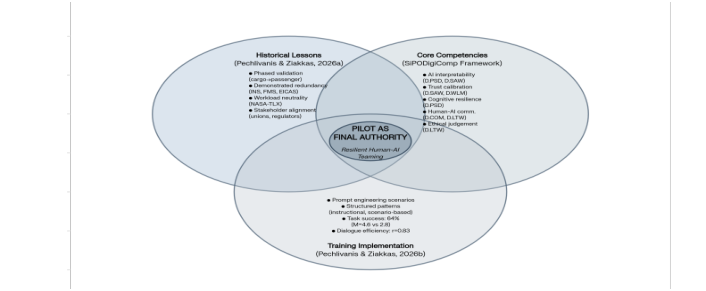
This technological constellation represents the latest phase in aviation’s century-long evolutionary de-crewing trajectory—from five-person crews (radio operator, navigator, flight engineer, captain, co-pilot) to today’s two-pilot standard (Pechlivanis & Ziakkas, 2026a). Historical transitions succeeded through phased adoption, demonstrated redundancy (e.g., INS, FMS, EICAS/ECAM), and socio-technical alignment among regulators, unions, and operators (Pechlivanis & Ziakkas, 2026a). SiPO’s defining shift replaces human social redundancy with algorithmic redundancy, requiring not just technological maturity but human-centred interaction paradigms to preserve cognitive resilience and error management (Helmreich & Foushee, 2010; Reason, 1997). Crucially, onboard AI copilots are increasingly designed to perform functional substitutions, such as cross-checking flight path management, monitoring automation modes, and flagging inconsistencies between aircraft state and pilot intent. Table 1 summarises core SiPO technological functions and their associated human factors implications. The following analysis synthesises human factors theory, interaction models, and socio-technical perspectives.
Table 1: SiPO AI functions and human factors implications.
Table available in the original PDF paper.
AI Function Operational Role in SiPO Human Factors Implications Adaptive automation Dynamic task redistribution Risk of mode confusion and skill erosion
Predictive analytics Anomaly and risk forecasting
Trust calibration and interpretability challenges
AI copilot monitoring Cross-checking and error detection
Shift from social to algorithmic redundancy
Natural-language interfaces
Intent communication Cognitive load reduction vs. ambiguity risk
Ground-based AI support
Remote supervision and assistance
Authority gradients and responsibility allocation Operationalising these functions demands new pilot competencies beyond traditional CRM and procedural skills. Prompt engineering—the structured formulation of intents, constraints, and context for GenAI/LLM assistants— emerges as a critical interaction skill for natural-language interfaces and AI copilots (Pechlivanis & Ziakkas, 2026b). Empirical testing across SiPO- relevant scenarios (fuel-critical diversion, comms loss, turbulence) showed structured prompts systematically improved task success (M = 4.6 vs. 2.8), dialogue efficiency, and perceived decision support, while correlating with higher trust and acceptance (Pechlivanis & Ziakkas, 2026b). This competency bridges abstract HF challenges (trust calibration, interpretability) to measurable cockpit behaviours.
Implementation of Human–AI Teaming in the Single Pilot Operations Era 47 While these technologies promise enhanced situational awareness and workload buffering, they simultaneously introduce new failure modes. AI opacity, brittle decision logic, and data-driven biases can undermine pilot confidence and lead to inappropriate reliance or rejection of system recommendations (Parasuraman & Riley, 1997; Endsley, 2017). These human factors challenges frame the integrative methodology presented below, which triangulates cognitive theory, interaction models, and socio-technical analysis to derive SiPO-specific training and design imperatives.
FINDINGS The most critical challenge in SiPO implementation lies in the loss of social redundancy, a cornerstone of aviation safety philosophy. In multi-crew operations, pilots continuously calibrate each other’s mental models, detect subtle performance drift, and provide emotional and cognitive regulation under stress (Salas et al., 2015). AI systems, by contrast, lack intrinsic contextual understanding and moral agency, requiring explicit design interventions to approximate these functions.
Prompt engineering provides the operational mechanism for achieving this transparency. Pilots must structure natural-language inputs (e.g., “Guide me through fuel-critical diversion to nearest alternate with deteriorating weather”) to elicit interpretable, contextually-appropriate AI responses (Pechlivanis & Ziakkas, 2026b). Empirical testing across SiPO scenarios showed structured prompts improved task success (M = 4.6 vs 2.8 unstructured), dialogue efficiency, and decision support ratings, directly addressing trust calibration through measurable interaction quality (Pechlivanis & Ziakkas, 2026b).
Explainable AI (XAI) is therefore not a supplementary feature but a prerequisite for SiPO viability. Pilots must be able to interrogate AI recommendations, understand underlying assumptions, and anticipate system behaviour under degraded conditions. Without this capability, human–AI teams risk becoming brittle, particularly in non-nominal and ambiguous scenarios where procedural guidance is insufficient.
Existing pilot training paradigms remain predominantly procedural and system-centric, reflecting assumptions of stable automation behaviour and shared human cognition. SiPO demands a shift toward interaction-centred training, focusing on how pilots and AI systems jointly perceive, reason, and act.
Key training objectives include:
Development of shared situational awareness with AI agents
Conflict resolution strategies between human judgement and algorithmic
output
Recognition of AI performance limits and degradation cues
Maintenance of manual and cognitive skills under reduced social feedback These scenarios must incorporate prompt engineering drills using validated patterns (instructional, scenario-based, problem-solution) proven effective in
These emerging competency domains necessitate fundamental training and assessment redesign, as explored below.
DISCUSSION
The transition toward Single Pilot Operations fundamentally challenges the adequacy of existing pilot training paradigms. Traditional multi-crew training frameworks, including Crew Resource Management (CRM), Evidence-Based Training (EBT), and Competency-Based Training and Assessment (CBTA),
Implementation of Human–AI Teaming in the Single Pilot Operations Era 49 are predicated on assumptions of distributed human cognition, social redundancy, and interpersonal cross-monitoring. In SiPO environments, these assumptions no longer hold. The replacement of a second human pilot with an AI-enabled teammate necessitates a reconceptualisation of training objectives, competency definitions, and assessment strategies.
The SiPODigiComp framework provides a concrete operationalisation, mapping Human–AI teaming competencies onto observable behaviours across Professional Standards & Discipline (D.PSD), Situational Awareness (D.SAW), Communication (D.COM), Leadership of the Team (D.LTW), and Workload Management (D.WLM) (Pechlivanis & Ziakkas, 2026b). Prompt engineering—structuring inputs for AI copilots using validated patterns (instructional, scenario-based, problem-solution)—directly develops D.COM and D.LTW while supporting D.SAW through interpretable outputs (Pechlivanis & Ziakkas, 2026b).
A central issue concerns the mismatch between procedural training and adaptive operational demands. Decades of human factors research demonstrate that procedural compliance alone is insufficient for managing complex, adaptive, and partially opaque systems (Reason, 1997; Ziakkas, 2020). In highly automated cockpits, pilots are increasingly required to engage in sensemaking, system interrogation, and supervisory control rather than direct manipulation. This shift is amplified in SiPO contexts, where the absence of a human copilot removes an essential cognitive buffer against fixation, confirmation bias, and unnoticed performance drift (Ziakkas, 2019; Pechlivanis & Henneberry, 2021).
From a training perspective, this raises critical questions regarding what constitutes expertise in human–AI teaming. Rather than mastery of procedures or system modes, SiPO pilots must demonstrate adaptive expertise: the ability to interpret AI behaviour, recognise system boundaries, and reconfigure strategies under uncertainty. Research on automation- intensive domains consistently shows that operators trained only in nominal system behaviour are poorly prepared for degraded or ambiguous states, precisely when human intervention becomes most safety-critical (Endsley, 2017; Ziakkas et al., 2021). Explainability emerges as a cornerstone of SiPO training. While explainable AI (XAI) is often discussed as a system design feature, its effectiveness is inseparable from training. Pilots must learn not only how to receive explanations, but how to question, contextualise, and challenge algorithmic recommendations. Without this capability, AI systems risk becoming authoritative yet poorly understood actors, fostering either automation complacency or systematic distrust (Lee & See, 2004; Ziakkas & Plioutsias, 2020). Training programmes must therefore explicitly address AI logic, confidence indicators, uncertainty communication, and failure modes as core learning objectives rather than ancillary knowledge.
This translates to scenario-based training incorporating prompt engineering drills: pilots practice one-shot queries like “Compare descent vs. endurance for moderate turbulence at FL350” and evaluate AI outputs for accuracy, relevance, and actionability—skills empirically validated to improve dialogue
Equation reproduced from the original PDF.
Scenario-based simulation plays a particularly critical role in this context. Evidence from both aviation and other safety-critical domains indicates that exposure to non-nominal, ill-defined, and contradictory scenarios is essential for preserving adaptive expertise under automation (Salas et al., 2015; Pechlivanis, 2022). For SiPO, this implies training scenarios in which AI systems provide incomplete, delayed, or conflicting recommendations, requiring pilots to resolve human–AI disagreement under time pressure. Such scenarios not only develop technical competence but also reinforce the pilot’s role as the final authority and moral agent within the system.
Historical decrewing phases (e.g., flight engineer→automation) preserved resilience through phased workload validation and union-supported retraining; SiPO demands equivalent safeguards, starting with cargo/low- complexity routes before passenger ops (Pechlivanis & Ziakkas, 2026a).
Another underexplored dimension concerns cognitive and psychological resilience. The removal of interpersonal interaction from the cockpit alters not only task execution but also emotional regulation, workload perception, and stress management. Studies on single-operator environments suggest increased vulnerability to fatigue, attentional narrowing, and degraded decision-making under sustained cognitive load (Ziakkas, 2019). Training must therefore incorporate strategies for self-monitoring, workload pacing, and recovery, recognising that AI support cannot fully substitute for human social feedback.
Assessment practices must evolve accordingly. Conventional check-based evaluations are poorly suited to capturing skills such as trust calibration, sensemaking, and ethical judgement. Instead, assessment frameworks should focus on process-oriented indicators, including how pilots interrogate AI outputs, manage uncertainty, and transition between automated and manual control. Key metrics include dialogue efficiency, transaction cost (cognitive/ time load of AI interaction), and structured prompt effectiveness—directly measurable from SiPO scenario performance (Pechlivanis & Ziakkas, 2026b). This aligns with emerging critiques of overly reductionist competency models in automation-heavy environments (Pechlivanis & Ziakkas, 2024).
Finally, the discussion highlights a broader organisational implication: training cannot be decoupled from system design and regulatory intent. Introducing AI-enabled teammates without correspondingly adapting training risks creating brittle human–AI relationships that perform well in demonstrations but degrade under operational stress. A human-centred training philosophy, grounded in human factors science and aligned with system transparency, is therefore a prerequisite for safe SiPO implementation rather than a downstream consideration.
SiPO training must evolve from “how much automation can a pilot manage” to “how humans and AI teammates jointly adapt under uncertainty,” operationalised through SiPODigiComp-mapped competencies, prompt engineering proficiency, and phased validation mirroring successful historical decrewing (Pechlivanis & Ziakkas, 2026a, 2026b). Success hinges less on AI sophistication than preserving pilot adaptive expertise, authority, and resilience. The following conclusions synthesise these implications into
Implementation of Human–AI Teaming in the Single Pilot Operations Era 51 actionable design, training, and regulatory imperatives for resilient SiPO implementation.
CONCLUSION
The transition toward Single Pilot Operations represents a fundamental reconfiguration of aviation as a socio-technical system, rather than a simple reduction in crew size. This continues aviation’s century-long evolutionary de-crewing trajectory—from five-person crews to two-pilot operations— where each successful phase required phased validation, demonstrated redundancy, and stakeholder alignment (Pechlivanis & Ziakkas, 2026a). This paper has argued that the feasibility and safety of SiPO depend not primarily on the maturity of individual technologies, but on the quality of human–AI teaming embedded within operational, training, and regulatory frameworks. As AI systems increasingly assume functions traditionally performed by a second human pilot, the nature of cockpit cooperation, authority, and responsibility is profoundly altered.
This analysis synthesises three complementary perspectives: historical decrewing patterns establishing implementation imperatives (Pechlivanis & Ziakkas, 2026a); empirical validation of prompt engineering as a core Human–AI interaction competency (Pechlivanis & Ziakkas, 2026b); and a human-centred framework mapping SiPO competencies to observable SiPODigiComp behaviours for training and assessment. The analysis demonstrates that replacing social redundancy with algorithmic support introduces new cognitive and organisational vulnerabilities. While AI-enabled systems can enhance monitoring, prediction, and workload management, they also reshape pilot cognition, trust relationships, and error management strategies. Without careful human-centred design, these systems risk fostering brittle human–AI interactions characterised by inappropriate reliance, reduced situational awareness, and diminished adaptive capacity during non-nominal operations.
The proposed interaction-centred training—featuring scenario-based prompt engineering drills and SiPODigiComp-mapped competencies— directly addresses these vulnerabilities, with empirical evidence showing structured prompts improve task success by 64% and decision support under operational stress (Pechlivanis & Ziakkas, 2026b). A central conclusion of this paper is that human–AI teaming in SiPO contexts must be treated as a design problem grounded in human factors science. Explainability, transparency, and cognitive compatibility are not optional features but foundational safety requirements. Equally, training systems must evolve beyond procedural proficiency toward the development of adaptive expertise, trust calibration, and resilience in the absence of interpersonal cockpit support. Scenario- based, interaction-centred training emerges as a critical enabler for preserving meaningful human authority in automation-intensive environments.
From a regulatory and organisational perspective, the findings underscore the need for coherent frameworks that explicitly address responsibility allocation, competency standards, and Just Culture principles in AI-mediated operations. Historical decrewing succeeded through gradual implementation
(cargo→passenger routes) and demonstrated workload neutrality via systematic validation—imperatives equally critical for SiPO certification (Pechlivanis & Ziakkas, 2026a). Regulatory uncertainty and fragmented certification approaches risk undermining both safety assurance and public trust. A harmonised, human-centred regulatory philosophy is therefore essential to guide the gradual and responsible introduction of SiPO concepts.
SiPO success will be determined not by AI replacing pilots, but by aviation systems supporting human judgement through: (1) human-centred design preserving cognitive resilience; (2) SiPODigiComp-guided training operationalising prompt engineering proficiency; and (3) phased regulatory validation mirroring proven decrewing strategies. The pilot remains the final authority; AI the resilient teammate (Pechlivanis & Ziakkas, 2026a, 2026b).
ACKNOWLEDGMENT
The authors thank Technical University - Coventry University - Purdue University – Hellenic Air Force Academy faculty members, and HF Horizons analysts for their invaluable feedback, which contributed to this work.
REFERENCES
Billings, C. E. (1997). Aviation automation: The search for a human-centered approach. Lawrence Erlbaum Associates. Dekker, S. (2014). Just culture: Balancing safety and accountability (2nd ed.).
Ashgate. EASA. (2023). Concepts of operations for extended minimum crew operations.
European Union Aviation Safety Agency. Endsley, M. R. (2017). From here to autonomy: Lessons learned from human–automation research. Human Factors, 59(1), 5–27. https://doi. org/10.1177/0018720816681350 FAA. (2022). Single pilot operations research roadmap. Federal Aviation
Administration. Helmreich, R. L., & Foushee, H. C. (2010). Why crew resource management?
Empirical and theoretical bases of human factors training. In E. Salas, R. L. Bowers, & E. Edens (Eds.), Crew resource management (pp. 3–45). Academic Press. Hollnagel, E. (2014). Safety-I and Safety-II: The past and future of safety management.
Ashgate. Lee, J. D., & See, K. A. (2004). Trust in automation: Designing for appropriate reliance. Human Factors, 46(1), 50–80. https://doi.org/10.1518/ hfes.46.1.50_30392 Parasuraman, R., & Riley, V. (1997). Humans and automation: Use,
misuse, disuse, abuse. Human Factors, 39(2), 230–253. https://doi. org/10.1518/001872097778543886 Pechlivanis, K. (2022). Competency-based training challenges in next-generation aviation operations. In Proceedings of the AHFE International Conference on Human Factors in Transportation. Springer. Pechlivanis, K., & Henneberry, D. (2021). Human performance implications
of reduced-crew and single-pilot operations. In Proceedings of the AHFE International Conference on Human Factors in Transportation. Springer.
Implementation of Human–AI Teaming in the Single Pilot Operations Era 53 Pechlivanis, K., & Ziakkas, D. (2024). Human–AI teaming competencies for
advanced and autonomous aviation systems. Human–Intelligent Systems Integration. https://doi.org/10.1007/s42454-024-000XX-X Pechlivanis, K., & Ziakkas, D. (2026a). The evolutionary de-crewing of airline cockpits: a historical and analytical perspective. Theoretical Issues in Ergonomics Science, 1–24. https://doi.org/10.1080/1463922X.2025.2610278 Pechlivanis, K. & Ziakkas, D. (2026b). Prompt engineering in generative AI
applications for commercial single pilot operations (SiPO): An emerging competency, Journal of Air Transport Management, Volume 131, 102916, ISSN 0969-6997, https://doi.org/10.1016/j.jairtraman.2025.102916. Reason, J. (1997). Managing the risks of organizational accidents. Ashgate. Salas, E., Sims, D. E., & Burke, C. S. (2015). Is there a “Big Five” in teamwork? Small Group Research, 36(5), 555–599. https://doi.org/10.1177/1046496405277134 Wickens, C. D., Hollands, J. G., Banbury, S., & Parasuraman, R. (2022). Engineering
psychology and human performance (5th ed.). Routledge. Ziakkas, D. (2019). Cognitive resilience and error management in highly automated aviation environments. Aviation Psychology and Applied Human Factors, 9(2), 85–94. https://doi.org/10.1027/2192-0923/a000153 Ziakkas, D. (2020). Training for adaptive expertise in complex socio-technical
systems. Human Factors and Ergonomics in Manufacturing & Service Industries, 30(4), 245–256. https://doi.org/10.1002/hfm.20825 Ziakkas, D., & Plioutsias, A. (2020). Trust calibration in safety-critical human–AI systems. Ergonomics, 63(6), 746–759. https://doi.org/10.1080/00140139.2019.1 705301 Ziakkas, D., & Vink, L. S. (2023). Human-centred integration of intelligent systems
in transportation domains. Human–Intelligent Systems Integration, 5(1), 1–14. https://doi.org/10.1007/s42454-023-000XX-X Ziakkas, D., Plioutsias, A., & Keller, J. (2021). Human factors training in automationintensive operational domains. In Proceedings of the AHFE International Conference on Human Factors in Transportation. Springer.
LISTED IN THE AHFE DIGITAL BOOKSTORE CATALOGUE
Explore the complete digital volume
Advances in Human Factors of Transportation
Read this individual research paper free through the original publisher, or explore the full digital proceedings book.
ISBN 979-8-950676-00-0
Explore this ISBN in the AHFE Bookstore ↗Listed in the July 2026 bookstore catalogue; search by ISBN to confirm current availability · Digital book purchase optional