Juanjuan June He, Koya Chen (2024). Crafting Improved Vision: A Comprehensive Evaluation of Products Supporting Individuals with Vision Challenges. In: Design for Inclusion. AHFE Open Access, vol. 128, pp. 120–128. https://doi.org/10.54941/ahfe1004797
Eyewear serves as a crucial aid in enhancing vision for a diverse range of users. Yet, finding devices tailored for individuals with specific vision challenges related to aging, such as glaucoma, macular degeneration, and Diabetic Retinopathy, proves challenging in standard optical stores. This article conducts a systematic review of available products in the market designed to enhance vision for those facing the mentioned visual impairments. The study's conclusion provides valuable insights into enhancing vision care for both patients and clinical practitioners, along with an overview of the products accessible in the market.
Addressing the prevalence of vision-related challenges is of utmost concern, particularly among aging populations grappling with conditions like glau- coma, macular degeneration, cataract, and diabetic retinopathy (Lemmens et al., 2020; Wang et al., 2000). This article, backed by a comprehensive lit- erature review, delves into various dimensions of this issue, underscoring the significance of addressing these prevalent vision problems.
As individuals age, the indispensable faculties of vision and hearing, crucial for daily functioning, often undergo impairment (Ivers et al., 1998). Notably, various medical conditions common in older age, including cardiovascular disease and diabetes, are associated with vision impairment and an increased risk of mortality, suggesting vision impairment may be a marker for mortality just like preexisting health conditions (Knudtson et al., 2006). Beyond the direct consequences of these health conditions, the decline in vision not only results from existing health issues but also contributes to a decline in the overall quality of life and health due to injuries caused by falls (Welp et al., 2016; Chia et al., 2004; Kulmala et al., 2008).
Crafting Improved Vision: A Comprehensive Evaluation of Products Supporting Individuals 121
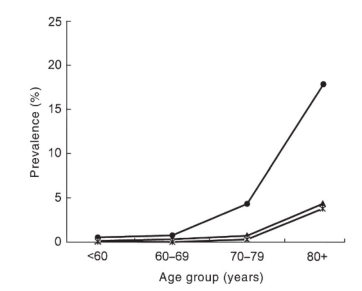
Figure 1: “Prevalence of bilateral visual impairment by age.” “•, Mild; ▲, moderate; ∗, severe.”
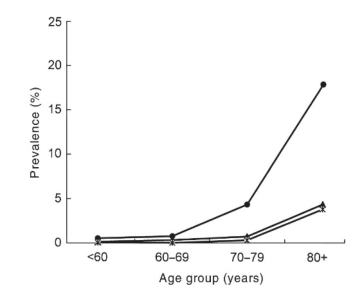
Note. Figure 1 and Figure 2 show that visual impairment increases signif- icantly in the population above 60 years old. From “Age-specific prevalence and causes of bilateral and unilateral visual impairment in older Aus- tralians: the Blue Mountains Eye Study,” by Wang, J. J., Foran, S., & Mitchell, P., 2000, Clinical & experimental ophthalmology, 28(4), 268–273. https://doi.org/10.1046/j.1442-9071.2000.00315.x.
Figure 2: “Prevalence of unilateral visual impairment by age.” “•, Mild; ▲, moderate; ∗, severe.”
The use of single-vision eyeglasses emerges as a prevalent solution for the older community (Haran et al., 2009), which underscores the need for a more in-depth examination of the effectiveness of assistive eyewear design, specif- ically in the older population. As implied in controlled environments such as the workspace, careful consideration in the quality of eyewear contributes to better productivity and safety for an aging population grappling with vision problems (Birch, 2013).
This paper aims to highlight the interconnectedness and multifaceted nature of vision-related challenges while analysing the strategies employed
122 He
by the current eyewear and wearable market that addresses vision-impacted health conditions and quality of life pertinent to older adults.
LITERATURE REVIEW
“Globally, it is estimated that at least 2.2 billion people have a vision impair- ment” (World Health Organization [WHO], 2022, p. 1). According to the Centers for Disease Control and Prevention (CDC, 2023), by 2050, Amer- icans aged 40 and above with vision impairment will reach 8.96 million, more than double of 4.2 million in 2012, due to the growing prevalence of diabetes and other chronic illnesses, alongside the aging demographic of the United States. The conditions of glaucoma, macular disease, corneal opaci- ties, and diabetic retinopathy are the main reasons for older adults to have vision impairment and blindness; vision rehabilitation interventions can help them to better cope with the difficulties in daily living by utilizing tools including assistive products, adjusted environment, and relevant trainings (WHO, 2022, p. 41). However, they are not easily accessible by majority of the population.
In World Health Organization’s 2022 publication Package of eye care inter- ventions (PECI, p. 42–43), it introduces a variety of vision rehabilitation interventions for older people: optical assistive products include filters, mag- nifiers, and telescopes; non-optical assistive products include “braille books and writers, reading stands, lamps, high contrast items such as bold pens or high-contrast toys, or talking/tactile watches”; electronic assistive products include “digital magnifiers, audiobooks, smartphones, tablets, computers, braille displays, and application and accessibility software”. Here we focus mostly on the review of various assistive products. There are other interven- tions in terms of designing for living space, training for mobility and vision skills, we will not cover that in this paper.
EXISTING PRODUCTS REVIEW A landscape literature review was conducted to study existing research and development of eyewear products and medical devices that support older individuals with vision challenges. Based on the research outcome, we have split the solutions into two categories: tangible assistive devices and digital products for smartphones or tablets.
Tangible Assistive Devices
Table 1 examines a variety of low-vision assistive devices that help improve the vision of older users with visual impairments. First, from the function- ality standpoint, most devices focus on elevating the users’ experiences by providing these services: a. Magnification to various degrees b. Optical Character Recognition (OCR) / Text-to-Speech c. Voice Commands d. Adjust Contrast e. Flashlight f. AI assistant
Crafting Improved Vision: A Comprehensive Evaluation of Products Supporting Individuals 123
Second, in terms of design, most of the devices look bulky and heavy, limit- ing scenarios for potential users to wear them daily, except for NuEyes PRO 3e Smart Glasses, only 68g/2.4 oz, but need to be paired with a Samsung Galaxy tablet to work together. All the devices offer the colors of black or grey. They often have the appearance of typical medical devices, which can potentially contribute to stigma for those who wear them in a public setting.
Third, the price range of these product solutions varies from $1,990 to $4,250. However, the lower-priced option at $1,990 lacks key functions such as Voice Commands and AI Assistant. Nonetheless, these prices present significant challenges for middle-class older adults in terms of affordability.
Table 1. Existing low vision assistive devices to help improve the conditions of vision impairment for older adults.
-Software -Pair with Samsung Galaxy Active Tab 3 + NuEyes PRO 3e Smart- glasses
Digital Products
Table 2 lists assorted digital products including various apps on smartphones and tablets. Based on analysis, they share similar functionality in these areas: a. OCR/Text-to-Speech b. Describe/recognize images c. Magnification d. Human identifier e. Object identifier
As you can see, digital products share certain similar functionalities with assistive devices, including OCR/Text-to-Speech, magnification, and AI assis- tants. The biggest advantage of digital solutions is that most of the apps are free and easy to install. They also do not add any extra weight to users’ faces. The only requirement for the user is to have a smartphone or tablet. Accord- ing to the testing conducted with these apps, they are easy to use. This ease of use stems from their focus on targeting specific tasks, rather than attempting to handle multiple functions simultaneously like traditional assistive devices while dealing with fitting issues.
Table 2. Existing digital products to help improve the conditions of vision impairment for older adults.
Table available in the original PDF paper.
Functionality Design Price Source
Name Improve Condition
Free www.bemyeyes.com/
Be My Eyes
-APP for smartphone
Blind and Low Vision
-Connect with volunteers -Connect with the company representatives -AI image describer -AI assistant -185 languages
Free www.seeingai.com/ -APP for smartphone
Seeing AI Blind and Low Vision
-OCR/Text-to-Speech including handwriting -Scan product info -Recognize people -Recognize currency notes -Describe scenes -AR audio of the environment -Indoor navigation -Identify colors -Describe images
(Continued)
Crafting Improved Vision: A Comprehensive Evaluation of Products Supporting Individuals 125
BigMagnify Low Vision -Magnify at 1x, 2x, 4x and 8x zoom levels -Magnify using both front and back cameras -APP for smartphone
Free https: //taptapseeapp.com/
TapTapSee Blind and visually impaired
-Recognize pictures -Identify objects in everyday life -Free audio books from local libraries -APP for smartphone
Free https://www.overdr ive.com/apps/libby
Libby Blind and visually impaired
PRODUCT ANALYSIS After examining all these solutions designed for individuals with vary- ing degrees of vision impairment, several noteworthy insights emerge that warrant discussion.
Fitting For the low-vision assistive devices, NuEyes e3+ Smartglasses provide adjust- ments for pupil distance, which is great for diverse users with various facial measurements. It can also “adjust the diopters on each lens to optimize focus and go glasses-free” (NuEyes, n.d.), adding to the convenience that users are spared the need to wear prescription glasses underneath the device. Most of the other devices have limited abilities to adjust. That is not ideal for diverse users.
Affordability According to the research findings, most assistive devices are priced beyond the reach of regular consumers, highlighting a significant gap in accessibility for these solutions to reach the mass market. Consequently, this presents a missed opportunity for designers and engineers to explore and address.
Fashion Eyewear is at the intersection of medical devices and fashion accessories. Users use eyewear as a statement and expression in their everyday lives. Designing for older adults and people with vision impairments does not mean that they must endure a lack of variety in styles and choices. Additionally, it’s important that these devices do not contribute to stigma, implying that indi- viduals are not independent without using them. How we can inject these design elements into medical devices is something worth exploring.
Business Model Selective devices are covered fully or partially by certain insurance compa- nies. For example, VSP offers coverage for IrisVision’s select plans (IrisVision, 2022). Veterans can be fully covered by the Veterans Administration for
126 He
multiple product offerings including IrisVision and NuEyes (NuEyes, n.d.). However, most of them are not covered by regular insurance plans, making it users’ responsibility to pay for the device.
DIRECTIONS FOR FUTURE DESIGN Turbert and Gudgel (2021) from the American Academy of Ophthalmology suggested these three techniques to improve people with low vision: “improve lighting”, “reduce glare”, and “increase contrast”, as well as using vision aids like magnifying devices, audible solutions, tactile labels, and more. The solutions listed in Tables 1 and 2 for older users with vision impairments are not exhaustive, but they provide a general overview of the current market offerings. When comparing the literature review with existing product review, there are several gaps for designers to tap into:
1. Existing products’ high pricing and users’ low affordability. 2. High demand from users with vision impairment and limited accessibility for vision rehabilitation resources. 3. Simple solutions to assist vision problems and complicated product offerings on the market.
Based on the analysis from this paper, we concluded several directions for future design consideration: a. Design simpler products with affordable pricing so more users could access them. b. Include critical functions informed by WHO’s handbook Package of eye care interventions (PECI). Refer to the literature review section of this paper. c. Co-design with users with vision impairment because each individual’s needs are unique based on their specific diagnostic. d. Consider technological components like artificial intelligence and assis- tive robotics.
CONCLUSION
Research shows strong evidence that improving eye health can reduce poverty, increase productivity, enhance physical and mental health, as well as achieve equality and independence (Burton et al., 2021). The world pop- ulation is shifting to an aging society, with the population age 65 or older being the fastest growing age group (United Nations, 2020), designers have a responsibility to assist older adults in achieving independence and maintain- ing dignity in their later years. Today, we invite product designers to explore the opportunities to create better-fitting low-vision assistive solutions with relatively reasonable pricing. We hope more older users can benefit from the innovations in this field.
REFERENCES
A Viable Solution to Battle with the Effects of Vision Loss. (2023, Feb.10). Retrieved from IrisVision’s websites in 2024: https://irisvision.com/vision-loss/.
Crafting Improved Vision: A Comprehensive Evaluation of Products Supporting Individuals 127
Acesight & Acesight S: Acesight S is the simplified version of Acesight. (n.d.).
Retrieved from Acesight’s website in 2024: https://www.acesight.com/acesight-ac esight-s/. Birch, D. (2013, March). A prescription for success: aging eyes need access to Rx safety eyewear. Industrial Safety & Hygiene News, 47(3), 44+. https://link-gale-com.ezproxy2.library.drexel.edu/apps/doc/A342769737/ ITOF?u=drexel_main&sid=bookmark-ITOF&xid=cf6ad79f Burton, M. J., Ramke, J., Marques, A. P., Bourne, R. R. A., Congdon, N., Jones, I., Ah Tong, B. A. M., Arunga, S., Bachani, D., Bascaran, C., Bastawrous, A., Blanchet, K., Braithwaite, T., Buchan, J. C., Cairns, J., Cama, A., Chagunda, M., Chuluunkhuu, C., Cooper, A., Crofts-Lawrence, J., … Faal, H. B. (2021). The Lancet Global Health Commission on Global Eye Health: vision beyond 2020. The Lancet. Global health, 9(4), e489–e551. https://doi.org/10.1016/S2214-109X (20)30488-5 Centers for Disease Control and Prevention. (2023). Fast facts of common eye disor-
ders. Vision Health Initiative (VHI). https://www.cdc.gov/visionhealth/basics/ced/ fastfacts.htm Cheng, D. (2010, September 25). BigMagnify. Apple App Store. https://apps.apple.c om/us/app/bigmagnify/id393247466 Chia, E. M., Wang, J. J., Rochtchina, E., Smith, W., Cumming, R. R., & Mitchell, P.
(2004). Impact of bilateral visual impairment on health-related quality of life: the Blue Mountains Eye Study. Investigative ophthalmology & visual science, 45(1), 71–76. https://doi.org/10.1167/iovs.03-0661 Cloudsight Inc. (2012, October 11). Taptapsee. Apple App Store. https://apps.apple .com/us/app/taptapsee/id567635020 Empowering your vision. (n.d.). Retrieved in 2024 from NuEyes’s websites: https:
//www.nueyes.com/e3, https://www.nueyes.com/nuvision-tebletedition, and https: //www.nueyes.com/financing. Haran, M. J., Lord, S. R., Cameron, I. D., Ivers, R. Q., Simpson, J. M., Lee, B.
B., Porwal, M., Kwan, M. M., & Severino, C. (2009). Preventing falls in older multifocal glasses wearers by providing single-lens distance glasses: the protocol for the Visible randomised controlled trial. BMC geriatrics, 9, 10. https://doi.org/ 10.1186/1471-2318-9-10 Ivers, R. Q., Cumming, R. G., Mitchell, P., & Attebo, K. (1998). Visual impairment and falls in older adults: the Blue Mountains Eye Study. Journal of the American Geriatrics Society, 46(1), 58–64. https://doi.org/10.1111/j.1532– 5415.1998.tb01014.x Knudtson, M. D., Klein, B. E., & Klein, R. (2006). Age-related eye disease, visual
impairment, and survival: the Beaver Dam Eye Study. Archives of ophthalmology (Chicago, Ill. : 1960), 124(2), 243–249. https://doi.org/10.1001/archopht.124.2. 243 Kulmala, J., Era, P., Pärssinen, O., Sakari, R., Sipilä, S., Rantanen, T., & Heikkinen, E. (2008). Lowered vision as a risk factor for injurious accidents in older people. Aging clinical and experimental research, 20(1), 25–30. https://doi.org/10.1007/ BF03324744 Lemmens, S., Barbosa Breda, J., Van Keer, K., Jacobs, T., Van Landeghem, R.,
De Boever, P., & Stalmans, I. (2020). The prevalence of undiagnosed age- related sight-threatening diseases in self-proclaimed healthy individuals. Journal of Ophthalmology. https://www.hindawi.com/journals/joph/2020/3709793/
128 He
Microsoft Corporation. (2017, July 12). Seeing AI. Apple App Store. https://apps.apple.com/us/app/seeing-ai/id999062298?ign-itscg=30200&ign- itsct=apps_box_badge National Academies of Sciences, Engineering, and Medicine; Health and Medicine Division; Board on Population Health and Public Health Practice; Committee on Public Health Approaches to Reduce Vision Impairment and Promote Eye Health; Welp A, Woodbury RB, McCoy MA, et al., editors. Making Eye Health a Population Health Imperative: Vision for Tomorrow. Washington (DC): National Academies Press (US); 2016 Sep 15. 3, The Impact of Vision Loss. Available from: https://www.ncbi.nlm.nih.gov/books/NBK402367/. OrCam MyEye - The Ultimate Visual Aid Device for visual impairment. (2024,
February 15). Retrieved from OrCam’s website: https://www.orcam.com/en-us/ orcam-myeye. OrCam Read 3: Advanced reading aid for visual impairments. (2024, February 15).
Retrieved from OrCam’s website: https://www.orcam.com/en-us/orcam-read-3. Plans and pricing. (2022, April 25). Retrieved from IrisVision’s website in 2024: https://irisvision.com/faq/plans-and-pricing/. See the world together. (n.d.). Retrieved from Be My Eyes website in 2024: https:
//www.bemyeyes.com/ Shifting demographics. (2020). United Nations. https://www.un.org/en/un75/shifti ng-demographics#:~:text=Older%20persons%20(ages%2065%20and,world’s %20fastest%20growing%20age%20group. Turbert, D., & Gudgel, D. (2021). Low vision assistive devices. American Academy
of Ophthalmology. https://www.aao.org/eye-health/diseases/low-vision-assistive -devices. United Nations. (2019). Ageing. Retrieved from United Nations Website: https://ww w.un.org/en/global-issues/ageing. Wang, J. J., Foran, S., & Mitchell, P. (2000). Age-specific prevalence and causes
of bilateral and unilateral visual impairment in older Australians: the Blue Mountains Eye Study. Clinical & experimental ophthalmology, 28(4), 268–273. https://doi.org/10.1046/j.1442–9071.2000.00315.x World Health Organization (Ed.). (2022). Package of eye care interventions. World Health Organization. https://www.who.int/publications/i/item/9789240048959
LISTED IN THE AHFE DIGITAL BOOKSTORE CATALOGUE
Explore the complete digital volume
Design for Inclusion
Read this individual research paper free through the original publisher, or explore the full digital proceedings book.
ISBN 978-1-964867-04-5
Explore this ISBN in the AHFE Bookstore ↗Listed in the July 2026 bookstore catalogue; search by ISBN to confirm current availability · Digital book purchase optional