Yi-Ying Lin, Jen-Suh Chern, Wanyin chen (2026). Factors associated with the objective outcomes of Electric Pallet Truck Interventions for Aging Workers. In: Human Factors in Aging and Special Needs. AHFE Open Access, vol. 214, pp. 45–54. https://doi.org/10.54941/ahfe1007572
Electric pallet trucks (EPTs) are commonly subsidized as job accommodation measures to reduce physical workload associated with material-handling tasks among aging workers. This retrospective study examined perceived post-intervention outcomes among 91 workers aged 45 years and older who received EPT subsidies through a government-funded job accommodation program in Taiwan. Perceived outcomes were assessed three months after implementation using a six-item self-reported scale capturing problem-solving effectiveness, productivity, work autonomy, work quality, comfort/safety, and ease of use.Fixed-effects regression analyses revealed item-specific associations between worker characteristics and perceived outcomes. Increasing age was negatively associated with perceived improvement in problem-solving effectiveness. Educational level showed differentiated associations across outcome domains, with lower educational attainment associated with greater perceived improvement in problem-solving effectiveness but lower perceived gains in productivity and work quality, while higher educational attainment was positively associated with perceived improvement in work autonomy. Manufacturing industrial workers reported significantly greater perceived improvements in productivity and work quality than workers in other job categories.Partial least squares structural equation modeling further demonstrated that perceived intervention effectiveness played a central role in linking EPT-based job accommodation to perceived improvements in work performance, whereas perceived usability did not show a significant direct association with intervention effectiveness. Overall, these findings indicate that the perceived benefits of EPT interventions are item-specific and strongly shaped by worker characteristics, job roles, and task contexts, underscoring the importance of aligning assistive-device provision with essential job demands rather than adopting uniform job accommodation approaches for aging workers.
Work-related musculoskeletal disorders (WMSDs) remain one of the most common occupational health problems worldwide, and are strongly linked to cumulative physical exposures at work, including repetitive movements,
forceful exertions, awkward and sustained postures, and manual material handling (Vieira and Kumar, 2004; Govaerts et al., 2021). Evidence from Europe’s secondary industries in the 21st century indicates that WMSDs are highly prevalent, with substantial proportions of workers reporting musculoskeletal symptoms over a 12-month period, underscoring a persistent burden in manufacturing and related sectors (Govaerts et al., 2021). Complementing this, ergonomics research and workplace assessments have repeatedly shown that the occurrence and perceived severity of musculoskeletal discomfort also depend on exposure duration, which collectively shapes risk accumulation over time (Vieira and Kumar, 2004; Govaerts et al., 2021). Musculoskeletal health has been recognized as a key prerequisite for healthy aging at work, and age-related functional and biological changes may reduce physical capacity and recovery, thereby increasing vulnerability to WMSDs, and threatening the sustainable work ability of middle-aged and older workers (Okunribido et al., 2010; Skamagki et al., 2022). Empirical findings further suggest that musculoskeletal symptoms can be meaningfully connected to work ability, especially in middle-aged groups, highlighting the importance of preventive strategies that support continued employment (Nawrocka et al., 2019).
High-risk work patterns for WMSDs commonly involve tasks with frequent trunk flexion and rotation, heavy or frequent lifting, and prolonged static or constrained postures (Vieira and Kumar, 2004; Tahernejad et al., 2024). For example, warehouse operations rely more on manual handling and may entail more time spent in extreme trunk posture (e.g., trunk flexion >75°) during lifting activities, whereas even highly mechanized systems can still expose workers to poor postures (e.g., rotation or lateral flexion) driven by equipment use and layout of the object to be moved or handled; this evidence emphasizes that mechanization alone does not guarantee lower biomechanical risk if ergonomic design is insufficient (Braam et al., 1996; Chowdhury et al., 2018; Vieira and Kumar, 2004). Accordingly, prevention should follow the hierarchy of controls—prioritizing engineering and work-design solutions to reduce exposure at the source, complemented by administrative measures and worker-focused programs (e.g., training, physical activity promotion) when appropriate (Silverstein and Clark, 2004).
The Manual (Hydraulic) Pallet Truck (MPT), a work assistive device frequently used in occupations that involve warehouse management, has been shown to reduce the repetitive physical strain on the body from manual lifting and carrying (Braam et al., 1996), and therefore reduces risk of WMSD in the back, knees and upper limbs when moving multiple loads. The Electric Pallet Truck (EPT) is equipped with a motor, and the required push/pull force for the driver is near zero. Therefore, it is reasonable to hypothesize that workers using EPTs may experience better work performance. Subsidies for such workplace assistive devices are an important current policy of our country’s labor authority in response to workforce aging. The primary objective of this policy is to maintain workers’ musculoskeletal health in the workplace, thereby building a sustainable and resilient workforce. This policy has been implemented for many years and requires robust empirical research evidence to support its continued promotion, evaluation, and ongoing refinement.
Factors Associated With the Objective Outcomes of Electric Pallet Truck 47 The purpose of this study was therefore to examine the objective perception of the use of EPTs of workers aged over 45 years working in traditional industries (de Looze et al., 2015; Yin et al., 2021).
METHOD
A total of 91 workers (54 males and 37 females), aged 45–74 years, with 5 to 440 months of experience in their current positions, were included in this study. Those participants were randomly sampled from the administrative database of a government-funded Job Accommodation Program (JAP) implemented under the Middle-Aged and Elderly Employment Promotion Act in Taiwan. The JAP Project provides subsidies for workplace assistive devices aimed at helping middle-aged and older workers overcome work- related barriers and maintain labor participation. All the participants in this study applied only for EPT subsidies to reduce horizontal load moving, decrease manual pushing and pulling demands during pallet transport, and lessen exposure to awkward or sustained postures associated with using MPTs (see Fig. 1).
Figure 1: Workplace material-handling tasks before and after the implementation of electric pallet trucks (EPTs).
Figure available in the original PDF paper.
The sampled workers were employed in labor-intensive jobs in manufacturing and other related secondary industries. Their primary job demands frequently involved manual material handling, particularly horizontal material or merchandise transport and trunk or pallet moving tasks, with reported handled load weights ranging from 20 to 2,000 kg, as well as other physically demanding activities. Employers of the included workers applied for JA subsidies through local employment service centers in accordance with the enforcement procedures of the national JAP. Details of participant characteristics are presented in Table 1.
Following the submission of employer applications, individualized workplace assessments were conducted by qualified human factors and ergonomics professionals. These assessments focused on identifying task- specific barriers, high-load subtasks, and physical workload risk factors, including high force exertion, frequent pushing and pulling, prolonged awkward postures, and cumulative exposure during material transport
tasks. Based on the assessment findings and the specific job demands at each workplace, a tailored accommodation plan was proposed and reviewed for subsidy approval. The expenses incurred for the purchase of assistive devices shall be reimbursed upon submission of valid receipts by the employer to the regional branch of the Workforce Development Agency having jurisdiction over the company’s location of registration.
Effectiveness of the JAP was evaluated three months after implementation of the assistive device, using an official structured self-report questionnaire to capture users’ perceived experiences of usefulness. The questionnaire consists of six items which are rated on a 0–100 scale, with higher scores indicating better perceived effectiveness of the assistive-device intervention. The scale consisted of three dimensions: (1) Effectiveness, assessing the extent to which the device solved work-related problems and improved work output quality; (2) Work Performance, assessing perceived changes in efficiency or productivity and autonomy at work; and (3) Usability and Safety, assessing perceived improvements in safety during work or device use and the convenience or ease of use of the device. Each dimension comprised two items (Table 2). However, given the exploratory purpose of the study, individual items were also examined separately during analysis, and their contribution to subsequent modelling was determined empirically.
Given the applied and exploratory nature of the study, and the lack of established measurement models for job accommodation outcomes in this context, the dimensional structure of the scale was not assumed to be fixed a priori. Instead, the relationships among perceived outcomes were further examined during data analysis, allowing for potential differentiation between dimensions that may represent distinct aspects of workers’ post-intervention experiences.
Descriptive statistics were first used to summarize perceived post- intervention outcomes. To explore factors associated with perceived improvements, fixed-effects regression models were applied to examine within-individual variation in perceived outcomes while controlling for key covariates, including age, gender, education level, job tenure, and job category. Statistical significance was set at p < 0.05.
Job categories were recoded based on the primary nature of work tasks and exposure characteristics relevant to the study outcomes. Detailed job titles were consolidated into three task-oriented job categories based on National Job Caregorical Criteria: Technical Professionals (TP), Manufacturing Industrials (MI), and Administrative Support (AS).
Supervisory and managerial roles were not retained as a separate analytical category. Although the number of supervisory participants was not negligible, these roles encompassed highly heterogeneous task compositions, ranging from frontline production involvement to predominantly managerial and coordinative functions. As the present study focused on task-level workload and exposure-related outcomes, supervisory roles were considered conceptually distinct from frontline job categories and therefore excluded from the final job category variable to preserve analytical coherence and interpretability.
Factors Associated With the Objective Outcomes of Electric Pallet Truck 49 In addition to regression analyses, partial least squares structural equation modeling (PLS-SEM) was employed to examine the structural relationships among perceived usability, intervention effectiveness, and work performance (Hair et al., 2019). This approach was selected to explore how different dimensions of perceived post-intervention outcomes were related to one another, rather than to identify demographic predictors. PLS-SEM was considered appropriate given the exploratory nature of the study, the use of subjective outcome measures, and the relatively small sample size. Bootstrapping with 5,000 resamples was used to assess the stability and significance of path coefficients (Hair et al., 2019).
Table 1: Participant characteristics.
Table available in the original PDF paper.
Category Count Gender
Male 54 Female 37
Age(yrs) 45~50 29
50~55 25 55~60 21
60~65 13 65~70 2
70~75 1 Education level
Primary school 10 Junior high school 11
Senior high school 53 College or university 16
Graduate school or above 1 Job tenure(yrs)
<5 23 5~9 25
10~14 10 15~19 12
20~29 11 ≥30 10
Job category Technical professionals(TP) 33
Manufacturing
33
industrials(MI) Administrative support(AS) 5
Supervisory/Managerial role 20 Total 91
Table 2: Items of each dimension of self-report questionnaire.
Table available in the original PDF paper.
Dimension Item
Item2: Problem-solving effectiveness Extent to which the intervention effectively solved work-related problems
Effectiveness
Item8: Work quality Extent to which the intervention improved work output quality Item5: Productivity Extent to which work efficiency or productivity improved after the intervention
Work Performance
Item7: Work autonomy Extent to which work autonomy improved after the intervention Item3: Comfort and safety Perceived improvement in safety during work or device use
Usability and Safety
Item4: Ease of use Perceived convenience or ease of use after the intervention Note: Item 1 and Item 6 were excluded in this analysis because they assess the applicant’s perception of administrative procedure but not the benefits of the implementation of EPTs themselves.
RESULTS
Fixed-effects regression analyses revealed item-specific associations between participant characteristics and perceived post-intervention outcomes.
For problem-solving effectiveness (Item 2), age was significantly negatively associated with perceived improvement (β = −0.39, p < .01), indicating that older workers reported lower levels of perceived problem resolution following the intervention. In addition, lower educational attainment was significantly associated with greater perceived improvement in problem-solving effectiveness (β = 12.16, p < .05). Regarding productivity (Item 5), lower educational attainment was significantly associated with lower perceived productivity improvement (β = −35.06, p < .05). Moreover, workers in manufacturing industrial (MI) roles reported significantly greater perceived productivity gains than workers in other job categories (β = 17.75, p < .01). For work autonomy (Item 7), higher educational attainment was significantly associated with greater perceived improvement in autonomy (β = 42.04, p < .01), suggesting that workers with higher levels of education experienced larger perceived gains in work autonomy following the intervention. With respect to work quality (Item 8), lower educational attainment was significantly associated with lower perceived improvement in work output quality (β = 27.24, p < .05). In addition, MI workers reported significantly greater perceived improvements in work quality than non-MI workers (β = 19.80, p < .01).
In contrast, no statistically significant associations were observed between worker characteristics and perceived improvements in comfort and safety (Item 3) or ease of use (Item 4), suggesting that perceived gains in safety,
Factors Associated With the Objective Outcomes of Electric Pallet Truck 51 comfort, and usability were relatively consistent across workers with different demographic and job-related backgrounds.
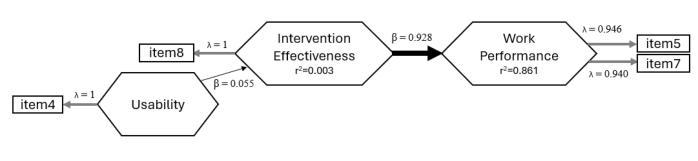
To further examine how perceived post-intervention outcomes were structurally related, partial least squares structural equation modeling (PLS- SEM) with 5,000 bootstrap resamples was conducted (see Fig. 2). During model evaluation, items assessing problem-solving effectiveness (Item 2) and safety during work or device use (Item 3) exhibited minimal variance and weak associations with other indicators, consistent with the observed ceiling effects. These items were therefore not retained as central indicators in the final structural model. The results indicated that perceived usability did not significantly predict perceived intervention effectiveness (Figure 2, β = 0.055, t = 0.641, 95% CI [−0.106, 0.229]), explaining only a negligible proportion of variance in intervention effectiveness (r² = 0.003).
The results further showed that perceived intervention effectiveness, primarily reflected by improvements in work output quality, showed a strong and statistically significant positive association with work performance outcomes, including productivity and autonomy (Figure 2, β = 0.928, t = 39.049, 95% CI [0.877, 0.969]), accounting for a substantial proportion of variance in work performance (r² = 0.861).
Figure 2: PLS-SEM of perceived usability, intervention effectiveness, and work performance.
These findings suggest that while problem-solving ( Item 2 in Effectiveness dimension) and safety improvements (Item 3 in Usability dimension) were widely reported and appeared to function as baseline conditions, these two items were not able to translate EPTs intervention into work performance or intervention effectiveness. Only workers’ overall perception of intervention effectiveness measure by Item 8 that played a central role in translating job accommodation into perceived improvements in work performance.
DISCUSSION
From the perspective of the hierarchy of controls, the EPT-based job accommodation examined in this study represents an engineering control and a work-design intervention, as it directly modifies the physical demands of material-handling tasks rather than relying on administrative measures or individual behavior change (Silverstein and Clark, 2004). By motorizing horizontal load transport, EPTs substantially reduce pushing and pulling force demands at the source of biomechanical exposure. This approach is consistent with established ergonomic recommendations that prioritize engineering and task redesign strategies for preventing work-related
musculoskeletal disorders, particularly among aging workers who may experience reduced physical capacity and slower recovery (Vieira and Kumar, 2004; Okunribido et al., 2010). Beyond this conceptual positioning, the fixed-effects regression analyses provide nuanced insight into for whom EPT-based job accommodation is most likely to be perceived as beneficial, and which aspects of work are most affected. Age was negatively associated with perceived problem-solving effectiveness, suggesting that older workers reported smaller incremental improvements following EPT implementation. One plausible explanation is that workers with longer exposure to physically demanding tasks may have already developed compensatory strategies or task adaptations over time, thereby reducing the perceived marginal benefit of a single assistive device. Prior research has similarly indicated that cumulative exposure and age-related functional changes shape how ergonomic interventions are experienced and evaluated by middle-aged and older workers (Vieira and Kumar, 2004; Okunribido et al., 2010).
Educational level showed differentiated, item-specific associations with perceived outcomes, underscoring the importance of distinguishing between functional domains rather than treating “effectiveness” as a unitary construct. Lower educational attainment was associated with greater perceived improvements in problem-solving effectiveness, whereas it was also associated with lower perceived gains in productivity and work quality. In contrast, higher educational attainment was positively associated with perceived improvements in work autonomy. These findings suggest that EPTs may more directly address task-level operational barriers for workers engaged in routine material transport, while workers with higher educational backgrounds—who may perform more complex, decision-oriented, or self- directed tasks—experience benefits primarily in terms of autonomy rather than output-related outcomes. Similar task-dependent differentiation in ergonomic intervention effects has been reported in studies of manual material handling and production systems, where reductions in physical load yield the greatest benefits for workers whose primary duties involve repetitive transport and physically demanding postures (Braam et al., 1996; Silverstein and Clark, 2004).
Job category further moderated perceived outcomes. Manufacturing industrial (MI) workers reported significantly greater perceived improvements in productivity and work quality than non-MI workers, suggesting that the effectiveness of EPT-based accommodation depends strongly on whether the intervention directly targets the worker’s primary exposure source. This finding aligns with prior ergonomic research emphasizing that engineering controls are most effective when they are closely aligned with essential job functions and dominant biomechanical risk factors (Vieira and Kumar, 2004; Govaerts et al., 2021). In contrast, for workers whose roles involve more heterogeneous task compositions, the impact of a single assistive device may be diluted.
The PLS-SEM results complement the fixed-effects findings by clarifying how workers’ perceptions are structured. Items assessing problem-solving effectiveness and safety exhibited minimal variance and were excluded from the final model, consistent with pronounced ceiling effects. Such ceiling
Factors Associated With the Objective Outcomes of Electric Pallet Truck 53 effects in self-report ergonomic intervention outcomes—particularly for safety- and comfort-related items—have been widely documented and may limit the explanatory power of structural models (Silverstein and Clark, 2004; Govaerts et al., 2021). Consequently, perceived usability did not significantly predict perceived intervention effectiveness, suggesting that once basic usability and safety requirements are satisfied, these attributes no longer differentiate workers’ evaluations of intervention success. Similar patterns have been observed in studies of assistive technologies and industrial exoskeletons, where perceived effectiveness is more strongly driven by task relevance and performance impact than by usability alone (de Looze et al., 2015). Taken together, the convergence of fixed-effects and PLS-SEM analyses indicates that perceived intervention effectiveness serves as the key mechanism linking EPT-based job accommodation to improvements in work performance, while the magnitude and nature of these perceived benefits are shaped by worker characteristics, job roles, and task context. These findings highlight that effective job accommodation requires not only provision of assistive devices, but also careful consideration of task composition, exposure patterns, and worker profiles to ensure alignment between intervention design and actual work demands (Silverstein and Clark, 2004; Vieira and Kumar, 2004).
Several limitations should be considered when interpreting these findings. Outcomes were assessed using a post-intervention self-report scale without baseline measurement, limiting causal inference and increasing susceptibility to expectancy or recall bias. In addition, the questionnaire items have not undergone formal psychometric validation, which may introduce measurement error and limit comparability across studies. Furthermore, many participants performed multiple job tasks, and EPT use may not have constituted their primary activity, potentially attenuating observable effects. Future studies should employ pre–post designs with validated outcome measures, objective exposure indicators, and detailed assessments of task composition and device utilization frequency to clarify the conditions under which EPT-based job accommodation most effectively supports sustainable employment among aging workers (Govaerts et al., 2021).
CONCLUSION
Subsidized EPT interventions within job accommodation programs may provide meaningful short-term benefits for aging workers performing high- load material handling, supporting the role of assistive devices as feasible engineering controls in settings with substantial WMSD burden. Effective adoption should be paired with task analysis, workflow and posture optimization, and safe management of powered equipment to maximize benefits and minimize biomechanical and incident risks. These findings align with Taiwan’s job accommodation framework promoting workplace improvements, equipment modification, and employment aids. However, conclusions remain provisional, as outcomes were measured only post- intervention using a scale without established reliability, highlighting the need for validated measures, baseline data, and longitudinal follow-up to confirm effects on WMSD symptoms and sustainable employment.
ACKNOWLEDGMENT
We would like to express our deepest gratitude to the Taoyuan–Hsinchu– Miaoli Branch of the Workforce Development Agency, Ministry of Labor (Taiwan), for their support in coordinating the job accommodation program.
REFERENCES
Braam, I.T.J., van Dormolen, M. and Frings-Dresen, M.H.W. (1996) ‘The work load of warehouse workers in three different working systems’, International Journal of Industrial Ergonomics, 17(6), pp. 469–480. Chowdhury, N., Aghazadeh, F. and Amini, M. (2018) ‘Ergonomic assessment of
working postures for the design of university computer workstations’, Work, 59(4), pp. 465–474. de Looze, M.P., Bosch, T., Krause, F., Stadler, K.S. and O’Sullivan, L.W. (2015) ‘Exoskeletons for industrial application and their potential effects on physical work load’, Ergonomics. doi:10.1080/00140139.2015.1081988. Govaerts, R. et al. (2021) ‘Prevalence and incidence of work-related musculoskeletal
disorders in secondary industries of 21st century Europe: A systematic review and meta-analysis’, BMC Musculoskeletal Disorders, 22, 751. Hair, J.F., Risher, J.J., Sarstedt, M. and Ringle, C.M. (2019) ‘When to use and how to report the results of PLS-SEM’, European Business Review, 31(1), pp. 2–24. Nawrocka, A. et al. (2019) ‘Association between objectively measured physical
activity and musculoskeletal disorders and perceived work ability among adult, middle-aged and older women’, Clinical Interventions in Aging, 14, pp. 1975–1983. doi:10.2147/CIA.S204196. Okunribido, O.O., Wynn, T. and Lewis, D. (2010) ‘Are older workers at greater risk of musculoskeletal disorders in the workplace than young workers? A literature review’, Occupational Ergonomics, 9(1), pp. 1–12. doi:10.3233/OER-2010-0192. Silverstein, B. and Clark, R. (2004) ‘Interventions to reduce work-related
musculoskeletal disorders’, Journal of Electromyography and Kinesiology, 14(1), pp. 135–152. doi:10.1016/j.jelekin.2003.09.023. Skamagki, G., Carpenter, C., King, A. and Wåhlin, C. (2022) ‘Management of chronic musculoskeletal disorders in the workplace from the perspective of older employees: A mixed methods research study’, International Journal of Environmental Research and Public Health, 19(15), 9348. doi:10.3390/ ijerph19159348. Tahernejad, S. et al. (2024) ‘Musculoskeletal disorders among truck drivers: A
systematic review and meta-analysis’, BMC Public Health, 24, 3146. Vieira, E.R. and Kumar, S. (2004) ‘Working postures: A literature review’, Journal of Occupational Rehabilitation, 14(2), pp. 143–159. Workforce Development Agency, Ministry of Labor, Taiwan (2024) ‘Job
Accommodation for People with Disabilities’. Available at: https://www.wda.gov. tw/en/cp.aspx?n=239 (Accessed: 25 January 2026). Yin, P., Yang, L. and Qu, S. (2021) ‘Development of an ergonomic wearable robotic device for assisting manual workers’, International Journal of Advanced Robotic Systems, 18. doi:10.1177/17298814211046745.
LISTED IN THE AHFE DIGITAL BOOKSTORE CATALOGUE
Explore the complete digital volume
Human Factors in Aging and Special Needs
Read this individual research paper free through the original publisher, or explore the full digital proceedings book.
ISBN 978-1-964867-90-8
Explore this ISBN in the AHFE Bookstore ↗Listed in the July 2026 bookstore catalogue; search by ISBN to confirm current availability · Digital book purchase optional