Sejal Shah, Jeff Feng (2026). Designing for Therapy: An Ergonomic Hand Orthosis that Enhances Functional Recovery. In: Healthcare and Medical Devices. AHFE Open Access, vol. 211, pp. 179–184. https://doi.org/10.54941/ahfe1007480
This project presents the design and development of an ergonomic, user-centered hand, wrist, and finger orthosis to support rehabilitation in pediatric users and stroke patients with neurological impairments. Conditions such as stroke and pediatric motor disorders are often associated with altered muscle tone, spasticity, and impaired neuromuscular control, limiting voluntary hand opening, extension, and functional grasp. These patients frequently exhibit flexor dominance and reduced active extension, making reach, release, and object manipulation challenging. There is a growing need for pediatric-specific orthotic solutions that address differences in hand anatomy, growth, activity patterns, and therapy engagement. The project began with a review of literature on neurological spasticity, pediatric rehabilitation, and existing orthotic devices, supplemented by discussions with therapists to understand functional limitations, positioning requirements, and safety considerations. Key design requirements included ergonomic alignment, adjustability, lightweight construction, comfort, and ease of application. Multiple concepts were developed through sketching and CAD modeling to ensure anatomical alignment of the wrist and metacarpophalangeal joints. Prototypes were fabricated using lightweight, skin-friendly materials and evaluated for fit, comfort, and range-of-motion support. The final design provides controlled extension assistance to counter flexor dominance while enabling functional grasp and release. Iterative refinement improved strap placement, joint mechanics, and structural stability, resulting in a prototype that demonstrates improved positioning, adjustability for growth, and enhanced comfort for rehabilitation use.
Neurological impairments such as stroke and pediatric motor disorders often result in altered muscle tone, spasticity, and impaired neuromuscular control, limiting voluntary hand opening, extension, and functional grasp. Pediatric patients present unique challenges due to hand size, growth, and therapy engagement patterns. While existing rehabilitation orthoses provide positioning and movement support, they are typically designed for adults and may not fully meet pediatric needs in terms of proper sizing and accurate mechanical movements (Imms et al., 2023).
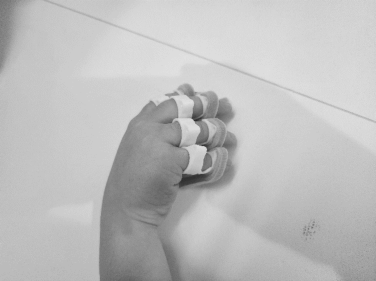
Figure 1: Fingers in a flexed posture of a child’s hand, demonstrating spasticity and reduced voluntary extension.
This study aims to design a pediatric-specific, ergonomic hand orthosis that supports functional recovery, muscle tone management, and active participation in therapeutic and daily activities. The orthosis integrates an extension-assist mechanism to facilitate controlled finger and wrist extension and promote normalized movement patterns during functional tasks, addressing the challenges illustrated in Fig. 1, where a child’s fingers are held in a flexed posture due to spasticity and reduced voluntary extension. By developing a user-centered design tailored for pediatric users, this work seeks to fill gaps in pediatric-focused orthotic solutions.
LITERATURE REVIEW
Existing orthotic solutions for neurological hand impairments vary in design, target population, and clinical impact. In adult stroke rehabilitation, dynamic and wearable hand orthoses have demonstrated improvements in range of motion, task performance, and daily activity engagement by assisting grasp (Jiang et al., 2017). Extension functions in affected hands like grip glove showed statistically significant improvements in finger extension, grip force, and manipulation tasks in stroke survivors with severe hand impairment, though users requested smaller glove sizes for better fit and usability (Fardipour and Hadadi, 2022). Recent randomized controlled trials have also shown that incorporating wearable orthoses into self-directed training can enhance upper limb motor recovery, balance, and activities of daily living post-stroke compared to standard therapy alone (Xu et al., 2025).
In pediatric populations, evidence for orthotic interventions remains limited and mixed. Systematic reviews of hand splints in children with cerebral palsy show only modest benefits for upper limb skills, and sustained effects often diminish once devices are removed (Jackman, Novak, and Lannin, 2014). A large randomized controlled trial investigating rigid wrist- hand orthosis use in children with cerebral palsy found some improvement in passive wrist extension, but long-term impact and comfort concerns highlight challenges with conventional orthotic designs (Imms et al., 2023). Case studies of customized 3D-printed wrist-hand orthoses demonstrate
Designing for Therapy: An Ergonomic Hand Orthosis That Enhances Functional Recovery 181 functional improvements in grasp tasks and better comfort and aesthetic fit for individual pediatric users (Schmitz et al., 2019). Additionally, research shows that orthoses designed to provide wrist extension and thumb abduction can improve range of motion, muscle strength, and manual ability in children with cerebral palsy (Barroso et al., 2011). A recent biomechanical device developed for pediatric spastic hand rehabilitation also suggests feasibility and safety while improving active range of motion in small pediatric cohorts, though further validation is needed (ValleOñate et al., 2025).
Although hand orthoses can help with rehabilitation, there are very few designs made just for children that are comfortable, lightweight, adjustable for growing hands, and help them use their hands better.
OBJECTIVE The design objectives for this pediatric hand orthosis were developed through close collaboration with children, their caregivers, and clinicians. They guide the design to ensure the device is not only effective for rehabilitation but also practical and comfortable for everyday use
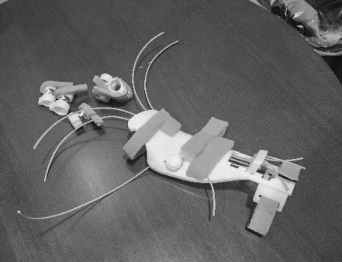
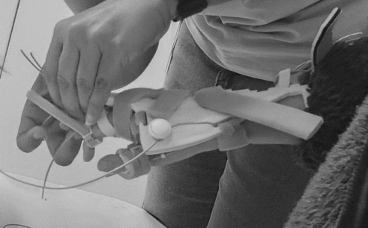
Comfortable and Adjustable Fit The orthosis should fit each child’s hand securely and comfortably, taking into account hand size, shape, and growth. A good fit helps prevent pressure points, skin irritation, and discomfort, which can improve compliance and daily use. Fig. 2 and Fig. 3 show a 3D-printed pediatric hand orthosis designed for comfort and support. The top finger section is adjusted to securely hold rings, improving fit and durability while reducing wear and tear on the plastic material.
Lightweight and Appealing The orthosis should be lightweight, breathable, and visually appealing to encourage long-term use. A positive appearance can improve acceptance, especially in children, and reduce social or emotional barriers to wearing it.
Figure 2: A 3D-printed pediatric hand orthosis designed for comfort and support.Figure 3: The figure shows a hand orthosis designed for quick application, secure strap adjustment, and support Support Natural Hand Movements
The device should guide proper hand and finger movements, including wrist and thumb positions, while reducing excessive flexor tightness. This helps children practice functional tasks and supports therapy goals without forcing unnatural movement.
Easy to Use Children and caregivers should be able to put on and take off the device easily, with minimal effort. Simple, child-friendly mechanisms allow the orthosis to fit into daily routines like play, school, or therapy without frustration.
These objectives served as a framework for design decisions, prototype development, and testing. They will be refined based on iterative feedback from users and therapists during the ongoing development process.
STUDY This study focused on designing a pediatric hand orthosis for rehabilitation that is comfortable, lightweight, and easy for children to use while providing the right support for wrist and finger movement. The orthosis includes controlled extension assistance, joints that allow functional grasp and release, and straps that can be easily adjusted for a secure fit (Ledoux, Kumar, and Barth, 2024).
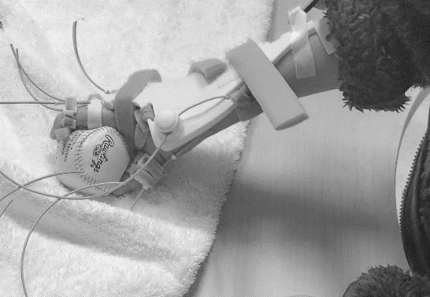
We followed an iterative, user-centered design approach. Early ideas were developed through sketches and CAD models to make sure the hand and wrist joints were aligned properly. Initial prototypes were made from PLA, which allowed us to quickly test and refine the design. The final orthosis was made from PETG, giving it strength while keeping it lightweight and making the device easy to put on. Areas that touch the skin are lined with medical-grade Velfoam padding, and plastic fasteners were used to make adjustments to TPU strings. The Fig. 4 shows a child using the hand orthosis during physical therapy, with caregiver assistance to slip it on and adjust the straps, while maintaining natural hand posture and enabling effective therapeutic exercises.
Figure 4: The child is shown using the hand orthosis during physical.
The orthosis was tested with the children during a variety of rehabilitation activities aimed at improving hand function. These activities included grasping and releasing objects of different shapes and sizes, picking up small items, performing simulated feeding tasks and stacking blocks reflecting activity-of- daily-living–focused hand rehabilitation approaches (Nathan, Johnson, and McGuire n.d.). Each activity was designed to encourage active movement while supporting the hand in safe, functional positions. Feedback from therapists, caregivers, and the children themselves guided improvements to fit, comfort, and movement support.
The most recent prototype successfully allowed children to engage in these exercises with greater ease. It improved hand positioning, active range of motion, and functional use of the fingers and wrist. The child was able to participate more actively in their therapy, which increased engagement and motivation, while the therapist could more effectively focus on skill development rather than struggling with poorly fitting or uncomfortable devices.
DISCUSSION
This study presents the ongoing development of a pediatric ergonomic hand orthosis using a human-centered design approach. The orthosis is designed to support proper muscle tone, manage spasticity, and facilitate functional hand movements, while remaining comfortable, lightweight, and easy for children and caregivers to use. Preliminary testing showed that children were able to perform tasks such as picking up objects and playing with improved hand positioning, demonstrating that the device helps control excessive flexor spasticity and promotes more natural hand opening, grasp, and wrist alignment. Feedback from therapists and caregivers indicates that the orthosis will potentially support participation in therapeutic exercises and daily activities, enhancing engagement and adherence. The project is ongoing, with future work focusing on refining thumb articulation, optimizing wrist and finger support, and conducting structured assessments of muscle tone, spasticity, and functional hand performance. By addressing spasticity and movement limitations in the hand and wrist, this orthosis aims to provide a practical, pediatric-focused solution that improves rehabilitation outcomes and encourages consistent, long-term use.
REFERENCES
Barroso, P. N., S. D. Vecchio, Y. R. Xavier, M. Sesselmann, P. A. Araújo, and M.
Pinotti. 2011. “Improvement of Hand Function in Children with Cerebral Palsy via an Orthosis That Provides Wrist Extension and Thumb Abduction.” Clinical Biomechanics 26 (9): 937–943. Fardipour, S., and M. Hadadi. 2022. “Investigation of Therapeutic Effects of Wearable Robotic Gloves on Improving Hand Function in Stroke Patients: A Systematic Review.” Current Journal of Neurology 21 (2): 125–132. https://doi. org/10.18502/cjn.v21i2.10496. Imms, C., M. Wallen, C. Elliott, B. Hoare, S. Greaves, M. Randall, and F. Orsini.
2023. “Implications of Providing Wrist-Hand Orthoses for Children with Cerebral Palsy: Evidence from a Randomised Controlled Trial.” Disability and Rehabilitation45(12):2046–2056. https://doi.org/10.1080/09638288.2022.2079734 Jackman, M., I. Novak, and N. Lannin. 2014. “Effectiveness of Hand Splints in Children with Cerebral Palsy: A Systematic Review with Meta-Analysis.” Developmental Medicine & Child Neurology 56 (2): 138–147. https://doi. org/10.1111/dmcn.12205 Jiang, Yongkang, Diansheng Chen, Jiacheng Que, Zhe Liu, Ziqi Wang, and Ying
Xu. 2017. “Soft Robotic Glove for Hand Rehabilitation Based on a Novel Fabrication Method.” In Proceedings of the 2017 IEEE International Conference on Robotics and Biomimetics (ROBIO), 817–822. IEEE. https://doi.org/10.1109/ ROBIO.2017.8324518 Ledoux, E. D., N. S. Kumar, and E. J. Barth. “Design, Modeling, and Preliminary Evaluation of a Simple Wrist–Hand Stretching Orthosis for Neurologically Impaired Patients.” 2024. Nathan, D. E., M. J. Johnson, and J. R. McGuire. “Design and Validation of Low
Cost Assistive Glove for Hand Assessment and Therapy during Activity of Daily Living Focused Robotic Stroke Therapy.” n.d. Schmitz, C., Y. T. Mori, H. R. Gamba, P. Nohama, and M. Abreu de Souza. “Development and Evaluation of a Customized Wrist–Hand Orthosis Using 3D Technology for a Child with Cerebral Palsy: A Case Study.” Annual International Conference of the IEEE Engineering in Medicine and Biology Society, 1476–1479. 2019. Xu, Lijuan, Jie Zhang, Qiang Liu, Yefan Cao, Nazhakaiti Aizezi, Jing Tian, Cheng
Wu, et al. 2025. “Effects of a Wearable Hand Orthosis on Upper and Lower Limb Motor Recovery in Stroke Patients: A Randomized Controlled Trial.” Frontiers in Bioengineering and Biotechnology 13 (May). https://doi.org/10.3389/ fbioe.2025.1600706
LISTED IN THE AHFE DIGITAL BOOKSTORE CATALOGUE
Explore the complete digital volume
Healthcare and Medical Devices
Read this individual research paper free through the original publisher, or explore the full digital proceedings book.
ISBN 978-1-964867-87-8
Explore this ISBN in the AHFE Bookstore ↗Listed in the July 2026 bookstore catalogue; search by ISBN to confirm current availability · Digital book purchase optional