Pengda Lu, Wenjing Yang (2026). Advances in Intelligent Rehabilitation Systems for Chronic Nonspecific Low Back Pain. In: Healthcare and Medical Devices. AHFE Open Access, vol. 211, pp. 329–338. https://doi.org/10.54941/ahfe1007496
Low back pain (LBP) is one of the most prevalent musculoskeletal disorders worldwide, and over 85% of chronic cases are classified as chronic nonspecific low back pain (CNSLBP). Traditional rehabilitation approaches, such as medication, physical therapy, and self-managed exercise, often face challenges like poor adherence and limited feedback. With advances in wearable sensors, virtual reality (VR), artificial intelligence (AI), and tele-rehabilitation, intelligent rehabilitation systems are emerging as innovative home-based solutions. Following the Preferred Reporting Items for Systematic Reviews and Meta-Analyses (PRISMA) framework, this review analyzes studies on CNSLBP rehabilitation systems published between 2016 and 2025. It identifies the critical components, smart technologies, and design characteristics of the CNSLBP rehabilitation systems, while highlighting their effectiveness in improving user engagement. Current limitations include fragmented system integration, inadequate user experience design, and weak behavioral intervention mechanisms. Future development should emphasize standardized digital therapeutics, multimodal personalization, and user-centered interdisciplinary collaboration to enhance the clinical efficacy and quality of life for patients.
Low back pain (LBP) is a major public health challenge, with a lifetime prevalence of up to 80% and substantial effects on disability and work participation worldwide (Nijs et al., 2024). When symptoms persist for at least three months, they may progress to chronic low back pain; more than 85% of these cases are classified as chronic nonspecific low back pain (CNSLBP), because no specific pathology can be identified (Balague et al., 2012). Although medication, physical therapy, education, and home exercise remain common strategies, traditional pathways often depend on face-to- face supervision or self-directed exercise, resulting in poor adherence, limited feedback, and inconsistent movement execution (Maher et al., 2017; Tuckson et al., 2017).
Recent advances in wearable sensors, mobile health, virtual reality (VR), artificial intelligence (AI), and tele-rehabilitation have created new Received May 22, 2026; Revised June 3, 2026; Accepted June 17, 2026; Available online July 20, 2026
330 Lu and Yang opportunities for adaptive, interactive, and home-based rehabilitation systems (Fatoye et al., 2020; Shi et al., 2024). These systems can monitor exercise performance, provide real-time or asynchronous feedback, and support personalized training based on individual movement patterns. Evidence suggests that mobile tele-rehabilitation can deliver exercise programs remotely, VR-based rehabilitation can improve engagement and functional outcomes, and AI-assisted programs may outperform conventional video- guided exercise in some contexts (Dario et al., 2017; Garcia et al., 2022).
However, current studies remain heterogeneous in system structure, feedback mechanisms, and outcome measurement. Many focus on single technologies or short-term efficacy, while design-oriented issues such as user experience, behavioral motivation, usability, and long-term engagement remain insufficiently explored (Berger et al., 2024; Hurmuz et al., 2025). This review therefore examines intelligent rehabilitation systems for CNSLBP from a holistic and design-oriented perspective.
Specifically, the review compares wearable devices, mHealth interventions, immersive rehabilitation experiences, and AI-assisted systems to identify research trends and gaps in system integration, user experience assessment, and behavior-change support.
MATERIALS AND METHODS
This study follows the PRISMA (Preferred Reporting Items for Systematic Reviews and Meta-Analyses) guidelines to conduct a systematic review of intelligent rehabilitation systems for CNSLBP. Studies published between October 2016 and October 2025 were retrieved, screened, evaluated, and synthesized to summarize system structures, key technological applications, and research progress, thereby providing a theoretical foundation for future system development.
Web of Science, Scopus, and IEEE Xplore were searched using combinations of keywords related to CNSLBP, intelligent rehabilitation systems, wearable devices, mobile health applications, VR, AI/machine learning, and system design. The final keyword categories are shown in Table 1.
Table 1: Search keywords used in the literature search.
Table available in the original PDF paper.
Category Strings Condition “chronic nonspecific low back pain” OR “nonspecific low back pain” OR “CNSLBP” OR “NSLBP” OR “chronic low back pain”
Technological Applications
“artificial intelligence” OR “machine learning” OR “computer vision” OR “IMU sensors” OR “motion tracking” OR “real-time feedback” OR “gamification” OR “adaptive training” System Type “intelligent rehabilitation system” OR “digital health system” OR “mHealth” OR “wearable device” OR “mobile app” OR “VR/AR platform”
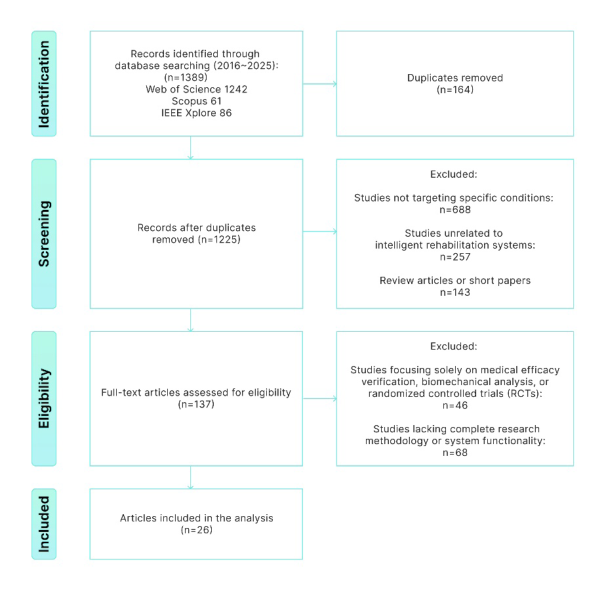
(1) Literature Search: Based on the keywords in Table 1, a systematic search was conducted in established databases for studies published from
Advances in Intelligent Rehabilitation Systems 331 2016 to 2025. A total of 1,389 records were retrieved. After removing 164 duplicates, 1,225 records remained for screening.
(2) Screening: Titles and abstracts were screened. Records unrelated to CNSLBP (n = 688), unrelated to intelligent rehabilitation systems (n = 257), and reviews or short communications (n = 143) were excluded, leaving 137 full-text articles for eligibility assessment.
(3) Eligibility Assessment: Full texts were assessed with an emphasis on system design and technological application, including system composition, user experience, wearable devices, mobile applications, VR, and AI in rehabilitation architecture. Studies primarily focused on clinical efficacy, biomechanical analysis, or randomized controlled trials were excluded (n = 46), as were studies lacking complete methodological or system descriptions (n = 68). Finally, 26 studies were included in the qualitative analysis.
Figure 1: PRISMA (Preferred reporting items for systematic reviews and Meta- analyses) flow diagram of the study selection process.
RESULTS
The reviewed literature shows a clear shift in intelligent rehabilitation systems for CNSLBP from single-function monitoring tools toward multimodal, closed-loop systems. Earlier studies mainly emphasized exercise monitoring and pain assessment with wearable devices, while recent studies increasingly
332 Lu and Yang integrate AI, VR, and mHealth platforms to support assessment, intervention, feedback, and personalized self-management. This trend reflects broader interest in digital health, home-based rehabilitation, and user-centered approaches.
Earlier studies often focused on physical therapy and pain assessment, using electrical stimulation, thermotherapy, cryotherapy, accelerometers, gyroscopes, or sEMG to quantify posture, activity, and pain-related status (Alfikri et al., 2025). More recent work combines AI, VR, and mHealth into dynamic systems that link data collection, movement analysis, feedback, and professional support (Li et al., 2024; Alfikri et al., 2025). The design goal has gradually shifted from ensuring exercise completion to actively engaging users through motivation, interaction, and behavior support (Amorim et al., 2019).
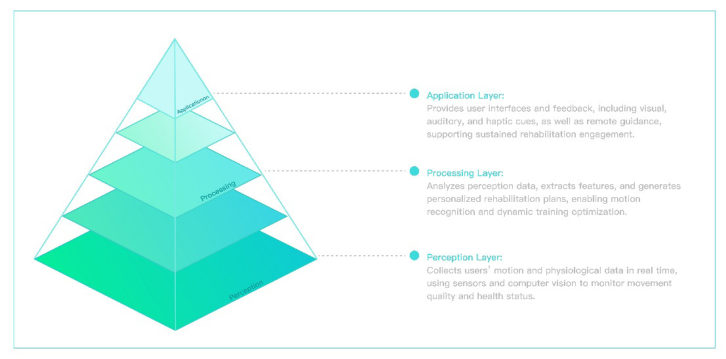
System Composition and Functional Structure Across the included studies, home-based intelligent rehabilitation systems for CNSLBP can generally be organized into three layers: perception, processing, and application. The perception layer collects movement and physiological data; the processing layer analyzes data and generates decisions; and the application layer presents guidance, feedback, and remote connectivity. Together, these layers form a closed loop from data collection to feedback- guided intervention.
(1) Perception Layer The perception layer collects user movement and physiological data in real time. Wearable sensors such as IMUs, accelerometers, gyroscopes, heart- rate monitors, and sEMG devices capture posture, activity, and body state. VR systems use headsets and controllers to track head, hand, and trunk movements, while some prototypes integrate therapeutic hardware such as TENS devices to combine sensing and physical therapy support (Alfikri et al., 2025; Maskeliunas et al., 2023). Computer vision is another important perception method. Monocular cameras and pose-estimation algorithms such as MediaPipe or OpenPose can extract body key points and measure lumbar, pelvic, trunk, and limb movements during rehabilitation (Garg et al., 2023; Cao et al., 2019).
The DynTherapy system illustrates this approach by using computer vision and an exercise library to provide customized guidance and real- time feedback, showing the potential of vision-based systems for home rehabilitation (Bataineh et al., 2024).
(2) Processing Layer The processing layer is the analytical core of the system. It preprocesses sensor data, extracts features, recognizes movement patterns, evaluates progress, and supports individualized rehabilitation decisions.
Advances in Intelligent Rehabilitation Systems 333 Many systems embed evidence-based exercise libraries and educational content to ensure safety and clinical relevance. The selfBACK system, for example, combines guideline-based decision support with machine-learning algorithms to generate adaptive weekly exercise and activity plans (Hurmuz et al., 2025).
The BACK-to-MOVE model uses pose-estimation algorithms to classify functional impairment in people with low back pain, achieving accuracy above 93% (Hartley et al., 2024). Such models can transform raw video or sensor data into clinically meaningful feedback.
(3) Application Layer The application layer is the user-facing part of the system, including mobile apps, tablets, VR interfaces, and dedicated devices. It delivers exercise guidance, feedback, progress information, reminders, and remote interaction. RabbitRun uses a gamified VR environment to guide lumbar movements (Alazba et al., 2018), while Dolodoc supports self-management by recording pain, mood, sleep, and other dimensions and providing personalized recommendations (Ehrler et al., 2025).
Feedback is usually multimodal, including progress bars, virtual coach animations, voice prompts, alerts, and device vibration. Notifications and training reminders are also used to encourage continued participation and build rehabilitation habits.
Network and cloud services extend the application layer by enabling data transmission, remote access, and professional support. Activity data can be synchronized with online platforms so that coaches or therapists can provide individualized advice (Amorim et al., 2019).
Thus, the three-layer architecture links sensing hardware, algorithmic analysis, and user-facing interaction. Its effectiveness depends on both technical accuracy and whether feedback is understandable, timely, and acceptable for home users.
Figure 2: Hierarchy diagram of the intelligent rehabilitation system architecture.
Home-based rehabilitation systems increasingly use mobile health, wearable devices, VR, AR, and AI to move rehabilitation from hospital-centered care to continuous home-based self-management. These technologies reduce temporal and spatial barriers, offer lower-cost support, and may improve pain, function, self-efficacy, and long-term adherence. However, their value depends on whether technology is connected to users’ real contexts, motivations, and behavioral barriers.
From a design perspective, intelligent rehabilitation should be understood as a user-centered and behavior-change-oriented intervention. Health behavior intervention systems should combine psychological theory and human- computer interaction, using motivation enhancement, behavior guidance, and personalized feedback to promote long-term behavior formation (Zhou et al., 2025). Frameworks such as COM-B, HAPA, and Self-Determination Theory can guide design by explaining rehabilitation behavior through capability, opportunity, motivation, and intrinsic needs.
Accordingly, research is shifting from technological feasibility to behavioral sustainability, emphasizing personalization, gamification, immersive interaction, and social support.
(1) Wearable Smart Device Research Wearable devices are important tools for monitoring posture, activity, and physiological status in daily contexts. They typically use IMUs, pressure sensors, sEMG, or heart-rate sensors, and some devices also provide heat, massage, or electrical stimulation for pain relief and lumbar relaxation.
Studies emphasize lightweight design, comfort, and daily usability. Rodriguez et al. developed a low-cost wearable system with three IMU sensors to monitor trunk and pelvic posture, provide real-time angle correction, and record data for therapy optimization (Rodriguez et al., 2021). However, bulky devices, sensor displacement, environmental interference, and restricted movement can reduce adherence (Bootsman et al., 2019).
Future wearable design should reduce device burden while integrating monitoring data with simple, actionable software feedback.
(2) Mobile Health Platform Research Mobile health platforms provide exercise instruction, pain and activity logging, education, reminders, progress visualization, and patient- clinician communication. Apps such as Kaia combine education, exercise, and mindfulness-based relaxation for home self-management (Toelle et al., 2019). Co-design studies, including MyPainHub, show the value of involving patients, clinicians, and developers in defining needs and interface requirements (Evans et al., 2025; Zhou et al., 2025).
However, app-based rehabilitation is not automatically effective. Static videos or images without supervision, real-time correction, or accurate feedback may not improve adherence or pain outcomes, and complex
Advances in Intelligent Rehabilitation Systems 335 interfaces can increase use barriers (Lewkowicz et al., 2023; Menychtas et al., 2022).
Future mHealth systems should combine simple interaction design with posture monitoring, personalized feedback, and safe home-exercise guidance (Cruz-Diaz et al., 2025).
(3) Emerging Technology Research AI, big data, VR, AR, and gamification are increasingly used to support intelligent prediction, immersive interaction, and personalized rehabilitation pathways. VR is particularly relevant for users with kinesiophobia because immersive environments can redirect attention from pain or fear, reduce anxiety, and make therapeutic movements more engaging (Visentin et al., 2025). RabbitRun illustrates immersive rehabilitation by asking users to control a rabbit character through trunk flexion and extension while avoiding obstacles and collecting rewards (Alazba et al., 2018). AR-based interventions also show potential by overlaying virtual coaches or psychoeducational content onto real scenes, correcting misconceptions about pain while reducing limitations of full VR, such as dizziness (Lo et al., 2018).
Immersive interaction alone cannot ensure effectiveness. Feedback remains essential, and studies suggest that combining auditory, visual, and tactile feedback can improve usability and motor learning, although no single feedback mode is optimal for all users (Conen et al., 2025).
Challenges remain in device cost, complexity, motion sickness, and long- term adoption. Future research should improve lightweight hardware, multimodal feedback, safety, and usability so that emerging technologies can support sustained behavior change rather than short-term novelty.
DISCUSSION AND FUTURE DIRECTIONS Overall, intelligent rehabilitation systems for CNSLBP show promise in improving adherence, engagement, self-management, and clinical outcomes through real-time feedback, gamified interaction, AI-driven personalization, and remote professional support (Fatoye et al., 2020; Shi et al., 2024; Garcia et al., 2022; Li et al., 2024). However, the evidence base is still limited by small samples, short follow-up periods, heterogeneous outcome measures, and a focus on single technologies rather than integrated systems.
From a design perspective, user experience remains insufficiently addressed. Many studies emphasize technical functionality but provide limited evaluation of interface usability, motivation, perceived burden, and behavior-change mechanisms (Amorim et al., 2019; Berger et al., 2024; Zhou et al., 2025). Future development should therefore strengthen co-design, usability testing, implementation planning, and behavioral science frameworks.
System integration is another major challenge. Many current solutions function as isolated apps, devices, or experimental platforms and lack interoperability with healthcare information systems or wearable ecosystems (Rodriguez et al., 2021; Bootsman et al., 2019; Toelle et al., 2019; Evans
336 Lu and Yang et al., 2025). Open platforms connecting sensors, apps, cloud services, and clinician dashboards could support more continuous care, provided that privacy, simplicity, and acceptance are addressed.
Future development is likely to move toward standardized digital therapeutics, multimodal personalization, and interdisciplinary collaboration. AI can dynamically adjust training intensity, predictive models can identify relapse risks, and mixed reality may provide more interactive rehabilitation environments. At the same time, social support and clinician- patient communication should be incorporated to strengthen adherence and practical implementation.
CONCLUSION
This review summarizes the development of intelligent rehabilitation systems for CNSLBP. Current systems use wearable devices, mobile applications, VR, and AI algorithms to support personalized home-based rehabilitation. They can improve adherence, self-management, pain reduction, and functional recovery, but most studies remain preliminary and lack long-term validation. Future work should emphasize integrated architecture, user-centered interface design, behavior-change mechanisms, and interdisciplinary collaboration.
ACKNOWLEDGMENT
This work was supported by the National Natural Science Foundation of China (Grant No. 52508338), the Guangdong Philosophy and Social Science Foundation (Grant No. GD25YYJ54), the Guangdong Provincial Education Science Project (Grant No. 2025GXJK0600), and the Shenzhen Education Science Research Project (Grant No. yb24003).
REFERENCES
Alazba, A., Al-Khalifa, H., & AlSobayel, H. (2018). RabbitRun: an immersive virtual reality game for promoting physical activities among people with low back pain. Technologies, 7(1), 2. Alfikri, Z. F., Johnson, M. E., Dicianno, B. E., Greco, C. M., Parmanto, B., Piva, S.
R., ... & Bell, K. M. (2025). Mobile Health (mHealth) for Chronic Low Back Pain Assessment: Design, Development, and Usability Evaluation. JOR spine, 8(4), e70118. Amorim, A. B., Pappas, E., Simic, M., Ferreira, M. L., Jennings, M., Tiedemann, A., ...
& Ferreira, P. H. (2019). Integrating Mobile-health, health coaching, and physical activity to reduce the burden of chronic low back pain trial (IMPACT): a pilot randomised controlled trial. BMC musculoskeletal disorders, 20(1), 71. Balagué, F., Mannion, A. F., Pellisé, F., & Cedraschi, C. (2012). Non-specific low back pain. The lancet, 379(9814), 482–491. Bataineh, Y., Abdallah, M. M., & Alkofahi, H. (2024, August). Enhancing
Rehabilitation Outcomes with DynTherapy: An AI-Driven Personalized Approach. In 2024 15th International Conference on Information and Communication Systems (ICICS) (pp. 1–5). IEEE.
Advances in Intelligent Rehabilitation Systems 337 Berger, M., Deblock-Bellamy, A., Chèze, L., Robert, T., Desrosiers, J. J., Christe, G.,
& Bertrand, A. M. (2024). Exploring the needs of people with chronic low back pain and health care professionals for mHealth devices to support self-managed physical activity and pain: user-centered design approach. JMIR Human Factors, 11, e59897. Bootsman, R., Markopoulos, P., Qi, Q., Wang, Q., & Timmermans, A. A. (2019).
Wearable technology for posture monitoring at the workplace. International Journal of Human-Computer Studies, 132, 99–111. Cao, Z., Hidalgo, G., Simon, T., Wei, S. E., & Sheikh, Y. (2019). Openpose: Realtime multi-person 2d pose estimation using part affinity fields. IEEE transactions on pattern analysis and machine intelligence, 43(1), 172–186. Conen, R., Mueller, S., & Tibubos, A. N. (2025). Integration of conventional and
virtual reality approaches in augmented reality for theory-based psychoeducational intervention design for chronic low back pain: Scoping review. Interactive Journal of Medical Research, 14(1), e59611. https://doi.org/10.2196/59611. Cruz-Díaz, D., García-Vázquez, J. F., Martínez-Lentisco, M., & León-Morillas, F.
(2025). Effects of Virtual Reality on Adults Diagnosed with Chronic Non-Specific Low Back Pain: A Systematic Review. Healthcare, 13, 1328. Dario, A. B., Cabral, A. M., Almeida, L., Ferreira, M. L., Refshauge, K., Simic, M., ... & Ferreira, P. H. (2017). Effectiveness of telehealth-based interventions in the management of non-specific low back pain: a systematic review with meta- analysis. The Spine Journal, 17(9), 1342–1351. Ehrler, F., Guebey, J., Rochat, J., Gosetto, L., Rehberg, B., Lovis, C., & Molinard-
Chenu, A. (2025). Dolodoc, an App to Leverage Self-Management of Chronic Pain: Design, Development, and Implementation Report. JMIR Medical Informatics, 13, e71597. Evans, K., Ko, J., Ceprnja, D., Maka, K., Beales, D., Sterling, M., ... & Rebbeck, T. J.
(2025). Development and Implementation of MyPainHub, a Web-Based Resource for People With Musculoskeletal Conditions and Their Health Care Professionals: Mixed Methods Study. JMIR Formative Research, 9, e63780. Fatoye, F., Gebrye, T., Fatoye, C., Mbada, C. E., Olaoye, M. I., Odole, A. C., & Dada, O. (2020). The clinical and cost-effectiveness of telerehabilitation for people with nonspecific chronic low back pain: randomized controlled trial. JMIR mHealth and uHealth, 8(6), e15375. Garcia, L., Birckhead, B., Krishnamurthy, P., Mackey, I., Sackman, J., Salmasi, V.,
... & Darnall, B. D. (2022). Durability of the treatment effects of an 8-week self- administered home-based virtual reality program for chronic low back pain: 6-month follow-up study of a randomized clinical trial. Journal of Medical Internet Research, 24(5), e37480. Garg, S., Saxena, A., & Gupta, R. (2023). Yoga pose classification: a CNN and MediaPipe inspired deep learning approach for real-world application. Journal of ambient intelligence and humanized computing, 14(12), 16551–16562. Hartley, T., Hicks, Y., Davies, J. L., Cazzola, D., & Sheeran, L. (2024). BACK-to-
MOVE: Machine learning and computer vision model automating clinical classification of non-specific low back pain for personalised management. Plos one, 19(5), e0302899. Hurmuz, M. Z., Jansen-Kosterink, S. M., Mork, P. J., Bach, K., & Hermens, H.
J. (2025). Factors influencing the use of an artificial intelligence-based app (selfBACK) for tailored self-management support among adults with neck and/or low back pain. Disability and rehabilitation, 47(4), 958–967. Lewkowicz, D., Bottinger, E., & Siegel, M. (2023). Economic evaluation of digital therapeutic care apps for unsupervised treatment of low back pain: Monte Carlo simulation. JMIR mHealth and uHealth, 11, e44585. https://doi. org/10.2196/44585.
338 Lu and Yang Li, R., Li, Y., Kong, Y., Li, H., Hu, D., Fu, C., & Wei, Q. (2024). Virtual reality–
based training in chronic low back pain: systematic review and meta-analysis of randomized controlled trials. Journal of Medical Internet Research, 26, e45406. Lo, W. L. A., Lei, D., Li, L., Huang, D. F., & Tong, K.-F. (2018). The Perceived Benefits of an Artificial Intelligence–Embedded Mobile App Implementing Evidence-Based Guidelines for the Self-Management of Chronic Neck and Back Pain: Observational Study. JMIR mHealth and uHealth, 6(11), e198. https://doi. org/10.2196/mhealth.8127 Maher, C., Underwood, M., & Buchbinder, R. (2017). Non-specific low back pain.
The Lancet, 389(10070), 736–747. Maskeliūnas, R., Damaševičius, R., Blažauskas, T., Canbulut, C., Adomavičienė, A., & Griškevičius, J. (2023). BiomacVR: A virtual reality-based system for precise human posture and motion analysis in rehabilitation exercises using depth sensors. Electronics, 12(2), 339. Menychtas, A., Galliakis, M., Pardos, A., & others. (2022). Gameful design of
an application for patients in rehabilitation. Frontiers in Computer Science, 4, 822167. https://doi.org/10.3389/fcomp.2022.822167. Nijs, J., Kosek, E., Chiarotto, A., Cook, C., Danneels, L. A., Fernández-de-Las-Peñas, C., ... & George, S. Z. (2024). Nociceptive, neuropathic, or nociplastic low back pain? The low back pain phenotyping (BACPAP) consortium’s international and multidisciplinary consensus recommendations. The Lancet Rheumatology, 6(3), e178-e188. Rodriguez, A., Rabunal, J. R., Pazos, A., Sotillo, A. R., & Ezquerra, N. (2021).
Wearable postural control system for low back pain therapy. IEEE Transactions on Instrumentation and Measurement, 70, 1–10. Rohaj, A., & Bulaj, G. (2023). Digital Therapeutics (DTx) Expand Multimodal Treatment Options for Chronic Low Back Pain: The Nexus of Precision Medicine, Patient Education, and Public Health. Healthcare, 11(10), 1469. https://doi. org/10.3390/healthcare11101469 Shi, W., Zhang, Y., Bian, Y., Chen, L., Yuan, W., Zhang, H., ... & Lin, Y. (2024). The
physical and psychological effects of telerehabilitation-based exercise for patients with nonspecific low back pain: prospective randomized controlled trial. JMIR mHealth and uHealth, 12(1), e56580. Toelle, T. R., Utpadel-Fischler, D. A., Haas, K. K., & Priebe, J. A. (2019). App-based multidisciplinary back pain treatment versus combined physiotherapy plus online education: a randomized controlled trial. NPJ digital medicine, 2(1), 34. Tuckson, R. V., Edmunds, M., & Hodgkins, M. L. (2017). Telehealth. New England
Journal of Medicine, 377(16), 1585–1592. Visentin, N., Fairhurst, M., Sun, W., Niu, X., Floessel, P., Wunderlich, F. C., ...
& Disch, A. (2025). The Power of Touch: How can Social Touch impact the Trust, Body Representation and Exercise Performance of Patients in a Wearable Physiotherapy Assistant?. medRxiv, 2025–05. Xiao, C., Zhao, Y., Li, G., Zhang, Z., Liu, S., Fan, W., Hu, J., Yao, Q., Yang, C., Zou, J., Zeng, Q., & Huang, G. (2025). Clinical efficacy of multimodal exercise telerehabilitation based on AI for chronic nonspecific low back pain: Randomized controlled trial. JMIR mHealth and uHealth, 13, e56176. https:// doi.org/10.2196/56176 Zhou, T., Kirby-Ginns, S., Salman, D., & McGregor, A. H. (2025). Using codesign
workshops to develop a conceptual framework for a mobile health app targeting chronic low back pain self-management. BMJ open, 15(2), e093386.
LISTED IN THE AHFE DIGITAL BOOKSTORE CATALOGUE
Explore the complete digital volume
Healthcare and Medical Devices
Read this individual research paper free through the original publisher, or explore the full digital proceedings book.
ISBN 978-1-964867-87-8
Explore this ISBN in the AHFE Bookstore ↗Listed in the July 2026 bookstore catalogue; search by ISBN to confirm current availability · Digital book purchase optional