Xiaoli Li, Wenjing Yang (2026). The Application of Machine Learning in Postpartum Low Back Pain. In: Healthcare and Medical Devices. AHFE Open Access, vol. 211, pp. 339–349. https://doi.org/10.54941/ahfe1007497
Postpartum low back pain (LBP) is a common health issue that significantly impacts women’s quality of life; however, traditional rehabilitation models often provide generalized guidance, making it difficult to address the individual differences in patients’ physiological, psychological, and lifestyle factors with precision. With the development of smart healthcare, machine learning (ML) provides the technological foundation for personalized interventions. This study employs a scoping review methodology to systematically analyze the current state of ML applications in postpartum low back pain and related fields between 2015 and 2025, aiming to provide a theoretical framework for the design of future personalized postpartum rehabilitation service systems.The study found that although ML has made significant progress in precise diagnosis and personalized recommendations in adjacent fields such as non-specific low back pain, its application to postpartum LBP remains in its infancy. This paper identifies key design challenges, including multi-dimensional data integration, model interpretability, and the motivation for participation among specific populations. From a design science perspective, the study proposes that future efforts should focus on integrating multimodal data—such as physiological indicators and psychosocial factors—to construct a personalized rehabilitation service system capable of real-time monitoring and dynamic adjustment, thereby meeting the complex needs of postpartum women. This research not only distils a transferable interdisciplinary methodology but also provides directional guidance for the design of smarter postpartum health services.
Postpartum low back pain (LBP) or pelvic girdle pain (PGP) is one of the common health issues following childbirth, typically manifested as soreness or radiating pain in the lumbar region. Most patients with postpartum LBP recover within three months after delivery (Gutke et al., 2018). However, 30% of women still report developing PGP after this (Nilsson-Wikmar et al., 2003), and some cases may progress to chronic back pain, lasting for months or even years. PGP is associated with functional limitations in weight-bearing activities such as walking and standing (Nilsson-Wikmar et al., 2003), leading to impairment in daily functioning (Robinson et al., 2014). Additionally, postpartum LBP is often accompanied by other health problems, such as urinary incontinence (Sjödahl et al., 2013) and depression (Christopher et al., 2019), which severely impact a patient’s daily life.
Postpartum LBP arises from multiple risk factors spanning physiological, psychological, and social aspects. For example, the growing uterus shifts the centre of gravity forward, straining the lumbar muscles, ligaments, and joints. These biomechanical changes increase lumbar disc pressure, which can lead to or worsen LBP. Age and physical conditioning have also been identified as potential risks. Postpartum activities can also trigger LBP. Maintaining flexed and incorrect postures during breastfeeding often leads to sustained tension in the lumbar musculature, which can trigger or worsen pain. Psychological factors, such as postpartum depression (PPD) are also strongly correlated Received May 22, 2026; Revised June 4, 2026; Accepted June 22, 2026; Available online July 20, 2026
340 Li and Yang with heightened pain sensitivity. Patients with PPD are more likely to report LBP, and the intensity of the pain is positively correlated with the level of psychological stress (Ostgaard et al., 1993). Additionally, psychosocial factors, including inadequate support from families and financial stress, can worsen postpartum LBP by causing women to bear excessive physical burdens from childcare and household duties.
Given the severe impact of postpartum LBP on patients’ mental health, work efficiency, and quality of life, finding effective interventions is a critical priority. Current management is broadly divided into non-pharmacological and pharmacological approaches. The former includes physical therapy, therapeutic exercise, and psychological interventions, while the latter primarily involves analgesics such as acetaminophen and nonsteroidal anti- inflammatory drugs (NSAIDs) (Li & Zhang, 2020). Due to breastfeeding needs, non-pharmacological treatments are widely used. However, traditional rehabilitation protocols often provide generalized guidance, failing to meet the patients’ diverse needs due to their physical condition, lifestyle, and recovery status.
In recent years, machine learning (ML) has advanced in medical rehabilitation by utilizing complex data. This study aims to integrate findings from related fields, evaluate the potential and challenges of ML in postpartum LBP intervention, and identify the future direction of postpartum LBP intervention driven by ML.
METHOD
Literature Search and Screening Strategy A scoping review was performed following the PRISMA-ScR (PRISMA Extension for Scoping Reviews) guidelines (Tricco et al., 2018). The search covered PubMed, Scopus, Web of Science, IEEE Xplore, and Google Scholar. The publication period was restricted to January 2015–October 2025 and limited to English. Given the limited research applying ML to postpartum LBP, this review also examined advances in related fields, including nonspecific LBP and postpartum pain or depression, to ensure comprehensiveness.
A particularly relevant field is non-specific LBP. Due to similarity in pathological mechanisms and rehabilitation strategies, this study reviewed the application of ML in non-specific LBP to identify transferable methodologies. The keywords were: (“machine learning” OR “artificial intelligence”) AND (“low back pain”).
Another significant adjacent field is postpartum rehabilitation, particularly postpartum pain and postpartum depression, which are often comorbid with postpartum LBP. This stage aimed to explore the application of ML to these related health issues and to deepen understanding of the specific characteristics of the postpartum population. The keywords for this stage were: (“machine learning” OR “artificial intelligence”) AND (“postpartum pain” OR “postpartum depression”) Ultimately, the research focused on the application of ML in postpartum LBP. The keywords for this stage were: (“machine learning” OR “artificial intelligence”) AND (“postpartum low back pain” OR “postpartum pelvic girdle pain”).
INCLUSION AND EXCLUSION CRITERIA Following a full-text review of studies meeting preliminary criteria, the inclusion criteria are: 1) Topic: studies applying ML to postpartum LBP or related issues; 2) Study type: Original research articles, reviews, conference papers, or preprints; 3) publication Period: January 2015 to October 2025.
The exclusion criteria are: 1) studies not involving ML; 2) animal studies; 3) non-English publications; 4) abstracts only, letters, or editorials.
RESULT
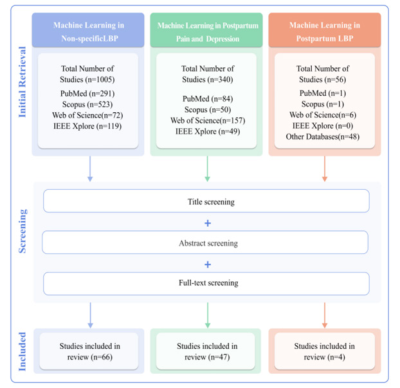
Screening Results During the initial retrieval, a total of 1005, 340, and 56 studies were identified from Stage 1, Stage 2, and Stage 3, respectively. Following a progressive screening of titles, abstracts, and full-texts against the pre-defined eligibility criteria, 66, 47, and 4 studies from Stage 1, Stage 2, and Stage 3 were ultimately included (Fig.1).
Figure 1: Literature retrieval process.
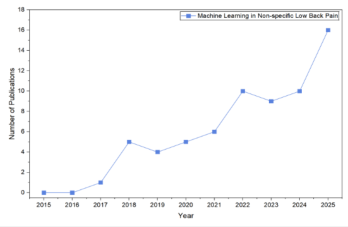
Machine Learning in Non-Specific Low Back Pain 66 studies were included for analysis. Research from 2017 to 2025 demonstrates a steady upward trajectory, with a notable acceleration after 2022. This field has attracted increasing research attention (Fig. 2). ML in the management of non-specific LBP primarily focuses on three areas: diagnosis and classification of LBP, prediction and prognostic assessment, and personalized treatment.
Figure 2: The publication trend of literature on the application of ML in nonspecific LBP.
Diagnosis and Classification Relevant studies have found that applying ML models to analyse medical images (e.g., magnetic resonance (MR) imaging, Aggarwal, 2021; X-rays, Tan et al., 2018), biomechanical data (e.g., movement patterns, Abdollahi et al., 2020; posture, Phan et al., 2024), and clinical data can stratify heterogeneous patients into distinct subgroups, helping clinicians achieve more precise diagnoses of non-specific LBP. Tan et al. (2018) developed a natural language processing (NLP) system to identify lumbar spine imaging findings associated with LBP.”
Prediction and Prognosis Assessment By analysing patient data (e.g., early symptoms, medical history, and physiological and psychological factors), ML can identify individuals at high risk of developing chronic LBP. This enables early intervention to prevent the condition from progressing. In a study targeting middle-aged and elderly Chinese subjects, Liu et al. (2025) constructed prediction models using seven ML algorithms, including Random Forest (RF) and extreme gradient boosting (XGBoost), to predict LBP by using features such as walking speed, grip strength, and self-rated health status.
By integrating multiple types of data, such as patient demographics and clinical information, ML models can predict the effectiveness of specific treatments for patients. Niederer et al. (2024) used a multivariable prediction model to forecast rehabilitation success and future healthcare utilization in patients with LBP. The study identified several prognostic factors influencing recovery and found that a 3-week inpatient multimodal medical rehabilitation intervention, incorporating physical and psychological strategies, may help prevent future healthcare use.
Personalized Treatment Some research demonstrates that ML models can recommend suitable treatment for patients and clinicians, improving compliance and clinical effectiveness. In a study by Rughani et al. (2023), the smartphone application
The Application of Machine Learning in Postpartum 343 “selfBACK” was used to provide personalized self-management and support for patients with LBP, which was effective in alleviating their symptoms. Hartley et al. (2024) combined wearable sensors with optical motion capture technology to develop an ML model named “BACK-to-MOVE” for LBP classification, facilitating the customization of physical interventions to meet individual needs.
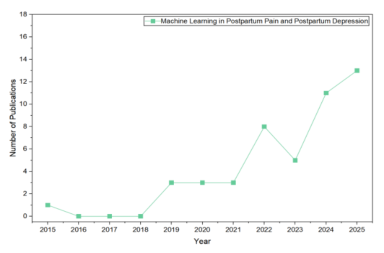
Machine Learning in Postpartum Pain and Depression 47 studies were included for analysis. Research in this field has increased in recent years, with a notable surge after 2021 (Fig. 3). ML applications for postpartum pain and PPD focus on three areas: early screening, personalized treatment, and multi-source data analysis.
Figure 3: The publication trend of literature on the application of ML in Postpartum Pain and PD.
Early Screening Some research has utilized ML models on demographic, clinical, and psychosocial data to assess the risk of onset for postpartum disorders, including postpartum depression, to facilitate preventive care within the postpartum recovery process. Xu and Sampson (2023) employed an RF model to explore physiological, psychological, and social factors during pregnancy and childbirth, identifying the most significant predictors of postpartum pain and depression.
Personalized Treatment Multi-Source Data Analysis Some research employs ML models that integrate Electronic Health Records (EHR) with wearable device data to enable real-time risk monitoring, thereby facilitating targeted interventions (e.g., medication or psychological support) for the combined management of pain and depression (Zhang et al., 2024). De Souza et al. (2024) developed a smartphone application that leverages AI to enable self-assessment for individuals experiencing postpartum breast pain, thereby improving the efficiency of physician-led telemedicine consultations. Poudyal et al. (2019) demonstrated that wearable digital sensors enable
344 Li and Yang the passive collection of data to identify PPD risk in adolescent mothers, facilitating the delivery of personalized psychotherapy.
Multi-Source Data Analysis Utilizing biological (e.g., plasma proteomics; S. Wang et al., 2025) and unstructured data, ML models predict postpartum depression, enhancing comprehensive recovery assessment for holistic care. Fatima et al. (2019) introduced a generalized approach that extracts linguistic features from social media posts and classifies them using various ML techniques as general, depressive, or indicative of PPD. Qi et al. (2025) employed ML models, including Logistic Regression and XG Boost, to integrate four categories of predictors, demographic characteristics, psychiatric history, psychosocial factors, and physiological indicators, to identify the risk of postpartum depression.
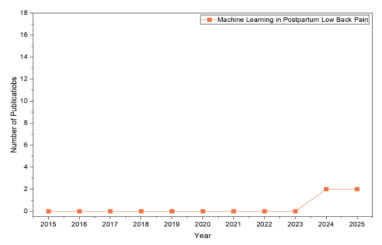
Machine Learning in Postpartum Low Back Pain Only four studies were included in the analysis. There is an absence of studies in this field from 2015 to 2023. Subsequently, two articles were published in each of the years 2024 and 2025, likely driven by advances in AI and increasing social concern for women’s health (Fig. 4). This pattern indicates that the field is still in the early stages of exploration. Currently, ML has three main applications in the intervention of postpartum LBP: risk identification, movement pattern analysis, and comprehensive diagnosis and management.
Figure 4: The publication trend of literature on the application of ML in postpartum LBP.
Risk Identification Relevant studies have found that models such as XG Boost and RF can identify risk factors to support early intervention for postpartum LBP. Liu et al. (2025) compared the predictive performance of six ML algorithms for postpartum pain, including LBP. The study identified five risk factors for postpartum pain, with the XG Boost algorithm demonstrating the strongest performance. Ashrafi et al. (2025) used ML models such as XG Boost and LR to identify women at risk of pregnancy-related LBP. Their study found that
The Application of Machine Learning in Postpartum 345 a history of LBP/PGP during previous pregnancies was the most significant predictor.
Movement Pattern Analysis By analysing movement data, patients can be more effectively guided in their physical therapy with targeted interventions. Abdel Hady and Abd El-Hafeez (2024) trained an ML model using diverse data (e.g., age, height, BMI, pain levels, and trunk movement patterns) from patients with postpartum LBP. This was done to understand and predict the range of motion (ROM) in the lumbar region and to identify the strongest predictors of limited ROM in these patients.
Comprehensive Diagnosis and Management In a study by Wang (2025), textual data for Postpartum Pain Diagnosis (PPDD) were collected from patient-reported symptoms, medical records, and Traditional Chinese Medicine (TCM) diagnostic records. By integrating NLP with TCM principles, their work analysed Postpartum Pain (PPP) management, including LBP. In this study, a “Refined Coyote Optimized Deep Recurrent Neural Network (RCO-DRNN)” model was employed to predict pain patterns and tailor an appropriate treatment course.
DISCUSSION
This review finds that while ML demonstrates significant potential in rehabilitating non-specific LBP, postpartum pain, and depression, its application in postpartum LBP remains scarce. To move beyond traditional rehabilitation, integrating intelligent technologies is essential to meet personalized patient needs.
Key Challenges and Future Directions Lack of Clinical Validation
The existing studies lack large-scale randomized controlled trials and longitudinal follow-up. Thus, the effectiveness, long-term impact, and clinical applicability of ML in postpartum LBP interventions remain poorly evaluated, thereby limiting their translation to clinical practice. Future research should employ longitudinal studies to elucidate the progression of postpartum LBP and evaluate the effectiveness of different treatment strategies. Collaboration with clinicians should be pursued to enhance the validation of predictive models.
Challenges in Subject Recruitment A major impediment in current research is the difficulty in acquiring sufficient samples. A case in point is Abdel Hady and Abd El-Hafeez’s (2024) study. Due to factors such as time constraints, the responsibility of taking care of children, psychological stress, and physical discomfort,
346 Li and Yang postpartum women often encounter difficulties in participating in research. Additionally, marginalized groups may face barriers to accessing recruitment advertisements (Parks et al., 2022).
Small sample sizes can affect model prediction accuracy, limiting model development and clinical translation. Research shows that postpartum women perceive information from healthcare professionals, friends or family, and other expert sources as more trustworthy (Beasley et al., 2020). Therefore, in future studies, researchers could enhance participant recruitment rates by advertising across diverse channels such as social media, healthcare facilities, government agencies, educational institutions, and child-friendly spaces.
Model Interpretability and Clinical Transparency A major barrier to the clinical adoption of ML models is the lack of interpretability, especially for those sensitive health predictions. Some complex models, such as high-performance deep neural networks, may undermine physician trust and limit clinical translation due to their “black- box” nature. Future research must prioritize Explainable Artificial Intelligence (XAI). For high-performance models, post-hoc explanation techniques must be employed.
Privacy and Security Patient privacy is of vital importance when developing ML models or applications for postpartum LBP intervention. The datasets involved typically contain sensitive personal information, including basic demographics, physiological data, medical history, mental health status, and even family relationships. Technologies such as encryption, access control and secure multi-party computation can ensure that sensitive data remains confidential and protected from attacks by malicious actors, thereby helping reduce these risks.
Future Directions: Insights From Adjacent Fields Integration of Multidimensional Data
The occurrence and development of postpartum LBP involve multiple factors, including physiological, psychological, and social or family. Studies on ML interventions for non-specific LBP and PPD have successfully integrated multi-source data, including biological data (such as cytokines, thyroid indicators) and unstructured data (such as social media texts).
Therefore, future research on postpartum LBP should also establish multidimensional, multimodal datasets, with a focus on incorporating postpartum-specific biomarkers and psychosocial text data. However, these data sources are fragmented, with significant differences in format and collection methods, posing substantial integration challenges. Future research should preprocess and normalise data to ensure compatibility across different data types; concurrently, it should employ model fusion techniques to effectively integrate information from these diverse sources while preserving their unique qualities.
The Application of Machine Learning in Postpartum 347 Precise Subtyping
Current research has made initial progress in applying machine learning to identify risk factors for postpartum low back pain and analyse its movement patterns. However, there are significant variations in patients’ clinical presentations. By drawing on technical approaches from related fields, future applications of machine learning must move beyond the risk identification stage and shift towards precise patient subtyping, categorising this heterogeneous population into distinct clinical subgroups to enable targeted treatment.
Personalized Intervention Current research concerning ML in postpartum LBP intervention has begun to explore comprehensive diagnosis and management. Meanwhile, in adjacent fields, researchers have already developed programs and applications capable of personalized treatment, such as ‘selfBACK’ (Rughani et al., 2023) and ‘LCBuddy’ (De Souza, Chamberlain, & Wang, 2024) . In the future, ML technology can be leveraged to develop service systems capable of real-time detection of postpartum LBP, providing personalized rehabilitation plans based on the patient’s condition, and dynamically adjusting those plans in response to patient feedback.
Limitations Firstly, this study included only English-language literature and might have overlooked important research in other languages. Secondly, to capture the latest developments, the study incorporated conference abstracts and preprints. Finally, limiting the scope to the past decade may have missed earlier foundational research.
CONCLUSION
ML applications in postpartum LBP intervention are still in their infancy. However, significant progress has been made in adjacent fields such as non- specific LBP and other postpartum health issues. This review identifies key challenges in clinical validation, subject recruitment, model Interpretability, and privacy security. This study also integrates transferable methods from adjacent domains, such as precise subgrouping, multi-source data analysis, and app-based personalized interventions, that provide clear directions for future research.
ACKNOWLEDGMENT
This work was supported by the National Natural Science Foundation of China (Grant No. 52508338), the Guangdong Philosophy and Social Science Foundation (Grant No. GD25YYJ54), the Guangdong Provincial Education Science Project (Grant No. 2025GXJK0600), and the Shenzhen Education Science Research Project (Grant No. yb24003).
REFERENCES
Abdel Hady, D. A., & Abd El-Hafeez, T. (2024). Utilizing machine learning to analyze trunk movement patterns in women with postpartum low back pain. Scientific Reports, 14(1), 18726. Abdollahi, M., Ashouri, S., Abedi, M., et al. (2020). Using a motion sensor to
categorize nonspecific low back pain patients: A machine learning approach. Sensors, 20(12), 3600. Aggarwal, N. (2021). Prediction of low back pain using artificial intelligence modeling. Journal of Medical Artificial Intelligence, 4. Ashrafi, A., Thomson, D., Khorshidi, H. A., et al. (2025). Predicting pregnancy-
related pelvic girdle pain using machine learning. Musculoskeletal Science and Practice, 77, 103321. Beasley, L. O., Ciciolla, L., Jespersen, J. E., et al. (2020). Best practices for engaging pregnant and postpartum women at risk of substance use in longitudinal research studies: A qualitative examination of participant preferences. Adversity and Resilience Science, 1(4), 235–246. Christopher, S., McCullough, J., Snodgrass, S. J., et al. (2019). Predictive risk factors
for first-onset lumbopelvic pain in postpartum women: A systematic review. The Journal of Women’s & Pelvic Health Physical Therapy, 43(3), 127–135. De Souza, J., Chamberlain, K., & Wang, E. J. (2024). LCBuddy: Towards a smartphone-based self-assessment tool for postpartum patients with breast pain. In Extended Abstracts of the CHI Conference on Human Factors in Computing Systems (pp. 1–7). Fatima, I., Abbasi, B. U. D., Khan, S., et al. (2019). Prediction of postpartum
depression using machine learning techniques from social media text. Expert Systems, 36(4), e12409. Gutke, A., Boissonnault, J., Brook, G., et al. (2018). The severity and impact of pelvic girdle pain and low-back pain in pregnancy: A multinational study. Journal of Women’s Health, 27(4), 510–517. Hartley, T., Hicks, Y., Davies, J. L., et al. (2024). BACK-to-MOVE: Machine learning
and computer vision model automating clinical classification of non-specific low back pain for personalised management. PLOS One, 19(5), e0302899. Li, Z., & Zhang, X. (2020). Research progress on postpartum lumbar-pelvic complex pain syndrome. International Journal of Obstetrics and Gynecology, 47(5), 579. Liu, A., Dou, X., Fan, B., et al. (2025). Development and validation of a machine
learning-based risk prediction model for low back pain in middle-aged and elderly Chinese: A SHAP-interpretable longitudinal cohort study [Preprint]. Research Square. Liu, F., Li, T., Zhou, D., et al. (2025). A machine learning–based framework for predicting postpartum chronic pain: A retrospective study. BMC Medical Informatics and Decision Making, 25(1), 168. Niederer, D., Schiller, J., Groneberg, D. A., Behringer, M., Wolfarth, B., & Gabrys, L.
(2024). Machine learning-based identification of determinants for rehabilitation success and future healthcare use prevention in patients with high-grade, chronic, nonspecific low back pain: An individual data 7-year follow-up analysis on 154,167 individuals. PAIN, 165(4), 772–784. Nilsson-Wikmar, L., Pilo, C., Pahlbäck, M., et al. (2003). Perceived pain and selfestimated activity limitations in women with back pain post-partum. Physiotherapy Research International, 8(1), 23–35. Ostgaard, H. C., et al. (1993). Influence of some biomechanical factors on low-back
pain in pregnancy. Spine, 18(5), 509–515.
The Application of Machine Learning in Postpartum 349 Parks, A. M., Duffecy, J., McCabe, J. E., Blankstein Breman, R., Milgrom, J., Hirshler,
Y., Gemmill, A. W., Segre, L. S., Felder, J. N., & Uscher-Pines, L. (2022). Lessons learned recruiting and retaining pregnant and postpartum individuals in digital trials: Viewpoint. JMIR Pediatrics and Parenting, 5(2), e35320. Phan, T. C., Pranata, A., Farragher, J., et al. (2024). Regression-based machine learning for predicting lifting movement pattern change in people with low back pain. Sensors, 24(4), 1337. Poudyal, A., Van Heerden, A., Hagaman, A., et al. (2019). Wearable digital sensors to
identify risks of postpartum depression and personalize psychological treatment for adolescent mothers: Protocol for a mixed methods exploratory study in rural Nepal. JMIR Research Protocols, 8(9), e14734. Qi, W., Wang, Y., Wang, Y., et al. (2025). Prediction of postpartum depression in women: Development and validation of multiple machine learning models. Journal of Translational Medicine, 23(1), 291. Robinson, H. S., Vøllestad, N. K., & Veierød, M. B. (2014). Clinical course of pelvic
girdle pain postpartum–impact of clinical findings in late pregnancy. Manual Therapy, 19(3), 190–196. Rughani, G., et al. (2023). The selfBACK artificial intelligence-based smartphone app can improve low back pain outcome even in patients with high levels of depression or stress. European Journal of Pain, 27(5), 568–579. Sjödahl, J., Gutke, A., & Öberg, B. (2013). Predictors for long-term disability in
women with persistent postpartum pelvic girdle pain. European Spine Journal, 22, 1665–1673. Tan, W. K., Hassanpour, S., Heagerty, P. J., et al. (2018). Comparison of natural language processing rules-based and machine-learning systems to identify lumbar spine imaging findings related to low back pain. Academic Radiology, 25(11), 1422–1432. Tricco, A. C., Lillie, E., Zarin, W., et al. (2018). PRISMA extension for scoping
reviews (PRISMA-ScR): Checklist and explanation. Annals of Internal Medicine, 169(7), 467–473. Wang, S., Xu, R., Li, G., et al. (2025). A plasma proteomics-based model for identifying the risk of postpartum depression using machine learning. Journal of Proteome Research, 24(2), 824–833. Wang, Y. (2025). NLP-driven integration of electrophysiology and traditional
Chinese medicine for enhanced diagnostics and management of postpartum pain. SLAS Technology, 32, 100267. Xu, W., & Sampson, M. (2023). Prenatal and childbirth risk factors of postpartum pain and depression: A machine learning approach. Maternal and Child Health Journal, 27, 286–296. Zhang, Y., Joly, R., Beecy, A. N., et al. (2024). Implementation of a machine learning
risk prediction model for postpartum depression in the electronic health records. AMIA Summits on Translational Science Proceedings, 2024, 1057.
LISTED IN THE AHFE DIGITAL BOOKSTORE CATALOGUE
Explore the complete digital volume
Healthcare and Medical Devices
Read this individual research paper free through the original publisher, or explore the full digital proceedings book.
ISBN 978-1-964867-87-8
Explore this ISBN in the AHFE Bookstore ↗Listed in the July 2026 bookstore catalogue; search by ISBN to confirm current availability · Digital book purchase optional