Anastasiia Gorelova, Alexandra Parichenko, Santiago Meli, Shirong Huang, Gianaurelio Cuniberti (2026). Digital Twin–Enabled Smart Health Monitoring for Reproductive Medicine: Integrating Hormone Biosensing and Physiological Data. In: Human Interaction and Emerging Technologies (IHIET-AI 2026): Artificial Intelligence and Future Applications. AHFE Open Access, vol. 201, pp. 580–590. https://doi.org/10.54941/ahfe1007211
1 Department of Software and Computing Systems, Universidad de Alicante, Carretera de San Vicente s/n, 03690 San Vicente del Raspeig, Alicante, Spain ↗
2 Institute for Materials Science and Max Bergmann Center for Biomaterials, TUD Dresden University of Technology, 01069 Dresden, Saxony, Germany ↗
3 Institute for Materials Science and Max Bergmann Center for Biomaterials, TUD Dresden, University of Technology, 01069 Dresden, Saxony, Germany ↗
Female infertility remains a major clinical and societal challenge, while the results of assisted reproductive technologies remain limited, and one reason is episodic hormone monitoring. Currently available methods for monitoring fertility or the menstrual cycle rely on periodic blood tests or indirect physiological indicators obtained from wearable devices, which provide only partial or delayed insight of rapidly changing hormonal fluctuations.In this work, we present a Digital Twin–enabled Smart Hormone Monitoring System (SHMS) under development, designed to integrate continuous hormone biosensing with physiological data within a unified digital twin (DT) architecture to support personalized infertility treatment. The proposed SHMS combines: (i) a minimally invasive wearable biosensor for real-time measurement of 17β-estradiol in interstitial fluid, (ii) patient and clinician applications for remote visualization and monitoring, and (iii) a patient-specific digital twin, designed to combine models trained at the population level datasets with individual hormone measurements.As a first step toward this integration, we validate the hormone-sensing and sensor-level DT components under controlled laboratory conditions. The biosensor response was evaluated across physiologically relevant estradiol concentrations ranging from 0 to 1000 pg/mL. After signal preprocessing and feature extraction, multiple regression models were trained to estimate hormone concentration from electrical biosensor signals. Linear Regression achieved the lowest cross-validated error (CV-RMSE = 178.27 pg/mL), indicating superior generalization compared to ensemble-based approaches. When predictions were discretized into clinically relevant concentration classes, an overall classification accuracy of approximately 87% was obtained.Ongoing work focuses on integrating longitudinal physiological data from wearable devices into the patient DT, enabling multimodal modelling of menstrual-cycle dynamics and prospective personalization of fertility treatment. Together, these results establish the proposed SHMS as a scalable foundation for DT–driven reproductive health monitoring.
Female infertility is a widespread health issue with major clinical, psychosocial, and economic implications. The World Health Organization (WHO) defines infertility as a disease of the male or female reproductive system characterized by the failure to achieve a pregnancy after 12 months or more of regular unprotected intercourse (Infertility, n.d.). In its most recent global assessment, WHO estimates that around 17.5% of the adult population (≈1 in 6 people) experience infertility during their lifetime, indicating that infertility is common across regions and income levels (Organization, 2023). Beyond medical consequences, infertility is associated with substantial negative social impacts, especially for women, including stigma, emotional stress, anxiety, and depression, and in some settings increased risk of violence or relationship disruption (Infertility, n.d.). Infertility care can also be financially burdensome because treatments are frequently funded out-of- pocket. WHO highlights that high costs can prevent people from accessing care and may push households toward financial hardship (Organization, 2023). For patients who are able to initiate treatment, however, standard infertility care often involves frequent in-clinic visits for hormone monitoring and treatment adjustments. These repeated visits contribute to cumulative financial, logistical, and psychological burden for patients, while also increasing workload for assisted reproduction clinics. These realities motivate the development of approaches that reduce the need for repeated clinic visits while improving treatment efficiency through continuous monitoring and decision support. Assisted reproductive technologies (ART) outcomes remain modest at population level. ESHRE reports that in Europe (2020) the mean pregnancy rate per embryo transfer was 33.2% after IVF and 33.0% after ICSI, with frozen embryo transfer around 35.9% (rates strongly depend on age and clinical context) (Smeenk et al., 2023). A critical bottleneck in ART practice is that endocrine monitoring is still largely episodic. Hormone levels such as estradiol are assessed via intermittent blood tests and clinic- based workflows, providing sparse snapshots of highly dynamic physiology. This limits timing precision for key decisions (e.g., trigger timing, cycle adjustment) and contributes to patient burden through frequent visits and venipuncture.
European health policy is increasingly aligned with data-driven and interoperable healthcare delivery, exemplified by the European Health Data Space (EHDS) Regulation adopted in 2025. This initiative strengthens the case for digital infrastructures capable of integrating longitudinal patient- generated data, including wearable and biosensor streams, into clinical workflows. At-home monitoring is advancing reproductive medicine, particularly through consumer and medical-grade wearables that measure signals such as skin temperature, heart rate, and activity. Recent work highlights the potential of wearables to track cycle-related physiological changes and support menstrual-cycle phase inference (Kilungeja et al., 2025),(Lyzwinski et al., 2024),(Cromack & Walter, 2024). However, most wearables rely on indirect proxies of endocrine status. Consequently, key reproductive events (e.g., narrow fertile window dynamics) may still be detected late or with
uncertainty, and direct hormone measurement remains a critical unmet need. Taken together, these observations underscore persistent methodological and implementation barriers that limit the clinical utility of real-time monitoring.
To address the limitations of episodic hormonal monitoring and proxy- based wearables, we propose a Digital Twin (DT) enabled Smart Hormone Monitoring System (SHMS) for reproductive medicine. The SHMS integrates: (i) a minimally invasive hormone biosensor patch for continuous monitoring, (ii) patient and clinician applications for real-time visualization and remote follow-up, and (iii) AI models trained to capture patterns linking physiological fluctuations and hormone dynamics throughout the menstrual cycle, providing personalized updates to the patient and healthcare providers for infertility treatment support.
BACKGROUND
Recent studies demonstrate that non-invasive wearable-based monitoring combined with ML methods can capture menstrual-cycle dynamics with moderate to high accuracy, particularly for retrospective ovulation detection. Clinical and real-world investigations (Niggli et al., 2023; Thigpen et al., 2025; Wang et al., 2025) show that physiological signals such as basal body temperature (BBT) and heart rate (HR) enable retrospective ovulation estimation with mean absolute errors between 0.3 and 1.6 days, identifying 73–96% of fertile days within ±2 days when validated against urinary LH tests, ultrasound, or serum hormones. ML based approaches using multimodal wearable data further improve phase classification performance: Kilungeja et al. reported up to 87% accuracy for three-phase cycle classification using wrist-derived signals, while Yu et al. achieved ~87% fertile-window prediction accuracy in regular cycles using combined BBT and HR models. However, across studies, performance consistently degrades for prospective prediction, irregular cycles, and individual-level calibration, with fertile-window prediction accuracy dropping to ~70% or lower and sensitivity significantly reduced in patients with irregular cycles. Collectively, these findings indicate that while wearable-based physiological monitoring enables scalable, low-burden cycle tracking at the population level, reliance on indirect endocrine proxies limits precision for clinical decision-making in infertility care without integration of direct hormone measurements.
Patient DTs have emerged as an individualized health-modelling paradigm that directly addresses many limitations of wearable-only health monitoring. Tang et al. outline a five-level roadmap for DT development from wearable sensing and multimodal data acquisition to predictive, intervention-aware, and explainable decision-support systems. Building on this foundation, Sahal et al. introduce the personal DT as a patient-centric evolution of DTs focused on actionable insights for personalized decision-making, treatment selection, and longitudinal care. Complementing these frameworks, Johnson et al. demonstrate how multimodal wearable data can serve as a foundational layer for constructing human DTs capable of real-time updating, disease prediction, simulated clinical trials, and remote treatment monitoring. In reproductive and infertility care, DTs enable capabilities not achievable
Digital Twin–Enabled Smart Health Monitoring for Reproductive Medicine 583 through monitoring a limited set of physiological parameters alone, including individualized calibration of fertile windows, prospective simulation of ovulatory timing, and evaluation of treatment effects such as ovulation induction or luteal-phase support, positioning DTs as a promising bridge between scalable population-level monitoring and clinically actionable, patient-specific fertility care.
SOLUTION: ARCHITECTURE AND CONCEPT The proposed SHMS is centred around a patient-specific DT, designed to continuously represent and update the individual’s state. This DT integrates heterogeneous data sources operating at different temporal and physiological scales, combining population-level physiological models with real-time hormone measurements obtained from the wearable biosensor.
Population-Level Physiological Menstrual-Cycle Datasets At the core of the patient DT lies a physiological layer driven by longitudinal data from patient wearable devices, including heart rate, skin temperature, physical activity, sleep metrics and etc. This layer leverages population-level models developed using publicly available datasets (Data 608 - Final Project Proposal, n.d.; NIAID Data Discovery Portal | GSHR in The BioCycle Study, n.d.) that integrate physiological fluctuations with clinically measured hormone levels and menstrual-cycle annotations, enabling learning of temporal patterns associated with ovulation and cycle phase transitions.
Machine learning models trained on these public datasets capture population-level relationships between physiological fluctuations and endocrine dynamics across the menstrual cycle. Within the SHMS, these models serve as contextual priors, providing an initial estimate of cycle phase, expected hormone trajectories, and temporal dependencies between physiological parameters and reproductive events.
However, models relying exclusively on physiological proxies remain indirect and subject to individual variability, environmental influences, and behavioral factors. As a result, physiological data alone is insufficient for precise, individualized fertility monitoring.
Hormone Measurement With the Hormone Biosensor To overcome the limitations of physiological proxy-based monitoring and enable true individualization, the patient DT is complemented by a hormone layer based on direct hormone sensing. At this satge, the layer provides real-time measurements of 17β-estradiol, a key reproductive hormone that cannot be reliably inferred from physiological signals alone, particularly at the individual level.
Within the SHMS, the hormone biosensor is represented by its own sensor- level DT, responsible for modeling sensor behavior, signal dynamics, and measurement uncertainty. Outputs from this biosensor DT are used to update the patient DT in real time, enabling consistent integration of hormone and physiological information.
Biosensor Experiment The experiments aimed to characterize the dynamic electrical response of the biosensor to controlled changes in 17β-estradiol concentration under laboratory conditions and to train a ML model capable of determining hormone concentrations in previously unseen samples. All measurements were conducted in phosphate-buffered saline (PBS), under controlled laboratory conditions. PBS was sequentially added to known concentrations of 17β-estradiol covering the physiologically relevant range for monitoring reproductive health. The tested concentration levels were 0, 20, 150, 400, and 1000 pg/mL. During all measurements, the gate voltage (Vg) was held constant at 1.1 V, and the drain–source current (Isd) was continuously recorded as a function of time Isd(t). Each concentration exposure was maintained for a fixed duration to capture responses resulting from hormone binding at the biosensor surface. The full measurement protocol was repeated across three independent experimental sessions.
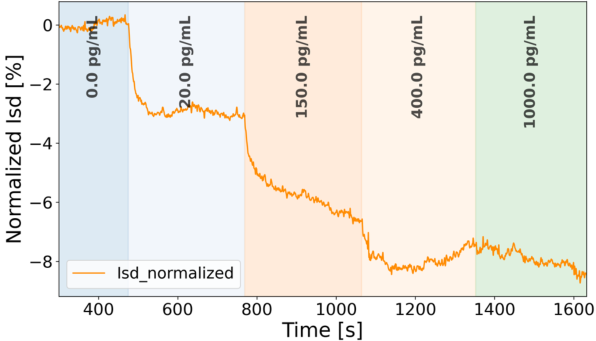
Raw Isd(t) signals were preprocessed to improve robustness for downstream modeling. First, signals were time-sorted and low-pass filtered to attenuate high-frequency noise while preserving physiological dynamics. Next, the time series was segmented into concentration-labeled exposure blocks corresponding to the protocol. To reduce boundary artifacts, short transient intervals at the start and end of each block were excluded. To enable comparability across blocks and sessions, baseline normalization was applied using the PBS reference period. Sensor response was expressed as a relative change with respect to baseline (see Figure 1), enabling stable comparisons even when absolute currents differed across experiments.
Using raw absolute biosensor signals as direct inputs to ML models can introduce variability and noise, which negatively affects model stability and generalization. To mitigate these issues, a feature engineering strategy was applied to the normalized drain–source current signal.
Figure 1: Normalized drain-source current (Isd) over time after preprocessing. The biosensor was sequentially exposed to 17β-estradiol concentrations (0–1000 pg/mL), showing a concentration-dependent decrease in Isd.
Digital Twin–Enabled Smart Health Monitoring for Reproductive Medicine 585 Each hormone exposure block was subdivided into 20 consecutive, fixed-length time windows. Within each window, a set of statistical and time-domain features was computed to characterize the local dynamics of hormone binding and signal evolution. The extracted features included the mean and standard deviation of Isd, capturing the average signal level and its variability, the change in drain–source current (ΔIsd), defined as the difference between the maximum and minimum values within the window, representing signal amplitude and the maximum signal slope, reflecting the fastest rate of current change. In addition, the area under the curve (AUC) was calculated using the trapezoidal rule to summarize the cumulative sensor response, while the signal-to-noise ratio (SNR) was used to quantify signal quality relative to noise. Together, these features describe the magnitude, stability, temporal dynamics, and reliability of the biosensor response within each window.
Biosensor signals are affected by nonlinear binding dynamics, baseline drift, and sensor variability, which limits the applicability of analytical modeling approaches. Hormone concentration estimation was therefore formulated as a supervised regression task, where ML models learn a direct mapping between engineered signal features and known hormone concentrations. Six features were selected as model inputs: mean and standard deviation of Isd, ΔIsd, maximum signal slope, AUC and SNR. Regression models were evaluated, including Linear Regression, ensemble tree-based models (Random Forest, Gradient Boosting, XGBoost, CatBoost), Support Vector Regression, and K-Nearest Neighbors. Models were trained using an 80/20 train–test split and evaluated using RMSE, R², and cross-validated (CV) RMSE.
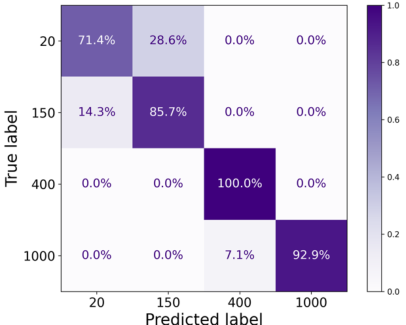
Figure 2: Confusion matrix of Linear Regression predictions. High classification accuracy was achieved across most hormone levels, including 100% at 400 pg/mL and over 85% at 150 pg/mL. Misclassifications mainly occurred between the lowest concentrations (20 and 150 pg/mL), likely due to subtle signal differences. A slight confusion between 1000 and 400 pg/mL suggests possible signal saturation at the highest concentration.
Among all evaluated models, Linear Regression achieved the lowest CV RMSE (178.27 pg/mL), indicating superior generalization. When predictions were discretized to reference concentration classes, an overall classification
accuracy of approximately 87% was achieved, with highest performance at mid-to-high concentrations and moderate confusion between the lowest levels (20 and 150 pg/mL) (see Figure 2).
MoSTHealth Framework To support continuous and personalized reproductive health monitoring, the proposed SHMS is implemented using the MoSTHealth platform (Gorelova et al., 2024). MoSTHealth provides an integrated software framework that unifies model-driven engineering (MDE), digital twins (DTs), machine learning (ML), and IoT device management into a single end-to-end environment for developing SHMS. Unlike conventional SHMS solutions, which are often manually engineered, difficult to adapt, and weakly standardized, MoSTHealth enables healthcare experts to define, test, and deploy monitoring scenarios at a high level of abstraction without requiring low-level software development. This approach reduces development complexity while improving scalability, interoperability, and early validation.
Conceptual Foundations MoSTHealth is built on three core principles. First, MDE elevates system specification from code to declarative models. Clinical entities (patients, devices, biomarkers, care plans) and workflows are defined at the model level and automatically transformed into executable artefacts, including databases, REST APIs, and simulation configurations. Second, DTs act as the central abstraction for runtime operation. Patients are represented as a DT with its own state, behavior, and temporal evolution. DTs operate both with real biosensor data during clinical use and with synthetic or historical data during simulation, enabling continuous operation across the system lifecycle. Third, simulation is embedded throughout development and deployment. Prior to real-world use, DES enables clinicians and developers to test monitoring logic, device configurations, and alert rules under controlled conditions (Gorelova et al., 2024). Once deployed, the same execution engine processes live IoT telemetry in real time, maintaining continuity between simulation and operation.
Architectural Overview of MoSTHealth At a high level, the framework consists of three interconnected layers: the MoSTHealth Core, Scenario Execution Systems, and External Integration Services. The Core contains the domain model defining patients, devices, physiological parameters, biomarkers, and care plans. This domain model is implemented using the OOH4RIA methodology (Meliá et al., 2008), which enables automatic generation of a service-oriented backend, including persistence schemas, object–relational mappings, REST interfaces, and validation logic. A web-based authoring application allows clinical experts to configure monitoring scenarios by selecting templates and defining DT behaviors, thresholds, and rules. For each configured scenario, MoSTHealth
Digital Twin–Enabled Smart Health Monitoring for Reproductive Medicine 587 generates a dedicated runtime backend. This backend manages DT state updates, rule execution, alert triggering, and simulation steps. DT snapshots are stored using standardized representations based on the Digital Twin Definition Language (DTDL), enabling structured access for downstream analytics and ML processing. MoSTHealth integrates with external IoT hubs (e.g. Azure IoT platforms) for device provisioning, telemetry ingestion, and command dispatching. This abstraction layer ensures that biosensor data from hormone biosensors and physiological wearables are semantically aligned with their corresponding DT representations, independent of vendor- specific communication protocols.
As mentioned before, ML is integrated at two complementary application levels. At the biosensor level, ML models transform the hormone biosensor’s electrical signals into clinically meaningful hormone concentration estimates. And at the patient level, ML is applied to multimodal longitudinal data, combining estimated hormone fluctuations with physiological signals and patient-reported inputs. This layer supports higher-level tasks such as pattern discovery, cycle-phase characterization, anomaly detection, and individualized prediction of clinically relevant events. Together, these two ML layers continuously update the patient-specific digital twin and provide a basis for real-time decision support for both patients and clinicians.
MoSTHealth provides dedicated user interfaces for clinicians and patients. The clinician interface displays real-time telemetry, DT states, predicted trajectories, and alert conditions. The patient mobile application delivers personalized feedback from medical team, care plans with task reminders, and educational content related to menstrual cycle physiology and fertility treatment.
Through its standards-oriented design, MoSTHealth enables seamless integration of SHMS into clinical workflows while remaining aligned with European regulatory and interoperability requirements. The platform supports structured health data exchange using HL7 FHIR resources, enabling integration with electronic health record systems and compliance with the interoperability mandates of the European Health Data Space (EHDS) regulation. From a regulatory perspective, the SHMS is designed in accordance with the EU Medical Device Regulation (MDR, EU 2017/745), under which both the biosensor and software components qualify as medical devices requiring CE certification. The system incorporates privacy-by- design and privacy-by-default principles to ensure compliance with the General Data Protection Regulation (GDPR) when processing sensitive health data, including hormone measurements and reproductive health information. The ML components within MoSTHealth are implemented exclusively as clinical decision-support tools. They provide predictions, trend analysis, and early-warning indicators to support, but not replace clinical judgment. No therapeutic or diagnostic decision is taken autonomously by the system. All medical actions remain under the responsibility of qualified healthcare professionals. In line with the EU Artificial Intelligence Act (Regulation 2024/1689), the system therefore emphasizes human oversight, transparency, and explainability, and integrates mechanisms for monitoring model performance and data drift without automated clinical intervention.
By combining regulatory compliance, standardized data exchange, and DT-based personalization, proposed SHMS provides a scalable and legally robust foundation for data-driven, patient-centered infertility care, bridging biosensor innovation with real-world clinical deployment across European healthcare systems.
CONCLUSION
This work presents an ongoing research and development effort toward a Digital Twin–enabled Smart Hormone Monitoring System (SHMS) for personalized infertility care. The project is carried out in close collaboration between TU Dresden, where the minimally invasive hormone biosensor is being developed, and the University of Alicante, where data analysis, machine learning methods, and software infrastructure for digital twin integration are actively under development. In this study, we validate the hormone-sensing and sensor-level digital twin components under controlled laboratory conditions, establishing a technical foundation for continuous hormone monitoring.
The proposed SHMS is distinct from currently available fertility technologies, which are predominantly consumer-oriented lifestyle devices that operate independently of clinical workflows. In contrast, the novelty of our approach lies in its direct integration with medical teams and assisted reproduction clinics, enabling bidirectional communication between patients and clinicians. This design aims to reduce patient uncertainty and feelings of abandonment during complex fertility treatments, while simultaneously providing clinicians with structured, real-time feedback on protocol adherence.
Interviews with physicians from assisted reproduction clinics highlighted the clinical need for reliable confirmation of time-critical actions, such as hormone injections, which are currently managed through manual messages or phone calls. The SHMS directly addresses this requirement through automated monitoring, notifications, and protocol tracking within a clinical decision-support framework.
Future work will focus on integrating longitudinal physiological data from wearable devices into the patient digital twin and validating the system in clinical settings. The main technological concepts and hormonal biosensor underlying SHMS have been submitted for patent protection, which underscores the practical and clinical significance of this work.
ACKNOWLEDGMENT
This research was funded by DFG project “Wearable sensor-actuator microsystems for the continuous monitoring of reproductive hormones during assisted fertilization” (WeRepro, grant agreement ID: CU44/66-1) and by the University of Alicante under the project “TWINS4FERTILITY: an IoT healthcare framework for fertility treatments” (acronym: UAFPU2021). This work was additionally funded by the VolkswagenStiftung (Grant No. 96632 and 9B396) project, German Research Foundation (DFG) under the Cluster
Digital Twin–Enabled Smart Health Monitoring for Reproductive Medicine 589 of Excellence CARE: Climate-Neutral and Resource-Efficient Construction (EXC 3115, project number 533767731), the Cluster of Excellence REC²: Responsible Electronics in the Climate Change Era (EXC 3035), and the Cluster of Excellence CeTI: Centre for Tactile Internet with Human-in-the- Loop (EXC 2050).
REFERENCES
Cromack, S. C., & Walter, J. R. (2024). Consumer wearables and personal devices for tracking the fertile window. American Journal of Obstetrics and Gynecology, 231(5), 516–523. https://doi.org/10.1016/j.ajog.2024.05.028 Data 608 - Final Project Proposal. (n.d.). Retrieved January 9, 2026, from
https://rstudio-pubs-static.s3.amazonaws.com/957255_923a5ba8e2ef 411591c975f0edb26307.html Gorelova, A., Meliá, S., & Gadzhimusieva, D. (2024). A Discrete Event Simulation of Patient Flow in an Assisted Reproduction Clinic With the Integration of a Smart Health Monitoring System. IEEE Access, 12, 46304–46318. https://doi. org/10.1109/ACCESS.2024.3380021 Infertility. (n.d.). Retrieved September 30, 2024, from https://www.who.int/
news-room/fact-sheets/detail/infertility Johnson, Z., & Saikia, M. J. (2024). Digital Twins for Healthcare Using Wearables. Bioengineering (Basel, Switzerland), 11(6). https://doi.org/10.3390/ BIOENGINEERING11060606 Kilungeja, G., Graham, K., Liu, X., & Nasseri, M. (2025). Machine learning-based
menstrual phase identification using wearable device data. Npj Women’s Health 2025 3:1, 3(1), 1–10. https://doi.org/10.1038/s44294-025-00078-8 Lyzwinski, L., Elgendi, M., & Menon, C. (2024). Innovative Approaches to Menstruation and Fertility Tracking Using Wearable Reproductive Health Technology: Systematic Review. Journal of Medical Internet Research, 26(1). https://doi.org/10.2196/45139 Meliá, S., Gómez, J., Pérez, S., & Díaz, O. (2008). A model-driven development
for GWT-based rich internet applications with OOH4RIA. Proceedings - 8th International Conference on Web Engineering, ICWE 2008, 13–23. https://doi. org/10.1109/ICWE.2008.36 NIAID Data Discovery Portal | GSHR in The BioCycle Study. (n.d.). Retrieved January 9, 2026, from https://data.niaid.nih.gov/resources?id=nichd_dash_dataset_428109 Niggli, A., Rothenbühler, M., Sachs, M., & Leeners, B. (2023). Can Wrist-Worn
Medical Devices Correctly Identify Ovulation? Sensors (Basel, Switzerland), 23(24), 9730. https://doi.org/10.3390/S23249730 Organization, W. H. (2023). 1 in 6 people globally affected by infertility: WHO.
https://www.who.int/ Sahal, R., Alsamhi, S. H., & Brown, K. N. (2022). Personal Digital Twin: A Close Look into the Present and a Step towards the Future of Personalised Healthcare Industry. Sensors 2022, Vol. 22, Page 5918, 22(15), 5918. https://doi.org/10.3390/ S22155918
Smeenk, J., Wyns, C., De Geyter, C., Kupka, M., Bergh, C., Saiz, I. C., De Neubourg, D., Rezabek, K., Tandler-Schneider, A., Rugescu, I., Goossens, V., Gliozheni, O., Hambartsoumian, E., Strohmer, H., Petrovskaya, E., Tishkevich, O., De Neubourg, D., Bogaerts, K., Balic, D., … Ewans, A. (2023). ART in Europe, 2019: results generated from European registries by ESHRE†. Human Reproduction (Oxford, England), 38(12), 2321–2338. https://doi.org/10.1093/HUMREP/DEAD197 Tang, C., Yi, W., Occhipinti, E., Dai, Y., Gao, S., & Occhipinti, L. G. (2024). A
roadmap for the development of human body digital twins. Nature Reviews Electrical Engineering 2024 1:3, 1(3), 199–207. https://doi.org/10.1038/ s44287-024-00025-w Thigpen, N., Patel, S., & Zhang, X. (2025). Oura Ring as a Tool for Ovulation Detection: Validation Analysis. Journal of Medical Internet Research, 27(1), e60667. https://doi.org/10.2196/60667 Wang, Y., Park, J., Zhang, C. Y., Jukic, A. M. Z., Baird, D. D., Coull, B. A., Hauser, R.,
Mahalingaiah, S., Zhang, S., & Curry, C. L. (2025). Performance of algorithms using wrist temperature for retrospective ovulation day estimate and next menses start day prediction: a prospective cohort study. Human Reproduction (Oxford, England), 40(3), 469–478. https://doi.org/10.1093/HUMREP/DEAF005 Yu, J. Le, Su, Y. F., Zhang, C., Jin, L., Lin, X. H., Chen, L. T., Huang, H. F., & Wu, Y. T. (2022). Tracking of menstrual cycles and prediction of the fertile window via measurements of basal body temperature and heart rate as well as machine- learning algorithms. Reproductive Biology and Endocrinology : RB&E, 20(1). https://doi.org/10.1186/S12958-022-00993-4
LISTED IN THE AHFE DIGITAL BOOKSTORE CATALOGUE
Explore the complete digital volume
Human Interaction and Emerging Technologies (IHIET-AI 2026): Artificial Intelligence and Future Applications
Read this individual research paper free through the original publisher, or explore the full digital proceedings book.
ISBN 978-1-964867-77-9
Explore this ISBN in the AHFE Bookstore ↗Listed in the July 2026 bookstore catalogue; search by ISBN to confirm current availability · Digital book purchase optional