Juanjuan June He (2023). Eyewear Design: The Journey to Improve Fitting for a Diverse Population. In: Interdisciplinary Practice in Industrial Design. AHFE Open Access, vol. 100, pp. 79–86. https://doi.org/10.54941/ahfe1002973
Eyewear is a product at the intersection of medical devices and fashion accessories. It is an everyday object most people take for granted without much consideration of its functionality and symbolic meaning. Many consumers do not know that their frames are not fitting them well, leading to potential damage to their visions. According to 2020 census data, America is diversifying racially and ethnically, which requires the ergonomics of eyewear to be diverse as well. Currently, there are various terminologies of eyewear fittings on the market, including Standard Fit, Alternative Fit, Elevated Fit, Low-Bridge Fit, Asian Fit, etc. Without a standard regulation for eyewear fitting, consumers often have a hard time understanding the differences and finding a good fit for themselves. This paper introduced an Eyewear Design Studio course initiated in the Fall 2022 term at Drexel University, collaborating with an eyewear start-up firm Knows Eyewear. It explores the students’ eyewear design journey and uses case studies to discuss how they provided better-fitting eyewear designs to diverse users and equal access to better vision.
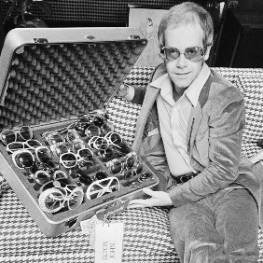
Eyewear is such a common product that users tend to take it for granted. Whether wearing sunglasses for outdoor activities or wearing optical glasses for vision correction, eyewear is closely related to everyday life. It’s a fashion statement on the consumer’s face, also a necessary medical device many users cannot live without. Numerous celebrities and designers own their eyewear brands to express themselves through styles, including Elton John, Iris Apfel and Dan Levy, see Figure 1. If you go to an optician’s store to check your vision, you will most likely see a variety of options as well. When consumers purchase clothing from retail stores, they know how to try the items on in the fitting rooms to figure out what size fits them the best. Eyewear has a variety of sizes, too, but few consumers understand how to find a perfectly fitting pair of eyewear that works for their unique facial structures.
If a consumer goes to an eyewear shop to purchase a pair of glasses, they often encounter a variety of terminologies regarding fitting, including Stan- dard Fit, Alternative Fit, Elevated Fit, Low-Bridge Fit, Asian Fit, etc. Do you know which one is right for you? Most likely not. There is no industry stan- dard for how to name different fittings. While some consumers would go to
Figure 1: Elton John and his sunglass line, 1974. Photo: D. Morrison/Express/Getty Images.
retail staff to ask for guidance, others would pick the ones they assume look great on them without understanding the terminologies. After all, they are not opticians, why should they know?
Every mass-produced consumer product is designed by designer(s) and manufactured by factories. Eyewear is not an exception. Eyewear designers are the masterminds behind these pieces. However, there are few academic eyewear design programs around the world. As a result, the most relevant majors would be accessory design or medical device design. The former major is more on the fashion side, without a comprehensive consideration of human ergonomics. The latter usually does not put fashion into its consideration.
Where do eyewear designers come from then? Currently, this is still a quite specialized field that highly skilled eyewear designers follow a practice similar to the apprentice model in the old time. Eyewear designers learn their crafts after they are in the field, usually mentored by a senior designer for a few years.
To introduce eyewear design methodologies to product design students, in the 2022 Fall term, June He, assistant professor of Product Design at Dre- xel University, created an Eyewear Design Studio Course for junior product design students. June He is an eyewear designer who worked in the eyewear industry in New York City for more than a decade before joining Drexel Uni- versity. She has extensive experience working for a variety of eyewear brands across the world. She aims to bring industry knowledge and experience to the academic world by collaborating with eyewear firms in the field. For the first eyewear studio course in the fall term of 2022, she collaborated with the eyewear firm Knows Eyewear to make this happen.
ERGONOMICS OF EYEWEAR “Poor vision is the world’s largest unaddressed disability and yet is one that the world has forgotten (Chen, 2017).” According to 2020 census data, Ame- rica is diversifying racially and ethnically (Jensen et al. 2021), which requires the ergonomics of eyewear to be diverse as well. Therefore, exploring diverse facial structures and understanding the fitting of eyewear is the first step of this course, with the goal to provide equal access to better vision for everyone.
Eyewear Design: The Journey to Improve Fitting for a Diverse Population 81
At the beginning of the course, the instructor introduced a two-week-long Design Sprint project, in which students paired with a team member to design a pair of glasses for each other to wear. The key knowledge to teach students here was to guide them to understand the proper terminology, methods, and tools to correctly capture the measurements of each person’s facial structure. Since the students in this class were quite diverse, the instructor matched each student with a student who has different facial structures from each other. In that case, students understood the concept and methods to design with the user, instead of designing out of their own needs, which often happens if without proper guidance.
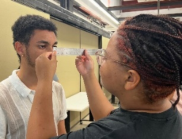
The Design Sprint began with student interviewing partners, data analysis, insights generation, mood board making, concept ideation, and low-fidelity prototype making and testing. At the interview session in the classroom, stu- dents were instructed to use rulers and calipers to measure key measurements from their partners, such as face width, Pupillary Distance (PD), estimate temple length, and nose pad heights, see Figure 2. They also learned how to measure eyewear’s key measurements like face front width and height, face wrap angle, Pantoscopic angle, and more. After two weeks of training, students gained basic knowledge and skills to carry to their collaborative projects with the eyewear firm Knows Eyewear.
Figure 2: Students measuring each other’s facial structures in the Design Sprint.
COLLABORATIVE PROJECT At the Design Briefing from Knows Eyewear, the instructor structured the class in a way that each student can choose their interested area to focus on. Three task sheets were posted for students to choose from: Eyewear Design, UX/UI Design and Social Media Content Design. 2/3 students in the class chose to work on eyewear design and each of these students was assigned to deliver three pairs of final eyewear pieces: a pair for Knows Eyewear; a pair for themselves; and a pair of conceptual eyewear. In this paper, we will focus primarily on the eyewear design process.
The Field Trip Before diving into the design process, the instructor grouped students to con- duct field trips to selected eyewear retail stores across Philadelphia, where Drexel University is located. The purpose of visiting these stores is for stu- dents to gain knowledge of existing eyewear fitting, fashion, trends, and materials on the market. After the field trips and as part of the assignment, students submitted their photos and analysis of their discoveries. This exe- rcise was necessary for students to understand the landscape of the eyewear
82 He
industry. They were enthusiastic about going out to the city and exploring the eyewear offerings.
Eyewear and Facial Analysis Knows Eyewear was founded in December 2020 with one mission: to elevate the world’s expectations of how eyewear should fit (Knows Eye- wear, 2022). The distinctive feature of its products is the customizable components to fit diverse users. Apart from small, medium, and large sizes for consumers like many other brands, it provides three pairs of nose pads for users to choose whichever best fits them. Furthermore, Knows Eyewear provides an option to bend the eyewear temple so the length of the temples can be adjusted according to the specific needs of the user.
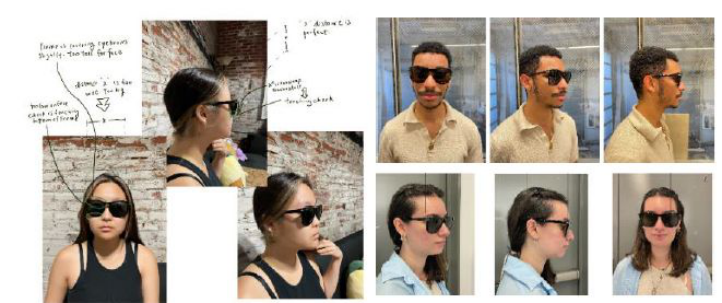
Knows Eyewear provided students with sample sunglasses ranging in diffe- rent sizes and fitting options. One of the assignments for students was to wear different fittings to figure out the best combination or provide an analysis of why they do not fit. Students took photos of their classmates’ faces from the front view, side view, and perspective view, and wrote about their wearing experiences (Figure 3).
Figure 3: Students’ Visual Analysis of Sunglasses from Knows Eyewear.
KEY DESIGN DIRECTIONS Through brand research and analysis, students came up with many conce- pts in the initial brainstorming session. They were mostly centered on these themes:
Design methods to enable the consumer to choose better-fitting frames
Design better-fitting eyewear pieces
Exploration of personal styles
Exploration of craftsmanship We will review each direction with selected students’ projects as case studies in this paper.
Eyewear Design: The Journey to Improve Fitting for a Diverse Population 83
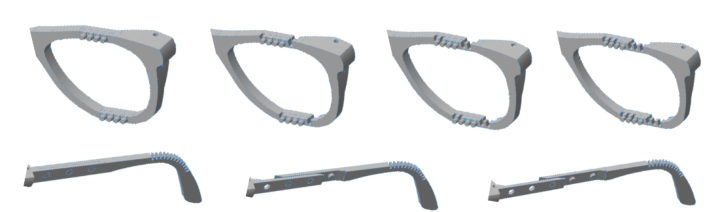
Frame Size Guide There are various mixed eyewear fitting options on the market. The most difficult part for consumers to decide is which frame fits them better. For retailers with physical stores like LensCrafters and Warby Parkers, consu- mers can visit their retail spaces and try on the frames. However, for online retailers like Knows Eyewear, how to communicate the size options to the consumers is of great importance. One of the students in the course, Jessica Niebuhr, developed a solution Frame Size Guide to guide the individual con- sumer in understanding their own best fitting. Frame Size Guide is a physical frame specifically designed in a way that seven adjustable components can be manipulated to represent different frame sizes, see Figure 4. This frame will be shipped to potential customers to figure out their best fitting and guide them to buy a well-fitted pair of eyewear. As part of the process, the student proposed a 10% discount to be applied on the final purchase if the guide frame is mailed back to the company.
Based on the design, the front width of the frame can be adjusted between 124 mm (XS), 130 mm (M), 136 mm (L) to 142 mm (XL), and the tem- ple length can be adjusted to 129 mm (S), 144 mm (M) to 159 mm(L). See Figure 5 for reference.
Figure 5: The front width and temple length can be adjusted to different sizes.
Currently, Jessica Niebuhr is working on a second mechanism to adjust the Frame Size Guide with the benefit of reducing the number of pieces and making it easier to adjust, see Figure 6 for reference.
Construction and Fitting The pair of sunglasses that another student, Kaitlyn Lu, designed for Knows Eyewear is to combine aesthetics and the concept of customization together.
84 He
Figure 6: A second mechanism for the Frame Size Guide is under development.
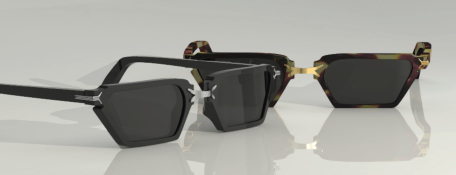
As you can see from Figure 6, the form of the nose bridge of the sunglasses resembles the form of the brand icon on the endpiece of the face front. In the initial design, the nose bridge could also be exchanged with different widths to fit diverse users’ facial features, achieving better fitting without compromising the look. See Figure 7.
Figure 7: Student Kaitlyn Lu’s sunglasses design for Knows Eyewear.
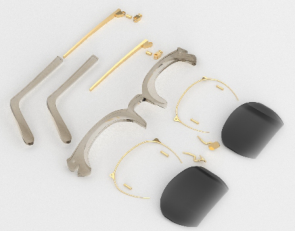
Figure 8 shows student Kaitlyn Lu’s other pair of sunglasses Dove Tail designed for herself. From the knolling photo, she displayed all the small components including both metal and acetate parts. It instructs the audience to understand the construction of this unique pair of sunglasses. The metal nose pads are adjustable so they can fit various nose structures.
Figure 8: Student Kaitlyn Lu designed this pair of sunglasses Dove Tail for herself.
Personal Style and Craftmanship Apart from designing for Knows Eyewear, students devoted time and passion to also designing for themselves. Here, they made sure the sunglasses were
Eyewear Design: The Journey to Improve Fitting for a Diverse Population 85
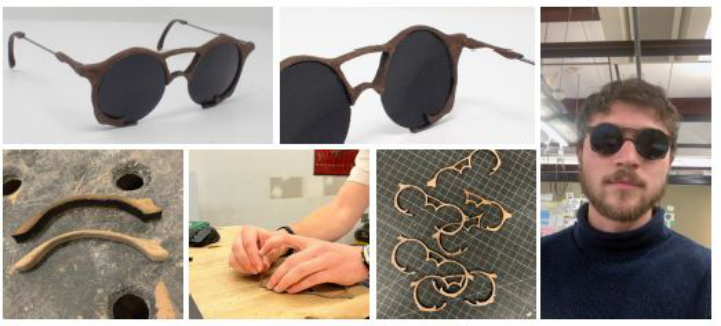
designed to fit their own faces by testing prototypes and iterating them based on testing results. Inspired by their own personal styles and passions, they made the frames using tools such as laser cutting machines, 3D printers and other model shop tools. For instance, student Ben Muchin handcrafted his model The Victuras using dark walnut and aluminum wire to represent the natural form of the materials. He experimented with different thicknesses, cuts, colors and forms to explore the best combination of form and fitting. See Figure 9 for Ben’s work progress.
Figure 9: Student Ben Muchin handcrafted this pair of sunglasses The Victuras.
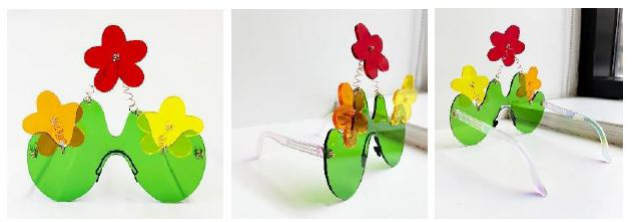
Some students played with their bold conceptual ideas with the fittings and ergonomics in mind. Student Achiraya Sripa achieved this task brillian- tly. Injecting fun forms and vibrant colors into her design expression, she delivered a great sense of fashion in her prototype. Figure 10 shows student Achiraya’s design.
Figure 10: Student Achiraya Sripa made this pair of conceptual sunglasses with the laser cutting machine.
These case studies are only the tip of the iceberg. Many other students explored numerous ways to deliver innovative solutions, fittings and forms to diverse users. As product designers, we used to talk a lot about universal design, creating products or services that are accessible to a wide range of
86 He
people. Through the eyewear design studio course, students learned that uni- versal design is not enough. Everyone is different. We need to utilize various design research tools to understand the value of customization and flexibi- lity of designed objects. We shall include an empathic design mentality to pay attention to each user’s specific needs. Hopefully, in that way, we can provide better-fitting eyewear to diverse users and equal access to better vision.
REFLECTION This course introduced product design students to the skills and knowledge of eyewear design and its relevant visual communication to consumers. It provides real industry experience in the academic environment. Students con- ducted research, design, and prototype testing with a client’s needs in mind, and experimented with their conceptual ideas as well. Most importantly, they gained knowledge of eyewear fitting, increased the awareness of the diver- sity of consumers, and understood how to measure their facial structures for design purposes.
Although this course was about eyewear design, it provided the context for students to consider designing for a more diverse society using human anthropometric measurements moving forward. It investigated the concept of human-centered design from science-based data collection and fashion- based sensory experience. The collaboration with Knows Eyewear motivated students to cultivate the presentation skills facing a client, preparing them for professional practice.
ACKNOWLEDGMENT
The author would like to acknowledge Knows Eyewear for supporting STEAM education and making this journey fruitful for students.
REFERENCES
Chen, J. (2017, October 13). World’s lack of vision is costing us our eyesight. Forbes.
Retrieved January 4, 2023, from https://www.forbes.com/sites/insideasia/2017/ 10/13/worlds-lack-of-vision-is-costing-us-our-eyesight/?sh=55a1658e3e28 Jensen, E., Jones, N., Rabe, M., Pratt, B., Medina, L., Orozco, K., & Spell, L. (2021, August 12). The chance that two people chosen at random are of different race or ethnicity groups has increased since 2010. Census.gov. Retrieved January 4, 2023, from https://www.census.gov/library/stories/2021/08/2020- united-states-population-more-racially-ethnically-diverse-than-2010.html#:~: text=Using%20the%20same%20Diversity%20Index,2020%20from%2054.9% 25%20in%202010. Knows Eyewear. (2022). Retrieved January 16, 2023, from https://www.knowseye
wear.com/about Wright, A. (2022). As Elton John Launches His Line of Glasses and Shades, We Chart the Rockstar’s Impact on Fashionable Eyewear - Everything Zoomer. Retrieved January 16, 2023, from https://www.everythingzoomer.com/arts-ente rtainment/2022/03/10/as-elton-john-launches-his-line-of-glasses-and-shades-we -chart-the-rockstars-impact-on-fashionable-eyewear/
LISTED IN THE AHFE DIGITAL BOOKSTORE CATALOGUE
Explore the complete digital volume
Interdisciplinary Practice in Industrial Design
Read this individual research paper free through the original publisher, or explore the full digital proceedings book.
ISBN 978-1-958651-76-6
Explore this ISBN in the AHFE Bookstore ↗Listed in the July 2026 bookstore catalogue; search by ISBN to confirm current availability · Digital book purchase optional