Sofia Soledad Duarte, Laura Anselmi, Valentina Rognoli (2023). Emerging materials fostering interdisciplinary collaboration in Materials Design. In: Interdisciplinary Practice in Industrial Design. AHFE Open Access, vol. 100, pp. 119–129. https://doi.org/10.54941/ahfe1002978
Materials Design is a recognized emerging and growing area in design practice and research that converges different fields and approaches to addressing a holistic perspective of materials in and for design. Therefore, it incorporates knowledge from various disciplines, like engineering and science. Direct interdisciplinary collaboration between engineers, scientists, artists and designers can benefit projects whose purpose is to bring innovation regarding materials and design. We assume this interdisciplinarity is a crucial practice for developing the emerging field of Materials Design with a sustainable and circular perspective. This article conveys the findings of an empirical collection of case studies on emerging materials and product design. The results demonstrate the sustainability and circularity orientations they present and different disciplinary cooperation to generate innovative outcomes. The authors examined ten European enterprises that present products driven by emerging materials from alternative sources to support the statement. The paper identifies and reflects on the importance and value of collaboration. It aims to disseminate knowledge about the field of Materials Design and intends to highlight that interdisciplinary collaboration in this area can be favourable for achieving a sustainable paradigm and more responsible production and consumption patterns.
Design focused on product development has significantly improved people’s quality of life. For decades, designers have concentrated on the form and function of products and artefacts to satisfy users’ needs, always creating innovative and more up-to-date products. However, many products crea- ted to provide satisfaction also brought some problems. For example, they have led to an excess of obsolete and disused objects and artefacts, which now form part of the vast amount of waste on our planet and contribute to environmental problems.
In this scenario, Materials Design (MD), which today is a recognised branch within the design discipline (Pedgley, Rognoli and Karana, 2021), started to develop strategies and methods to address environmental issues
arising from traditional practices related to materials and product develo- pment (Karana, Pedgley and Rognoli, 2014). This field and approach was born to create projects with more awareness of materials for design and evo- lved to consider the holistic study of materials, including user experience, technologies and, lately, sustainability aspects (Pedgley, Rognoli and Karana, 2021). In addition, the boundaries between design and materials are blur- ring as researchers and designers explore new ways of using materials and their processing capabilities (Barati and Karana, 2019). Designers today are exploring alternative sources and production methods, seeking support from different disciplines to address environmental sustainability issues.
Through analysing a collection of empirical cases involving materials and products in the above-mentioned direction, we provide results and conside- rations that led us to affirm that the interdisciplinary perspective in MD can generate innovation to accelerate the development of a sustainable and circu- lar paradigm. In conclusion, this paper aims to raise awareness of MD as an emerging and growing interdisciplinary field.
BACKGROUND OF THE STUDY Materials Design (MD) has been recognised as a branch within the discipline of industrial design for more than a decade. Based on studies in the field (Rognoli and Levi, 2005), it derives from the importance given to the senso- rial perception and expressive dimension of materials, part of the legacy of the Bauhaus and other design approaches such as Design primario (a cen- tral theme in the relationship between material culture and design in Italy in the 70s and 80s) where it was proposed to see materials as bearers of a specific and culturally recognisable identity, not only as carriers of the form (Castelli and Mitchell, 2014). In 1986, Ezio Manzini presented The Materials of Invention, a story of materials for design beyond technical and functio- nal specifications, delving into questions of perception, personal and social experience and the culture of materials, which gave impulse to materials and design, constituting new bases for innovation.
While the most traditional type of MD was for decades characterized by the development of new and advanced materials with suitable characteri- stics for a given application (thus that require more engineering knowledge), a materials perspective from design and its possible interventions beyond finishing and colour did not cease to increase. For several years, practices, research, and strategies emerged that strengthened the concept of the MD; for example, materials libraries such as Materials Connexion, founded in 1997, set out as a resource for designing and interpreting materials as more than just functional elements of engineering.
In 2002, materials engineer Mike Ashby and industrial designer Kara John- son presented an issue exploring the role of materials and their processing in product design, with a particular emphasis on creating both desired aesthetics and functionality. This work was crucial in shaping the current understanding of MD by merging design and engineering knowledge and fostering collabo- ration. Under the design perspective, the MD was developing to establish itself as a complex field that not only aims to use materials for their technical
characteristics. As stated by Rognoli and Levi in 2005, “materials design con- sists of a design research that makes the subject of materials the very basis of the project”; materials and their languages began to acquire autonomy in design, and the practice in MD was defined as the development of specific materials capable of responding to new design needs, whatever they may be (Andrea Branzi in Rognoli and Levi, 2005).
For some years, materials and design concepts have been further expanded, and new strategies and tools have been produced to address it, driving new definitions for the experiences people have with and through the materials of a product (Rognoli, 2004; Karana, Hekkert and Kandachar, 2008; Karana, 2009). In recent years the foundations that contributed to establishing know- ledge in this area have been laid (Karana, Pedgley and Rognoli, 2014), and the MD has been extended in relation to user experience, sustainability and potential new intervention technologies. In 2020, research at the European level has been engaged in this area by funding the MaDe project (2020). The project aimed to promote circular economies and a sustainable future by highlighting the role of material designers as agents of change through partnerships with cultural and design institutions and showing their responsi- bility in researching, experimenting, advising, educating, and communicating about the potential of materials across sectors. In 2021 the latest publication of Materials Experience: Expanding territories of materials and design (Ped- gley, Rognoli and Karana, 2021) was published. It deepened into MD and the material designer perspectives. It explores critical perspectives on the new and emerging relationships between designers, materials and artefacts. It also describes how these concepts have been expanded in the context of design education with tools and techniques. The authors assert that MD is now emerging as “a new transdiscipline, with materials designers as transdiscipli- nary practitioners capable of designing materials with unique functionalities and experiential qualities”.
As Barati and Karana (2019) explained, there is a big difference in this area today compared to the 1990s; it is now much easier to follow this path due to the democratisation of technologies, improved accessibility to tools and, most importantly, access to information through the Internet and social media platforms. Today, the “design of materials” and the “materi- als of design” are blurring to discover new possibilities in materials’ form, function, experience, and processing capabilities.
MD today is a recognised, emerging and growing field within the design discipline that encompasses materials and design practice and theory, inclu- ding topics beyond those named, such as self-production (Rognoli et al., 2015; Ayala-Garcia, Rognoli and Karana, 2017); new practices of biode- sign and biofabrication (Myers, 2012; Camere and Karana, 2018; Ginsberg and Chieza, 2018); interactive connected and smart materials (Rognoli and Ferraro, 2021); design with emerging materials and technologies (Romani, Rognoli and Levi, 2021) to name just a few.
A collection of emerging material and product design projects is presen- ted below to understand the current state of MD-related practice outside academia and the potential of interdisciplinary collaboration to generate
innovation and accelerate the development of a sustainable paradigm. Through the analysis of this collection of empirical cases, interdisciplinary collaboration is explored, focusing on sustainable and circular approaches to address current environmental problems such as the scarcity of virgin resources and the overproduction of waste.
METHOD
The exploratory approach of this work consisted of desk research in academic databases to define the background of the study. Information was gathered to frame MD as an emerging area of practice and research. Following this, a qualitative approach was used to investigate how interdisciplinary collabo- ration between designers and other disciplines is fostered in MD projects to drive sustainable and circular innovation.
Methodologically, a collection of case studies has been prepared to under- stand a particular phenomenon and issue. This type of research involves an examination of different examples to identify common patterns that emer- ges across them (Yin, 2018). The selection of cases was a crucial aspect of this approach. As the researcher’s biases can influence the selection process and the outcome, the study provides full transparency in the selection criteria used.
We selected 10 case studies and collected official data to analyze them. The study sheds light on current interdisciplinary collaboration in projects from different European enterprises interested in innovation, emerging mate- rials from alternative sources and design, sustainability, and circularity. This analysis helped support our assumption that interdisciplinary practice in MD is essential.
Case Selection and Analysis Procedure Projects of emerging materials and products with a focus on sustainable and circular approaches have been a trending topic for design in recent years; therefore, applying criteria for the inclusion and exclusion of examples in the collection was crucial to ensure that the sample was representative, relevant, bias-free, and sufficient to support the findings, increasing the internal and external validity of the study (Stake, 1995; Gerring, 2017; Yin, 2018). The first criterion was to select examples with significant attention in creating innovation through materials and design, considering the emerging material at the heart of the project. The second criterion was that the examples appea- red in the last ten years or where the enterprises were established within that period. It means that examples must be contemporary to work within the current state of the art. The third criterion was to include examples demon- strating circular and sustainable orientations. Finally, we excluded cases where it was difficult to find information on the team members’ backgrounds involved in the projects.
The cases were found online through design magazines like Dezeen and Design wanted social media platforms like LinkedIn and Instagram and web- sites like Material District. Secondly, intriguing cases were discovered during
in-person events like material conferences, design lectures, and visits to mate- rial libraries. The phase of enquiry and classification of the cases was carried out using qualitative methods, such as desk research by collecting infor- mation from the producers’ official websites, LinkedIn profiles and official videos or interviews.
According to Yin (2018) and Gerring (2017), the next step in the case research was to transcribe and organize the data collected to normalize it as a strategy for finding insights. We collected descriptive information from the materials, the design related, the alternative sources, the type of colla- boration, the sustainable and circular approach, and the disciplinary fields involved in each project and enterprise. Strategies for reducing and tran- sforming information into smaller phrases were used to identify themes and patterns, and hints were revealed by matrix comparison. These strategies allowed us to deepen the importance of interdisciplinary collaboration in materials and design projects with a sustainable and circular perspective and to draw conclusions about the research question.
The information available for many examples was often limited and, in some cases, unclear or inconsistent. Therefore, the selection of cases was limi- ted to a small number; the selection may not represent the entire population of existing cases. Future research should include a broader range with a global perspective.
RESULTS
As stated before, we undertook this research to argue that interdisciplinary collaboration is crucial in the emerging field of MD and will enhance the development of materials and products with sustainable and circular orienta- tions. Through the results from the multiple examples selected, we supported our argument.
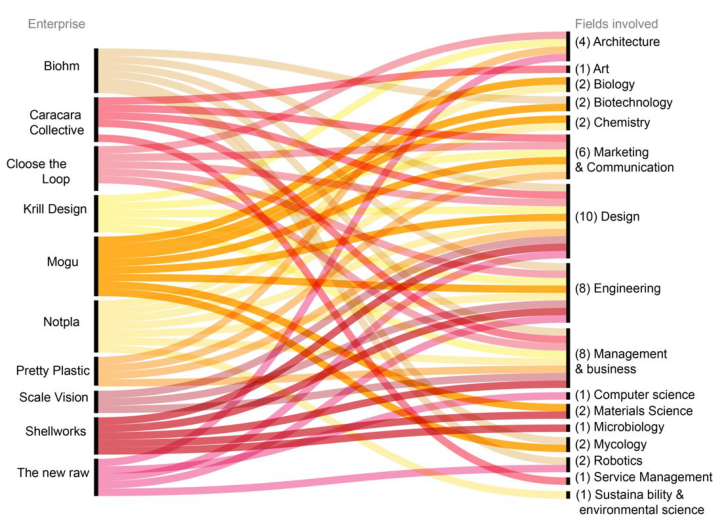
The ten companies listed in Table 1 disclose, through their communication channels, the collaboration between professionals from different disciplines working on developing their materials and products. They all have an internal interdisciplinary team; many also provide information on external interdisci- plinary collaboration involving specific actors depending on the project. To identify the current disciplines collaborating in the selected projects, precise background information on the team members was sought through the offi- cial website and platforms such as LinkedIn. Through the Rawgraphs 2.0 software, Figure 1 was generated to visualize the data and obtain the results in a more direct way. It was possible to see that all enterprises have a team built by at least four disciplines to manage and develop design innovation.
Figure 1 confirms that all enterprises include design discipline. The fol- lowing sub-disciplines are contained: product design, design engineering, industrial design, biodesign, graphic design, and interior design.
The discipline of engineering, which is included in eight enterprises, com- bines the following sub-disciplines: mechanical engineering, materials engi- neering, chemical engineering, civil engineering, environmental engineering, informatic engineering and structural engineering. This analysis revealed that almost all companies include Management and Business. On the other hand,
Table 1. Selected examples for the study (Prepared by the authors. 2023).
Table available in the original PDF paper.
Location Designed by Products website www.notpla.com
9 London Shellworks Spready from Vivomer material Packaging
www.thenewraw.org
10 Netherlands The new raw The Pots Plus collection Street furniture
Figure 1: Fields involved in each enterprise. Between brackets the number of enterpri- ses including that discipline or field. (Prepared by the authors, 2023).
marketing and communication is a field that stands out in more than half of the examples, while architecture is found in less than half of them. Materials science, robotics, mycology, biotechnology, biology, and chemistry are inclu- ded in at least two examples, while sustainability, microbiology, computer science, art, and service management are found only in one.
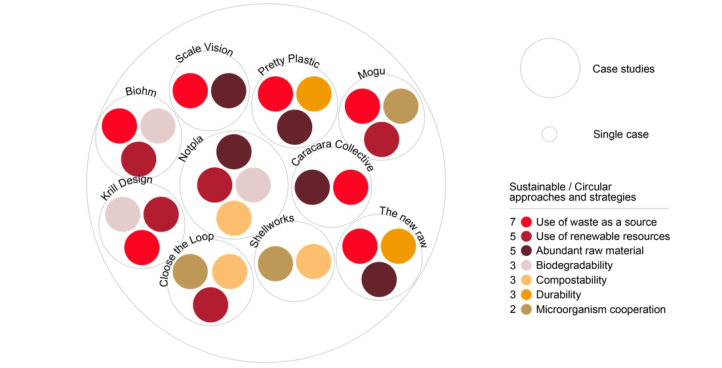
Evidence shows that the examples use different material strategies to orient their projects to sustainability and circularity. The selected collection involved seven, and Figure 2 illustrates this finding. At least each example prosed two approaches, while just one presented four. A clear trend towards using waste as a source and renewable resources was detected; both strategies are related to using abundant raw materials. Other approaches well recognized among the examples are the use of microorganism cooperation, biodegradability, compostability and durability.
In conclusion, one finding was of great concern. It was observed that the selected examples had similar applications and came from repeated countries. However, these unexpected results helped generate debate and did not negati- vely influence our argument. What follows is a discussion that interprets the most significant results to shed light on the research purpose of this study.
Figure 2: Approaches oriented to sustainability and circularity concepts used to develop materials. (Prepared by the authors, 2023).
DISCUSSION
The discussion generates considerations for interdisciplinary collaboration to be enhanced and valued as a crucial aspect of MD practice and resea- rch. This work aims to broaden the knowledge of this evolving area and hopes to contribute to creating strategies to foster related innovation that supports a sustainable and circular paradigm with responsible production and consumption patterns. Several authors have deepened the importance of collaboration between the design discipline and other fields to expand perspe- ctives in research, obtain better results or improve teamwork (Frayling, 1993;
Peralta, 2013; Cross, 2019), however today, interdisciplinary collaboration in the practice and study of materials for design in relation to sustainability and circularity is not widely reported.
The literature has revealed that authors have considered interdiscipli- nary collaboration a critical strategy to foster innovation, new materials and sustainable or circular design aspects. For example, according to pro- fessor and material expert Sasha Peters (2013), interdisciplinary dialogues between research, technology and design will lead to the development of sustainable products in which new types of materials will play an increa- singly important role. For their part, academics Rognoli and Ayala-García (2021) associated interdisciplinarity collaboration with the DIY-Materials approach. It combines making, crafting and personal fabrication with design, advanced and digital fabrication technologies to auto-produce inno- vative materials (Rognoli et al., 2015). It interweaves different disciplines, rejecting the fragmentation of knowledge and aiming instead for an inte- grated understanding. This approach also brings into debate the strong orientation towards sustainability and circularity, as it often considers discarded or renewable sources to generate materials. As a final exam- ple, more recent research on emerging materials and technologies related to new approaches in design (Ferraro and Pasold, 2020) states that it is now understood that interdisciplinary collaboration and knowledge of emerging materials and technologies in the design phase are essential ele- ments on the way to a circular economy and can contribute to sustainable development.
The desk research gave us a theoretical background of MD, allowing us to assume that interdisciplinarity is a crucial practice for developing this emerging discipline. Through the case research, it was possible to gain more empirical knowledge and significant results that allowed us to support our statement.
The data collection revealed that it is not common to find information on materials and product design projects with sustainable and circular appro- aches where interdisciplinarity is emphasized. This may be for a variety of reasons, including that companies do not want to reveal the fields involved in order not to give too much information about the innovative process, that they are not aware of the relevance of this information, or simply that they do not have a dedicated section to share this type of news. Howe- ver, communicating the existence of interdisciplinary collaboration within an enterprise can be beneficial in building trust and credibility with customers and stakeholders, as it demonstrates a commitment to innovation and a willingness to embrace new ways of working.
The data analysis also revealed that these companies apply interdiscipli- nary collaboration to develop such projects, usually including at least three different disciplines. Design is a common denominator, while most enterprises involve engineering branches, which seems adequate as they deal with pro- duct and material innovation as a central part of the project. Management, business, and communication (including economics, finance, marketing, accounting, operations, and human resources) specific to commercial rea- lities also stand out. Interestingly, the enterprises integrated into their team
professionals with knowledge in architecture, chemistry, art, biology, bio- technology, mycology, microbiology, and robotics. When looking closer at each project with the connected disciplines is easier to understand it. One illustrative example from the selection is Notpla, an enterprise that produces innovative packaging solutions with a material made of seaweed and plants that naturally degrades. This enterprise communicates as a value the broad collaboration they have and includes the following fields: design, enginee- ring, management and business, chemistry, communication, sustainability, and biology. Since they propose algae as an alternative resource to gene- rate new materials and products, logically, they should include knowledge of chemistry and biology for efficient development.
Interdisciplinary collaboration is essential in MD projects because it leads to a better understanding of the problems and the development of more effective solutions, considering the problem’s different aspects. For example, biologists and mycologists can bring knowledge about cultivation, microor- ganisms, and the use of fungal materials. Engineers can provide technical development and testing expertise to make it all work. Robotics and compu- ter experts can bring expertise in integrating software and hardware to create more intelligent and responsive processes, materials and products. By brin- ging together experts from different disciplines, it is possible to develop new and innovative materials and products that are functional and sustainable, considering environmental and social impacts.
Following the interpretation of the results, we can look at graph 2, which indicates sustainable and circular approaches. Emphasis is placed on using abundant resources, such as renewable resources and waste, on developing these new materials and design applications. A unique trend was observed in the active pursuit of natural and circular resources, with equal attention to biodegradability, compostability, durability and the use of microorganisms in manufacturing materials. All projects included in the study deal with at least two strategies for approaching sustainability or circularity through materials and design. These results suggest awareness and commitment to using mate- rials and design for sustainable and circular solutions. These strategies bring a viable option to address environmental MD project concerns. However, applying these approaches alone does not guarantee that the results will be more sustainable or circular.
Finally, we would like to highlight one point of concern. Product typo- logies, such as packaging, lamps, and interior tiles, are repeated among the selected examples. In addition, it was also observed that locations such as London, the Netherlands and Italy were also common among the proje- cts. This repetition in both product typologies and locations suggests several things to us: it could indicate a lack of diversity in the field, that more research is needed to understand the current state of interdisciplinary collaboration, and that further research is needed in other regions and product typologies. The results suggest that more awareness of these projects and transparency to achieve positive results are required. This reflects that the concepts discussed here and the development of this emerging area of research and practice need to be widely disseminated.
Despite the limitations due to the lack of specific information, this research shed light on the primary research issue. We can now argue that interdisci- plinary collaboration is a crucial and beneficial aspect in the emerging and growing field of MD, especially when it comes to using alternative resources to manufacture materials and aiming for meaningful applications of those materials, not only as a substitute for traditional, less sustainable ones.
CONCLUSION
Interdisciplinary collaboration is proving to be a fundamental approach in design. It involves the cooperation and coordination of multiple disciplines, such as design, engineering, science and sustainability, to achieve a common goal. Regarding Materials Design, this approach can help propose targeted solutions to environmental problems such as resource extraction and waste overproduction. This proposal has presented a developed aspect of Mate- rials Design to expand knowledge of the field and collaborate in creating new strategies to approach materials design solutions that can contribute to a paradigm shift. This approach (interdisciplinary collaboration) will allow a more holistic understanding of the problems and help to identify new and innovative solutions for the design of oriented sustainable and circular materials and products, which is critical to enabling new opportunities and fulfilling the needs of a transition towards sustainability.
REFERENCES
Ashby, M. and Johnson, K. (eds) (2002) Materials and Design. Butterworth- Heinemann. Ayala-Garcia, C., Rognoli, V. and Karana, E. (2017) ‘Five Kingdoms of DIY-materials
for design’. In Alive. Active. Adaptive: International Conference on Experiential Knowledge and Emerging Materials, EKSIG 2017, Delft University of Technology, Netherlands, June 19–20. pp. 222–234. Barati, B. and Karana, E. (2019) ‘Affordances as materials potential: What design can do for materials development’, International Journal of Design, 13(3), pp. 105–123. Camere, S. and Karana, E. (2018) ‘Fabricating materials from living organisms: An
emerging design practice’, Journal of Cleaner Production, 186, pp. 570–584. Castelli, C. T. and Mitchell, C. T. (2014) ‘Clino Trini Castelli: Design Primario’, AIS/Design. Storia e Ricerche, 2(4), pp. 305–312. Cross, N. (2019) Design Thinking: Understanding How Designers Think and Work.
Bloomsbury Publishing. Ferraro, V. and Pasold, A. (2020) Emerging materials & technologies: new approaches in design teaching methods on four exemplified areas. FrancoAngeli, Milano. Frayling, C. (1993) ‘Research in Art and Design’, in Royal College of Art Research
Papers, 1, pp. 1–5. Gerring, J. (2017) Case Study Research: Principles and Practices. 2nd edn. Cambridge University Press. Ginsberg, A. D. and Chieza, N. (2018) ‘Editorial: Other Biological Futures’, Journal
Karana, E. (2009) Meanings of Materials. Ph. D thesis. Faculty of Industrial Design Engineering. Delft University of Technology. Karana, E., Hekkert, P. and Kandachar, P. (2008) ‘Material considerations in product
design: A survey on crucial material aspects used by product designers’, Materials & Design, 29(6), pp. 1081–1089. Karana, E., Pedgley, O. and Rognoli, V. (eds) (2014) Materials Experience. Fundamentals of Materials and Design. Butterworth-Heinemann. Made (2020). Available at: http://materialdesigners.org (Accessed: 26 January 2023). Manzini, E. (1986) La materia dell’invenzione. Materiali e progetto. Arcadia edizioni. Material Connexion (1997). Available at: https://materialconnexion.com (Accessed:
26 January 2023). Myers, W. (2012) Bio Design: Nature, Science, Creativity. Thames & Hudson, London. Pedgley, O., Rognoli, V. and Karana, E. (eds) (2021) Materials Experience 2:
Expanding Territories of Materials and Design. Butterworth-Heinemann, Boston. Peralta, C. (2013) Collaboration between Designers and Scientists in the Context of Scientific Research. Ph.D. thesis. University of Cambridge, Department of Engineering. Peters, S. (2013) Material Revolution 2. Birkhauser Architecture. Rognoli, V. (2004) The expressive-sensorial characterization of materials for design.
Unpublished Ph. D. thesis. Faculty of Design. Politecnico di Milano. Rognoli, V. and Ayala-Garcia, C. (2021) ‘Defining the DIY-Materials approach’, in Pedgley, O., Rognoli, V. and Karana, E. (eds.) Materials Experience 2: Expanding Territories of Materials and Design. Butterworth-Heinemann, Boston, pp. 227–258. Rognoli, V. and Ferraro, V. (eds) (2021) ICS MATERIALS Interactive, connected,
and smart materials. Francoangeli, Milano Rognoli, V. and Levi, M. (2005) Materiali Per Il Design: Espressivita’ E Sensorialita’.
Polipress, Milano. Rognoli, V., Bianchini, M., Maffei, S., & Karana, E. (2015) ‘DIY materials’, Materials & Design, 86, pp. 692–702. Romani, A., Rognoli, V. and Levi, M. (2021) ‘Design, Materials, and Extrusion-
Based Additive Manufacturing in Circular Economy Contexts: From Waste to New Products’, Sustainability, 13, p. 7269. Stake, R. E. (1995) The Art of Case Study Research. SAGE Publications. Yin, R. K. (2018) Case Study Research and Applications: Design and methods. 6th edn. SAGE Publications.
LISTED IN THE AHFE DIGITAL BOOKSTORE CATALOGUE
Explore the complete digital volume
Interdisciplinary Practice in Industrial Design
Read this individual research paper free through the original publisher, or explore the full digital proceedings book.
ISBN 978-1-958651-76-6
Explore this ISBN in the AHFE Bookstore ↗Listed in the July 2026 bookstore catalogue; search by ISBN to confirm current availability · Digital book purchase optional