Lotta Straube (2026). From Concept to Closet: Expectations and Realities in Circular Denim Design. In: The Human Side of Service Engineering. AHFE Open Access, vol. 221, pp. 179–188. https://doi.org/10.54941/ahfe1007722
Product design plays a critical role in advancing a more circular and thereby sustainable fashion industry. While various circular design approaches exist, each product group offers particular challenges. Given this complexity, the present article focuses on denim jeans, which allows for specific but scalable insights, due to denim’s global ubiquity. The objective of this research is an exploratory analysis of industry professionals’ expectations and realities in circular denim design contexts. The analysis is grounded in the principle-based philosophical framework for Fashion Design Praxis by Harvey & Ankiewicz (2023), examining volition (mind-set), design knowledge (epistemology), design process (methodology), and objects (ontology) in circular denim design. Data were collected through semi-structured qualitative interviews with denim professionals (n=9) including designers, and technical specialists at different stages of adopting circular practices. Interpreting findings through the underlying framework reveals differences between conventional and circularity-optimized denim design from early design stages to final product aesthetics. While the analysis identified trade-offs regarding components like fabrics, washes or trims, it also highlights how the given constraints can stimulate creativity and enable innovative design solutions. This research provides insights to proactively manage change processes for circular design adoption and outlines concrete directions for future empirical research that support the broader transition toward a more circular fashion industry.
Linear economic principles that follow wasteful “take-make-dispose” paradigms, pose significant environmental challenges. This is also evident in the textile industry. The Circularity Gap Report for textiles states that only 0.3% of global textiles are recycled into new ones (Saliba et al., 2024). A recent study on recycling streams in Denmark found similar results, indicating that less than 2% of textiles in the national market were recovered in high-quality fiber-to-fiber recycling in 2024 (Logan et al., 2025). While a growing body of knowledge about circular design strategies for fashion exists, their implementation remains slow.
This is exacerbated by distinct circular challenges that vary per product group. That is why the present study focuses on denim jeans as it is one of the globally most ubiquitous garments, produced and worn across cultures, markets, and price segments. Denim is characterized by material complexity, intensive finishing processes, and strong aesthetic conventions, making it a Received February 6, 2026; Revised April 13, 2026; Accepted May 3, 2026; Available online July 20, 2026
180 Straube particularly interesting product group. Moreover, denim jeans have been featured prominently across several key circular design approaches by many brands involved in initiatives like the Jeans Redesign project (Ellen MacArthur Foundation, 2021, 2023) or the Denim Deal (Mastenbroek, 2023). This, in turn, makes circular denim jeans a suitable and relevant product group, ensuring that a robust group of professionals with concrete experiences exists.
However, the challenges in the transformation toward a circular economy are not only of a technical nature, but also include human systems challenges. That is why the present study explores how circularity is understood and enacted in denim design practice to provide an overview of expectations and lived realities of industry professionals. This allows to describe key challenges, opportunities, and concrete recommendations for those wanting to adopt more circular approaches. Grounded in the Fashion Design Praxis framework by Harvey and Ankiewicz (2023), the study analyses circular denim design across four interrelated dimensions: volition (mind-set), design knowledge (epistemology), design process (methodology), and design objects (ontology). Overall, this contributes to practice-oriented insights to the broader transition toward a circular fashion industry.
LITERATURE REVIEW
Circular Fashion The global economy is predominantly based on a linear “take-make-dispose” model (Morseletto, 2023). The alternative to this approach is a circular economy, which aims to “minimize[..] matter, energy-flow and environmental deterioration without restricting economic growth or social and technical progress” (Stahel, 1981, p. 74), by circulating resources for prolonged use. The fashion industry follows largely linear principles, characterized by increasing consumption, decreasing use, and growing waste. Conversely, Helinski et al. (2025) define circular fashion as “a regenerative system that maximizes the use of sustainable resources while minimizing pollution and waste. This approach fosters extended product lifespans and continuous material circulation through sustainable design and reverse logistics” (p. 1). Designing products fit for a circular economy is a foundational step for the industry’s transformation.
However, circular design is complex and shows product-group specific challenges regarding materials, construction, and component placement (Logan et al., 2025). For that reason, this research focuses one specific product group, namely denim jeans. Miller and Woodward (2007) describe denim to have a “global presence, [as] it not only exists in every country in the world, but in many of these it has become the single most common form of everyday attire” (p. 336). Regarding circular fashion there is a growing body of resources, including the Jeans Redesign project (Ellen MacArthur Foundation, 2021, 2023) Cradle to Cradle certified design (Fashion For Good, 2018) and the Denim Deal (Mastenbroek, 2023), which offer concrete and practical design recommendations for this product group. Focusing on
From Concept to Closet: Expectations and Realities in Circular Denim Design 181 denim jeans allows for specific but broadly relevant and scalable insights. Despite the available technical guidance on circular design for denim, it is nonetheless important to also consider challenges in the human side of the transformation process.
Principles of Fashion Design Praxis Despite its cultural, economic, and environmental significance, fashion has often been criticized for lacking explicit theoretical underpinning or specific methodological strategies (Kawamura, 2020).
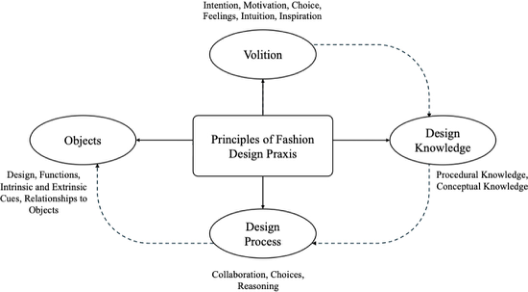
In order to ground the following analysis in theory and thereby allow for systematic analysis, the Fashion Design Praxis framework by Harvey and Ankiewicz (2023) is used. It is a principle-based philosophical model that makes the underlying dimensions of fashion design practice analytically accessible. The framework integrates two established theoretical foundations: Mitcham’s (1994) philosophical framework of technology and Love’s (2000) meta-theoretical taxonomy for design theory. By combining Mitcham’s four dimensions of technology with Love’s taxonomy and adapting them to a fashion context, Harvey and Ankiewicz created a structured approach for examining fashion design praxis. Figure 1 outlines the key components of the framework, which includes the interrelated dimensions of volition (mind- set), design knowledge (epistemology), design process (methodology), and objects (ontology).
Figure 1: Principles of fashion design praxis framework with exemplary analysis categories (Adapted from Harvey & Ankiewicz, 2023).
In this study, the Fashion Design Praxis framework serves as an analytical lens to examine expectations and experiences of circular design among denim professionals. This allows for an exploratory, yet structured analysis of how circularity is embedded in fashion praxis across values, knowledge, processes, and material outcomes. Thereby, the learnings of experienced circular design professionals can be highlighted and new stakeholders can be educated about key challenges and opportunities.
METHODS
This study follows an exploratory approach with open-ended, qualitative interviews. The interview guide was systematically derived from Harvey & Ankiewicz’s (2023) Fashion Design Praxis framework and structured to analyze expectations and experiences in circular denim contexts.
Participants were selected through purposive sampling based on their professional experience in circular denim design. Initially, designers with varying degrees of sustainable design experience were recruited, consciously including small brands (<10 employees) as well as large international organizations (>5000 employees). However, throughout the interviews it became clear that given the technical nature of denim, it would also be necessary to also address technical specialist perspectives, which were subsequently included. Recruitment continued until thematic saturation was reached. The final sample included designers and technical (material or finishing) specialists with varying levels of experience in circular practices. In total, nine denim professionals participated, as outlined in Table 1.
Table 1: Overview of interviewed experts.
Table available in the original PDF paper.
Expert (E) Function Experience Location #1 Designer >10 years Netherlands
#2 Designer >10 years Germany #3 Designer >10 years Germany
#4 Designer > 5 years Germany #5 Designer >10 years Germany
#6 Technical specialist >10 years Germany #7 Technical specialist >10 years Turkey
#8 Technical specialist >5 years Turkey #9 Designer >20 years Germany
Data collection took place between November 2025 and February 2026. The interviews lasted around 30 minutes and were conducted in English or German. All interviews took place digitally on Microsoft Teams or Google Meet, were recorded and transcribed verbatim. The participants provided informed consent, and data were anonymized to protect confidentiality. The analysis themes were iteratively developed and refined across interviews, using a thematic analysis approach in Taguette.
DISCUSSION
Volition (Mind-Set) Internal motivation was evidenced by a recurring theme of ethical tension in the denim professional’s roles. One designer explicitly described fashion as “inherently unsustainable” due to its orientation toward producing more. Their awareness of negative externalities inspired personal commitment to
From Concept to Closet: Expectations and Realities in Circular Denim Design 183 minimizing social and environmental harm and, in some cases, to setting new industry standards (E5-E7). While the interviewees were highly motivated about circular initiatives, they noted that many colleagues do not perceive sustainability as part of their role. Hence, this internal motivation only applies to a subset, thus constituting a persisting barrier through lack of shared responsibility among design professionals more generally (E5).
External motivation was provided through top-down direction from a brand or the corporate level (E1). Corporate priorities were repeatedly framed as decisive, with commercial success (predominantly sales and growth key performance indicators) consistently positioned ahead of sustainability ambitions (E2, E3, E4, E7). Moreover, stability and leadership were mentioned as critical, with visionary leaders having the potential to motivate and inspire action: one designer described that their circular product line faded out after a supportive manager left the company (E2). This highlights the relevance of internal champions in creating incentives and mandates for circular development. Several interviewees discussed the ambivalent role of marketing opportunities as a motivator. It was seen as potentially increasing product attractiveness through communication, but fears of overcommunicating or greenwashing were also raised (E1, E2). Some designers preferred “quiet” improvements without marketing (E2), showing the ambivalent role of communication. Another motivator was identified from outside the organization: Regulatory pressure (from government or stakeholder initiatives) was seen as generally growing but uneven, geographically varied, and unpredictable (E1, E7). Nonetheless it served as a motivator to take action for circular principles.
Inspiration was described as continuous and context dependent. It is drawn from offline observation, travel, benchmarking, trade fairs, archives, and occasional chance discoveries in development trials (E2-E6). Designers did not differentiate between conventional and circular inspiration sources. The emergent difference, however, was that the limitations of circular design itself could turn into a source of inspiration, enabling creative, out-of-the box, and innovative design approaches.
In summary, a combination of internal and external motivating factors emerged. This highlighted that both own motivation and drive as well as official mandates enabled the described initiatives. Moreover, key elements of the creative inspiration process were discussed. While the sources of inspiration did not significantly differ in circular processes, working with circular design constraints was generally seen as inspiring new innovative approaches.
Design Knowledge (Epistemology) Conceptually, design knowledge focused on longevity and life-cycle impacts (E1), recyclability (E1, E3), biodegradability (E4, E5), and detailed fabric, treatment, and wash knowledge (E1, E2, E4, E6, E8). To acquire knowledge about circular design, both internal and external standards or guidelines
184 Straube were mentioned. Environmental impact metrics regarding waste generation or water usage were also referenced (E2, E5, E7). Several participants raised concerns about what happens to products after use, even when designed for recyclability, pointing to limits of designers’ conceptual knowledge beyond their system boundaries (E5). Moreover, participants described confusion caused by seemingly sustainable materials or process alternatives which turned out to be more environmentally damaging (E4, E6). Identifying genuinely better options required designers to independently verify claims, adding complexity and uncertainty (E4).
Procedurally, circular design required new ways of crafting and process thinking. Designers described honing creative skills by developing new approaches, like recyclable patch alternatives, and rethinking design approaches that rely less on embellishments that could inhibit recycling and instead leveraging more subtle cues like seams and construction details (E2-E4). Specialized denim development software was mentioned as helpful, but that trained professionals were needed to operate them, which was not always the case (E3).
Designers reported gaining conceptual and procedural knowledge through collaboration with sustainability departments (E2), technical specialists (E3, E5), and suppliers (E3, E5, E6). Additional knowledge sources included trade fairs, talks, and events (E6, E7), working with machine suppliers and technology providers (E6), the chemistry industry for technical professionals (E6), and field research as well as direct feedback from business stakeholders (E8). Moreover, knowledge development was described as constant and iterative, drawing from trial and error in development processes (E6), small- scale test pilots, and customized approaches to adapt crafts and skills to circular ways (E8). This shows diversified internal and external sources of design knowledge as well as the operationalization thereof.
Design Process (Methodology) Circular denim processes were described as differing from conventional ones. Particularly the need for a layered and holistic product approach which considers the full product as opposed to isolated elements (E1). Simply adding circular concepts into existing processes was seen as a challenge by several interviewees. They clarified that for best success, circular considerations need to be integrated from the very beginning, because when added retrospectively, they were described as an “uphill battle” that rarely succeeded (E1). Tight product creation schedules were further seen as limiting innovation efforts (E1). That is why one designer described working on circular projects on the side, which meant it was slower, but allowing for deeper experimentation and ultimately success (E1). Another designer shared experiences of fully developing circular products, yet seeing them cancelled at the order stage when a comparable (more cost attractive) conventional option existed, stressing that parallel developments tend to disadvantage circular options (E3).
From Concept to Closet: Expectations and Realities in Circular Denim Design 185 This also demonstrates the connection and collaboration with other stakeholders: Circular requirements often concern not only design decisions but also departments like buying, sourcing, and sales. As a consequence, this requires that new approaches are being aligned on from the beginning, as otherwise internal pushback could ensue (E1). Circular design can also create additional process steps and complexity, for instance managing certifications and labels (e.g., certification on recycled contents). The responsibility of managing such tasks varied by brands and was either taken up by the designer directly, thus adding new responsibilities to the profile (E9), or was in other cases covered by a dedicated person responsible for the process (E3).
Participants emphasized that circular projects required different forms of collaboration, involving designers, technical specialists, sustainability departments, suppliers, and management (E2). This collaboration was often experienced as enriching and a way of breaking routine work cycles (E2). However, it could also become political, particularly when designers felt excluded from strategic negotiations about guidelines and future directions (E2). Across interviews, the importance of strong partnerships and continuous communication was repeatedly emphasized. Finding the right suppliers, clarifying feasibility early on, and establishing two- way feedback loops were seen as critical to making circular approaches work in practice (E1, E4, E5, E8). Over time, some designers reported that suppliers developed a shared understanding of their expectations, enabling smoother collaboration (E5). Strategic partnerships and joint development were viewed as especially important for accessing new technologies and co-creating innovation (E8).
For future developments, participants expressed expectations that digital tools and particularly Artificial Intelligence (AI) could support circular design processes through virtual prototyping (E2, E3), creating guidelines (E5), quality management (E5), and more efficient product development overall (E9). In summary, the circular design process was seen as a different approach compared to conventional ones. Rigid schedules, existing hierarchies, and structures were seen as particularly limiting. This could be remedied through reassessing processes and collaborative ways of working with existing and new stakeholders alike.
Objects (Ontology) Circular denim design was seen as impacting a product’s internal and external cues, ranging from material composition, construction, to communicative features. The discussed circular jeans were characterized by more sustainable material and finishing technologies (E2-E4), recycled or recycling-optimized trims (E1, E4, E9), reduced complexity and material diversity for better recyclability (E2, E4).
Overall, circular design imposed more limited options in fabrics, trims, and finishing choices (E1). Particularly recycled fibers were described as giving products a distinct appearance, however, one designer consciously embraced this as a design feature rather than a drawback (E1). Functionally, circular
186 Straube design impacted performance characteristics, particularly in relation to fabric properties such as stretch (E4). Some fits and effects (e.g., specific wash styles) were described as difficult or impossible to achieve with currently available material and process alternatives (E6). However, in some cases even technical specialists admitted to struggle in identifying differences in wash processes due to significant technological advances over the last years (E3, E6). This is aligned with participants’ general impression of a strong evolution in sustainable design aesthetics: In the past, sustainable fashion was stigmatized as an unattractive eco-look. However, given recent technological developments it can now be contemporary, fashionable, and desirable (E1, E2, E9).
Some designers said circular products could be seen as minimalistic or less creative due to circular design restrictions and reduced complexities (E3), however several participants also stressed that these constraints made them come up with alternative solutions, such as creative embroidery instead of rivets or patch alternatives that maintained a premium appearance and differentiated the products from others (E2, E4). However, these design features were subtle, and it was brought up that from a consumer perspective, circular and conventional denim are often visually indistinguishable, unless explicitly communicated (E3, E5, E6).
Regarding external cues, participants were undecided about marketing and communication. Circular features were sometimes intentionally not labelled, based on the belief that these claims could trigger skepticism or greenwashing implications (E2, E4, E5). Several participants argued that improving products “quietly” could be more effective than overt sustainability messaging. However, they also saw value in making products more attractive through communication and highlighting specific features toward consumers who would otherwise not recognize the design optimizations.
CONCLUSION
This exploratory study examined circular fashion praxis through the specific yet scalable case of denim jeans. Grounded in Harvey & Ankiewicz’s Fashion Design Praxis framework and based on semi-structured interviews with nine experienced professionals, the analysis provides an overview of circular design approaches, particularly taking into consideration the human factor. The insights ranged from early decision-making to final product aesthetics.
As for practical and managerial implications: Embedding circularity from the outset of the design brief was stressed from several participants. Aligning projects with commercial objectives and embedding circular in the initial design briefs improves likelihood of success, but in many cases the described project still required the designers to go the extra mile. Thus, providing designers and technical experts with time and resources to invest in circular design processes may help adoption and in turn lead to innovative products, as circular constraints were shown to stimulate new and creative outputs. Moreover, investing in cross-functional collaboration (including design, technical experts, sustainability, and suppliers) emerged as a key theme,
From Concept to Closet: Expectations and Realities in Circular Denim Design 187 showing the need for deepened or new collaborative structures and systems. Findings also revealed structural trade-offs in design (e.g., fabrics, washes, trims) but also show such constraints can stimulate creativity and enable innovative solutions. Expectations about future developments highlighted that the use of AI may support design knowledge and processes, providing a promising field for future research with practical applicability.
Regarding the limitations and opportunities for future studies: Building on the exploratory insights of this study, several avenues for further empirical research emerge. This project deliberately focused on denim, however, denim’s strong heritage and finishing complexity mean results may not generalize to other categories. Accordingly, future research could include additional product groups and may also take comparative approaches. Moreover, the small, Euro-centric sample further limits transferability, which is why extending the work to additional geographies is recommended. Longitudinal research approaches that follow designers over multiple seasons could capture learning processes and organizational change over time. Finally, consumer-facing studies could explore how circular design features are perceived, interpreted, or valued. Incorporating scientific methods such as Design Science Research (Dresch et al., 2015) could further prove useful, providing deeper insight into the four analysis dimensions in an iterative context. Together, these future research directions would advance the field from describing circular design challenges toward systematically understanding and enabling circular fashion praxis.
In conclusion, this research provides an overview of circular design experiences, key challenges, and opportunities. It provides by no means an exhaustive analysis but instead is to be understood as a starting point for analyzing circular fashion design practice. This holds practical relevance for organizations aiming to transition to circular approaches and provides a systematic overview for researchers aiming to empirically expand on circular design frameworks.
ACKNOWLEDGMENT
The author would like to thank the experts for kindly sharing their time and expertise.
REFERENCES
Dresch, A., Lacerda, D.P., Antunes, J.A.V. (2015). Design Science Research. In: Design Science Research. Springer, Cham. https://doi.org/10.1007/978-3-319-07374-3_4 Ellen MacArthur Foundation. (2021). The Jeans Redesign Guideline. https://
content.ellenmacarthurfoundation.org/web/c785c5c527315f87/the-jeans- redesign---guidelines/?viewType=grid&mediaId=6B4F903D-D56C-4EC5- 8341A6DE7A8BF7C2 Ellen MacArthur Foundation. (2023). The Jeans Redesign Insights Report. https:// content.ellenmacarthurfoundation.org/m/3f96b28b6c02023b/original/The- Jeans-Redesign-Insights-Report.pdf Fashion For Good. (2018). Developing C2C Certified Jeans.
for fashion design praxis and education in new design landscapes. International Journal of Technology and Design Education, 33(5), 1883–1900. https://doi. org/10.1007/s10798-022-09794-7 Helinski, C., Westmattelmann, D., & Schewe, G. (2025). Necessary and sufficient values: A dual perspective on consumers’ willingness to pay premiums and purchase intentions for circular fashion. Journal of Cleaner Production, 501, 145220. https://doi.org/10.1016/j.jclepro.2025.145220 Kawamura, Y. (2020). Doing research in fashion and dress: An introduction to
qualitative methods (Second edition). Bloomsbury Visual Arts. https://doi. org/10.5040/9781350089785 Logan, H. M., Rossi, V., Hansen, K. K., Søndergaard, M. Z., & Damgaard, A.
(2025). Assessing the circularity potential of textile flows for future markets in Denmark: A study of textile anatomy. Sustainable Production and Consumption, 59, 127–142. https://doi.org/10.1016/j.spc.2025.08.002 Love, T. (2000). Philosophy of design: A meta-theoretical structure for design theory.
Design Studies, 21(3), 293–313. https://doi.org/10.1016/S0142-694X(99)00012-5 Mastenbroek, L. (2023). Lessons of the Denim Deal 2020-2023. https://www.
afvalcirculair.nl/publish/library/277/denim-deal-booklet.pdf Miller, D., & Woodward, S. (2007). Manifesto for a study of denim.
Social Anthropology, 15(3), 335–351. https://doi.org/10.1111/j.0964- 0282.2007.00024.x Mitcham, C. (1994). Thinking through technology: The path between engineering and philosophy. The University of Chicago press. Morseletto, P. (2023). Sometimes linear, sometimes circular: States of the economy
and transitions to the future. Journal of Cleaner Production, 390, 136138. https:// doi.org/10.1016/j.jclepro.2023.136138 Saliba, M., Keys, A., & Murdie, M. (2024, November). The Circularity Gap Report Textiles. https://www.circularity-gap.world/textiles Stahel, W. R. (1981). The Product-Life Factor. An Inquiry into the Nature of
Sustainable Societies. The Role of the Private Sector. Houston Area Research Centre, 72–105.
LISTED IN THE AHFE DIGITAL BOOKSTORE CATALOGUE
Explore the complete digital volume
The Human Side of Service Engineering
Read this individual research paper free through the original publisher, or explore the full digital proceedings book.
ISBN 978-1-964867-97-7
Explore this ISBN in the AHFE Bookstore ↗Listed in the July 2026 bookstore catalogue; search by ISBN to confirm current availability · Digital book purchase optional