Andreas Eursch, Sophie Steinmaßl (2024). Sustainability in innovation and product development: A holistic study on the importance of the influencing human factor. In: Creativity, Innovation and Entrepreneurship. AHFE Open Access, vol. 125, pp. 1–11. https://doi.org/10.54941/ahfe1004715
It is well known that innovation is the key to success for companies. There is a consensus in science and politics that new products must be sustainable. In the long term, sustainable innovations will determine the success or failure of a company. In recent years, numerous methods and procedures have been developed in science and by leading companies. Nevertheless, it is necessary to investigate whether the current process models and tools are successful or need to be adapted. On the way to answers, you inevitably come across the human factor. In this paper, we present the first results of a study on the topic of "sustainable innovations" in product development, which focused on the human factor. A three-dimensional study was set up on this basis to do justice to the need for a holistic, systemic approach: The first dimension is the survey of managers who act as role models and carry the topic of sustainability to the employees. The second dimension is the employees who have to implement sustainability, for instance experts in the R&D environment, such as innovation managers or design engineers. The industry focus was placed on manufacturing companies from the mechanical engineering and automotive sectors, as well as manufacturers of consumer goods, because this is where the sustainability aspect is most relevant. For a holistic approach, a consumer survey was conducted as a third dimension to explore the significant part of the market. In an online survey, consumers were asked about their purchasing behavior with regard to sustainable products and their premises, among other things. The aim of the study was to ensure transparency and identify any conflicting goals that currently stand in the way of sustainable products. This paper focuses on the dimensions one and three. One finding of the study (part one) is that the human factor is decisive for the implementation of sustainability aspects in product development. The consumer survey reveals the attitudes and values of individuals and they mainly indicate a clear awareness of the issue of sustainability.
There is currently a lot of change in Germany in the area of “sustainability”, including the heating act for private individuals and the supply chain due dili- gence act for companies, to mention just two examples. The environmental concept has been present in the automotive sector for years. Major OEMs are
focusing on alternative drive systems and research is focusing on alternative vehicle concepts. Vehicle scrapping and recycling have been an integral part of the development process for years. Change and transformation make for an exciting research environment, which was used to determine the current status in terms of sustainability and any remaining obstacles. The focus here is on the human factor.
Everyone has different roles in their private and professional lives. In the context with product development, is the role as a consumer in the private surrounding and the role as an engineer, employee in the professional envi- ronment. This is accompanied by heterogeneous perspectives on a subject. These require different actions and can lead to a dilemma. The design of an environmentally friendly product is not always in line with the requirements of a company and therefore the expectations of an employee. Economic and functional requirements are set against ecological requirements and can lead to conflicting objectives. Striking a balance and finding the so-called “triple bottom line” between ecological, economic and social goals is a challenge in product development. (Pigosso & McAloone, 2021)
PROCEDURE As a basis, a literature review on the topic of “sustainability in product devel- opment” was carried out. There are extensive publications on this subject, so this paper will not go into detail about them. (Vilochani, McAloone, & Pigosso, 2023). The literature ranges from general models of the circular economy, such as Cradle to Cradle (C2C), to workshop-based approaches for the optimization of existing products, to detailed design processes such as Pahl/Beitz or the framework for sustainable product development. Moreover there are interesting newer and unknown process models such as the tetra- hedron of sustainability design (Stegmüller & Braun, 2023). (Mayer, 2020), (McAloone & Bey, 2009), (Kammerl, Schockenhoff, Hollauer, Weidmann, & Lindemann, 2017), (Bender & Gericke, 2021)
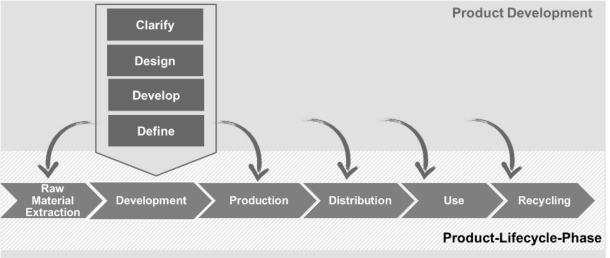
In the elaborations and considerations, however there is often a lack of reference to employees or engineers who decisively control the topic of sustainability in development through their decisions (Figure 1) (Klein & Zanker, 2023).
Figure 1: Impact of product development on the lifecycle based on (Klein & Zanker, 2023).
Sustainability in Innovation and Product Development: A Holistic Study 3
The development team is responsible and makes a large number of deci- sions which have a major impact on the product life cycle that means the basis for or against a sustainable product is made. This once again illustrates the influence of the human being.
Research Questions The aim is to find barriers that prevent or block sustainability and then develop solutions to overcome them. First, an overview is to be created in order to find out where there is still a need for optimisation and thus research.
The following research questions arise from the literature review: What is the current status of companies with regard to sustainability efforts in product development? What has already been done?
In addition to the companies, the perspective and expectations of the customers are of particular interest.
How important is sustainability to customers? Are they willing to pay more for a sustainable product? How much?
In this context - what contribution can frugal products make?
Structure of the Study A three-dimensional study was set up on the basis to do justice to the need for a holistic, systemic approach:
PART I – MANAGERS
PART II – EMPLOYEES
PART III – CONSUMERS The first dimension is the survey of managers who act as role models and carry the topic of sustainability to the employees. The second dimension is the employees who have to implement sustainability, for instance experts in the R&D environment, such as innovation managers or design engineers. The industry focus is placed on manufacturing companies from the mechanical engineering and automotive sectors, as well as manufacturers of consumer goods, because this is where the sustainability aspect is most relevant. A con- sumer survey is being conducted as a third dimension in order to explore the significant part of the market.
This paper discusses the results of an extract from the manager interviews and the consumer survey. PART II (employees) will be presented in a separate publication.
Participants PART I - MANAGERS A lot has been developed in recent years. It is therefore necessary to first assess the current state and review what has been learned so far before seek- ing solutions or taking actions. For this purpose, a survey of experts is carried out with representatives from the management level of German companies, because they have a good overview of the company, the employees, but also the market and the customers. The range of both the field of activity and
4 Eursch and Steinmaßl
the position was deliberately chosen because a good overview of the cur- rent situation is aspired. Representatives from management were interviewed in order to prepare the survey of employees (PART II) in the development departments.
Personal interviews were conducted along the lines of guideline, which gave the interviewee sufficient freedom to contribute their own aspects and set priorities.
The industry focus was placed on manufacturing companies from the mechanical engineering and automotive sectors, as well as manufacturers of consumer goods, because this is where the sustainability aspect is most relevant.
PART III - CONSUMER In this study, an internet-based questionnaire with 16 questions was devel- oped. Four main topics were created:
Product example - smartphone The questionnaire incorporates mainly questions with answers, in which respondents had the opportunity to supplement their answers with com- ments. The use of closed questions increases the objectivity of the survey and facilitates the interpretation of results. In open questions the participants had the opportunity to express their own opinion on various issues related to sustainability.
Comments and also the open questions are evaluated by means of a quantitative content analysis.
In the survey a total of 120 people participated, 70% of them are under 30 years old and almost all come from Germany. The survey was distributed among student associations, thus the values and opinions of the leaders of tomorrow (Gen Z) are represented. The distribution between male and female participants is almost even.
RESULTS
PART I – MANAGERS The automotive industry in Germany appears to be the most interesting for the study because it has been under the most pressure for years, both politi- cally due to new and stricter environmental regulations and laws, as well as from customers and the public in particular. However, companies in this sec- tor also have the best prerequisites because they generally have relatively good financial resources and good employees. The expert interview confirmed the high expectations and showed that the measures already taken can serve as a model. Sustainability is so important to a large Bavarian car manufacturer that the company management has made it a marketing objective with which the company wants to present itself in future.
The company has set itself the goal of even undercutting the legal require- ments, i.e. achieving climate neutrality sooner. These sustainability targets are
Sustainability in Innovation and Product Development: A Holistic Study 5
translated into specific requirements for the products: each new product is given clear and measurable sustainability targets, for example with regard to improving the use of recycled materials or recyclability. The parts list contains information on the proportion of recycled materials, for example.
The company has set itself the goal of sustainable vehicles and has shown with sensational product visions which sometimes radical steps are neces- sary but also possible. This relates not only to the drive system, but also in particular to recyclability and innovative, sustainable materials.
Extensive measures have been taken to ensure that the sustainability targets are achieved: for example, each product line is assigned its own sustainability team made up of sustainability experts who provide support in achieving the sustainability targets at product level. If developers need support with their work, they receive expert assistance there.
At company level, a separate department has been set up to record sus- tainability data and document all relevant data as completely as possible, for example the CO2 emissions generated. These are also requested from suppliers so that all sustainability information is available.
Despite these extensive measures, the products are still a long way from being completely sustainable or recyclable. However, this is also due to the fact that the development of new products in the automotive industry is very complex because many requirements have to be met and this takes a lot of time. It usually takes 5 to 7 years to develop a new vehicle.
It is not possible to switch to sustainable solutions in the short term. The high demands on safety and durability, particularly in the transport sector, are another reason why sustainable solutions have to be examined very carefully and often fail to gain acceptance. Conflicting objectives are increasingly aris- ing where requirements such as rigidity, breaking strength or crash safety are considered more important than ecological aspects such as emissions. Partic- ularly in the case of automobiles, the additional sustainability requirements are leading to an increasing number of conflicting objectives, which are also difficult to resolve.
The fact that solutions are nevertheless created that overcome these con- flicting objectives, and perhaps even achieve both goals, is down to the employees, who invest more commitment in the search for solutions and work harder to find a solution. However, they must also have the time to do so, and this is currently one of the most important obstacles at this level. Employees who don’t have enough time cannot also take care of sus- tainability. Despite the many measures taken by the company, it still comes down to the human factor, the employee who has the motivation to develop sustainable solutions.
This applies all the more to the supply industry. Here, the situation is per- ceived as the opposite by the interviewees. Sustainability is also an issue here, but to a much lesser extent and more for the company and less for the prod- ucts. According to the representatives surveyed, economic aspects continue to play the biggest role. For many clients, only monetary aspects such as the price of the product, the company’s own return on investment or the bonus payments that can be achieved count. This also reveals a human factor, albeit a negative one: the pursuit of one’s own monetary advantage (maximization
6 Eursch and Steinmaßl
of income). The example of a young company that has developed a product that makes waste heat usable and thus clearly fulfils a sustainable purpose is interesting. However, sustainability was not taken into account in the product itself because it is neither demanded nor paid for by the customer.
Most of the SMEs surveyed were themselves intrinsically motivated to take measures to increase sustainability, but not with regard to the product but the company in general. Similar to the car manufacturer, CO2 neutrality by 2035, for example, was formulated as a goal for the company.
Almost all of the interviewees had already implemented a sustainable energy supply in the company and, for example, installed photovoltaics or invested in geothermal energy for the heat supply. However, it should also be noted that, in addition to the environmental aspect, these measures also have advantages in terms of costs and security of supply. The question remains as to whether the measures would have been implemented if they had not also brought economic benefits.
Although sustainability is not explicitly required in the supplier industry in some cases, attention has been paid in product development for decades to minimizing material requirements and weight, simplifying assembly, avoiding waste during production and achieving a long service life. One of the most important factors for sustainability is also evident here: the motivation of the people involved, in this case the managing directors or shareholders, who have committed themselves to sustainability out of their own conviction and have gone the extra mile.
This is particularly remarkable as the supplier industry currently has very little financial leeway to invest in sustainability because the economic situ- ation is very tense due to the changes and various crises. In addition, they are not getting more money from their clients for sustainable products. The interviewees were unanimous on this point. Even for a premium product in the automotive sector, customers are not prepared to pay a higher price just for sustainability, according to the employee surveyed. Against this back- ground, the results of the consumer survey, which tend to say the opposite, are interesting.
All interviewees also agreed that the development of sustainable products is significantly more complex because a holistic approach is required, i.e. a broader view must be taken. In addition, it is usually necessary to delve deeper into the matter because the additional requirement of sustainability often means that a large part of the solution is out of the question. This means that a larger solution space must be developed, i.e. more time and commitment must be invested in the search for a solution. This prolongs the development phase and costs money. In addition, there are the aforementioned conflicts of objectives, which are difficult to resolve, particularly in the case of sustain- ability, as has already been pointed out in the case of the automotive company. More engineering is required and well-trained engineers are needed for this.
In the expert interviews, it was generally pointed out that the workload in the company increases significantly as a result of sustainability and that the costs rise accordingly. The measures must be monitored and documented. As a rule, audits and reports are required, which further increase bureaucracy and require additional work that is not paid for.
Sustainability in Innovation and Product Development: A Holistic Study 7
The managing directors among the interviewees in particular noted that the state has been intervening more and more in entrepreneurial processes in recent years, on the one hand through regulations and laws, and on the other through support measures linked to performance such as sustainability. On the one hand, this was criticized because it restricts entrepreneurial freedom. On the other hand, they were welcomed as a basis that creates binding rules to which everyone must adhere. In most cases, sustainability targets are linked to legal requirements.
The capital market has also become an immensely important factor. According to some interviewees, it has one of the greatest influences on sus- tainable development. Small and medium-sized companies in particular are dependent on financing from funds. More and more of them are subject to ESG criteria (environmental, social, governance), for which sustainability is a basic requirement. As a result, companies are being given specific sustainabil- ity requirements, such as the availability of end-of-life solutions. Companies that do not meet the sustainability requirements hardly receive any capital.
PART III - CONSUMER The consumer survey was conducted in order to explore the significant part of the market. In an online survey, consumers were asked about their pur- chasing behavior with regard to sustainable products. The aim of the study was to ensure transparency and identify any conflicting goals that currently stand in the way of sustainable products. An assessment of the prioritiza- tion of requirements and the importance of the topic of sustainability for consumers is shown. The challenge is to find a balance between ecological, economic, and social factors. The entrepreneurial relationship between eco- nomic factors such as purchase price and environmentally friendly product design is examined.
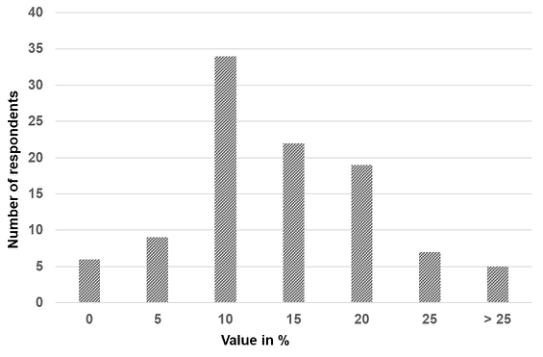
The gross monthly disposable income per household of more than half of the study participants is less than € 4000 gross. This approximately cor- responds to the average monthly gross salary of a full-time employee in Germany, which was € 4100 in 2021 (BMF, 2023). Depending on this, it is astonishing that most study participants are prepared to pay a higher pur- chase price for a sustainable product. According to their own statements, almost 95% are willing to pay a higher purchase price for a sustainable product (Figure 2).
Just under six percent are not willing to pay more because of the sus- tainability of a product. Over 70% of the respondents would pay between 10% - 20% more for an environmentally friendly product, without getting an additional product feature. This contradicts the expert opinion, they cannot observe this behaviour in their sales figures. However, the survey confirms the statement. Another important point is the prioritization of requirements from the customer’s point of view. The functionality of a product is the most important factor in the purchase decision. Followed by the purchase price, which has almost the same importance as sustainability for most people. For instance, 94% of all respondents would prefer a higher purchase price with the same functionality to a product that is reduced to core functions. This is a contradiction to the trend of “frugal developments”. These are characterized
8 Eursch and Steinmaßl
by the focus on core functionalities and the fulfilment of these requirements. No further additional requirements will be implemented. As a result, costs, especially TCOs, can be kept low and resource consumption can be reduced (Weyrauch, 2018).
Figure 2: Percentage of additional price for a sustainable product.
In addition to that, in the literature are statements that the implementation of additional technological functionalities losing weight compared to sustain- ability aspects (Förtsch & Meinholz, 2023). It is quite conceivable that the group of people surveyed, mainly from Germany, with an average income, has different requirements for products and accordingly different priorities arise. A possible explanation for the study’s contradictory statements is that it is not uncommon for relevant articles from the media and some research results to not correspond to reality. (Weinhauser, Steinmaßl, & Eursch, 2023).
Almost three-quarters of all study participants have changed their purchas- ing behaviour in recent years and paid more attention to sustainability when making a purchase decision. For the majority of them, the topic sustainability plays a role not only in their private but also in their professional lives. As far the importance of the topic is concerned, employees have different per- ceptions and thus almost a third classify the importance of the employer as low. In this aspect it is still necessary to examine what roles the humans have within the company. It is striking that more than a quarter do not answer the question “whether their own values and expectations with regard to sustain- ability are in line with those of their employer” at all or with “sustainability is only important to me in my private life”.
The feedback that more than half of the survey participants use their smart- phone for four years or longer reflects the sustainable behaviour of the survey participants. This is also emphasised by the reasons for replacing the device: old device was defective, battery life was too short, performance was no longer sufficient or operating system or software could no longer be updated. However, just under a fifth of those surveyed stated that they had purchased a
Sustainability in Innovation and Product Development: A Holistic Study 9
new device because of new extended functionalities or a “more stylish look”. In this context it should be mentioned that the growth of the refurbished and used mobile phone market is expected to rise sharply in the coming years. In the USA, the market size for 2023 was around 55 billion U.S. dollars and is expected to increase to 172 billion U.S. dollars by 2033 (Research 2023).
One aspect in favour of refurbishing is the reparability and thus the exten- sion of the product lifetime. In 2010, it was possible to replace four modules in an Apple iPhone. By 2022 there were already 11 modules, including the speaker, battery, camera and display. Apple has also implemented various design measures to extend the product lifetime. These include for example a sapphire crystal lens cover and IP68 water and dust protection (Apple, 2023).
Nevertheless, 12 percent of those surveyed stated that they had replaced their mobile phone due to a broken display, even though a repair would have been possible. Other reasons for replacing a device were outdated security standards, used up memory or switching to a company phone.
62% are of the opinion that products in general are becoming increasingly sustainable. For the same percentage, an associated price increase is perfectly acceptable. Three fifths of respondents say that they themselves should do more to promote climate protection and sustainability. There is also the opin- ion that the population needs to rethink and pay more attention to the issue of sustainability. This clearly shows the existing awareness and urgency of the issue. Furthermore the topic is still considered important. From this it can be deduced that the issues have not yet been clarified for most human beings. This is entirely in line with reality and is largely confirmed in the expert interviews.
Each person has different roles and associated obligations. If the values and attitudes of a private person deviate from the requirements of a role in a professional environment, this can lead to internal conflicts. 60% may be unsure or deny that sustainability plays an important role at their employer. In the private context, however, as already explained, the topic is definitely categorised as significant.
Around 60% are of the opinion that action on issues such as CO2 taxation, the supply chain due diligence act or the heating act is no excessive. Only a fifth take the opposite view.
CONCLUSION
The study shows that sustainability has arrived – everyone is dealing with it. But there are big differences. While car manufacturers have come a long way, SMEs are struggling with the fact that they cannot get higher prices for sustainable products. In addition product development becomes more demanding when the aspect of sustainability has to be taken into account, because you have to think holistically when it comes to sustainability. This means that not only all stages in the product life cycle must be considered, but also all possible effects, which is very extensive and makes product develop- ment more expensive and time consuming. The interviews showed that this can be a barrier for sustainability, since cost is still the decisive factor. But there is a big chance if innovation and sustainability go hand in hand.
10 Eursch and Steinmaßl
The companies expect that customers refuse to pay more for a sustainable product if it does not offer additional or better features. The results of the survey beyond consumers shows opposite results. The vast majority say they are prepared to pay more for sustainable products. In general the results of the survey were surprisingly positive towards sustainability. The question is whether consumers are not being honest, whether the younger generation thinks differently, or whether companies are misjudging their customers. This still needs to be investigated.
The most important finding from both surveys is that human beings are the decisive factor. In companies, they ensure that sustainable products are developed despite all obstacles such as costs, bureaucracy and conflicting objectives. As consumers, they can and must make a conscious decision in favor of sustainable products. The two go hand in hand.
According to the interviews, the young generation of engineers is making the difference. Apparently, the fact that sustainability is taught at universities such as Munich University of Applied Sciences is paying off. Because “human factors” are of importance, it makes sense that in addition, a new course of study sustainable engineering has been developed, in which the topic of sus- tainability is given more space. The aim of both teaching formats is to enable future engineers to think and act sustainably by carrying out real projects with partners from industry and research as part of their studies. Specifi- cally, the aim is to develop environmentally friendly products and consider the whole lifecycle until end-of life.
REFERENCES
Apple (January 5, 2023). Apple Fortschrittsbericht zum Umweltschutz 2023.
https://www.apple.com/de/environment/pdf/DEDE_Apple_Environmental_Prog ress_Report_2023.pdf Bender, B., Gericke, K. (2021). Gestaltungsrichtlinien. In B. Bender, K. Gericke, Pahl/Beitz Konstruktionslehre. Berlin: Springer Vieweg. BMF. (March 14, 2023). Durchschnittlicher Netto-Jahresarbeitslohn von ledi-
gen Arbeitnehmern ohne Kindern in Deutschland von 1960 bis 2023. https://de.statista.com/statistik/daten/studie/164047/umfrage/jahresarbeitsloh n-in-deutschland-seit-1960/ Förtsch, G., Meinholz, H. (2023). Produktverantwortung und Ökodesign. In G. Förtsch, H. Meinholz, Handbuch Betriebliche Kreislaufwirtschaft (2. Auflage Ausg., S. 177-225). Berlin, Heidelberg: Springer Vieweg. Johannson, G. (2002). Success factors for integration of ecodesign in product
development: A. Environmental Management and Health, 13, 98-107. Kammerl, D., Schockenhoff, D., Hollauer, C., Weidmann, D., Lindemann, U. (2017).
A Framework for Sutainable Product Development. In M. Matsumoto, K. Masui, S. Fukushige, S. Kondoh, Sustainability Through Innovation in Product Life Cycle Design. Springer Singapore. Klein, M., Zanker, W. (2023). Auf dem Weg zum Sustainable Engineering. Nachhaltige Industrie, 01. Mayer, K. (2020). Nachhaltigkeit als Treiber für Innovation. In Nachhaltigkeit: 125
Fragen und Antworten. Wiesbaden: Springer Gabler. McAloone, T., Bey, N. (September 20, 2009). Environmental improvement through product development: A guide. https://backend.orbit.dtu.dk/ws/portalfiles/portal /3996106/mpu-elektronisk-uk.pdf
Sustainability in Innovation and Product Development: A Holistic Study 11
Pigosso, D. C., McAloone, T. C. (2021). Ökodesign. Entwicklung von Produkten mit verbesserter Ökobilanz. In Konstruktionslehre (Bd. 9, S. 975-1021). Berlin, Heidelberg: Springer Vieweg. Research, P. M. (January 15, 2023). Global refurbished and used mobile phone
market size from 2022 to 2033 (in billion U. S. dollars). Persistance Market Research. Statista. https://www.statista.com/statistics/1309671/refurbished-smar tphone-market-size-worldwide/ Sheldrick, L., Rahimifard, S. (2013). Evolution in Ecodesign and Sustainable Design Methodologies. 20th International Conference on Life Cycle Engineering (CIRP). Singapore. Stegmüller, S., Braun, F. (2023). The tetrahedron of sustainability design - a 3D
framework for the integral and interdisciplinary development of circular economy oriented products. In Human Systems Engineering and Design (IHSED 2023): Future Trends and Applications (Bd. 112). Vilochani, S., McAloone, T., Pigosso, D. (2023). Management Practices For Sustainable Product Development: Insights Form a Systematic Literature Review. International Conference on Engineering Design (IECD23). Bordeaux. Weinhauser, T., Steinmaßl, S., Eursch, A. (2023). Exploiting the innovation potential
of medium-sized mechanical engineering companies thorugh the practical appli- cation of agile methods. In E. Markopoulos, R. Goonetilleke, Y. Luximon (Hrsg.), AHFE, 74. Weyrauch, T. (2018). Frugale Innovationen. Eine Untersuchung der Kriterien und des Vorgehens bei der Produktentwicklung. Wiesbaden: Springer Fachmedien.
LISTED IN THE AHFE DIGITAL BOOKSTORE CATALOGUE
Explore the complete digital volume
Creativity, Innovation and Entrepreneurship
Read this individual research paper free through the original publisher, or explore the full digital proceedings book.
ISBN 978-1-964867-01-4
Explore this ISBN in the AHFE Bookstore ↗Listed in the July 2026 bookstore catalogue; search by ISBN to confirm current availability · Digital book purchase optional