Donovan Esqueda Merino, Hector Rafael Morano Okuno, Daishi A Murano Labastida, Jesus Enrique Chong Quero, Gloria A González Sarmiento, Arturo Vargas Olivares, Arturo Desaix López Rojas, Carlos Alberto Cruz Villar, Joaquin Loaiza Martínez, Armando R San Vicente Cisneros, Daniel Rodriguez Flores (2024). Engineering Project Management Skill Development in Research vs. Corporate Realms. In: Creativity, Innovation and Entrepreneurship. AHFE Open Access, vol. 125, pp. 112–122. https://doi.org/10.54941/ahfe1004727
In this study, we look into into two educational approaches implemented in a capstone course designed for Senior Mechatronic Engineers. Despite sharing a common syllabus and learning objectives, the course was delivered by two different groups of professors: the first focused on a research-oriented approach working together with a research laboratory, while the second emphasized an enterprise-driven perspective in partnership with various internal and external stakeholders.Mechatronic Engineers engaged in innovative technology-based projects require a fusion of technical expertise, soft skills, strategic thinking, and collaborative proficiency. Recognizing that vicarious experiences alone are insufficient for students to master such projects, our capstone course incorporated challenges with Training Partners to bridge the gap and simulate real-world demands.As part of the course requirements, students were tasked with developing a team project that culminated in a physical prototype and a poster presentation at an Engineering fair. Subsequently, students underwent a mock interview assessment, evaluated by their professors, during which they also assessed their self-efficacy across different skills. Our observations revealed that both evaluators and students shared similar perceptions regarding certain sub-competencies, including effective communication, impact on business/society/environment, and ethical commitment. However, some differences emerged in sub-competencies related to teamwork, problem formulation and resolution, methodological approach to design, and innovation capability.It is noteworthy that students exhibited a higher self-perceived leadership capability, a very important skill in non-hierarchical leadership roles like project management, than external assessments indicated. This observation is intriguing, considering that not all team members could assume leadership roles simultaneously, and the course did not explicitly require students to define leadership roles. The results highlight that while the difference between professor expectations and student self-assessment is relatively modest, the course emphasis may influence the development of specific skills.The study scrutinized two educational paradigms: one research-oriented and the other enterprise-driven. Findings indicate that enterprise-oriented students expressed greater proficiency in understanding the course objectives and planning skills, whereas research-oriented students demonstrated heightened confidence in project execution and interaction with stakeholders.
Mechatronics Engineering requires an understanding of diverse topics across different engineering specialties (i.e. mechanics, electronics, control systems, computer engineering). This is of utmost importance to design, integrate, validate, or evaluate proposals involving multiple engineering domains. Thus, students of this major must have a very comprehensive skillset to be successful.
Capstone courses provide an excellent opportunity to evaluate the perfor- mance of students regarding both hard and soft skills. However, empowering newly formed Mechatronic Engineers for their capstone projects necessitates exposure to applied core concepts, tools, we well as strategic thinking skills
Engineering Project Management Skill Development in Research vs. Corporate Realms 113
(García-Moran et al., 2021). This can be fostered with adequate challenges that become relevant and motivational for the students.
Since 2019, Tecnológico de Monterrey has included Training Partners (i.e. institutions providing real-life business cases to students) as part of their educative model. As presented by Esqueda et al. (2023a, 2023b), they actively participate in different ways in the best interests of the student’s education, at the time that they explore new ideas to help their companies become more competitive.
The industry-university collaboration programs benefit students by immersing them in a work-related context, facilitating learning of industry procedures, teamwork, independent learning, communication, and collabo- ration (Morano-Okuno et al., 2019). Moreover, higher education aims at students’ development of essential competencies in students, encouraging technical, technological, analytical, and critical thinking growth (Miranda et al., 2021) that will be useful in their future work lives. Likewise, employ- ers place importance on soft skills possessed by future graduates as much as on technical skills (Low et al., 2021).
In industry, Mechatronic Engineers leading innovative projects involving new product development must have a clear understanding of design, manu- facturing, and business alike (Esqueda et al., 2019). Educational methodolo- gies such as the one presented in Esqueda et al. (2023c) explore teaching by linking a course’s learning outcomes and Key Performance Indicators (KPIs) in engineering courses, specifically aimed at product development.
However, the requirements of research projects might be slightly different from those of industry, as their KPIs and timelines are different. Yet, common ground can be identified in Research & Development (R&D) projects, where there exists a higher incertitude of the project’s commercial success. Often, alliances are made between the academy and industry even when there is no expected tangible outcome, but rather a learning experience over the whole innovation cycle (Perkmann & Walsh, 2007).
To facilitate project execution in collaborative R&D projects, Barnes et al. (2006) propose having clear objectives, defined roles, and responsibilities. Additionally, DeCampos et al. (2022) state the need for adequate frameworks and methodologies, especially when dealing with the latest technological developments posed by Industry 4.0 (Cotrino et al., 2020, Ribeiro et al., 2021), to whom Mechatronic Engineers are akin. However, quantifying the competence of project management is chal- lenging (Crawford, 2000, El-Sabaa, 2021). In fact, the developments 4th Industrial Revolution necessitates new ways of managing projects, empha- sizing the need for insights into the leadership style of project managers (Marnewick & Marnewick, 2019), which is crucial since having an adequate motivation for the team strongly supports the project’s success (Anantatmula, 2010). Measures of self-efficacy beliefs are considered the best predictors of indi- vidual performance, highlighting a clear gap in project management literature (Blomquist et al., 2016). Self-efficacy, defined as an individual’s belief in their ability to succeed (Bandura, 1977), emerges as a valuable metric for
students managing complex Mechatronic projects (Blomquist et al., 2016, García-Moran et al., 2021, Borg et al., 2023).
Assessing self-efficacy helps educational institutions develop students’ con- fidence and skills necessary for navigating the complexities of Mechatronic projects effectively. However, to reduce the bias in the students’ percep- tion, it is equally important to have an external assessment of the student’s performance.
Through this paper, we present a comparative look at two groups of Mechatronic Engineering undergraduate students developing an R&D project for a Training Partner in the context of a capstone course. Both courses, taught by different professors, have different teaching emphases but still focus on the project’s completion. Assessments are provided by both the students and their professors to contrast the results.
COURSE CONTENT AND LEARNING OBJECTIVES The present work falls within the closing capstone course for the Mechatron- ics Engineering Major at the University, named Design and Implementation of Mechatronic Systems. This course lasts 11 weeks, for a total of 260 hours of work.
This course has the following learning objectives (Tecnológico de Monterrey, 2023):
O1. Propose feasible and cutting-edge technological solutions to solve industrial, social, and environmental problems.
O2. Apply methodologies and technological tools for the design of mechatronic systems.
O3. Validate automation proposals guaranteeing quality, safety, and productivity.
O4. Implement automation proposals using cutting-edge technologies.
O5. Prepare state-of-the-art research based on reliable sources to generate a proposal for a mechatronic system.
O6. Generate innovative proposals for a mechatronic system according to standards.
O7. Evaluate the technical and economic feasibility of technological development based on restrictions.
This involves a series of lectures and project-oriented activities in relation to the following modules: research methodologies, definition of the project and development of the proposal, conceptual design, detailed engineering, and implementation and evaluation. The direction of the projects is set out with the help of the Training Partners, which can be chosen as internal or external entities to the University as long as they pose a real-life industrial problem to the students.
METHODOLOGY AND SKILLS DEVELOPMENT In the first half of 2023, a total of 37 students at our campus at Greater Mex- ico City enrolled in said course, distributed into two different groups having
Engineering Project Management Skill Development in Research vs. Corporate Realms 115
different professors, projects, and emphases – one geared towards academic research and the other tailored to meet industrial needs (see Table 1).
Table 1. Student projects as part of the capstone course.
Table available in the original PDF paper.
Group 1 projects No. of students Partnership Drones with visual recognition 3 American multinational information technology company Train recognition system using artificial vision
3 Small-sized industrial weighing company Signal filtering for industrial button panel
3 Small-sized screw-maker company
3 Small-sized distributor of industrial components Automatic screw-counter for screw-making machine Bioreactor instrumentation 4 Internal Solar panel with sun tracking 3 IoT greenhouse 3
Group 2 projects No. of students Partnership Force feedback system between 2 robots
4
4 Mexican Governmental Scientific Research Institution (CINVESTAV) Physical human-robot interaction with a cobot
4
Mobile robot with top-view camera for navigation tasks
4
Mobile robot following people through artificial vision
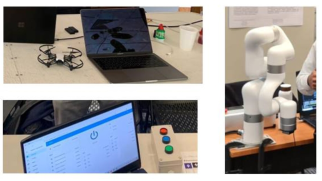
Students could choose in which group to enroll based on the titles of the potential projects they could be working on, as well as the name of the professors, without any further information. Then, on the first week of class, professors would provide further information about the projects, their Training Partners and their expectations of the projects, size of the teams, among other important information for the grading of the course. Students would then be able to contact partners as needed, but some progress updates would be established with the assistance of the professors. If specific elements from the Training Partner were required (e.g. drone, industrial panel button, Cobot), professors would make sure they were accessible to the students (see Figure 1).
While both groups of professors would cover all the syllabus topics of the course, they would teach them in a way in which they could satisfy the requirements of their partnerships. For example, Group 1 (i.e. Enterprise- focused projects) would use SCRUM (Sutherland & Schwaber, 1995) as a project management methodology, whereas Group 2 (Research-oriented projects) would focus more on a progressive execution of the project with slightly more flexible deadlines. Another example is related to the research of the state-of-the-art, which was more thorough in Group 2. Nevertheless, both groups of professors would make sure that students had all the right tools to successfully accomplish their projects before the end of the course.
IMPACT ASSESSMENT The objective of this study is to identify if there are any differences in the development of skills and sub-competences (i.e. a mix of skills, knowledge, behaviours, and abilities) among the students in relation to the way in which this course was taken. To measure this, students participated in different activities with distinct means of evaluation:
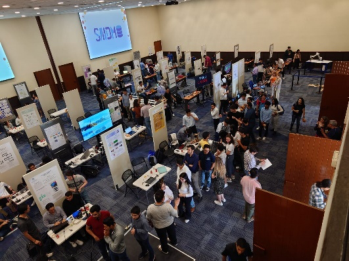
Poster Exhibition and Mock Interview After students presented their projects to their Training Partners and their final grade for the course was computed, they had to take one last one- week course to fulfil their semester. This pass/fail course, oriented towards feedback the students, had two main activities (see Figure 2):
The first one implied an oral presentation with a poster at the Engineer- ing fair of the campus. When possible, a space for their prototypes would be assigned so that they could show their functionality. It was requested that all students participate in it and that through the 4 hours that it lasted, their poster was never left alone. During this time, students would present their projects to faculty, peers, and special guests from the industrial and entrepreneurial world.
Engineering Project Management Skill Development in Research vs. Corporate Realms 117
The second one was a Mock Interview Assessment. This activity is one that has been carried out at the campus for several years for diverse engi- neering majors, and that has no relation to their past projects whatsoever. Instead, it follows up on some of the abilities that partner companies have reported as relevant when hiring young graduates. For this matter, a leading professor provides students with an engineering business case, strate- gically distributing the information over time to the students. In parallel, guests evaluated the performance of the students in the teamwork ses- sions and two-people presentations of their findings regarding the following sub-competences:
SC1. Effective communication
SC2. Teamwork
SC3. Engineering problems formulation and resolution
SC4. Methodological approach to design
SC5. Impact on business, society, and environment
SC6. Ethical commitment
SC7. Innovation capability
SC8. Leadership
Self-Efficacy Evaluations At the end of the one-week course, students would fill out a 5-point scale Likert questionnaire (Nemoto & Beglar, 2014) regarding their self- efficacy associated with the learning outcomes of the course and the short-version project management self-efficacy questionnaire proposed by (Blomquist et al., 2016):
PM1: Effective communication with stakeholders regardless of their technical or operational understanding.
PM2: Work breakdown considering tangibility, measurability, commit- ment, and reachability.
PM3: Execution of effective meetings introspection analysis and plan of action.
PM4: Convincing key stakeholders by clearly introducing business bene- fits and product features.
PM5: Elaboration of a project charter or similar document to get sign-off from key stakeholders.
PM6: Evaluation of progress and acting on feedback based on stake- holder’s approval.
Figure 3 presents the results of these self-efficacy questions, in which we can observe that the enterprise-oriented group felt that their projects allowed them to further reach the learning objectives of the course (except the part of the technological proposal). However, on the side of the project management skills, we can see that while this same group felt that they became better at planning and communicating, their skills for execution, evaluation, and convincing of the Training Partners were less developed than such of the Research-oriented group.
Figure 3: Self-assessment evaluations. Left: learning outcomes of the course, right: project management skills. Both were evaluated using a 5-point likert scale.
Cross-Evaluation As a final element, we were interested to see if the self-efficacy of students was similar to the evaluation given by the guests to the assessment. However, guests focused on the previously presented sub-competences instead of skills, so a relationship had to be established. Table II relates the 8 sub-competences (i.e. SC1-SC8) with both the Project Management Skills (PM1-PM6) and the Learning Objectives (O1-O7) of the course.
Table 2. Externally evaluated sub-competences versus self-efficacy skills assessed.
SC1 X X X X X X SC2 X X X X X SC3 X X X X X X X X X X X SC4 X X X X X X X X X X X SC5 X X X X X X X SC6 X X SC7 X X X X SC8 X X X
The grading of the sub-competences was done on a scale of 1 (incipient) to 4 (outstanding). However, as the self-efficacy evaluations were carried out on a Likert scale of 1 to 5, for both cases the data was normalized to values going from 0 to 1.
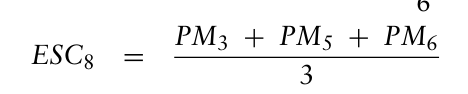
As a second step, the equivalent sub-competence (ESC) is calculated. This was obtained as the average value of the related sub-competences and related learning objectives. For example, and considering Table II, the first and last element’s equivalent sub-competences were calculated as presented in (1) and (2): ESC1 = PM1 + PM3 + PM4 + PM5 + PM6 + O5
6 (1)
Equation reproduced from the original PDF.
3 (2)
Engineering Project Management Skill Development in Research vs. Corporate Realms 119
Then, an equivalent student’s index 1SCn(m) was calculated for each student (m) related to each sub-competence (n) as presented in (3).
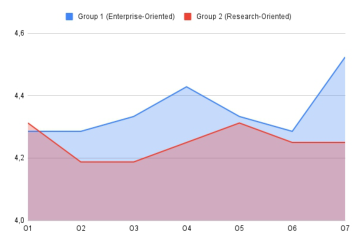
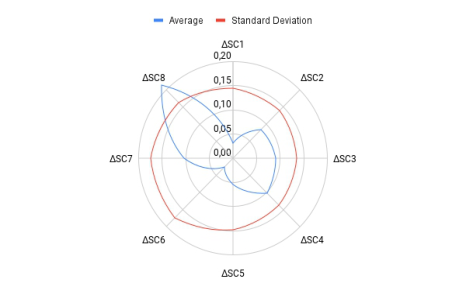
1SCn(m) = ESCn(m) −SCn(m) (3) The mean value and standard deviation of the responses of the differ- ent students can be observed in Figure 4. As we can observe, the stan- dard deviation is similar in all rubrics (close to 0.15), meaning that in general the opinions of both the students and the guests didn’t vary too much.
From Figure 4 we can observe that both guests and students had a similar feeling in relation to sub-competences 1, 5, and 6. For sub- competencies 2, 3, 4, and 7, the difference becomes more important. Lastly, it is important to see that students have a much higher self-appreciation of their leadership than what the external guests could identify in the exercises.
This last element becomes interesting as not everyone can be a leader in the team at the same time, but since it wasn’t requested neither in the project nor at the mock interview to state the role of a leader, most of the students felt that they were implicitly taking the role. Moreover, as stated by (Low et al., 2021; Marnewick et al., 2019), leadership is of paramount importance in project management roles, even if it is not usually implicit hierarchically.
Figure 4: Difference (1SCn) between sub-competence evaluation (SCn) provided by external evaluators and equivalent student’s index (ESCn) calculated from their learn- ing outcomes and project management skills self-assessment.
CONCLUSION
Mechatronic Engineers dealing with innovative technology-based projects require a merger of technical expertise, soft skills, strategic thinking, and effective collaboration. As vicarious experiences are not enough for students of this major to be able to develop such projects, challenges with Training Partners were provided as part of their capstone course to bridge this gap and mirror real-world demands.
This study examined two educational paradigms: one research-oriented, the other enterprise-driven. Outcomes show that enterprise-oriented stu- dents felt more proficient about the learning objectives of the course and their planning skills, in contrast to research-oriented students who felt more confident in the project execution and dealing with the Training Partners. Lastly, Self-assessments indicated higher leadership proficiency among students compared to the professors’ observations, underscoring the pivotal role of leadership in managing technological projects.
Future work could include the use of the product development frame- work presented in Esqueda et al. (2024) with startup companies to com- pare against new groups both orientation towards research and enterprise realms.
ACKNOWLEDGMENT
The authors would like to acknowledge the financial support of Writing Lab, Institute for the Future of Education, Tecnologico de Monterrey, Mexico, in the production of this work. We would also like to thank Emilio Caudillo, Rodolfo Figueroa, Fernando Méndez, Ivan Trujillo, Iker Villagomez, Manlio Quintana, Carlos Castro, Israel Abarca, Diego Balderas, Hector Munro, and Ulises Romero for sharing their work to illustrate this research.
REFERENCES
Anantatmula, V. S. (2010). Project manager leadership role in improving project performance. Engineering management journal, 22(1), 13–22. Bandura, A.(1977). Self-efficacy: toward a unifying theory of behavioral change.Psy-
chological review, 84(2), 191. Barnes, T. A., Pashby, I. R., & Gibbons, A. M. (2006). Managing collaborative R&D projects development of a practical management tool. International Journal of Project Management, 24(5), 395–404. Blomquist, T., Farashah, A. D., & Thomas, J. (2016). Project management self-
efficacy as a predictor of project performance: Constructing and validating a domain-specific scale. International Journal of Project Management, 34(8), 1417–1432. Borg, J., Scott-Young, C. M., & Borg, N. (2023). Early career project managers’ work readiness: Adopting a self-efficacy lens. International Journal of Project Management, 41(2), 102454. Cotrino, A., Sebastián, M. A., & González-Gaya, C. (2020). Industry 4.0 roadmap:
Implementation for small and medium-sized enterprises. Applied sciences, 10(23), 8566. Crawford, L. (2000, June). Profiling the competent project manager. In Proceedings of PMI Research Conference (pp. 3–15). Newton Square, PA, USA: Project Management Institute. DeCampos, H. A., Fawcett, S. E., & Melnyk, S. A. (2022). Collaboration expectation
gaps, transparency and integrated NPD performance: A multi-case study. Journal of Purchasing and Supply Management, 28(4), 100789. El-Sabaa, S. (2001). The skills and career path of an effective project manager. International journal of project management, 19(1), 1–7.
Engineering Project Management Skill Development in Research vs. Corporate Realms 121
Esqueda-Merino, D. M., Bargalló-Rocha, A., García-García, A., Maldonado-Carrillo R., Chong-Quero, J. E. (2023). Enhancing student learning through multi-case collaboration industry partnerships for Product Design Education. Technological Advancements & Innovations of Future of Education: Select Proceedings of FOE 2023, in press. Esqueda-Merino, D. M., Delgado-Cepeda, F. J., Morano-Okuno, H., & García, A.
(2019). Engineering product design education with a mixed design-thinking & lean start-up approach. In DS 95: Proceedings of the 21st International Confer- ence on Engineering and Product Design Education (E&PDE 2019), University of Strathclyde, Glasgow. 12th-13th September 2019. Esqueda-Merino, D. M., González-Sarmiento, G. A., Morano-Okuno, H. R., San Vicente-Cisneros, A. R., López-Rojas A. D. & Quintero-Fernández D. A. (2023). Developing Industry 4.0 Skills: A case study for Engineering students. Technological Advancements & Innovations of Future of Education: Select Pro- ceedings of FOE 2023, in press. Esqueda-Merino, D., Jaramillo-Godínez, R., Miranda-Mendoza, J., Contreras-Domínguez, D., FRACTAL methodology for Industry 4.0 & Society 5.0-Driven New Product Development: empowering engineering students for startup innovation (2024). 12th International Conference on Information and Education Technology. in press. Esqueda-Merino, D. M., Mondragon-Ugarte, D., Vargas-Olivares, A., Chong-Quero, J. E., & Herrera-Corral, J. A. (2023). Role: Role-Oriented Learning Environment: Innovative Educational Approach for Engineering Edu- cation. In Proceedings of the 2023 8th International Conference on Information and Education Innovations (pp. 55–61). Garcia-Moran, E., Esqueda, D., Solis-Cordova, J. D. J., Villagomez, L., Morano, H.,
& Ramírez, R. (2021). Industry 4.0 Competencies as the Core of Online Engineer- ing Laboratories. Design and Technology Education, 26(3), 30–51. Low, S. P., Gao, S., & Ng, E. W. L. (2021). Future-ready project and facility management graduates in Singapore for industry 4.0: Transforming mindsets and competencies. Engineering, Construction and Architectural Management, 28(1), 270–290. Marnewick, A. L., & Marnewick, C. (2019). The ability of project managers to
implement industry 4.0-related projects. IEEE Access, 8, 314–324. Miranda, J., Navarrete, C., Noguez, J., Molina-Espinosa, J. M., Ramírez-Montoya, M. S., Navarro-Tuch, S. A., Bustamante-Bello, M. R., Rosas-Fernández, J. B. & Molina, A. (2021). The core components of education 4.0 in higher education: Three case studies in engineering education. Computers & Electrical Engineering, 93, 107278. Morano-Okuno, H., Sandoval-Benitez, G., Caltenco-Castillo, R., Esqueda-Merino, D., Garcia-Moran, E., & Garcia-Garcia, A. (2019, December). Industry-University Collaboration: An Educational Program with Automotive Industry. In 2019 IEEE International Conference on Engineering, Technology and Education (TALE) (pp. 1–7). IEEE. Nemoto, T., & Beglar, D. (2014). Likert-scale questionnaires. In JALT 2013 conference proceedings (pp. 1–8). Perkmann, M., & Walsh, K. (2007). University–industry relationships and open
innovation: Towards a research agenda. International journal of management reviews, 9(4), 259–280. Ribeiro, A., Amaral, A., & Barros, T. (2021). Project Manager Competencies in the context of the Industry 4.0. Procedia computer science, 181, 803–810.
Sutherland, J., & Schwaber, K. (1995). SCRUM Development Process; Business Object Design and Implementation. In 10th Annual Conference on Object- Oriented Programming Systems, Languages, and Applications Addendum to the Proceedings. ACM/SIGPLAN October. Tecnológico de Monterrey. Planes de Estudio. (2023) Website: https://samp. itesm.mx/Materias/VistaPreliminarMateria?clave=MR3002B&lang=EN#.
LISTED IN THE AHFE DIGITAL BOOKSTORE CATALOGUE
Explore the complete digital volume
Creativity, Innovation and Entrepreneurship
Read this individual research paper free through the original publisher, or explore the full digital proceedings book.
ISBN 978-1-964867-01-4
Explore this ISBN in the AHFE Bookstore ↗Listed in the July 2026 bookstore catalogue; search by ISBN to confirm current availability · Digital book purchase optional