Tero Reunanen, David Oliva (2024). Business creation activities to optimize the outcomes of RDI projects in an applied science university – The Spin&Launch incubator. In: Creativity, Innovation and Entrepreneurship. AHFE Open Access, vol. 125, pp. 12–21. https://doi.org/10.54941/ahfe1004716
Universities of applied sciences and other high education institutions are expected to act as catalysts of innovations and innovators. Optimally, the research, development and innovation work they perform should produce a positive number of new startups spinning off from their project portfolio. The performance of a school within a high education institution from Finland was evaluated with respect to value creation to the local business ecosystem. The evaluation considered parameters like number of RDI projects, projects’ budget, achieved technology readiness level in each project, and the number of companies (new or existing) directly benefiting from the developed innovations. The results revealed that a good portfolio including over 200 projects, from small and fast-paced student projects to more complex national and international projects, didn’t transform in a satisfactory number of new companies spinning off from the school activities. The reasons for non-satisfactory performance were evaluated at managerial, personnel, and student levels. The two most important reasons were mindset to start entrepreneurial activities and the lack of an action plan for innovation deployment after project official ending date. An action plan was subsequently designed to improve the performance. The new Spin&Launch incubator was conceived. The incubator services are available for all local individuals and companies aiming to develop new and scalable business activities from technology-based innovations. The service concentrates in three specific action areas; Team Building – help to find the right skills from our students and personnel, Innovation Validation – action plans to verify the real value of the innovation, and Funding Reach – support to write funding applications and perform efficient pitching and networking. Benchmarking of the new incubator against other incubators and accelerators from Finland confirmed the suitability of the three specific action areas taken in, because those were not normally covered by others, and here a further reason for tight co-operation with other incubators. This paper explains in detail the analysis process, the support work within each of the three specific actions, the benchmarking process, and the first experiences of the Spin&Launch incubator with real innovation cases.
Business Creation Activities to Optimize the Outcomes of RDI Projects 13
INTRODUCTION
Universities of applied sciences and other higher education institutions sig- nificantly contribute to the economic and technological advancement of their respective countries. They are envisioned as catalysts of innovation, foster- ing conditions that stimulate the creation of spin-offs (Fini et al., 2017). A spin-off is a company that capitalizes on technological inventions devel- oped during university research, which might otherwise remain unexploited (Shane, 2004).
Such startups are viewed as crucial mechanisms for research commercial- ization, contributing not only to the economic wealth of the university and the region, since most remain locally situated (Åstebro & Bazzazian, 2009), but also enhancing status and brand recognition. Ideally, the research, develop- ment, and innovation (RDI) work they undertake should yield a substantial number of new startups spinning off from their project portfolio. Hence, it is vital for governments and universities to establish framework conditions that encourage their personnel and students to launch new businesses around the innovations they produce.
National level initiatives might encompass legislative changes and fund- ing instruments, while university level initiatives typically involve technology transfer offices and other support actions. However, there seems to be no magic recipe for success (Fini et al., 2017; Bergeral-Mirabent et al., 2015). For instance, Markman et al. (2005) established a correlation between the support provided by universities via technology transfer mechanisms and the number of spin-offs founded by academics. In contrast, Meoli & Vismara (2016) concluded, after evaluating the background of 559 spin-offs from 85 Italian universities, that academics are more likely to launch business activi- ties when the support provided by their universities is inadequate. Fini et al. (2017) studied national- and university-level initiatives from Italy, Norway, and the UK, concluding that while changes in the institutional framework led to the creation of more spin-offs, the increase in quantity was at the expense of quality. Berbergal-Mirabent et al. (2015) examined the factors that explained the creation of spin-offs from 63 Spanish universities, including technology transfer activities, normative frameworks, support infrastructures like business incubators and science parks, and the development of their specialists’ technical skills. They suggested that several strategies can success- fully lead to academic entrepreneurship but they could not identify a unique combination of factors yielding more university spin-offs.
On a personal note, we, the authors of this paper, have entrepreneurial backgrounds and founded our own companies while working as permanent staff at our university. We understand the challenges of finding additional time to launch side economic ventures. Based on our experience, we con- cur with Åstebro et al. (2011), who encouraged universities to focus on fostering startups by recent graduates, as they are more likely to start busi- ness activities after graduation, and their spin-offs are of higher quality than faculty-led startups. Therefore, it is crucial to identify the factors that enhance entrepreneurial willingness among students. Morris et al. (2017) analysed data from universities in 25 countries and concluded that student
14 Oliva and Reunanen
involvement in entrepreneurship-related programs and activities was posi- tively related to student startup activities. Similar findings were reported by Hua et al. (2022) and Pauceanu et al. (2018), the latter having investigated the motivation for entrepreneurial intentions among over 150 students from 10 universities in the United Arab Emirates. They identified four determi- nants for students to start their own businesses: entrepreneurial confidence, entrepreneurial orientation, university support for entrepreneurship, and cultural support for entrepreneurship.
Overall, Åstebro et al. (2011) suggested that university entrepreneur- ship policy should focus on creating supportive ecosystems for student entrepreneurship, incentivizing graduates to start businesses related to their education, and fostering a culture of entrepreneurship on campus. However, the impact of general entrepreneurship courses on students’ intentions to start businesses is a subject of debate. Some studies conclude that these courses increase students’ entrepreneurial intentions (Peterman & Kennedy, 2003; Souitaris et al., 2007), while others suggest that they produce the opposite effect (Oosterbeek et al., 2008; Von Graevenitz et al., 2010).
The motivation behind this work, i.e., to create a supportive ecosystem in our university to encourage student and personnel entrepreneurship, is based on four key objectives: 1) Contribute to the economic wealth of our region, 2) Provide self-employment opportunities for our students, 3) Mone- tize the outcomes of our own RDI projects through the commercialization of research, and 4) Improve our brand recognition both nationally and internationally.
These objectives underscore the pivotal role that universities can play in fostering entrepreneurial spirit and facilitating the practical application of academic research in the business world.
METHODS
The work was divided in three phases: state-of-the-art analysis, critical analysis, and action plan design.
State of the Art Analysis The state-of-the-art analysis aimed to clarify the potential and success of the School of ICT of Turku University of Applied Sciences (TUAS) in creating business activities from the results of Research, Development, and Innova- tion (RDI) projects. The evaluation work considered parameters such as the number and type of RDI projects, projects’ budget, the achieved Technology Readiness Level (TRL) in each project, and the number of companies (both new and existing) directly benefiting from the developed innovations.
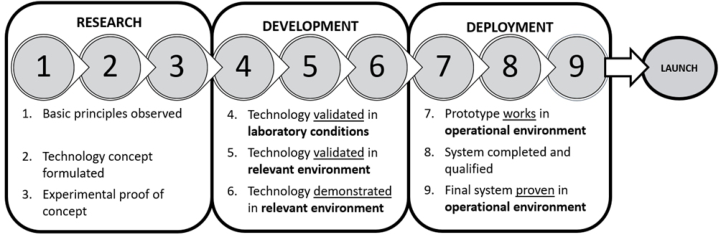
Overall, the TRL emerged as the most critical parameter to explain per- formance. The TRL is a method frequently used to estimate the maturity of a technological innovation or a service with respect to its readiness for mar- ket launch (Héder, 2017). The scale is divided into three phases: Research, Development, and Deployment, with each phase further composed of three levels (see Figure 1). This structure provides a comprehensive framework for assessing the progress and potential of various projects.
Business Creation Activities to Optimize the Outcomes of RDI Projects 15
At the time of analysis, the portfolio of RDI projects at our school com- prised a total of 203 ongoing or recently completed projects. These projects spanned a wide range, from small, fast-paced student projects to high-level research projects funded by national and international instruments.
Figure 1: The nine levels of the technology readiness level scale (TRL).
To analyse each project and determine their TRL, we adopted a positive mindset approach. We envisioned that each project would deliver at least one innovation or service and would successfully achieve the goals defined in the project plan. We then evaluated the expected or achieved TRL, i.e., the readiness of the innovation or service for launch. For instance, during the ImA-Box project, we created and patented a method to automatically convert the audio signal of any video into 3D audio using machine listening and machine vision algorithms. However, it only reached TRL 5 as it was validated only for certain cases and conditions. In contrast, the virtual reality simulator developed during the Marisot project to train sea captains achieved TRL 7, performing well with over 100 test-users from the maritime industry across three different countries.
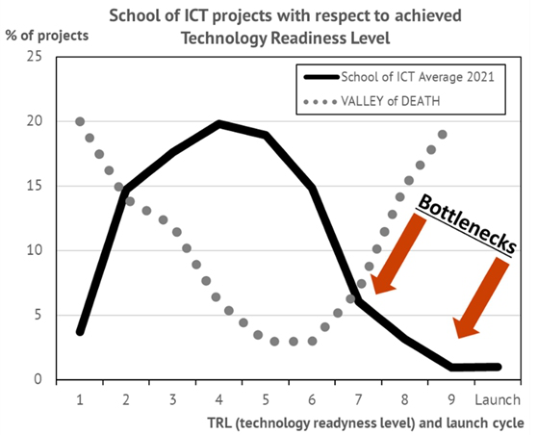
The performance of the 203 projects (School of ICT from Turku University of Applied Sciences) in terms of the TRL scale is shown in percentage form in Figure 2. The percentage for each TRL was calculated considering only the projects that reached that specific TRL as their highest level, not all the projects that at least reached that level. For instance, all projects reached TRL 1, so the cumulative percentage at that level was 100%. However, presenting cumulative percentages in a graph did not aid in interpreting the performance, which is why Figure 2 presents the percentage of projects reaching a specific TRL as their maximum.
Over half of the projects (54%) established themselves in the Research phase (TRL 4, 5, or 6), while only 10% reached the Deployment phase (TRL 7, 8, or 9). The change in slope from TRL 6 to 7, and later from TRL 8 to 9, seems to correspond with two bottlenecks. The first bottleneck indicates that the prototype is not verified in an operational environment, i.e., it works for a target group representing the expected final clients, but it never reaches them. The second bottleneck indicates that the system works and would be ready for commercialization, but the necessary steps to achieve that goal are not initiated.
16 Oliva and Reunanen
For illustrative purposes, Figure 2 also includes the so-called “valley of death” of technology development. Typically, this valley represents the diffi- culty for innovations to transition from research to deployment, or in other words, from research centres to industry. When comparing our school’s per- formance with the valley of death curve, it appears that we perform well in terms of technology development. However, we should engage more effec- tively with industrial partners to ensure our innovations ultimately reach the market.
Figure 2: The performance of the school of ICT with respect to the achieved technology readiness level.
Critical Analysis The second phase involved a critical analysis aimed at uncovering the real rea- sons behind the results of the previous analysis. This included understanding the two identified bottlenecks and, more broadly, the general impediment for our developed innovations to reach the market.
The workflow during the critical analysis began with the creation of a list of hypotheses that could potentially explain the performance of our RDI projects with respect to deployment and launch. We then counted how many of the 203 projects fulfilled any or several of these hypotheses. Hypotheses that received more hits were marked as the reasons for poor performance. These reasons were subsequently grouped into five categories: Project-based, Protocol-based, Management-based, Personnel-based, and Student-based. The 19 reasons are presented in Table 1, but they are not listed in any order of importance, as we found it clearer to group them into these five categories.
Upon completion of the initial phase of the critical analysis, we embarked on a series of informal interviews. These discussions involved a diverse group of individuals, including peers from the same school engaged in RDI projects,
Business Creation Activities to Optimize the Outcomes of RDI Projects 17
students who have demonstrated excellence in project development-oriented courses, investors from our network, and professionals from two local incu- bators, Spark Up and Boost Turku. SparkUp, based in Turku, Finland, is a vibrant startup community that aims to foster rapid business growth and expansion into international markets. It serves as a hub, bringing together startup companies, networks, and events in the Turku region under one roof (SparkUp, 2024). On the other hand, Boost Turku is an entrepreneurship society tailored for growth-minded young entrepreneurs. It hosts and par- ticipates in over 100+ events annually and organizes a 10-week accelerator program. Boost Turku functions as a platform for entrepreneurs from all fields of commerce, providing them with the resources and support they need to thrive (BoostTurku, 2024).
The primary goal of these interviews was to verify the accuracy of our results and identify any additional information that we might have over- looked. The insights gained from these interviews and informal discussions played a crucial role in the design of our subsequent action plan.
Table 1. Reasons identified behind the lack of deployment or launch performance of RDI projects.
Table available in the original PDF paper.
Project based Management based 1 Research group not interested to take innovation further
12 Weak focus on commercialization of research 2 Deployment was not main purpose of project
13 Strong focus on short term accounting as main indicator of success 3 Get funding is easier for newer projects than older ones Personnel based (mentality)
14 Human/economic resources to develop innovation further after project end 4 Timing was lost or industry moved faster than us
5 Innovation was not good enough to justify deployment work
15 Researchers and teachers don’t have entrepreneurial mindset Protocol based 16 Entrepreneurship is not seen as realistic professional opportunity 6 Not clear process to transfer innovation or IPR to deployment team Student based (mentality)
17 Commercialization of research is seen as an extra workload 7 Not clear process to transfer innovation or IPR to existing company 8 Weak strategy to build up deployment team 18 Entrepreneurship is not seen as realistic professional opportunity 9 Optimization of in-house structure. 19 Entrepreneurial knowledge is poor 10 Errors in the organization or based on bureaucracy
20 Individual efforts (e.g., courses) are not enough to motivate students 11 Poor co-operation with local incubators
Action Plan Design Informed by the results presented above and the insights gained from the interviews, the School of ICT of Turku University of Applied Sciences made the strategic decision to launch a new incubator, aptly named Spin&Launch. The incubator’s services are open to all local individuals and companies aim- ing to develop new, scalable business activities rooted in technology-based innovations.
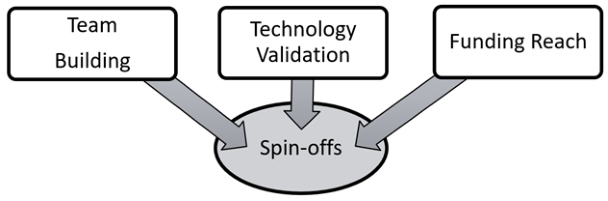
The Spin&Launch incubator focuses on three specific action areas: Team Building, Innovation Validation, and Funding Reach (see Figure 3). These
18 Oliva and Reunanen
areas represent the core strengths of our school and are where we can provide the most value.
In addition to our own services, we actively seek cooperation with other local incubators, such as Spark Up and Boost Turku. Recognizing the excel- lent work they do, our aim is not to duplicate their efforts but to look for synergies. By focusing on our three specific action areas, we complement the services offered by other incubators and collectively strengthen the local inno- vation ecosystem. This collaborative approach underscores our commitment to fostering entrepreneurship and driving technological advancement.
The aim of Team Building is to ensure that the team behind each innovation is well-balanced, encompassing all the necessary hard and soft skills. For instance, a team of two or three mechanical engineers might be designing and testing a new device for application in automated manufacturing. However, they may lack knowledge in business or marketing, or they may not know how to scale the company should they reach production phases.
Figure 3: The three specific action areas to increase the number of spin-offs within the school of ICT of TUAS.
Our university is a multidisciplinary community of 13,000 members offer- ing a range of bachelor’s and master’s programs in engineering and business. In principle, we could always find excellent students from these fields and invite them to join an emerging team. Our hypothesis is that young gradu- ates can be more eager and energetic to start their own business ventures, despite lacking industry experience, than most of our permanent staff. This aligns with the results by Åstebro et al. (2011).
In practice, Team Building includes a series of activities to match uni- versity inventors with high-performing students. This could be through a two-sided market for entrepreneurial talent and inventions (as suggested by Åstebro et al., 2011), or through a personalized tailored service based on the specific needs of each team or invention. Furthermore, we now closely analyse all student-based development projects and interview the teams working on them. The goal is to awaken, whenever possible, the necessary entrepreneurial mindset. This proactive approach underscores our commitment to fostering a culture of entrepreneurship and innovation within our institution.
Technology Validation refers to the qualitative and quantitative assessment of an innovation’s added value and business potential. In this service, our focus is not necessarily on helping the team fully develop their technology
Business Creation Activities to Optimize the Outcomes of RDI Projects 19
or service, but rather on verifying its added value over existing solutions from competitors and estimating its business potential. We apply a pragmatic approach and strong cost-saving principles. As emphasized by investors dur- ing our interviews, it is often better not to further develop something if it is clear it isn’t good enough. Sometimes, we inventors believe that our innova- tion is superior to others, but this may not necessarily be true. In such cases, it might be better to move forward with other ideas, saving time, and economic and human resources. However, it is important to note that in practice, there is no straightforward method to verify the added value and business poten- tial of innovations. These might be of different kinds, and comparison against existing solutions might require interviewing target users or measuring their user experience or feedback.
Funding Reach activities aim to ensure that the team or the future com- pany secures the financial resources needed to sustain operations for the next two to three years. Funding is always needed, and it is easier to obtain when the team is well-balanced and the potential of the innovation has been val- idated. Our service in this aspect unfolds in two areas. First, considering private funding, we assist applicants in preparing a suitable pitch-deck, train them on how to pitch to investors, and help them secure a place on the stage of national pitching contests or competitions. Face-to-face meetings with investors from our network are also facilitated. Conversely, in cases where public funding appears more feasible and convenient, we assist teams in identifying suitable funding calls and may even collaborate with them in writ- ing the funding application. This comprehensive approach ensures that our incubator provides the necessary support to foster successful entrepreneurial ventures.
DISCUSSION
According to Åstebro & Bazzazian (2009), there is no concrete evidence that the creation of incubators and science parks on university grounds would have a discernible impact on local start-up rates. The Spin&Launch incubator is a recent initiative, and we do not yet have enough projects in our portfolio to draw definitive conclusions about its effectiveness. To empirically assess its success, we intend to follow a collection of quantitative and qualitative metrics, for instance number of successful startups launched, the amount of funding raised, and the survival rate of these startups over time. Additionally, we need to track the quality of intellectual property generated, such as patents filed or licensing deals secured. Qualitatively, surveys and interviews with incubator participants and stakeholders will yield insights into the effective- ness of mentorship, network expansion, and skill development offered by the program. Longitudinal studies tracking the career trajectories of alumni can further elucidate the incubator’s impact on individual professional growth and contribution to the industry.
Maybe, the most significant challenge – and opportunity – lies in shifting the entrepreneurial mindset of our students. We believe the path to awaken- ing their entrepreneurial spirit needs to balance entrepreneurial knowledge and innovation culture. Our university has already a collection of core and
20 Oliva and Reunanen
elective courses related to business creation. It seems justified to launch coop- eration activities with the lecturers in charge of these courses, as that would allow us to approach the students that have some interest in entrepreneur- ship. Overall, that will facilitate our Team Building activities. However, we also need to reach and identify those students, that may not see for themselves entrepreneurial as a logic employment path, but who are great developers or are natural innovators. Competitions and hackathons, net- working events, entrepreneurship clubs and societies, guest lectures and workshops, and pitching events might help to foster the innovation culture and entrepreneurial mindset that we might still be missing.
We are confident in the balanced approach of the incubator and believe it offers services that other incubators cannot or usually don’t offer. We antici- pate that as the incubator matures and our portfolio grows, we will be able to engage in more detailed discussions about its operations and impact. Its evolution is tight to emerging technologies and market demands. Reflect- ing on current trends in university incubators and accelerators will help us to find ways to enrich our approach. The future holds promise for the Spin&Launch incubator, and we look forward to seeing its contribution to fostering innovation and entrepreneurship.
ACKNOWLEDGMENT
The authors wish to express their gratitude for the opportunity to conduct this research in the spirit of open science. We affirm that our work was guided solely by our commitment to contribute to the academic community, free from external demands or influences. Furthermore, we acknowledge that this research was undertaken without the benefit of external funding, underscor- ing our dedication to the pursuit of knowledge. We hope that our findings will serve to further enrich the discourse in our field.
REFERENCES
Åstebro, T., & Bazzazian, N. (2009) Universities, Entrepreneurship and Local Economic Development. Entrepreneurship Educator: Courses. https://doi.org/10. 4337/9780857936493.00013 Åstebro, T., Bazzazian, N., & Braguinsky, S. (2011) Startups by Recent University
Graduates and their Faculty - Implications for University Entrepreneurship Policy. https://doi.org/10.2139/ssrn.1752832 Berbegal-Mirabent, J., Ribeiro-Soriano, D., & García, J. (2015) Can a magic recipe foster university spin-off creation?. Journal of Business Research, 68, pp. 2272–2278. https://doi.org/10.1016/J.JBUSRES.2015.06.010 BoostTurku (2024) Internet page. Available at: https://boostturku.com/ Fini, R., Fu, K., Mathisen, M., Rasmussen, E., & Wright, M. (2017) Institutional
determinants of university spin-off quantity and quality: A longitudinal, mul- tilevel, cross-country study. Small Business Economics, 48, pp. 361–391. https: //doi.org/10.1007/S11187-016-9779-9 Gras, J., Lapera, D., Solves, I., Jover, A., & Azuar, J. (2008) An empirical approach to the organisational determinants of spin-off creation in European universi- ties. International Entrepreneurship and Management Journal, 4, pp. 187–198. https://doi.org/10.1007/S11365-007-0061-0
Business Creation Activities to Optimize the Outcomes of RDI Projects 21
Héder, M. (2017) From NASA to EU: The evolution of the TRL scale in Public Sector Innovation. The Innovation Journal, 22(2), 1–23. Hua, J., Zheng, K., & Fan, S. (2022) The impact of entrepreneurial activities and
college students’ entrepreneurial abilities in higher education—A meta-analytic path. Frontiers in Psychology, 13. https://doi.org/10.3389/fpsyg.2022.843978 Markman, G. D., Phan, P. H., Balkin, D. B., & Gianiodis, P. T. (2005) Entrepreneurship and university-based technology transfer. Journal of business venturing, 20(2), 241–263. Meoli, M., & Vismara, S. (2016) University support and the creation of tech-
nology and non-technology academic spin-offs. Small Business Economics, 47, pp. 345–362. https://doi.org/10.1007/S11187-016-9721-1 Morris, M., Shirokova, G., & Tsukanova, T. (2017) Student entrepreneurship and the university ecosystem: A multi-country empirical exploration. European Journal of International Management, 11, pp. 65–85. https://doi.org/10.1504/EJIM.2017. 081251 Oosterbeek, H., van Praag, M., & IJsselstein, A. (2008) The impact of entrepreneur-
ship education on entrepreneurship competencies and intentions (No. 08-038/3). Tinbergen Institute Discussion Paper. O’shea, R., Allen, T., Chevalier, A., & Roche, F. (2005) Entrepreneurial orientation, technology transfer and spinoff performance of U. S. universities. Research Policy, 34, pp. 994–1009. https://doi.org/10.1016/J.RESPOL.2005.05.011 Pauceanu, A., Alpenidze, O., Edu, T., & Zaharia, R. (2018) What Determinants
Influence Students to Start Their Own Business? Empirical Evidence from United Arab Emirates Universities. Sustainability. https://doi.org/10.3390/SU11010092 Peterman, N. E., & Kennedy, J. (2003) Enterprise education: Influencing students’ perceptions of entrepreneurship. Entrepreneurship theory and practice, 28(2), 129–144. Shane, S. A. (2004) Academic entrepreneurship: Univerity spinoffs and wealth
creation. Edward Elgar Publishing. Souitaris, V., Zerbinati, S., & Al-Laham, A. (2007) Do entrepreneurship programmes raise entrepreneurial intention of science and engineering students? The effect of learning, inspiration and resources. Journal of Business venturing, 22(4), 566–591. SparkUp (2024) Internet page. Available at: https://sparkup.businessturku.fi/en/ Von Graevenitz, G., Harhoff, D., & Weber, R. (2010) The effects of entrepreneurship
education. Journal of Economic behavior & organization, 76(1), 90–112.
LISTED IN THE AHFE DIGITAL BOOKSTORE CATALOGUE
Explore the complete digital volume
Creativity, Innovation and Entrepreneurship
Read this individual research paper free through the original publisher, or explore the full digital proceedings book.
ISBN 978-1-964867-01-4
Explore this ISBN in the AHFE Bookstore ↗Listed in the July 2026 bookstore catalogue; search by ISBN to confirm current availability · Digital book purchase optional