David Oliva, Kimmo Tarkkanen, Timo Haavisto, Brita Somerkoski, Axel Lindberg, Mika Luimula (2024). Human factors and pedagogic principles to design a fire-safety pedagogic game. In: Human Factors in Virtual Environments and Game Design. AHFE Open Access, vol. 137, pp. 164–174. https://doi.org/10.54941/ahfe1004999
A previous study using virtual reality demonstrated that children didn’t know how to efficiently exit a building with smoke on the corridors. Fire safety is important, and as such, it should be taught in Finnish schools by kids with ages 10 – 16. However, materials are not harmonized and at the end each school is free to decide how and how much their study programs include fire safety. With the aim of creating a useful and effective pedagogic tool for teachers, we designed and created an educational game to instil the knowledge, skills and attitudes related to fire safety that kids should have. The design was done together with fire inspectors and a pedagogy expert in the field. Human factors of children as players and five pedagogic design principles were considered. The outcome was a free-to-play mobile game called Virpa – Fire Expert which was provided for iOS and Android devices. The game provides several hours of gameplay via numerous tasks and minigames, and it achieved exceptionally good player retention rates. The most innovative and pioneering aspect in the game was the combination of virtual and real worlds in the same digital learning environment via machine vision algorithms and augmented reality functionalities. Furthermore, the game was conceived as a research tool, as we wanted to evaluate the impact of the tool on the overall learning process, but also, to provide teachers, educators, and parents, with feedback about the learning outcomes of their pupils or children. Always respecting young players’ privacy, the game collects anonymously metrics and data points, which were combined in an efficient and effective evaluation form. The design of the form considered a total of seven human factors related to teachers needs and interests. The form is also free to access via a website which collects real-time data from the server and automatically organizes it for the teacher. This paper describes the applied design principles and the considered human factors regarding children, the typical walkthrough in the game, the type of collected data, the game engagement, the learning impact assessment, and the final verification tool created for teachers and educators.ame engagement and learning impact assessment results, and the final verification tool created for teachers and educators.
Human Factors and Pedagogic Principles to Design a Fire-Safety Pedagogic Game 165
INTRODUCTION
Various normative documents in Finland focusing on children and youth state that learning fire safety is important. The Basic Act for Education (Perusopetuslaki, 2016) states that all kids participating in education are enti- tled to a safe learning environment, while the National Core Curriculum for Basic Education (Finnish National Agency for Education, 2014) sets that health education studies for grades 7 – 9 (ages 13 – 16) and environmen- tal studies for grades 3 – 6 (ages 10 – 12) should contain fire safety learning (Somerkoski and Lindfors, 2021). In addition, the Rescue Act requires a gen- eral duty for everyone to prevent fires (Pelastuslaki, 2011). Despite all this, we observed that children under 15 years were not able to exit efficiently a building with smoke on the corridors during a previous research work using a virtual reality simulator (Oliva et al., 2019). The children participating in our research had in principle received above mentioned education, but instead of looking at the floor plan or searching for exit signs to abandon safely the virtual building, they rushed open-mindedly and wildly taking risks that in reality could cost their lives. That result was sad and unacceptable. Further- more, 1) teachers think that current fire safety education is insufficient and that available materials are not pleasant (Vaittinen and Rosu, 2023), 2) it is expensive, dangerous, and partly impossible to practice fire safety scenarios in real environments (Bernardes et al., 2015), and 3) digital games provide immersive and engaging experience for learning compared to widely used standard and passive training practices, such as lectures or videos (Tarkkanen et al., 2020; Smith and Ericson, 2009). Therefore, we decided to contribute with a new pedagogic material to improve youth knowledge, skills, and atti- tudes on fire safety. The design and implementation work of a serious game called Virpa – Fire Expert started in Spring 2020. Additional information regarding the game and a collection of materials for researchers and educators can be found in website https://www.virpagame.fi
METHODS
Virpa - Fire Expert is a free-to-play mobile game to teach school children, 7–13 years old, the most elementary knowledge, skills and attitudes related to fire safety. The game can be downloaded for iOS and Android devices from the two most popular app stores. The development work started with brain- storm sessions between pedagogic experts, local fire department officers, and our team of game developers. The game design workflow considered peda- gogic principles and human factors related to the target group. For the shake of simplicity, in this paper we introduce first the game description, followed later by the pedagogic principles and human factors that supported its design.
Game Description The virtual game environment represents a school building with three floors and an outside play-yard (see Figure 1A). Each floor has classrooms to unlock (see Figure 1B) and a set of hazards, puzzles, newspapers and minigames to play and discover. The school can be explored following an open world approach, but it includes a progression system that forces the players to
unlock classrooms in a predefined order. The progression system relates to the pedagogic approach to taught in a logic order the knowledge, the skills, and the attitudes of fire safety topics. The player unlocks these classrooms by scanning with the phone camera fire safety objects and related signs in real- world buildings (see Figure 1C). The objects and signs were 1) fire alarm sign, 2) fire alarm button sign, 3) fire alarm button, 4) fire extinguisher sign, 5) fire extinguisher, 6) emergency exit sign, 7) fire hose sign, 8) defibrillator sign, and 9) meeting point sign. Typically, scanning one sign or object allowed to enter the first room out of three dedicated to that item. Inside the room the player encounters a fire officer (see Figure 2A) who asks a question related to the general Knowledge of that item. Correct answering grants the player a Bronze Star. A Bronze Star and another scanning of the same item grants permission to enter the second dedicated room, where another officer asks a question related to the Skills. Gaining the Silver Star and performing a third scanning allows to enter the next dedicated room, where the player doesn’t need to answer any question, but reads instead a text regarding positive atti- tude about that object. This granted the Gold Star. Further on, gaining six Gold Stars allows the players to enter the Final Exam room. In that room, the previous 12 questions are repeated and six extra ones (total 18 questions). The player receives a gold, silver or bronze “fire expert” diploma based on the number of correct answers.
The game includes three distinct minigames to improve knowledge, each of them with three levels of difficulty. In the Skateboard minigame the player needs to follow exit signs to leave a labyrinthic corridor filling up fast with smoke (see Figure 2B). The Fireman minigame recreated PacMan arcade game and emphasizes the importance of evacuating a building in case of a fire emergency (see Figure 2C). The Fire Extinguisher minigame uses augmented reality to display a virtual fire over a surface in the physical environment where the player is playing (see Figure 3A). The player must extinguish it before it spreads. In the library, behind the only bookshelf with no books, the player can find a secret room where s/he is invited to perform a fire drill (see Figure 3B). Once the fire drill has been performed, it is possible to per- form the same exercise but this time with the lights of the building switched off (see Figure 3C).
Throughout the school, the player can identify and solve nine hazards, for instance a coffee machine with a damaged electric cord (see Figure 4A), a mobile phone charging close to a water point, or an object obstructing a fire exit door. Also, six newspapers can be found and collected. Each newspaper includes a real story of a fire or emergency event occurring in a Finnish school. Furthermore, a total of twelve school chalkboards and whiteboards include puzzles to solve (see Figure 4B). On top of few other things, the player can find and collect up to 40 clothing elements, which can be used to customize the playing avatar.
Basically, all actions in the game grant points which are added to the total score. The player is able at any time to use a series of menus with information about the collected items, the tasks done or yet to be done, the floorplans of the three floors, basic instructions about the game objectives, and the general score list where the players can see their performance in terms of points with
Human Factors and Pedagogic Principles to Design a Fire-Safety Pedagogic Game 167
respect to other players. It should be noted that scanning signs and objects with the phone camera to unlock rooms also granted points, but it granted less points with every subsequent scanning in the same geographical location or building.
Figure 1: A) Avatar observing floor plan, which can be amplified for inspection. B) Information to player to unlock room 1A. C) Children scanning fire-safety objects in real buildings (photo by Juha Paju-Heikkilä).Figure 2: A) Avatar in front of fire officer who will ask a fire safety question. B) Skateboard minigame. C) Fireman minigame.Figure 3: A) Fire extinguisher minigame. B) The fire drill minigame. C) The fire drill minigame with lights off.Figure 4: A) One of the nine hazards that can be found in the school. B) One of the 11 puzzles to solve found in a chalkboard. C) The terms and condition menu with the button to delete all related data.
Pedagogic Design Principles Our design efforts in the context of education followed five key principles and considerations: (1) Pedagogy – Earlier studies indicate that successful learning games need a strong foundation in pedagogy (Hamari et al., 2016) and the importance of combining abstract learning with concrete experi- ences (Dale, 1969). We aimed to create a game that not only appealed to
children as entertaining and fun, but also held significant pedagogical value for educators, including fire authorities and departments, public education coordinators, school teachers, and parents or legal tutors. The pedagogic con- tent of the game is based on the definition of the competence (Møller et al., 2021). In Virpa game the instructional support promotes players’ thinking for instance by providing feedback that expands understanding. (2) In Virpa game we wanted to implement more on the features of constructivist learn- ing theories. The game design drew inspiration from Vygotsky’s theory of constructive learning (Vygotsky, 1997), so we emphasized the active role of learners in constructing their own knowledge. Moreover, the game considers search, collection, and powerup rewards as game elements. All these enhance players’ motivation but also possibilities based on cognitive constructivism. Inside the room the player encounters a fire officer (see Figure 2A) who asks a question related to the general Knowledge of that item. The incorpora- tion of the zone of proximal development and scaffolding (de Florio, 2016) allowed learners to receive necessary support and then later fostering inde- pendent progress. The iterative nature of the tasks encouraged repetition, enabling children to memorize content over time. (3) Authenticity – Despite the game’s cartoonish visuals, fire safety elements were meticulously placed to ensure accuracy. A co-developing setting involved collaboration with local fire inspectors, who provided pedagogic and professional guidance regard- ing the visualization and placement of safety-related elements like fire stairs, exit doors, fire extinguishers, and all safety signs typically used in Finnish public buildings. Furthermore, it is important not to run or push others in fire drills or in real evacuation emergencies. In the game, the fire inspectors placed along the path remind this sort of issues with speech bubbles, and the player is penalized with points if rushes and overtakes the other non-playable characters (NPC) exiting the building (see Figure 3B). This leads us to think about the features and the theory of social constructivism. (4) Curriculum alignment – The game was carefully crafted to enable teachers to integrate it into lessons seamlessly. Ensuring grammatical precision, accurate definitions, and concept representation were paramount to enhance the game’s suitabil- ity as study material within the framework of the National core curriculum for basic education (Finnish National Agency for Education 2014). (5) Uni- versality. The game was translated to Finnish, Swedish and English, and it is accessible globally for mobile iOS and Android devices in the two most popular app stores. The game will always be free of cost, and it does not con- tain adds or purchasable content. This aimed to facilitate its use in schools. Despite variations in safety signs and emergency phone numbers (112 in Fin- land and in nearly all member states of the European Union), the game’s universal appeal aimed at addressing fire safety concerns on an international scale.
Human Factors of Children as Players Human factors in game design refer to the psychological and physiological aspects of human behaviour to consider when creating videogames. Consid- ering these factors during the game design, i.e., how players interact with
Human Factors and Pedagogic Principles to Design a Fire-Safety Pedagogic Game 169
games on a cognitive, emotional, and physical level, helped us to enhance the overall gaming experience. We accommodated our considerations on five human factors. The target group were children 7 – 13 years old and the main goal was the pedagogic scope, i.e., teaching fire safety knowledge, skills, and attitudes.
Cognitive Load (1) refers to the mental effort required to process informa- tion and Learning Curve (2) to the way players grasp the rules, mechanics, and controls. In principle, games need to balance challenge and progress achievement, and avoid being neither too easy or obvious nor too difficult and frustrating. We aimed to provide an intuitive design and applied stan- dardized navigation controls. However, we decided not to apply a linear progression principle. As game designers but also as players, we wanted to allow the young players to explore freely the multiple rooms in the game envi- ronment, and that during that time they would work out the way to complete the game. This is supposed to enhance the child’s decision-making process and empowerment regarding fire safety. We thought that open-world struc- ture would smooth the learning curve and reduce peaks of cognitive load. NPCs offer instructions explaining the rules and what to do, especially in the first stages. User Experience (3) and User Engagement (4) were optimized by combining exploration, collection of items, minigames, customization of avatars, and scoring system, among others. Furthermore, we integrated real- world environments via augmented reality, where player could extinguish a virtual fire or by scanning real-world fire safety signs using the mobile phone camera. In our opinion, the dichotomy between virtual and real-world modes contributes to a unique gaming experience, as it forces them to divide their attention. This approach not only aimed to enhance knowledge, skills, and attitudes towards fire safety but also to encourage players to pay attention to fire safety signs in their everyday environment. Emotional Engagement (5) was mostly evoked with the virtual school building, and with that, we expected to arise on them a feeling of identity. Emotional engagement was enhanced with NPC interaction: players can make NPCs to perform funny dance movements. Score progression and in-game rewards such as avatar customization were considered also as part of Emotional Engagement.
Related to GDPR and to ethical research principles, the game does not store any personal identifiable data that could infringe player’s privacy rights. For research purposes, players are treated anonymously as numbers, and their exact locations are not stored by the system, neither any visual information related to the use of the camera to scan and identify the fire related signs and objects. The system saves multiple sets of data related to players action within the game. The game incorporates in the Terms and Conditions menu the option for the player to delete from our server all the information related to their own game play (see Figure 4C).
Needs and Factors of Educators and Parents The game was conceived both as a digital learning environment and as a research tool. As researchers, we wanted to evaluate the impact of the tool on the overall learning process and share the results with the research com- munity, the educators, and the stakeholders. For that purpose, we designed and implemented a web-based feedback form to display the progression and
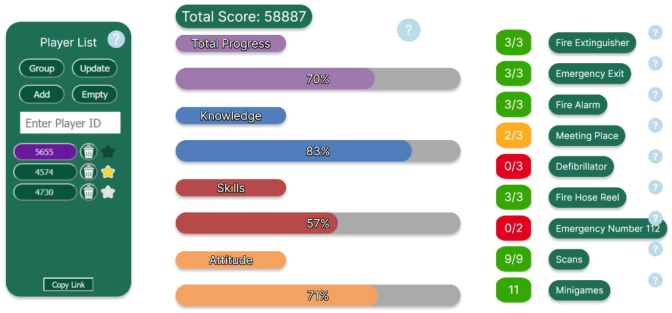
learning outcomes of players. Due to ethical reasons, the game collects anony- mously multiple data points which can be further analysed to evaluate game retention, in-game actions, and learning related metrics. The form is now online and free to access via the www.virpagame.fi website (see Figure 5). The following needs and factors of educators and parents were considered: (1) Comprehensive reporting – The player can perform in the game 114 different actions, most of them related to the learning objective. The tool evaluates all these actions and simplifies them in an efficient and simplified report. It offers information of individual players’ progress, strengths, and areas for improve- ment. The same information can be retrieved from a collection of players, for instance, to see how a team of students have progressed together. (2) Align- ment with learning objectives – The progress of each player with respect to fire-safety knowledge, skills, and attitudes learning, in addition to the over- all progress, is given via four progress bars. This helps teachers to assess the level of learning and the sort of engagement. (3) Clear and measurable outcomes – In addition to the four progress bars, the tool presents eight mea- surable outcomes that directly relate to eight primary educational goals of the game. Each of the outcomes is categorized as untouched, partially completed, or totally completed. (4) User-friendly interface and accessibility – The design facilitates navigation, fast retrieving of data, and interpretation of results for teachers with varying levels of technological proficiency. (5) Adaptability and Customization – Overall, we avoided customization options to keep the tool intuitive and simple. However, an educator might want to analyse the performance of small groups at a time or the whole class. This is enabled.
Figure 5: Capture of the online evaluation form for researchers, educators, and parents to visualize the progression and achieved learning of players.
RESULTS
The game has been downloaded 4090 times from the app stores at the time of writing this article (7.1.2024). A total of 195 players have used their right to delete all related data about their playing. This, “deleting all related data”(see Figure 4C), was from our side a very exaggerated way to implement GDPR
Human Factors and Pedagogic Principles to Design a Fire-Safety Pedagogic Game 171
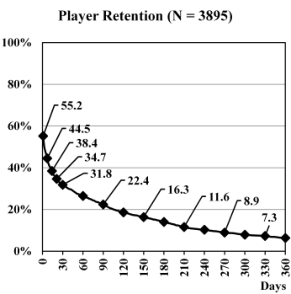
directives. The results presented in this paper are therefore based on the other 3895 players that didn’t use that option. The retention rate is one of the key performance indices used in gaming industry to evaluate the interest of the player on a game. The retention rate plot (see Figure 6A) shows the percentage of users who played the game later than the downloading day. The first data point in the left of the figure repre- sents day 1 after downloading, while the second, third, and forth data points are days 7, 14, and 21 respectively. After that the intervals change to every thirty days. Therefore, 44.8% of players never played the game a second day as the retention rate in day 1 was 55.2%. Almost one third of the players (31.8%) play the game after one month, while 14% still play it half a year after downloading date.
Only 1390 players out of the 3895 (36%) scanned fire-safety signs or objects in real buildings. This function was essential to unlock the 18 rooms where players answer questions to progress on the game. The share of scan- ning players increases from 36% to 65% when we consider only the players that kept playing the game longer than one single day. The total number of scans was over 65000, which is an average of 47 scans per scanning player. The average value is misleading, as several players scanned hundred times the same sign, presumably aiming to cheat the system obtaining more points and rise in the overall ranking. However, as explained before, we foreseen this sort of behaviour by players and counteracted with a rapidly decreasing number of game points by each successive scanning of the same sign in the same location. Better than the average number of scans per player, we anal- yse the number of different signs or objects scanned by those 1390 players that understood and were interested in the scanning functionality to unlock doors. Figure 6B presents the percentage of these players who scanned dif- ferent signs. The data seems to verify that players who scanned fire safety signs in real buildings were interested on this function, as over 40% of scan- ning players (15% of total players) identified in real buildings a total of seven different fire safety related signs or objects.
Figure 6: A) Retention rate chart presents the percent rate of players using the game after the app installation date. B) Scanning rate chart presents the percent rate of players scanning a certain number of fire safety signs or objects.
Only 170 players out of 1390 (12% of scanners, 4.3% of total players) unlocked the 18 rooms that granted access to the Final Exam Room. Out of these, 53 obtained the Gold Diploma, which was granted after answering cor- rectly to the 18 questions presented in that room, while 54 and 22 obtained the Silver or the Bronze Diploma which were obtained if answering correctly to at least 16 but less than 18, and at least 14 but less than 16 questions respectively.
Figure 7: Top) Responses by a group of children to the question “have you noticed fire safety signs in your school?” N-before = 259, N-after = 228. Bottom) Responses by a group of children to the question “how many fire safety sings have you seen in your school?” N-before = 260, N-after = 225.
A parallel user experience research was performed in six local schools with 260 kids (6th grade, average age 12 years). The kids answered a questionnaire before playing, and the same questions were repeated two weeks after the first playing date. The results (see Figure 7) show a clear change (before Vs after) in the number of signs they could recognize and in the number of signs they see daily. More information about this research can be found in Somerkoski et al. (2022).
Finally, a qualitative study using thematic interviews with fire safety train- ers of rescue services and with teachers and principals from Finnish schools was performed (Vaittinen and Rosu, 2023). Teachers considered Virpa – Fire Expert as a necessary tool and practical teaching method. By contrast, fire safety trainers didn’t consider the game to be suitable for their own activities as they already have a process for that purpose and tight schedules.
DISCUSSION
The high retention rates achieved by the game help us to believe that we succeeded to create a well-balanced educational game. Nevertheless, despite the good quality of the game and the positive feedback from both players and teachers, we consider the number of downloads is still small. In relative terms the game has succeeded to improve fire safety knowledge of only a small number of children. A new set of dissemination activities along Finnish schools is being performed to increase the knowledge about its existence and
Human Factors and Pedagogic Principles to Design a Fire-Safety Pedagogic Game 173
the number of children benefiting from it. Furthermore, we expect word of voice among players will contribute to an organic growth in the number of downloads. We committed to maintain the game available for many years in the two most popular app stores for iOS and Android.
We like to consider our game as pioneer and innovative. To our knowl- edge, this was the first serious game for children applying machine vision technology to connect real and virtual worlds, and to gamify in this way the learning of fire safety signs and objects. The results from a set of interviews to children published in a previous work showed that this functionality was of high interest among them (Somerkoski et al., 2022). The new results pre- sented in this work confirmed that players like to find, scan, and ultimately collect available signs. This result was kind of expected based on the success of other games like Pokémon Go. Collecting items appeals strongly to human factors like User Engagement and Emotional Engagement. We hope the use of augmented reality and machine vision in pedagogic games will increase in the close future. Traffic safety might be the most obvious application, but also for instance the learning of hazard pictograms and related chemical products, representative buildings in cities and their history, and paints and life of their creators, could benefit of this sort of interaction connecting real and virtual worlds.
In essence, “Virpa - Fire Expert” stands as a well-rounded approach, combining pedagogy, constructivist learning theory, authenticity, curricu- lum alignment, and universality to create an engaging educational tool for both students and teachers in the realm of fire safety education. Although we do not have any data on how transferable the fire safety competence gained in this game is, we believe this result was the outcome of both, the high quality of the development team, which in fact consisted of students from our university, and all the time and effort spent creating the game design document. In addition to the fire human factors of children as play- ers, e.g., cognitive load, learning curve, user experience, user engagement, and emotional engagement, we consider pedagogic principles and factors like motivation, immersion, accessibility, user interface design, interactivity, safety, privacy, offline access, age-appropriate content, feedback, rewards, parental and educators involvement, and finally the curriculum integration.
ACKNOWLEDGMENT
The authors thank the Fire Protection Fund in Finland (Palosuojelurahasto) for economically supporting us with three consecutive projects. We also thank all developers and fire experts that contributed to these project outcomes.
REFERENCES
Bernardes, S. M. F., Rebelo, F., Vilar, E., Noriega, P., Borges, P. T. (2015).
Methodological approaches for use virtual reality to develop emergency evacu- ation simulations for training in emergency situations. Procedia Manufacturing 3, pp. 6313–6320. Dale, E. Audiovisual methods in teaching. (1969) New York, Holt, Rinehart & Winston.
de Florio, I. (2016). Effective teaching and successful learning: Bridging the gap between research and practice. Cambridge, Cambridge University Press. Finnish National Agency for Education. (2014). NCCBE The National Core Cur-
riculum for Basic Education. Helsinki. Hamari, J., Shernoff, D. J., Rowe, E., Coller, B., Asbell-Clarke, J., Edwards, T.
(2016) Challenging games help students learn: An empirical study on engagement, flow and immersion in game-based learning. Computers in human behavior, 54, pp. 170–179. Møller, J. L., Kines, P., Dyreborg, J., Andersen, L., Ajslev, J. Z. (2021) The competences of successful safety and health coordinators in construction projects. Construction Management and Economics, 39, pp. 199–211. https://www.tand fonline.com/doi/full/10.1080/01446193.2020.1818800 Oliva, D., Somerkoski, B., Tarkkanen, K., Lehto, A., Luimula, M., (2019). Virtual
reality as a communication tool for fire safety-Experiences from the VirPa project. Proceedings CEUR-WS-org. Vol-2359. GamiFIN Conference, Levi, Finland, pp. 241–252. Pelastuslaki (2011). Ajantasainen lainsäädäntö, 29, https://www.finlex.fi/fi/laki/ajan tasa/2011/20110379. Perusopetuslaki. (2016) L. 628/1998. Finlex. Lainsäädäntö. https://www.finlex.
fi/fi/laki/ajantasa/1998/19980628 Smith, S., Ericson, E. (2009) Using immersive game-based virtual reality to teach fire-safety skills to children. Virtual reality, 13, pp. 87–99. https://dl.acm.org/doi /10.5555/3227228.3227443 Somerkoski, B., Lindfors, E. (2011). Turvallisuuspedagogiikka perusasteen opetus-
suunnitelman perusteissa. In: E. Luukka, A. Palomäki, L. Pihkala-Posti, J. Hanska (eds.), Opetuksen ja oppimisen ytimessä. Suomen anedidaktisen seuran julkaisuja. Ainedidaktisia tutkimuksia. 19, (2021), pp. 53–78. http://hdl.handle.net/10138/ 333969 Somerkoski, B., Tarkkanen, K., Oliva, D., Lehto, A., & Luimula, M. (2022). Pedagogic solutions and results in designing a mobile game for fire safety teaching. GamiFIN Conference. Tarkkanen, K., Lehto, A., Oliva, D., Somerkoski, B., Haavisto, T., Luimula, M.
(2020) Research Study Design for Teaching and Testing Fire Safety Skills with AR and VR Games. IEEE, CogInfo, Mariehamn, 23–25 September, pp. 167–172. Vaittinen, N., Rosu, R. (2023). Virpa-mobiilipelin hyödynnettävyys osana lasten ja nuorten paloturvallisuusopetusta: koulujen ja pelastustoimen näkemys. https://ur n.fi/URN:NBN:fi:amk-2023051912095 Vygotsky, L. S. (1997). The collected works of LS Vygotsky: Problems of the theory
and history of psychology. Springer Science & Business Media.
LISTED IN THE AHFE DIGITAL BOOKSTORE CATALOGUE
Explore the complete digital volume
Human Factors in Virtual Environments and Game Design
Read this individual research paper free through the original publisher, or explore the full digital proceedings book.
ISBN 978-1-964867-13-7
Explore this ISBN in the AHFE Bookstore ↗Listed in the July 2026 bookstore catalogue; search by ISBN to confirm current availability · Digital book purchase optional