Sara Buonocore, Edoardo Granata, Antonia Maria Tulino, Giuseppe Di Gironimo (2025). Augmented Reality Aids Logistics: Augmenting workers' abilities during customs inspections. In: Human-Computer Interaction & Emerging Technologies. AHFE Open Access, vol. 195, pp. 417–428. https://doi.org/10.54941/ahfe1006259
Random goods inspections are a critical component of customs operations, ensuring that imported and exported goods comply with relevant regulations. Currently, these inspections rely on manual efforts by operators, making them susceptible to delays and increased costs, often attributed to "human errors." This paper shifts the narrative from "human errors" to "human factors", emphasizing the role of cognitive and operational challenges in inspection tasks. We introduce “Virtual Storage Assistant”, a wearable Augmented Reality tool designed to enhance the efficiency and accuracy of customs inspections. By leveraging Augmented Reality, the proposed system aims to bridge the gap between: (1) the required performance standards for the inspection process, and (2) the specific cognitive abilities and skills of customs workers, thereby streamlining operations and reducing associated inefficiencies.
The management and organization of goods within containers pose a crucial challenge in the logistics and international transportation industry. A critical aspect of this process is the rearrangement of goods after a customs inspection (UNCTAD, 2019). This issue can cause delays, damage to goods, and additional costs for the companies involved (WCO, 2018). Customs inspections are necessary to ensure the safety and compliance of imported and exported goods, but they can also significantly disrupt logistics operations (Fleetwood, 2010). After an inspection, goods must be carefully rearranged within the container to ensure safe and optimized transport. However, this process can be complex and time-consuming, especially if the goods were originally arranged in a specific manner to maximize available space and reduce damage during transportation (Tseng et al., 2005). Even today, these operations are entirely entrusted to humans, who primarily rely on their photographic and muscular memory to recall the unloading sequence, and, conversely, the reloading order of a container. The lack of a robust procedure for saving and subsequently consulting the unloading order of the container frequently leads to human error. However, it is inaccurate to
speak of human error when this conceals a systemic issue in such operations, effectively shifting the responsibility to the operator to ‘remember’ numerous sequential steps, thereby implicitly creating psychological pressure to achieve performance that is cognitively too costly, if not impossible.
Therefore, this paper shifts the narrative from ‘human errors’ to ‘human factors’, highlighting the role of Augmented reality (AR) to face cognitive and operational challenges in inspection tasks, and adopting a user- centric perspective, rather than organization-centric perspective. This study examines the adoption of AR as a solution to enhance the process of rearranging goods within containers after customs inspections, with a novel approach, by highlighting the potential of AR and its positive effect on the operator’s cognitive state, rather than on the well-known organizational expectations such as reducing downtime. Specifically, we propose VSA: a Virtual Storage Assistant, that exploits wearable AR technology to boost workers’ cognitive ergonomics, with digitisation of repetitive unloading container procedure, to cut time taken and minimize errors during reloading procedure.
RELEVANT LITERATURE Augmented Reality (AR) is experiencing a significant surge in adoption across various industries, with logistics being a key sector benefiting from its advancements. This article explores the applications of AR in logistics, highlighting its advantages in efficiency, accuracy, and streamlined training while also examining the future potential of this emerging technology.
A review of the literature suggests that the primary contributions and added value of AR in logistics can be summarized in the following key areas (Cirulis, 2013; Reif, 2008; Wang, 2020):
Navigation: AR can provide real-time directions to warehouse operators, optimizing routes and reducing travel times. This can be particularly useful in large or complex warehouses where traditional navigation can be challenging and time-consuming. AR can also enhance order picking by providing operators with visual instructions on which products to select and where to find them in the warehouse, leading to reduction of time waste and errors (e.g., order unwanted returns).
Inventory control: AR can provide real-time stock information to the operators, as the quantity of available products and their location in the warehouse. This can help reduce inventory errors and ensure that products are always available to meet customer demand.
Product identification: Operators can use AR devices to quickly and accurately identify products, reducing errors and improving efficiency. For example, operators can use AR devices to scan barcodes or QR codes and receive detailed information about the products, as their location in the warehouse, available quantities, and handling instructions.
Goods Reorganization: AR offers visual guidance to facilitate the handling and organization of goods, reducing errors and enhancing accuracy. For example, operators can receive step-by-step instructions on
Augmented Reality Aids Logistics 419
how to properly position products on shelves or stack pallets safely and efficiently.
Staff training: AR-based training solutions provide immersive and interactive learning experiences, complementing traditional classroom instruction and accelerating employee onboarding. Through realistic simulations, new operators can learn how to perform their tasks and receive real-time feedback, leading to a more effective learning process.
Several real-world industrial implementations reinforce the positive organizational impact of AR. For instance, DHL (DHL, 2022) has developed a guided picking system that leverages AR glasses to assist warehouse operators by providing visual cues for product identification and storage locations. This system has demonstrated a 25% reduction in picking time and a 40% decrease in errors, showcasing the transformative potential of AR in logistics.
While evaluating the Organizational Performance Indicators (OPIs) of augmented logistics solutions is crucial, there is a risk of overlooking the broader picture. Many efforts focus on justifying investments in AR and similar technologies, yet the essential role of human capital—particularly cognitive effort—must not be underestimated. This is especially relevant in processes such as random customs inspections, where an operator’s cognitive workload significantly influences performance standards.
In response to this challenge, this study presents the design and pilot implementation of VSA, an AR-based solution aimed at enhancing the cognitive ergonomics of operators conducting random customs inspections. By integrating AR technology, VSA seeks to optimize the efficiency and accuracy of these critical inspection processes, ultimately improving overall operational performance.
THEORETICAL FRAMEWORK AR Enhances Workers’ Cognitive Ergonomics
Dual Coding Theory (DCT) (Clark, 1987) posits that human cognition operates through two distinct processing systems: the verbal system, responsible for linguistic information, and the non-verbal (visual) system, responsible for graphical information. Neurological studies have demonstrated that processing visual and verbal information activates different areas of the brain, and the presentation of both types leads to more brain stimulation (Lazaro, 2021). This means that real tasks execution that are “Augmented” with visual, auditory and other stimuli, according to DCT, require users to process both verbal and non-verbal information, enhancing users’ brain stimulation and providing higher immersion, engagement and attention to the task execution itself.
Also, coherently with CLT, the Cognitive Theory of Multimedia Learning (CTML) confirms the beneficial contribution of visual and attention-guiding cues in “Augmented” experiences. It is consistent with the split-attention effect and the principles of spatial and temporal contiguity principle, as all
the most relevant data (and only the necessary data) needed to accomplish a specific task is shown within the user’s field of view (Buchner, 2021).
Moreover, neurological studies have demonstrated that spatial navigation and memory both engage the hippocampus. When a human faces new experiences (as opening a new container to be inspected or continuing an inspection), his/her brain scans the environment, acquires new information and verifies if they can be linked to previous knowledge (process of memory and recall). Such process activates regions of the brain involved in spatial awareness, such as the medial parietal cortex, retro splenial cortex, and the right posterior hippocampus (Maguire, 2002). Thus, we can say that spatial awareness and navigation processes are strictly connected to memory recall processes, and AR can exploit the former to enhance the latter processes. In this context, VSA utilizes AR technology to shift customs goods inspection from a memory-reliant task to a spatial navigation-based task, mitigating human cognitive limitations and transforming them into performance-enhancing factors VSA and Cognitive Load Theory
VSA design is crafted from main cognitive theories’ exploration, grounding its theoretical basis in the well-known Cognitive Load Theory (Sweller, 2011). According to it, human cognitive architecture to process information is made of a working memory with limited capacity and a long-term memory with unlimited storage size. According to Paas (Paas, 2003), Cognitive Load Theory mainly states that:
Intrinsic Cognitive Load (ICL) is determined by the number of novel elements and their interactivity within a task. It reflects the inherent complexity of a task, though it is also subjective depending on how much of the task’s content is already familiar to the user. In customs goods inspection, ICL decreases when fewer boxes require inspection, when the boxes share similar characteristics, or when prior knowledge helps reducing the cognitive effort required.
Extraneous Cognitive Load (ECL) is not strictly related to the task goals, but more to the interaction with real (and virtual) environment to conduct the task. Speaking of AR experiences, the better is the design of AR application (e.g., User Interface, User Interactions, digital content characteristics, etc.), the less will be the ECL required to the user to conduct the task. Speaking of customs goods inspection, visual cues can guide the operator’s attention and lead him/her to focus only on relevant information during task execution. This helps to reduce ECL, making room in working memory capacity for the ICL of the task (Mayer, 2014).
Germane (or Generative) Cognitive Load (GCL) refers to the mental effort invested in integrating new information with existing knowledge, facilitating the transfer of information from working memory to long- term memory, a desirable process for learning. Speaking of customs goods inspection and VSA contribution, since container unloading/reloading is a repetitive procedure, some common aspects (as the sequence of actions
Augmented Reality Aids Logistics 421
to be taken to inspect each box) may be transferred from working to long-term memory. Such aspect may be more interesting also for a VSA use for training purposes.
VSA USAGE SCENARIOS VSA will make a crucial contribution to overcoming the current challenges of customs goods inspection, thanks to AR technology contribution. We summarize them into four scenarios:
1) Dependence on specific operator: the first type of interruption that may occur during container unloading/reloading procedure is connected to shift changes time when a new operator must take over the task. We can summarize this as new operator intervention. Since these procedures can take several hours, it is likely that the operator responsible for unloading does not have enough time to complete the reloading process within the same shift. Without AR support, the process depends entirely on the initial operator’s availability. This means the inspection may be interrupted for an entire workday, waiting for the same operator to resume their shift. As a result, this dependency leads to significant delays and financial losses.
VSA will allow to drastically cut down time, as knowledge of current state of ongoing unloading or reloading task is fully digitized and can be easily restored by accessing to the information stored in cloud. In this case, singular “operator’s knowledge” becomes “digital knowledge”, at all operators’ disposition.
2) Pause/resume task execution, due to sudden interruption: the second type of interruption is more related to workers’ cognition, we can summarize it as: same operator, different cognitive state. Several distractions may disturb ongoing container unloading/reloading procedures (e.g., loud noises in the surrounding environment, incoming emergency call, inadequacies in the procedure and/or the content of the container itself, etc.). Such distractions may be perceived as “little shocks” for the operators’ cognition, catching all his/her attention and making it complicated to refocus on the ongoing task, even more if he/she is not properly conscious of his/her distraction. As a sudden signal interruption, the cognitive process of information processing (i.e., visual selection of the box to be taken, learning its geometric and aesthetic characteristics, recording its position in the container, processing the trajectory and body movements to be made to approach it, etc.) is interrupted, sometimes in a non-reversable manner, requiring to repeat the whole process from the beginning.
In line with point 1, “digital knowledge” provided by VSA will be helpful to the same operator, enabling easy and quick restore of cognitive processes (e.g., attention, memory, etc.), by just visualizing and listening to such knowledge, rather than only trying to remember.
3) Human memory natural limitations: Avoiding in any way the alteration of the original condition of the container (e.g., to ensure the correct closure, prevent the fall of some and possible breakage of the objects inside, etc.) is mandatory in customs goods inspection. Generally, inspections involve unloading/reloading of a considerable percentage of the goods, sometimes this means dozens and dozens of boxes with different characteristics, that must be precisely reloaded in the same position and order. We can summarize it as: too much stuff to be remembered!
VSA visual cues easily provide information about original state of the container to enable reloading procedure. Specifically, 3D representation of boxes and numbers in ascending order will be provided in the operator’s field of view to enable focus on relevant information.
4) Quality of work life: Customs goods inspections are fundamental in logistics, but their repetitive nature may lead workers to perceive them as tedious, and sometimes to underestimate the importance of staying focused during task execution. On the other hand, the consciousness of their potential errors’ consequences may lead workers to keep high vigilance levels for many hours, reflecting into higher fatigue and, on long-term, generate a non-healthy work life. We can summarize it as it is not my fault!
Thanks to the shift from “human error”to “human factor”in VSA design approach, cognitive ergonomics of workers will be improved and, further, positive side effects as performance anxiety reduction as well as work- related satisfaction and self-confidence increase will be gained.
APPARATUS
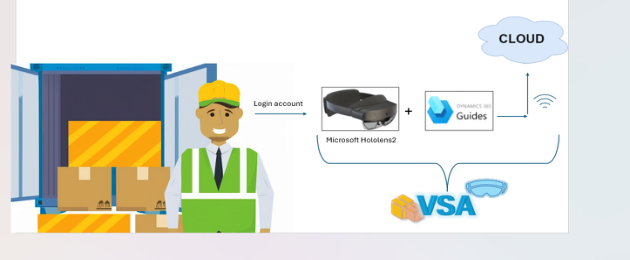
Figure 1 shows the software/hardware architecture of VSA, including:
a wearable Augmented and Mixed Reality headset with optical-see- through technology by Microsoft (Hololens 2), that can be worn like glasses. This allows operators to view holograms superimposed onto the real-world environment, enhancing task guidance and spatial awareness;
the software application developed starting by Microsoft platform for task guidance in AR called “Dynamics Guides 365”, including the authentication module to allow operators to login with personal account;
the Cloud infrastructure to access to all data stored (not locally on Hololens 2) in the specific digital unloading/reloading procedure. Examples of data are the position of 3D virtual replica of boxes to be inspected, 3D panels with textual instructions, etc.
the internet wireless infrastructure to allow open-air access to cloud- based VSA application.
Augmented Reality Aids Logistics 423
Figure 1: VSA architecture, including Hololens 2 (hardware) and dynamics guides (software), with all digital information stored in cloud, accessible by powerful internet connection.
User Interactions Human Computer Interaction (HCI) literature defines three broad categories of interaction with digital content (Nizam, 2018): (1) visual-based modality, consisting of facial expression analysis (emotion recognition), body movement tracking, gesture recognition and gaze detection (eyes movement tracking); (2) audio-based modality, consisting of speech and speaker recognition, auditory emotion analysis and musical interaction; (3) sensor-based modality, using input devices as keyboard, mouse, joystick or controllers, touch, haptic sensor, pressure sensor and taste / smell sensor.
Numerous studies over decades have focused on both the objective and subjective evaluation of the optimal input modality in terms of usability, satisfaction, degree of intuitiveness, and more, according to Universal Design approach (Hsu, 2024; Hürst, 2016; Lazaro, 2021; Lee, 2013; Xiao,2020). However, most of such studies have demonstrated that the presence of multiple interaction modalities (Multi-Modal Interaction, MMI) is often the best design choice, enhancing user performance when interacting with digital objects through increased flexibility and personalization. In a nutshell, having variety of modality and communication channels (rather than a unique solution) resulted to increase accuracy in the interaction and Quality of Experience for the user.
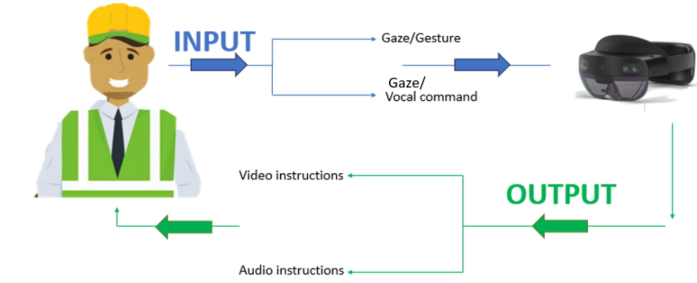
Considering this, we have designed and implemented MMI for VSA, as showed in Fig. 2. Both (1) visual and (2) auditory interaction modalities have been introduced, respectively with: (1) a combination of gaze direction to “point at” and gesture to “select” virtual items, as well as virtual 3D panels with textual instructions about task to be done; (2) a combination of gaze direction to “point at” and vocal commands to “select” virtual items, as well as synthetic audio providing instructions about task to be done. Due to the fact that during such inspections all actions are manipulation actions (mainly with both hands’ use), including also the input modality (3) in VSA design was found to be not compliant workers’ hands-free requirement. Thus, the operator will be able to use both the interaction modalities (and free to switch
between them at any time), to interact with digital buttons to manage given instructions sequence (Go back/Next) during unloading/loading procedures.
Figure 2: Input/output multi-modal interaction modalities in VSA.
VSA WALKTHROUGH
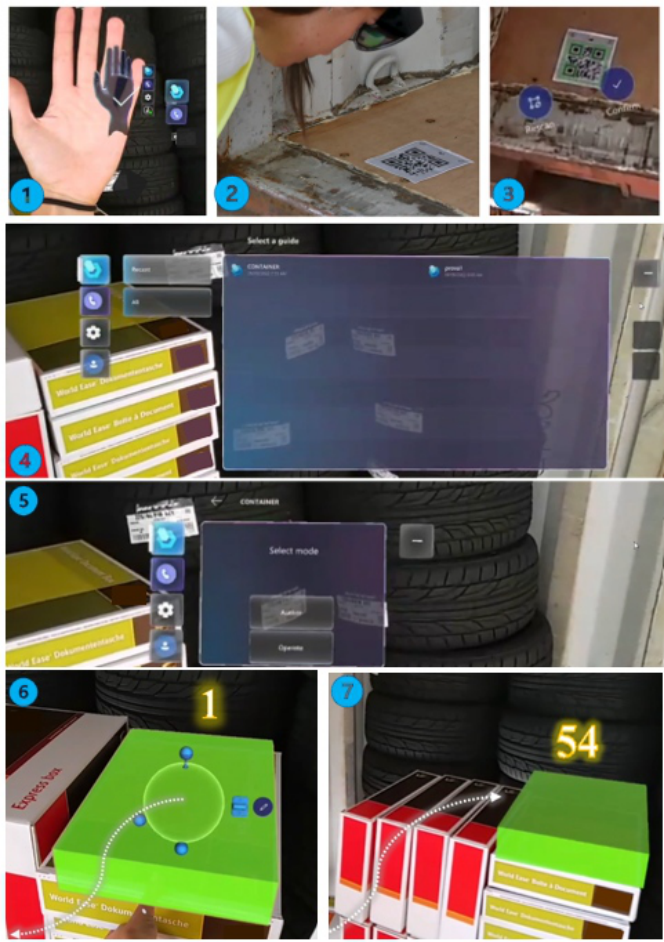
Figure 3 provides a pictorial explanation of main steps while using VSA walkthrough. Preliminary, the operator has been assigned the container to be inspected. He/she has the AR device at disposition as well as personal account login credential to access VSA. The operator approaches the container, opens it, wears the AR headset, checks that he/she is comfortable, and accesses the main menu with his/her login credentials. At this point, (Fig. 3): (1) the operator accesses VSA app; (2) Scans the scans QR-Code at the inner bottom of the container to execute the preliminary “virtual to real” world anchor procedure; (3) Checks and confirms anchor, as virtual green replica of scanned QR code is showed, with possibility to confirm or redo the scan. Since new inspection is to be started, (4) the operator creates a new virtual procedure of specific container (enters the alphanumeric identification code of the container); (5) Selects “Author” mode to start unloading procedure digitisation; (6) Executes unloading procedure, from box #1 to #n, while VSA memorizes it. VSA creates a virtual replica of each picked box and also create the picking order, by showing numbers in ascendant order, and so on. After all the required inspections, the same operator (or even a different one), repeats (1-2-3) and then (4bis) searches for the same alphanumeric code to open the digitised procedure; (5bis) Selects “Operator” mode to access the procedure in “read-only” modality, in reverse order; (7) Executes reloading procedure, following instructions and visual cues given by VSA. VSA displays a 3D panel with textual instructions, simultaneously a voice reads such instructions, while 3D replica of boxes to be reloaded placed in the original position in the container and holograms of numbers (in descending order in such case, from “x” to “1”) showing reverse picking order are displayed. For instance, in Fig. 3, we have hypnotized an inspection on 54 boxes, that is why at the reloading phase start, the first box to be picked is number 54 (7).
Augmented Reality Aids Logistics 425
Figure 3: VSA walkthrough. (1-2-3-4) preliminary steps: VSA app execution, personal account login, “virtual to real world” anchor (i.e., QR code scan); (5) selection of “author” or “operator” (i.e., “read-only”) mode; (6) container unloading procedure digitisation in “author” mode; (7) container reloading procedure in “read-only” mode.
CONCLUSION
This paper shifts the perspective from “human errors” to “human factors,” emphasizing the role of cognitive and operational challenges in customs goods inspection tasks. After briefly reviewing the critical role of AR in logistics and main cognitive theories that have inspired us (as CLT and
DCT), we introduced the Virtual Storage Assistant: a wearable Augmented Reality tool designed to enhance the efficiency and accuracy of customs inspections. VSA leverages AR technology to mitigate human cognitive limitations, reframing them as actionable human factors. By shifting customs inspection tasks from memory-dependent processes to spatial navigation- based operations, VSA optimizes cognitive workload and improves task performance. According to DCT, a Multi-Modal Interaction system has been designed and implemented, providing visual and auditory cues to operators during container unloading and reloading. Additionally, gesture and voice commands allow users to navigate through instructions seamlessly, improving usability and task execution. With this work, we aim to bridge the gap (and inspire future works) between: (1) the required performance standards of the inspection process, and (2) the specific cognitive abilities and skills of customs workers, thereby streamlining operations and reducing associated inefficiencies.
ACKNOWLEDGMENT
The authors would like to acknowledge Interporto di Nola for the kindly participation by providing real use cases, and 5G Academy, organized by University of Naples Federico II in partnership with Nokia and TIM, and in collaboration with Fastweb Kineton and Opnet for the technical contribution. Specifically, “Team 3” members must be acknowledged: Edoardo Granata, 10 Author Name et al. Francesca Spano, Raffaella Manfellotto, Antonio Migliuolo, Carmine Aveta, Alessandra Martino, as they have been the backbone for VSA realization.
Equation reproduced from the original PDF.
REFERENCES
Amador, O., Aramrattana, M., & Vinel, A. (2022). A survey on remote operation of road vehicles. IEEE Access, 10, 130135–130154. Buchner, J., Buntins, K., & Kerres, M. (2021). The impact of augmented reality
on cognitive load and performance: A systematic review. Journal of Computer Assisted Learning, 38(1), 285–303. https://doi.org/10.1111/jcal.12617 Cirulis, A., & Ginters, E. (2013). Augmented reality in logistics. Procedia Computer Science, 26, 14–20. https://doi.org/10.1016/j.procs.2013.12.003 Clark, J. M., & Paivio, A. (1987). A dual coding perspective on encoding processes.
In Springer eBooks (pp. 5–33). https://doi.org/10.1007/978-1-4612-4676-3_1 Costa, G. d. M., Petry, M. R., & Moreira, A. P. (2022). Augmented Reality for Human–Robot Collaboration and Cooperation in Industrial Applications: A Systematic Literature Review. Sensors, 22(7), 2725. https://doi.org/10.3390/ s22072725 DHL successfully tests augmented reality application in warehouse (2022). https://
Fleetwood, S. and Hesketh, A. (2010) Explaining the Performance of Human Resource Management. Cambridge University Press, Cambridge. http:// dx.doi.org/10.1017/CBO9780511781100 Hsu, K., & Liu, G. (2024). Towards a design of the Best Practices for AR-Guided
Oral Communication Development: A Systematic Review of selected research published from 2000 to 2023. Journal of Computer Assisted Learning. https:// doi.org/10.1111/jcal.13103 Hürst, W., & Vriens, K. (2016). Multimodal feedback for finger-based interaction in mobile augmented reality. In ICMI ‘16: Proceedings of the 18th ACM International Conference on Multimodal Interaction (pp. 302–306). https:// doi.org/10.1145/2993148.2993163 Lazaro, M. J., Kim, S., Lee, J., Chun, J., & Yun, M. (2021). Interaction
Modalities for Notification Signals in Augmented Reality. In Proc. 2021 International Conference on Multimodal Interaction. https://doi.org/10.1145/ 3462244.3479898 Lee, M., Billinghurst, M., Baek, W., Green, R., & Woo, W. (2013). A usability study of multimodal input in an augmented reality environment. Virtual Reality, 17(4), 293–305. https://doi.org/10.1007/s10055-013-0230-0 Maguire, E. A., Valentine, E. R., Wilding, J. M., & Kapur, N. (2002). Routes
to remembering: The brains behind superior memory. Nature Neuroscience, 6(1), 90–95. https://doi.org/10.1038/nn988 Mayer, R. E., & Fiorella, L. (2014). Principles for reducing extraneous processing: Coherence, signaling, redundancy, spatial contiguity, and temporal contiguity principles. In R. E. Mayer (Ed.), The Cambridge handbook of multimedia learning (2nd ed., pp. 279–315). Cambridge University Press. Nizam, S. S. M., Abidin, R. Z., Hashim, N. C., Lam, M. C., Arshad, H.,
& Majid, N. a. A. (2018). A review of multimodal interaction technique in augmented reality environment. International Journal on Advanced Science Engineering and Information Technology, 8(4–2), 1460–1469. https://doi.org/ 10.18517/ijaseit.8.4–2.6824 Paas, F., Renkl, A., & Sweller, J. (2003). Cognitive Load Theory and Instructional Design: Recent Developments. Educational Psychologist, 38(1), 1–4. https:// doi.org/10.1207/S15326985EP3801_1 Plakas, George & Ponis, Stavros & Agalianos, K. & Aretoulaki, Eleni & Gayialis,
Sotiris. (2020). Augmented Reality in Manufacturing and Logistics: Lessons Learnt from a Real-Life Industrial Application. Procedia Manufacturing. 51. 1629–1635. 10.1016/j.promfg.2020.10.227. Reif, R., & Walch, D. (2008). Augmented & Virtual Reality applications in the field of logistics. The Visual Computer, 24(11), 987–994. https://doi.org/10.1007/ s00371-008-0271-7 Remondino, M. (2020). Augmented reality in logistics: Qualitative analysis for a managerial perspective. International Journal of Logistics Systems and Management, 36(1), 1. https://doi.org/10.1504/ijlsm.2020.107218 Rohacz, A., & Strassburger, S. (2021). The acceptance of augmented reality as a
determining factor in intralogistics planning. Procedia CIRP, 104, 1209–1214. https://doi.org/10.1016/j.procir.2021.11.203 Sweller, J. (2011). Cognitive load theory. In J. P. Mestre & B. H. Ross (Eds.), The psychology of learning and motivation: Cognition in education (pp. 37–76). Elsevier Academic Press.https://doi.org/10.1016/B978-0-12-387691-1.00002–8 UNCTAD, Rapporto Annuale UNCTAD 2019 Website: https://unctad.org/ annualreport/2019/Pages/index.html.
Wang, W., Wang, F., Song, W., & Su, S. (2020). Application of Augmented Reality (AR) Technologies in inhouse Logistics. E3S Web of Conferences. WCO, World Customs Organization website: https://www.wcoomd.org/en/media/
newsroom/2018.aspx. Xiao, M., Feng, Z., Yang, X., Xu, T., & Guo, Q. (2020). Multimodal interaction design and application in augmented reality for chemical experiment. Virtual Reality & Intelligent Hardware, 2(4), 291–304. https://doi.org/10.1016/ j.vrih.2020.07.005
Read this individual research paper free through the original publisher, or explore the full digital proceedings book.
ISBN 978-1-964867-71-7
Explore this ISBN in the AHFE Bookstore ↗Listed in the July 2026 bookstore catalogue; search by ISBN to confirm current availability · Digital book purchase optional